WeChat Agent "Xiaowei" Unveiled: Capabilities Are Clear, Boundaries Are the Real Mystery
After much anticipation, WeChat Agent, which is expected to truly bring AI capabilities into the daily lives of 1.4 billion people, has finally arrived.
On June 20th, users on multiple platforms reported that a small green - eyed robot icon had quietly appeared in the top - left corner of the WeChat message list. Clicking on it reveals an AI assistant named "Xiaowei", with the words "Beta Version" marked at the top.
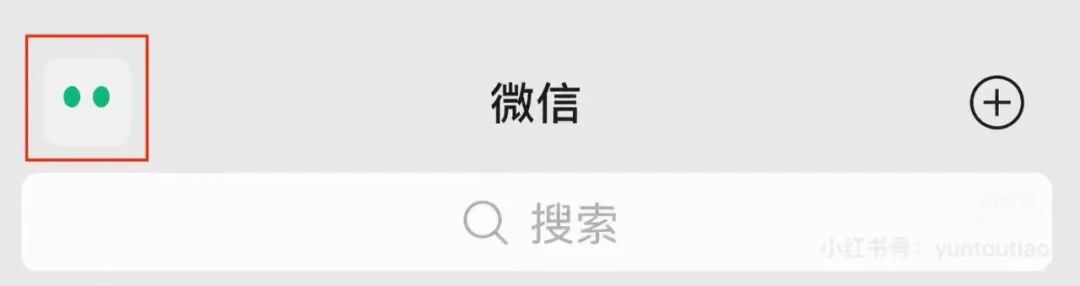
Journalists from media outlets such as IT Home and Science and Technology Innovation Board Daily contacted Tencent's customer service for verification. They received consistent responses: Xiaowei is a native AI assistant that the WeChat team is currently conducting a phased release test on. It supports operating WeChat's native functions through text or voice conversations, covering scenarios such as adjusting settings, sending messages, ordering takeaways, and generating images. The phased release test covers multiple systems, and the official launch date has not been determined yet.
In fact, Xiaowei's appearance is not sudden. This project was launched within Tencent at least in the first half of 2025 and was listed as a "top - priority top - secret project". In November 2025, Liu Chiping publicly confirmed for the first time at the Q3 earnings conference that "WeChat will eventually launch an AI agent". It wasn't until June 2nd this year that the Financial Times reported that Tencent had completed the prototype test and would start the compliance review as early as that month.
Before its official debut, WeChat had completed a series of quiet infrastructure - building actions. On June 8th, WeChat released "Guidelines for Developers to Access the WeChat AI Ecosystem" to developers. Leading platforms such as Meituan, JD.com, Ctrip, and Dewu immediately announced their access. On June 17th, WeChat Pay launched an "AI - exclusive card" designed specifically for AI agent payment scenarios. From infrastructure building to product debut, WeChat's pace has been compact and clear.
Now, this long - awaited product has finally revealed its true face. Based on the feedback from users in the phased release test, we can roughly outline Xiaowei's capabilities, advantages, and limitations.
01
Two Unreplicable Aces Under Four Layers of Capabilities
In terms of the underlying model, Xiaowei adopts a hybrid approach: the main model is WeLM, a large Chinese language model independently developed by the WeChat team, and some answers are supplemented by DeepSeek.
WeLM is a MoE architecture model deeply developed by the WeChat team, which has been specifically optimized for Chinese language understanding and WeChat ecosystem scenarios. According to the research results published by the WeChat AI team, it has strong scenario - adaptation capabilities in executing Chinese instructions.
However, there is still a significant gap between WeLM and DeepSeek in general hardcore tasks such as complex logical reasoning and mathematical calculations. This explains the logic behind Xiaowei's hybrid scheduling: using WeLM to handle instruction execution within the ecosystem and using DeepSeek to handle scenarios that require in - depth reasoning is a practical way to make up for each other's deficiencies.
Based on the feedback from users in the phased release test, Xiaowei's capabilities can be roughly divided into four levels.
The first level is basic execution: voice or text instructions can directly control WeChat's native functions. You can send messages, make calls, adjust settings, and set reminders with just one sentence, getting exactly what you ask for.
The second level is ecosystem invocation: after identifying your intention, Xiaowei will automatically launch the corresponding mini - program and complete the entire process of life services such as making appointments, shopping, and hailing a cab within WeChat, eliminating the need for users to switch between apps repeatedly.
The third level is content understanding: if you send a PDF or a file to it, Xiaowei can provide a structured summary and show the complete thinking process. For the first time, the large number of work files stored in WeChat can be efficiently utilized.
The fourth level is generating mini - tools: describe your needs in everyday language, such as "Help me create a running punch - in tool", and Xiaowei can generate a prototype of a mini - program with basic pages and functions within seconds. It also supports multi - round conversations to adjust details. Currently, it can only be used by the creator.
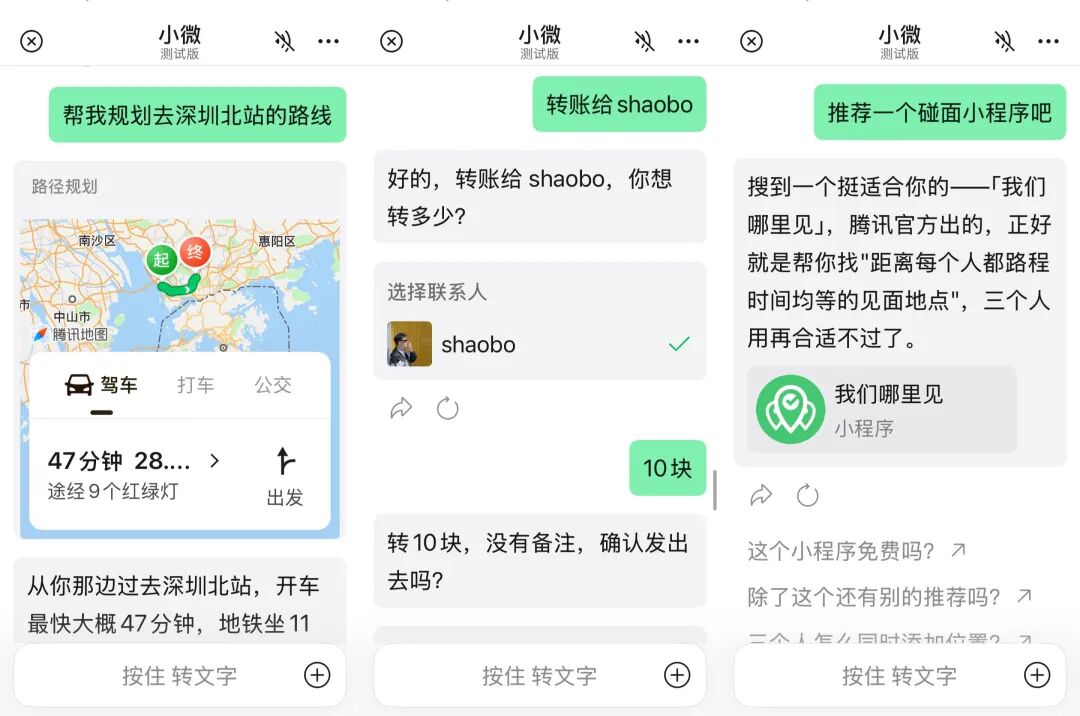
Among the four levels, two capabilities are worth highlighting separately. They are the core features that truly distinguish Xiaowei from all external AI tools and are also WeChat's real trump cards this time.
The first is the full - link closed - loop of the mini - program ecosystem. In the past, if users wanted to use a life service, they had to switch between numerous mini - programs repeatedly. Xiaowei aims to end this inefficiency. You just need to say "Help me order a braised chicken rice" or "Help me find a coffee shop with an average consumption of less than 150 yuan", and it will automatically identify your intention, launch the corresponding mini - program, and complete the entire process from searching, placing an order to payment. The payment still needs to be confirmed by the user.
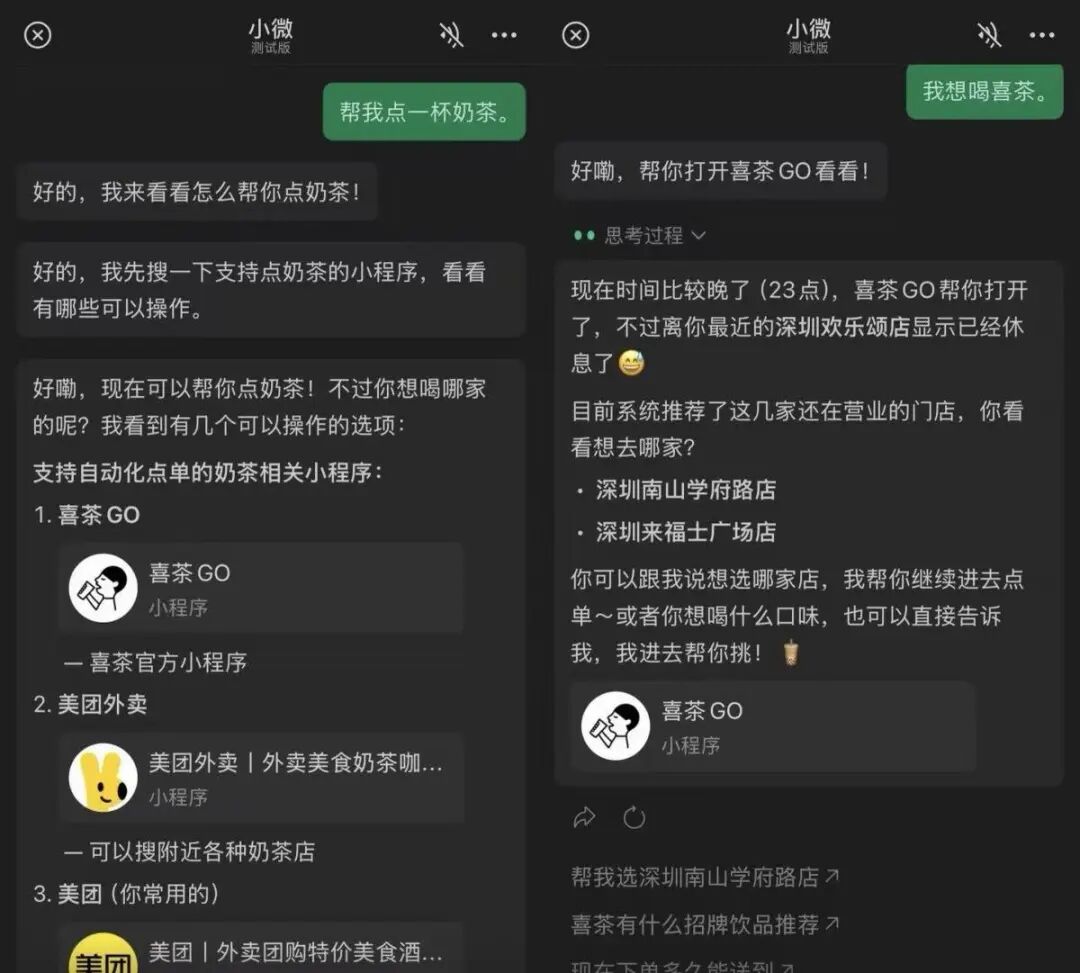
Currently, mainstream services such as Meituan, Didi, Ctrip, and JD.com have taken the lead in completing the access. WeChat Pay has specially launched an "AI - exclusive card", which can be understood as setting an independent payment limit for Xiaowei. After setting the limit, the AI can complete transactions independently within the authorized range, but the user still needs to manually confirm key steps to ensure fund security.
WeChat is evolving from a communication tool into an "AI operating system" that can be operated with natural language. Users no longer need to remember which service is in which mini - program. They just need to express their needs and leave the rest to Xiaowei.
The second is the deep integration of the WeChat social layer, which is the real advantage that is difficult for all third - party AIs to replicate.
From the leaked test screenshots, Xiaowei's ability to access chat records far exceeds external expectations. With a simple request like "Show me what videos my friends have been liking recently", Xiaowei can scan the content preferences in the friend circle and compile a list of recently liked videos and hot topics among multiple friends. It's like a social radar at your service, helping you quietly understand the interest trends in your friend circle.
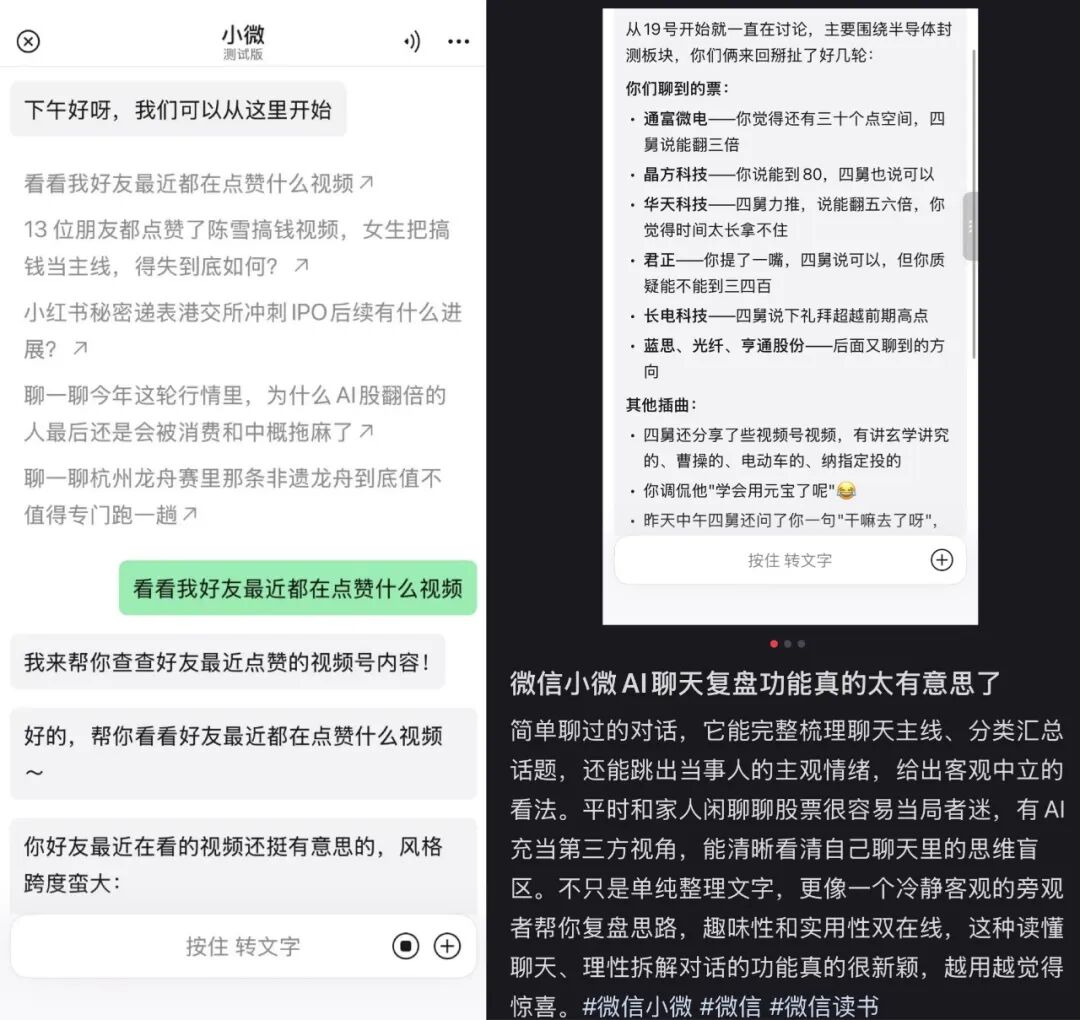
What really surprises test users is Xiaowei's chat review ability. If you send a chat conversation with your family to Xiaowei, it can comprehensively sort out the main points of the chat, categorize and summarize the discussed topics, and help you see the blind spots in your thinking during the chat from a calm and objective perspective, beyond the subjective emotions of the participants.
Thanks to AI, the 1.4 - billion - user relationship chain and content accumulation that WeChat has built up over the years have the potential to be truly activated for the first time. Xiaowei is expected to become an AI assistant that truly exists in the circle of acquaintances, serving as an invisible bond to lubricate daily communication and a personal advisor to help you understand the social network and maintain interpersonal relationships.
02
Generating Mini - Tools with One Sentence: Vibe Coding May Truly Go Mainstream
Another potential game - changer is Xiaowei's ability to "generate mini - tools with one sentence", which for the first time puts the power of software development in the hands of ordinary people.
From the test screenshots, a user asked Xiaowei to "Create a mood - recording tool", and Xiaowei immediately generated a fully functional prototype of a mini - program, complete with pages, recording buttons, emotion statistics, and trend charts. This ability directly meets the needs of ordinary users to create simple tools on their own.
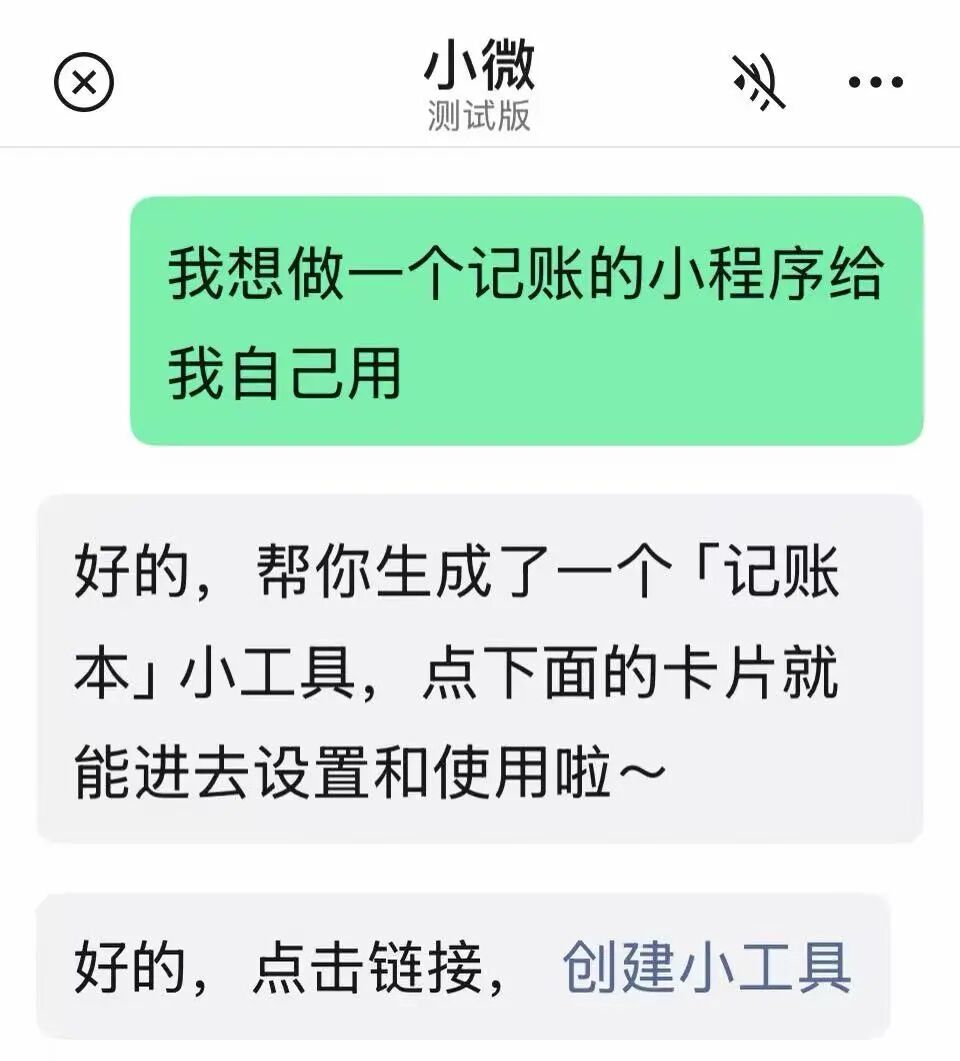
Personalized needs such as a couple's anniversary recorder, a class duty schedule, or a temporary event registration form have always existed but were not developed due to cost. What Xiaowei does is to turn "stating a need" into "producing software", eliminating the barriers through conversations.
More importantly, Xiaowei integrates this ability into WeChat, which is used by 1.4 billion people every day. In a sense, Xiaowei may achieve what no other tool has been able to do: make Vibe Coding truly accessible to the masses. This ability is almost a game - changer for AI application generation platforms like Shanguang and Miaoda.
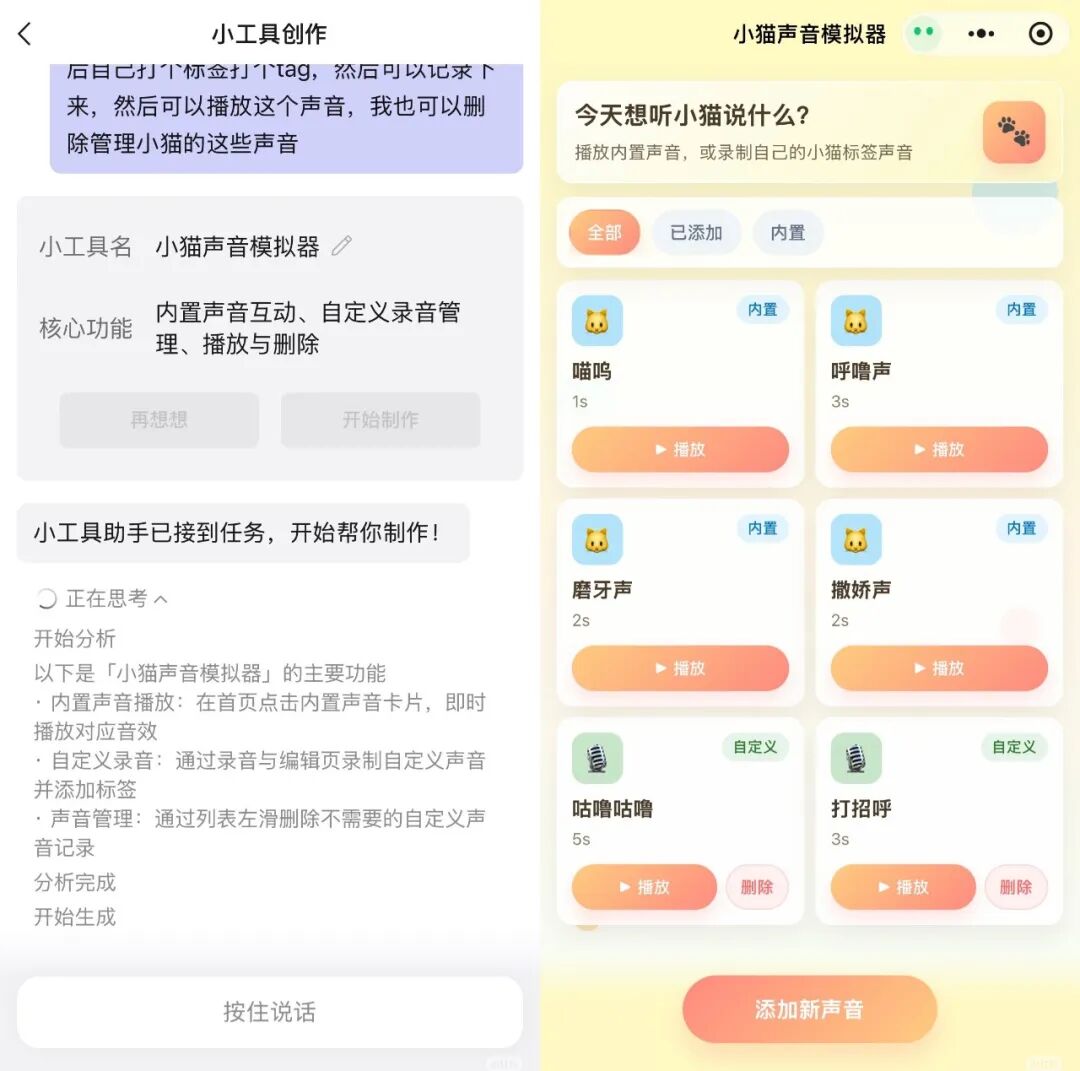
Of course, the boundaries of Xiaowei's current generation ability are also clearly visible. The generated mini - programs can only be used by the creator and cannot be shared or commercialized. When it comes to enterprise - level needs such as state management, multi - device synchronization, and payment interfaces, Xiaowei is still not up to the task.
As some developers have observed, "generating with one sentence" is mainly for simple tools with low technical barriers and weak community attributes. Professional developers and enterprise - level software are not currently under real threat.
For businesses and enterprises, a more profound change lies in the reconstruction of the user access path. In the past, it was about searching, scanning codes, and clicking menus. In the future, more and more often, it will be "telling Xiaowei one sentence". Those who can pre - package their services into interfaces that Xiaowei can call will gain an advantage in the new traffic entrance.
Meituan, JD.com, Ctrip, and Dewu have taken the lead in announcing their access to the WeChat AI ecosystem. The first - mover advantage in this competition will gradually pay off after Xiaowei is fully rolled out.
From a broader perspective, Xiaowei's potential impact goes beyond the mini - program ecosystem itself. As of the end of the first quarter of 2026, the combined monthly active users of WeChat and WeChat International reached 1.432 billion, and there are millions of mini - programs. When all these millions of mini - programs can be smoothly called by Xiaowei, combined with the lightweight tools generated by users in real - time, a super service entrance driven by natural language will take shape.
In the long run, as natural language becomes the mainstream way to access services, users' dependence on downloading and using independent apps may further decrease, and the value of app stores as software distribution channels will also face continuous challenges.
03
Two Unsolved Problems: Social Boundaries and Privacy Concerns
To understand Xiaowei's boundaries, we first need to clarify its current role.
Based on the current test scenarios, Xiaowei is essentially a "single - user agent", and its service scope is mainly limited to meeting an individual's needs. However, this scope is quite extensive: sending messages, making calls, searching for articles, ordering takeaways, generating images, summarizing the friend circle... All these together form a fairly complete personal life - service AI assistant.
The greater potential lies in whether Xiaowei can be extended to social and collaborative scenarios, such as helping users manage group chat information, coordinate multi - party tasks, and even serve as a personal information hub to some extent.
However, this touches on the core boundary of WeChat's product philosophy. WeChat's restraint is reflected in not allowing AI to replace users in core social expressions and emotional interactions. The currently available group chat statistics and friend circle analysis are essentially auxiliary tools. The final social decisions and content output are still made by the users themselves.
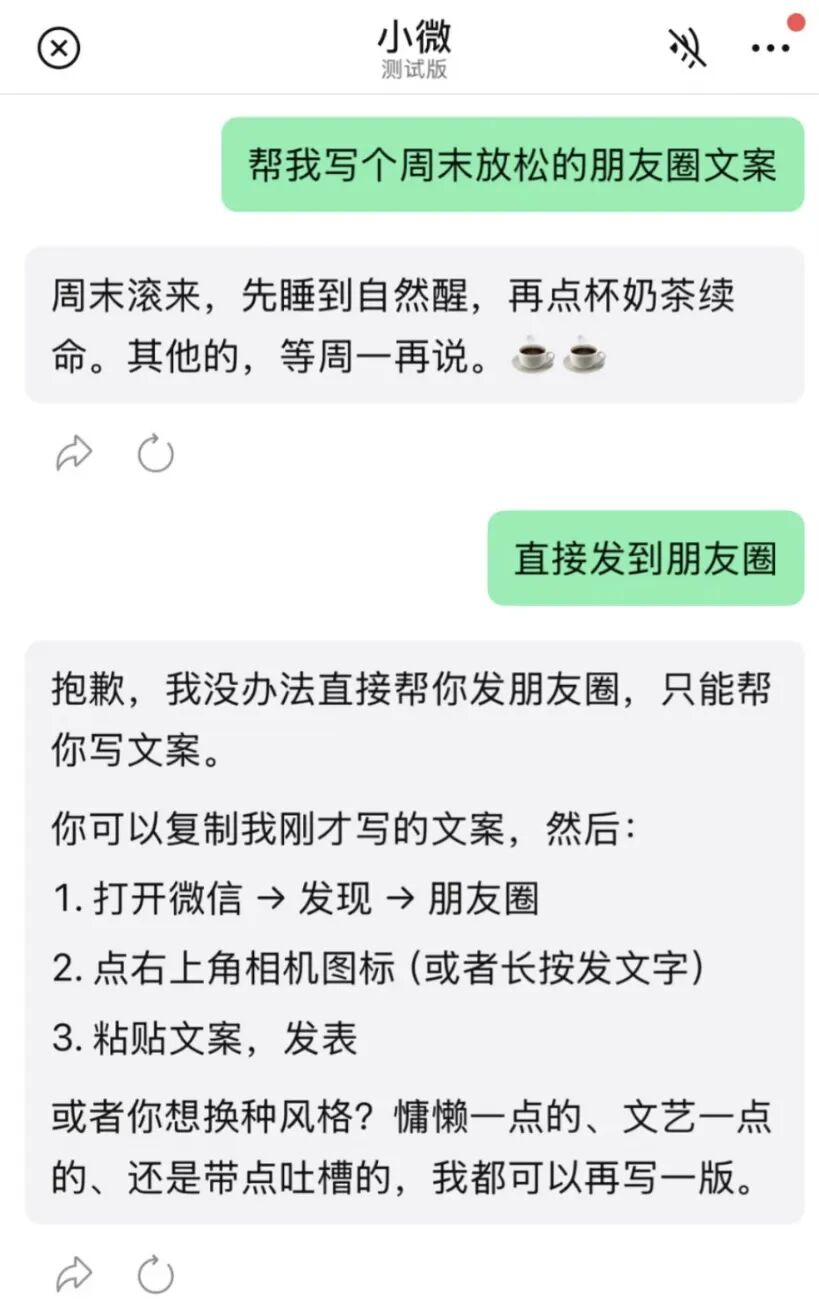
Some users have found through testing that Xiaowei can help write friend - circle posts, but when asked to "post it directly to the friend circle", it refuses. The final posting action still needs to be done by the user. This principle of "assisting but not substituting" is the first boundary that WeChat has drawn between the expansion of AI capabilities and the authenticity of social interactions. AI can be your creative assistant, but you should always be the main subject of social expression.
This is a safety boundary that WeChat has actively set based on its product philosophy and is also a bottom - line that it has to defend. Once AI starts to "substitute" for real social behaviors on a large scale, the density and quality of real - life social interactions will be subtly diluted. The most core moat of WeChat, the acquaintance relationship chain, will face the risk of internal collapse. How to define and continuously enforce this boundary will be a long - term game.
Privacy is another potential challenge that cannot be ignored. Although WeChat has set up permission isolation for chat data in its privacy architecture and clearly defined the data scope that AI can access, the transparency and compliance of Xiaowei's data security mechanism will be under close scrutiny for a long time.
Whether this privacy defense line can withstand the real pressure of large - scale use will be truly tested after Xiaowei is fully rolled out.
Less than a week before Xiaowei started its phased release test, Alipay officially launched the internal test of its AI agent "Abao" on June 16th. These two national - level apps have revealed their AI cards within a few days, officially kicking off a battle for the AI entrance of super apps. Currently, both products are in the semi - finished stage, and their functional experiences are still being refined.
As industry insiders have said, the iteration speed of current AI products is extremely fast, and the problems exposed at this stage may be resolved in the next version. The real question is not what Xiaowei can do today, but where the boundaries of WeChat's openness and capabilities will be when it is fully mature.
This article is from the WeChat official account "AI Value Officer". Author: Xingye, Editor: Meiqi. Republished by 36Kr with permission.