Google: I have the most Nobel laureates on my hands, but why can't I keep them?
Recently, Google has lost two key figures.
Within just three days, first, Noam Shazeer, a co - author of the Transformer paper, left Google to join OpenAI. Immediately afterwards, Nobel laureate and AlphaFold leader John Jumper switched to Anthropic.
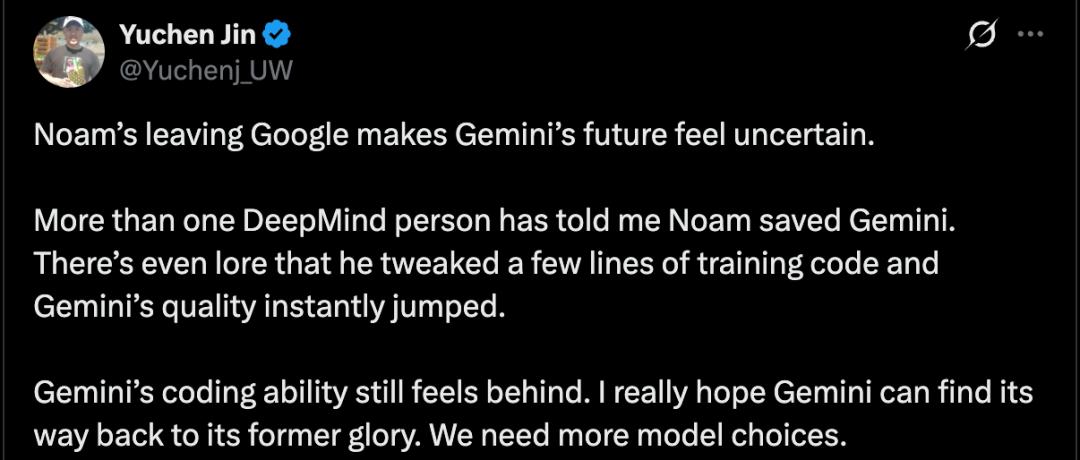
Some netizens believe that Noam's departure has cast a shadow of uncertainty over the future of Gemini.
More than one DeepMind employee has revealed that it was Noam who saved Gemini. There are even rumors that he only changed a few lines of training code, and the performance of Gemini immediately skyrocketed.
Now that he's gone, the programming ability of Gemini still seems lagging.
Google is caught in an embarrassing paradox: It has the most abundant financial resources and the most comprehensive industrial chain, yet it can't prevent itself from becoming the "Whampoa Military Academy" of Silicon Valley.
The root cause: Big - company disease
Many senior commentators point out that Google is not short of technological vision. The core reason for the departure of top - tier talents is the suffocating organizational structure brought about by big - company disease.
One is the internal consumption of computing resources. There is intense internal politics in the competition for computing resources among different teams within Google (such as the integration process between the former Google Brain and DeepMind).
Llion Jones, one of the co - authors of the Transformer paper, once said: "I feel that Google's bureaucratic system has developed to a point where I can't advance anything."
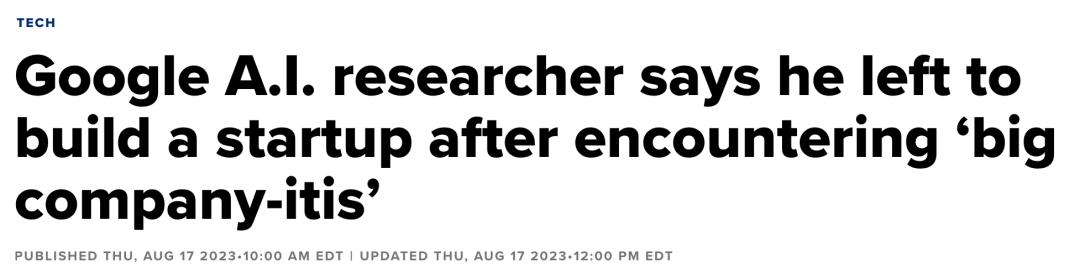
In contrast, Anthropic and OpenAI have flatter organizational structures and highly consistent goals.
Some netizens have also pointed out that Google's leadership lacks absolute faith in the Scaling Law in terms of strategy. In October last year, they even packaged and sold or rented the precious Google Cloud TPU computing power to the competitor Anthropic instead of keeping it for their own DeepMind.
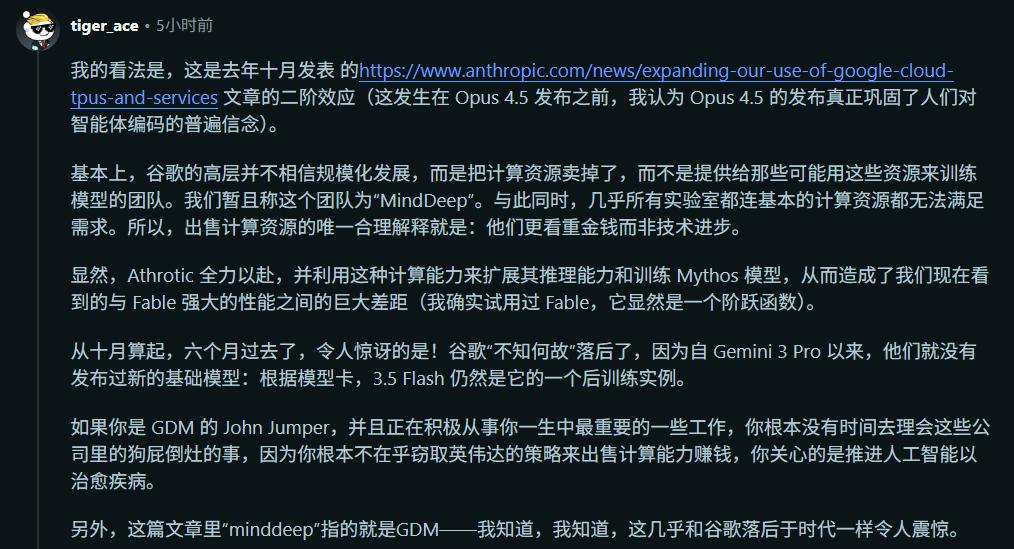
There is also a divergence in routes.
Google tries to cover everything. It wants to build the underlying infrastructure and maintain a large existing business at the same time, which results in a lack of the focus of "All in LLM" like Silicon Valley startups in frontier exploration. Some scientists are reluctant to waste their energy in endless cross - departmental collaboration and management meetings.
Some netizens have pointed out that "The politics of big companies and their attitude towards AI are sometimes more important than pure computing power."
Many people are worried that DeepMind is gradually degenerating from the once "AI research sanctuary" into a bloated traditional large - scale enterprise, leading top - level talents to flow to startup camps with flatter organizations and more focused execution.
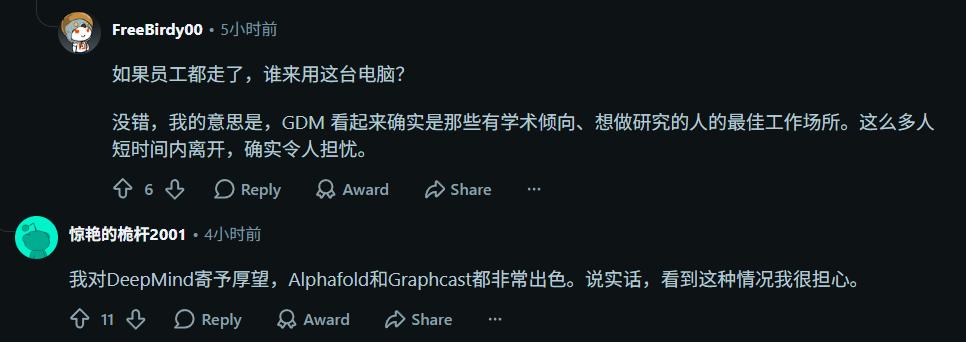
An industry engineer has issued a profound warning: Although Google has the largest TPU computing power and data centers, its real moat is walking out of the door.
"You can lock the model weights (Weights) and keep them in the data center; but those who build them take away implicit knowledge, training intuition, security trade - offs, architectural patterns, and experience in avoiding pitfalls."
This kind of technical intuition cannot be fully replicated through papers in top - level research.
The departures of Shazeer and Jumper mean that the unpublicized technical secrets and training "feel" that Google has accumulated over the past few years are substantially spreading to OpenAI and Anthropic.
The model and product line are in a complete mess
Even before the release of Gemini 3.5 Pro, some people have started to speak negatively about it.
Some netizens say that Google's operation mode is very different from that of startup labs like OpenAI or Anthropic.
Google has too many executives, a too - long development cycle, and too many independent projects. The problem of cultural bureaucracy is serious. "Under the current structure, it's hard to believe that Google can release a cutting - edge model that can really compete with GPT or Claude."
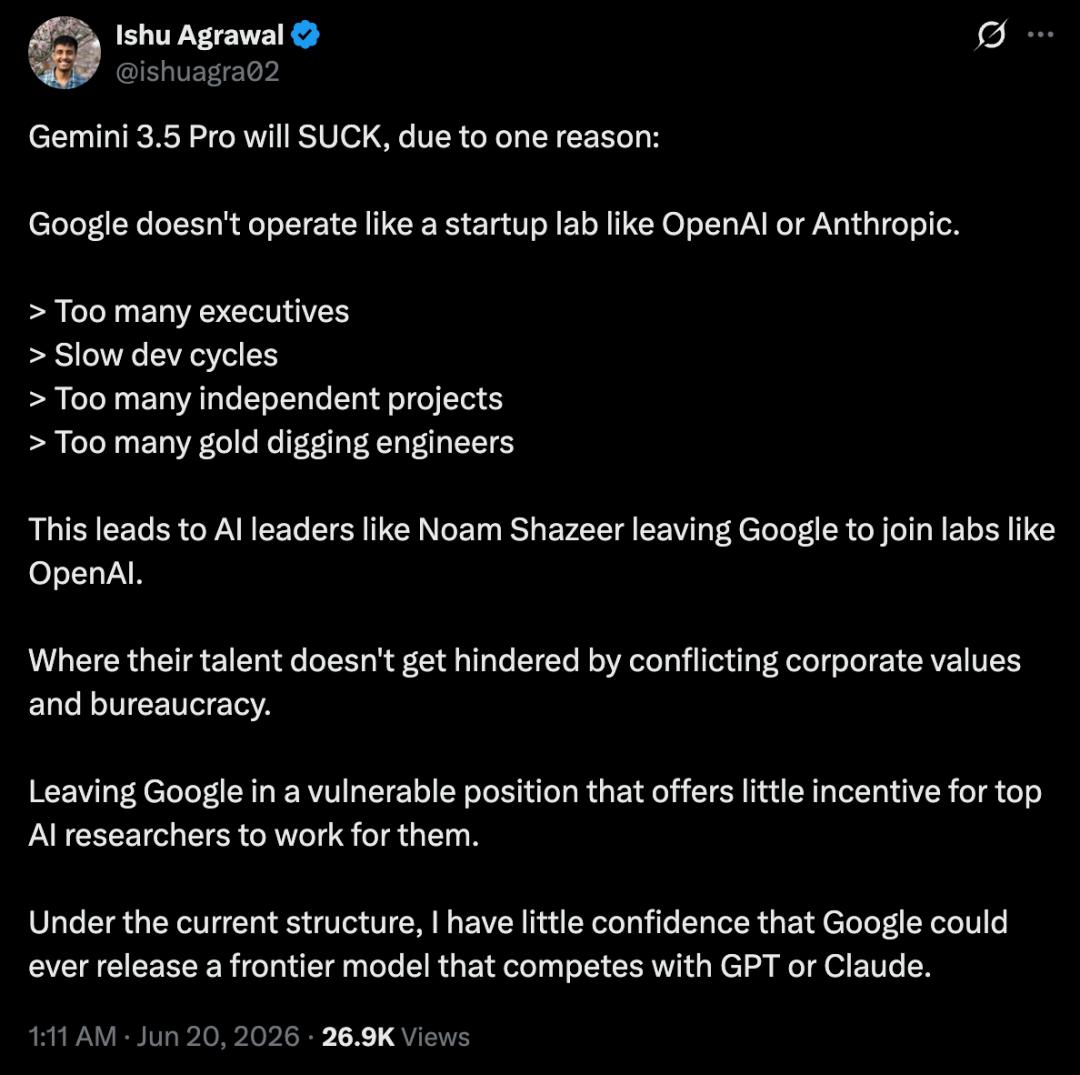
https://x.com/ishuagra02/status/2068018795449290760?s=20
Previously, some netizens complained about the confusion of Google's various AI products, versions, and names.
The same Gemini - related capabilities are scattered across different entrances and packages such as AI Studio, Workspace, Spark, Jules, Antigravity, Flow, Veo, NotebookLM, and AI Mode, and the names are often changed, making it difficult for users to figure out which one to use.
The Google AI ecosystem has become extremely chaotic, but it still pretends that everything is simple.
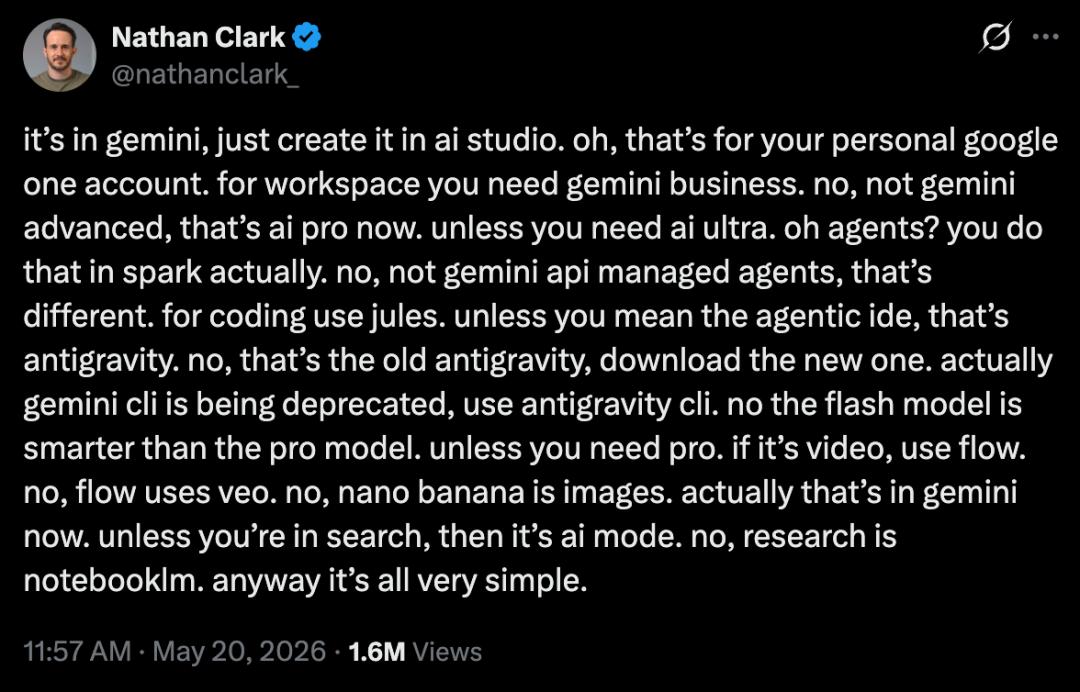
https://x.com/nathanclark_/status/2056947354654355849?s=20
Some netizens have also raised a soul - searching question: Why does Google have two competing coding agents, Antigravity and Jules?
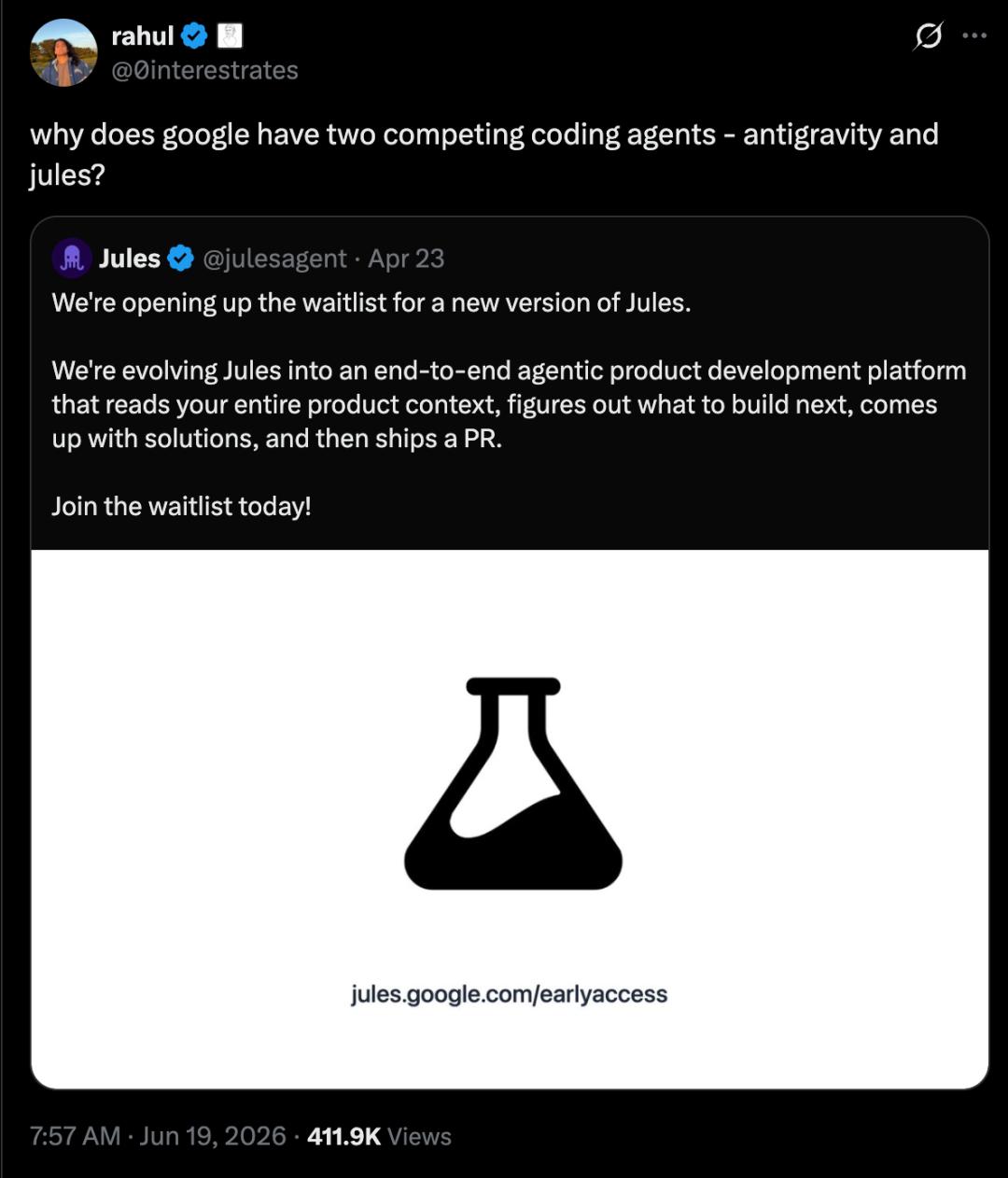
Do you think Google only has these two similar AI programming tools? There used to be Gemini CLI, which has just been shut down; and Project IDX, which was later changed to Firebase Studio. There are probably a bunch of similar projects running in parallel within Google.

https://x.com/TheBalkanHacker/status/2067798660847464876?s=20
Some people joke that if there aren't at least three teams working on the same thing, then it might not be worth doing.

https://x.com/bilawalsidhu/status/2067810862526599267?s=20
This is an old problem for Google. Back then, a bunch of chat apps were launched simultaneously for the same reason. Multiple teams compete to do similar things for promotion and resources, and in the end, one of them will probably be cut.
Former Uber/Skype engineer Gergely Orosz also explained the reason.
Google's internal incentive mechanism encourages people to create new things, which makes it easier to get promotions and rewards. However, maintaining existing products has little value for promotion. As a result, new products with the same function emerge every year, while old products are not maintained, and user migration is also not taken seriously.

https://x.com/GergelyOrosz/status/2057336026046095508?s=20
"The past 12 months have completely belonged to Anthropic"
In sharp contrast to netizens pouring "oil" on Google, many people agree that "the past 12 months have completely belonged to Anthropic."
In the past 18 months, Anthropic has built the strongest team in the tech world.
They have recruited Peter Bailis, the Chief Technology Officer of Workday; Bryan McCann, the Chief Technology Officer of You.com; Mike Krieger, the co - founder of Instagram; Sam Ghods, the Chief Technology Officer of Box; Henry Shi, the Chief Technology Officer of Super; Niki Parmar, the Chief Technology Officer of Adept AI; and Karpathy, a founding member of OpenAI.
Now, with the addition of John Jumper, it is the best endorsement of Anthropic's full - scale explosion in model capabilities, technical routes, and industry reputation in the past year.
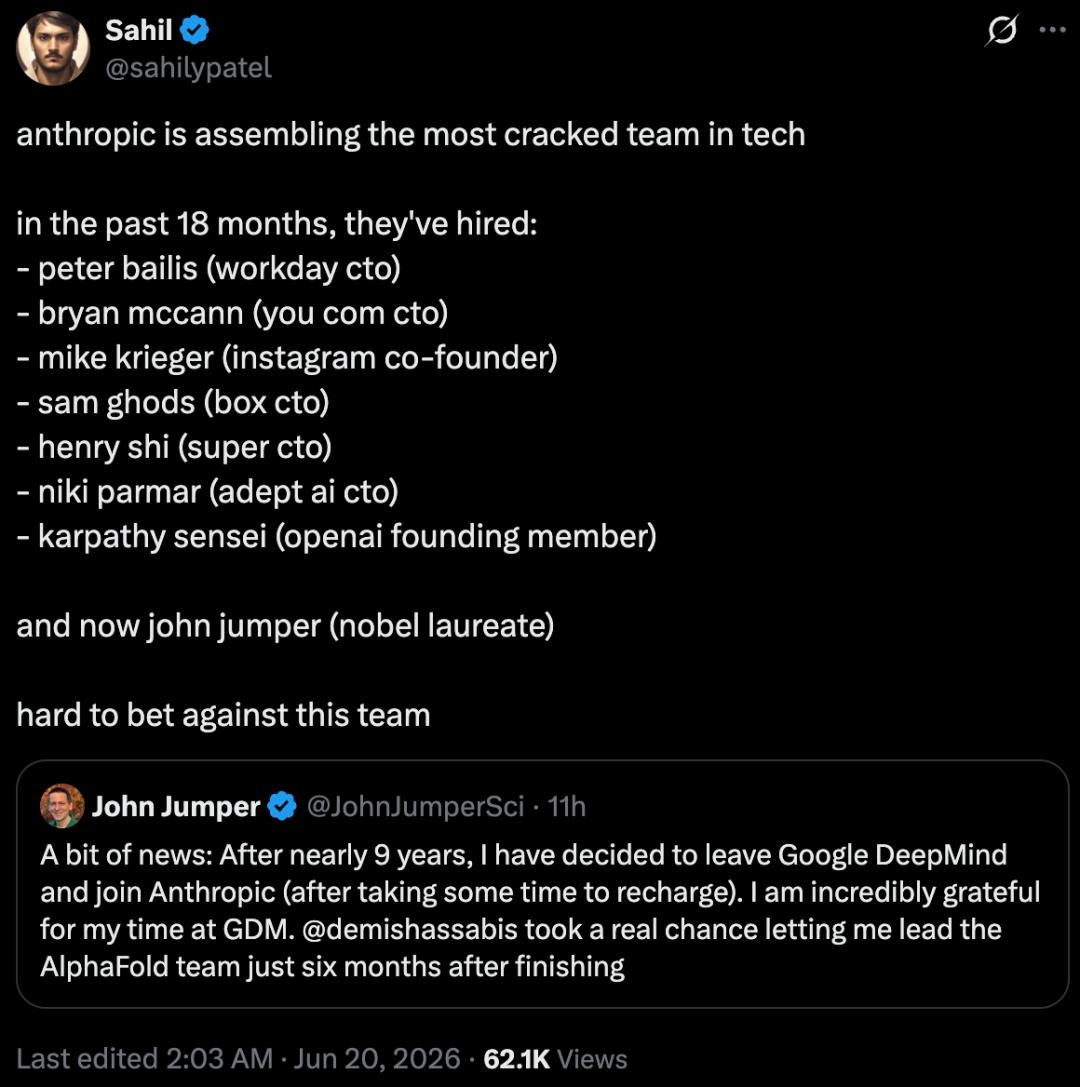
https://x.com/sahilypatel/status/2068031973667508531
From the most practical business and compensation perspectives, this is not difficult to understand.
OpenAI and Anthropic are gradually approaching the IPO stage. The pre - IPO stock options in their hands are almost like a "super lottery" for top - tier talents. Once they get on board just before the listing, they may get explosive returns dozens of times over in the future. This is exactly where mature listed companies have difficulty competing head - on.
However, John Jumper's move to Anthropic is by no means just a personal career choice. From a deeper perspective, it is likely to be a landmark event for the AI for Science track to enter a new stage.
For a long time in the past, Anthropic was almost equivalent to Claude in the public's perception, that is, a pure large - language - model company.
In April 2026, Anthropic spent $400 million to acquire the AI biotech startup Coefficient Bio. Now, with the addition of John Jumper, the core figure of AlphaFold, the signal is very clear:
Anthropic is accelerating the application of large - model capabilities from language, code, and agents to more hardcore AI for Science fields such as biology, chemistry, and life sciences.
This also means that Anthropic is likely to face off against Demis Hassabis in the territory of Isomorphic Labs.
And this new competition in AI for Science is not only happening in Silicon Valley. Domestic Internet giants have already entered the arena to varying degrees.
For example, in the early days, ByteDance's AI4S (Scientific Computing Intelligence) team developed cutting - edge protein and molecular generation models such as Protenix and Seedfold. In terms of self - developed pipelines, it has also laid out candidate drugs covering the field of autoimmune diseases, such as IL - 17 small - molecule inhibitors.
Tencent adopts a strategy closer to "investment means layout" and is also exploring directions such as molecular design.
Alibaba and JD.com have not significantly delved into drug R & D itself, but with their supply chains, pharmaceutical distribution, and industrial resources, they have also started to enter more downstream industrial links such as stem - cell drugs.
Of course, besides money and the track, there is also an important variable, culture.
According to the departure data analysis of Silicon Valley venture capital firm SignalFire, Anthropic has a two - year employee retention rate as high as 80%, ranking among the top in first - tier Frontier AI laboratories. This shows that few people who join regret it.
Anthropic has a very famous "Culture Interview" in its recruitment. It screens not only technical abilities but also a rarer trait for working together: high trust and low arrogance. Anthropic even explicitly encourages employees to be skeptical and critical of the company's own routes.
This management culture that protects the independence of high - IQ individuals is very attractive to scholars and engineers who are reluctant to get involved in corporate politics and waste time in internal games.
Top - tier engineers hate excessive architectural design for PPTs, reports, and organizational hierarchies the most. Therefore, one of Anthropic's core values is very prominent: Do the simple thing that works (Do the simplest thing that is effective).
Conclusion
For Google, having the most Nobel laureates and top - tier scholars is certainly a top - notch flex. However, if it cannot provide a sufficiently relaxed, efficient, and ambition - releasing mechanism within the company, it may ultimately become the largest "talent Whampoa Military Academy" in Silicon Valley.
In this AI long