Just now, a Nobel laureate has become a new employee of Anthropic
The Nobel laureate has joined Anthropic!
Today, John Jumper, the core leader of AlphaFold, officially announced that he is leaving Google DeepMind, where he has worked for nearly 9 years, and joining Anthropic.
The Nobel laureate who rewrote the entire field of structural biology with an AI model has left.
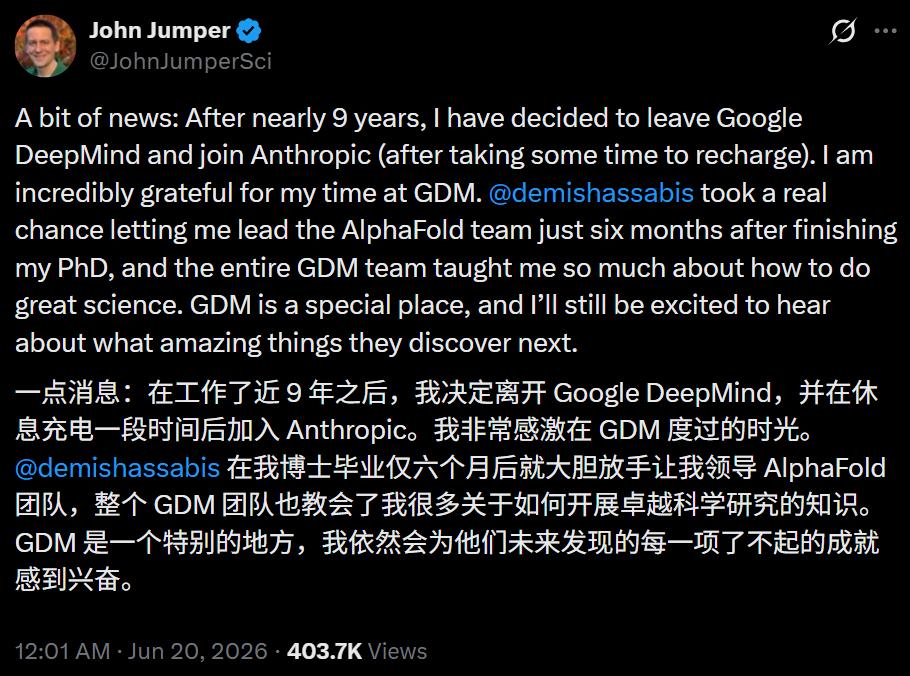
Hassabis quickly responded: "Thank you, John, for your extraordinary partnership over the past 9 years! The achievements we've made with AlphaFold have changed the world."
After 9 years of collaboration and sharing a Nobel Prize, this is probably the most graceful farewell in the tech circle.

Just two days ago, Noam Shazeer, the legendary co-first author of the Transformer paper and the co-leader of Gemini, announced that he was leaving Google to join OpenAI.
In less than 72 hours, Google has lost two aces.
One they bought back for $2.7 billion couldn't be retained, and the other, after 9 years of partnership, also left.
6 months after graduating with a doctorate, he directly led the AlphaFold team
In the life science community, John Jumper is synonymous with "rewriting an entire discipline with AI."
In 1985, Jumper was born in Little Rock, Arkansas, an ordinary small city in the southern United States.
He obtained a double major in mathematics and physics at Vanderbilt University as an undergraduate. Then he went on to study at the University of Chicago all the way to a doctorate, with a research focus on theoretical chemistry. Specifically, it was about using computational methods to simulate the dynamic behavior of proteins.
Mathematics gave him the intuition for modeling, physics gave him an understanding of complex systems, and theoretical chemistry made him understand the protein problem better than any pure AI researcher.
The combination of these three fields happens to be the rarest knowledge combination for solving the protein folding problem.
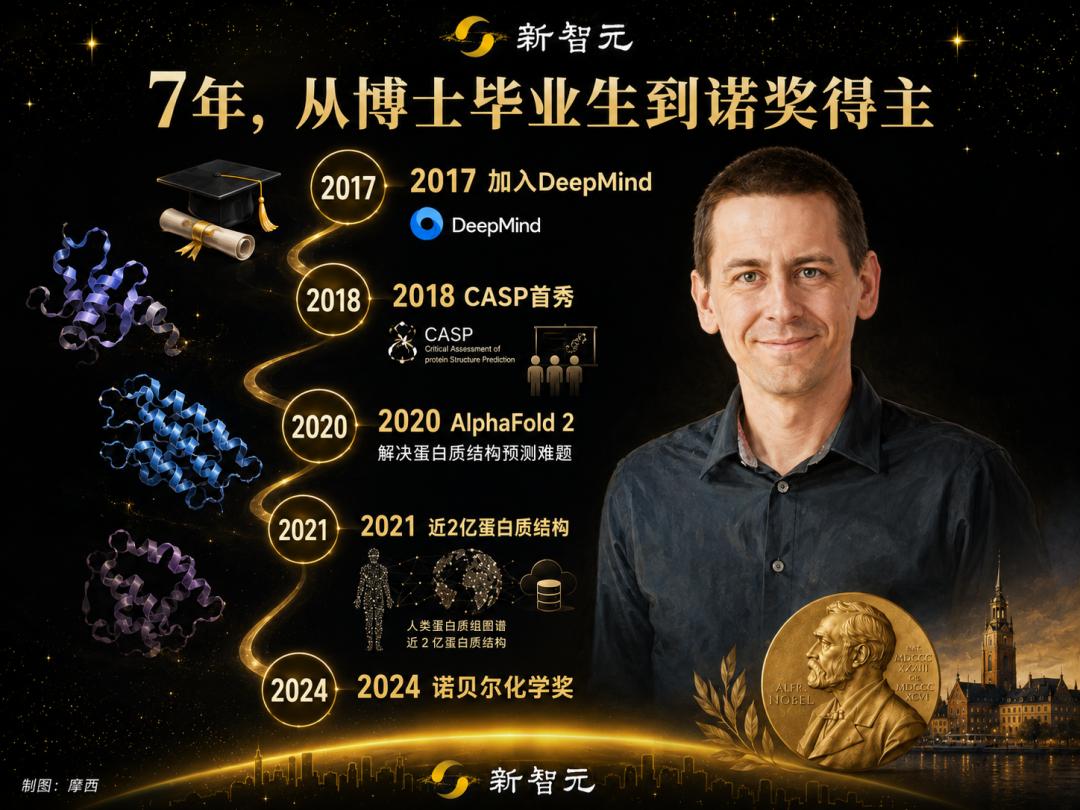
After receiving his doctorate in 2017, Jumper directly joined DeepMind.
It's worth noting that at that time, he had almost no experience in deep learning. The most prominent thing on his resume was not his mastery of neural networks, but his understanding of protein physics.
But this was exactly what Hassabis valued.
Immediately afterwards, he made a decision that no one expected - he let this young man who had only graduated 6 months ago and was still learning deep learning on the job directly lead the AlphaFold team.
There was no transition period, no "spend a few years as a researcher to gain experience."
Hassabis was betting that for solving the protein folding problem, understanding proteins was more important than understanding AI. And what Jumper took on was the biggest gamble in the entire field of computational biology.
One person multiplied the impact on biology by 1000 times
What happened in the next few years can only be described as "absurd" -
In 2018, AlphaFold made its debut at the protein structure prediction competition CASP and crushed traditional methods.
In 2020, AlphaFold 2 emerged out of nowhere, and the protein folding problem that had troubled biologists for 50 years was directly "solved" by an AI model.
In 2021, Jumper led the team to calculate the 3D structures of almost all more than 50,000 human proteins. And finally, they achieved the generation of the structures of nearly 200 million known proteins from about 1 million species.
Before AlphaFold, humans spent decades using experimental methods such as X-ray crystallography and cryo-electron microscopy to solve about 200,000 protein structures in total.
Jumper's team multiplied that number by 1000 at once.
It's no exaggeration to say that what biologists couldn't finish in a hundred years, AlphaFold finished in a few months.

In May 2024, AlphaFold 3 was released - it can not only predict proteins, but also calculate the interactions between DNA, RNA, and small molecule drugs. The accuracy of protein-ligand docking is 76.4%, a 1.8-fold improvement over previous methods.
Five months later in Stockholm, John Jumper and Demis Hassabis stood on the podium for the Nobel Prize in Chemistry together.
That year, Jumper was 39 years old, the youngest Nobel laureate in chemistry in 70 years.
It only took him 7 years from being a doctoral graduate who had to learn deep learning on the go to standing in the spotlight in Stockholm.
By now, the return on Hassabis' bet back then is probably among the highest in the history of human science.
So today when he leaves, the pain for Google DeepMind is not just about losing a director.
What's wrong with Google?
After the news broke, the comment section on X went crazy.
Netizen Chubby exclaimed: "This is a huge loss for Google, and it's crazy for Anthropic!"
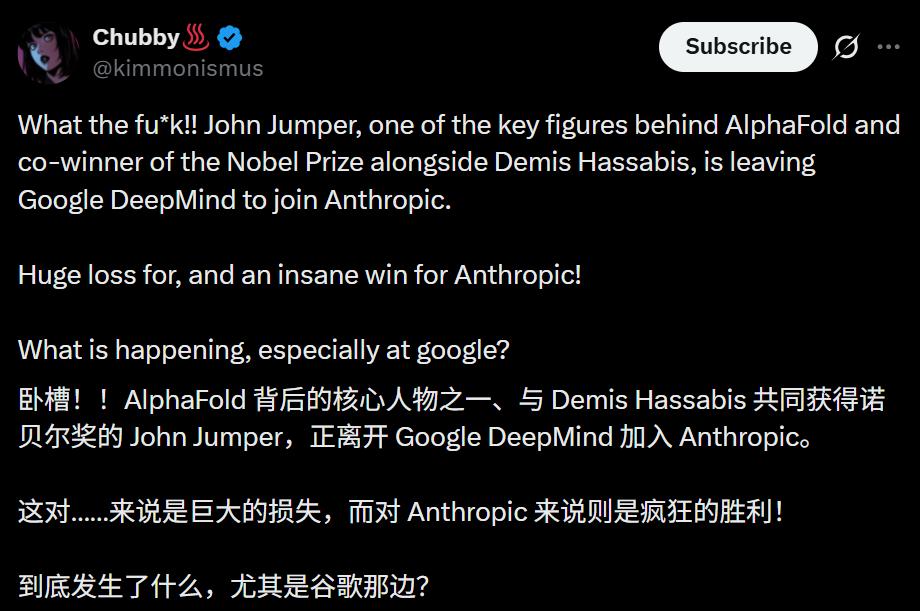
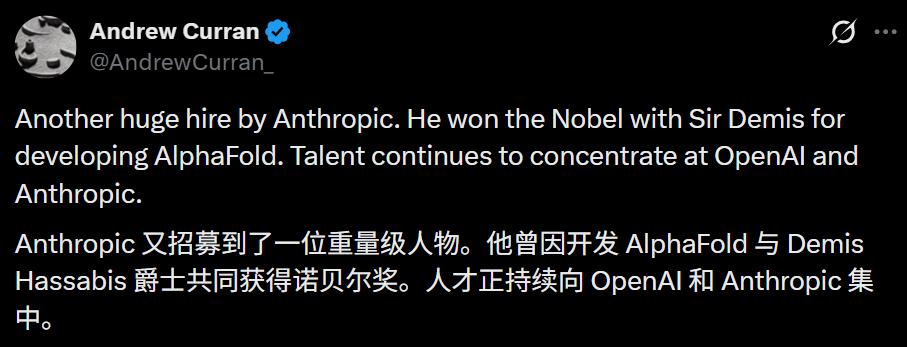
Some netizens sighed that "Anthropic has welcomed a Nobel laureate, and talents are continuously concentrating on OpenAI and Anthropic." Others directly shouted: "First Karpathy, and now the person behind AlphaFold. Anthropic is assembling an AI Avengers Alliance."

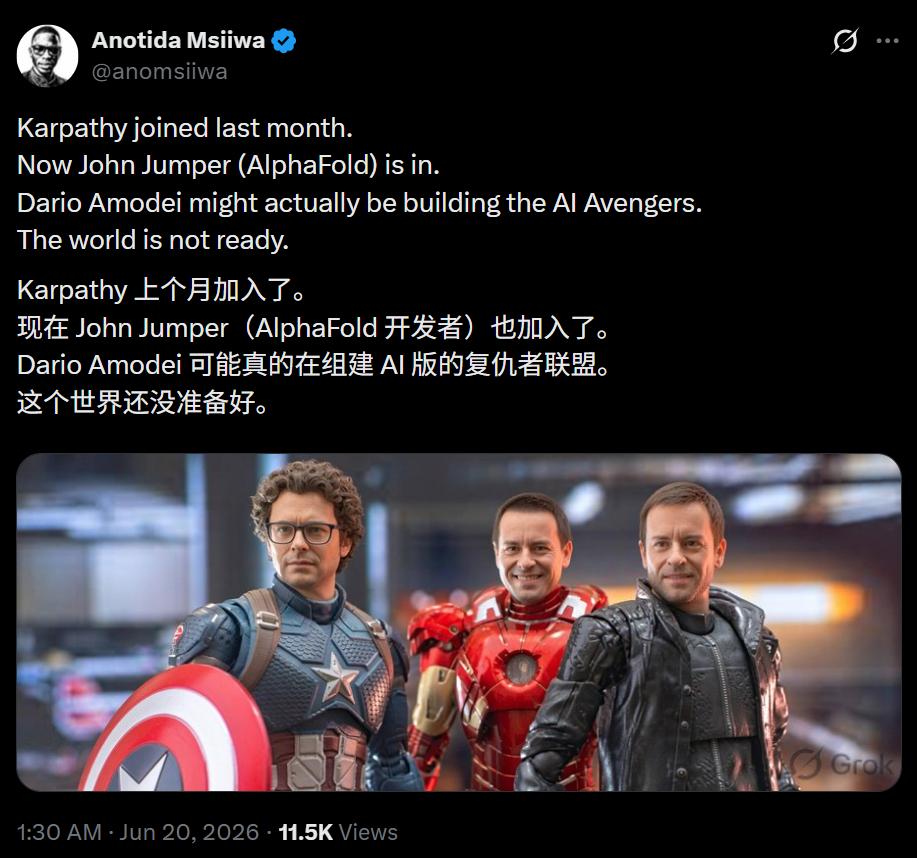
Logan Kilpatrick joked that he was looking forward to Jumper "winning another Nobel Prize." It was a joking tone, but thinking about it carefully, it's not an exaggeration.
After the shock, everyone is asking the same question - what's wrong with Google?

Jumper didn't say, Anthropic didn't say, and Google didn't say either.
Perhaps a comment from investor Lior Alexander is the closest to the answer so far -
"Cutting-edge AI labs are offering something that Google can't: the feeling that one person can change the company's trajectory."

The person bought back for $2.7 billion couldn't be retained either
Just two days before Jumper's official announcement, Noam Shazeer announced that he was leaving Google to join OpenAI as the "Head of Architecture Research."
He was one of the core authors of the 2017 paper "Attention Is All You Need," which is the cornerstone of modern AI. He designed the multi-head attention mechanism, and he wrote the first available implementation that outperformed the state-of-the-art line by line.
And Google spent $2.7 billion to bring him back from Character.AI.
After returning, Shazeer became the co-leader of Gemini and was the top contributor to Google's counterattack in the field of large models.
But less than two years later, he left. Two days later, Jumper also left.
They are neither the first nor the last.
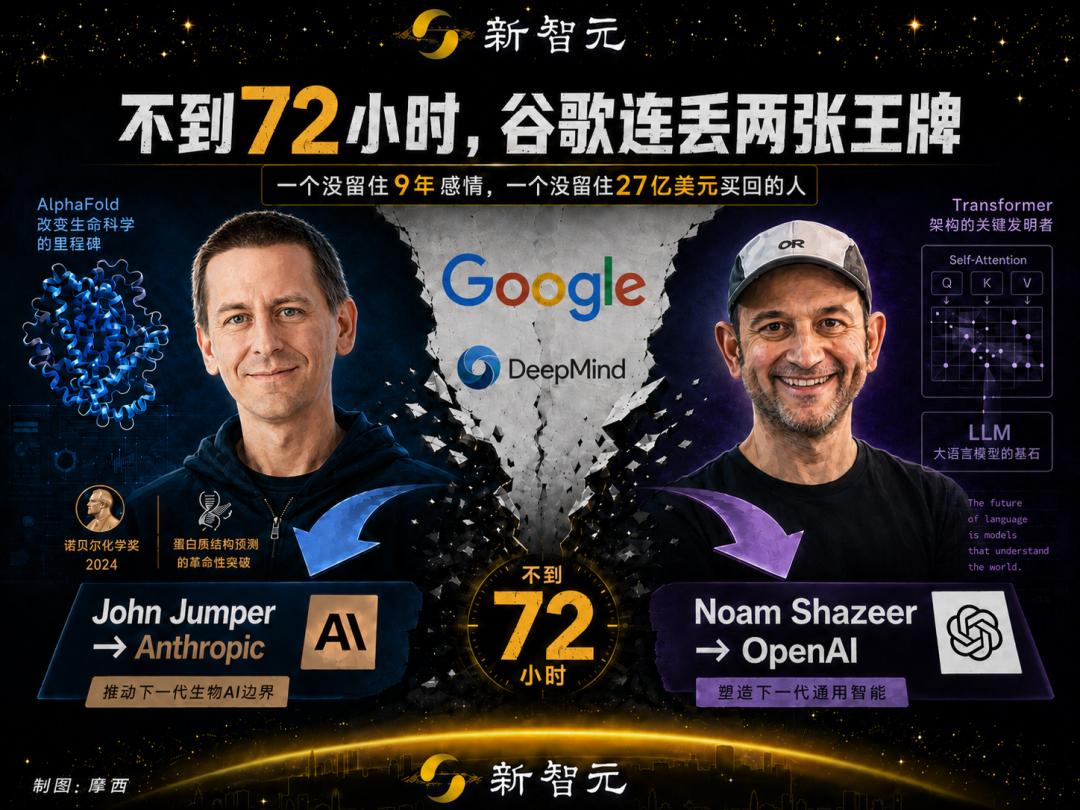
In the past 8 years, more than 20 top researchers who signed on milestone papers have left DeepMind/Brain one after another.
In 2025 alone, at least 11 executives left. Mustafa Suleyman, the co-founder of DeepMind himself, was poached by Microsoft in a $650 million acqui-hire deal.
Life science: the next battlefield for the three AI giants
Let's turn to Anthropic. The layout started more than two months ago.
On April 3rd, Anthropic acquired the biotech company Coefficient Bio with $400 million in stock. The team has less than 10 people, but they have already achieved top-notch results in the field of AI-driven antibody design.
At the same time, Anthropic is also building its own wet lab. In October last year, it launched Claude for Life Sciences to help researchers accelerate drug discovery and biological experiment design. In January this year, it launched Claude for Healthcare for medical institutions.
They say their goal is to compress the R & D cycle in life science by 10 times. And now, a Nobel Prize-level protein scientist is leading this effort.
In fact, it's not just Anthropic that is betting on life science.
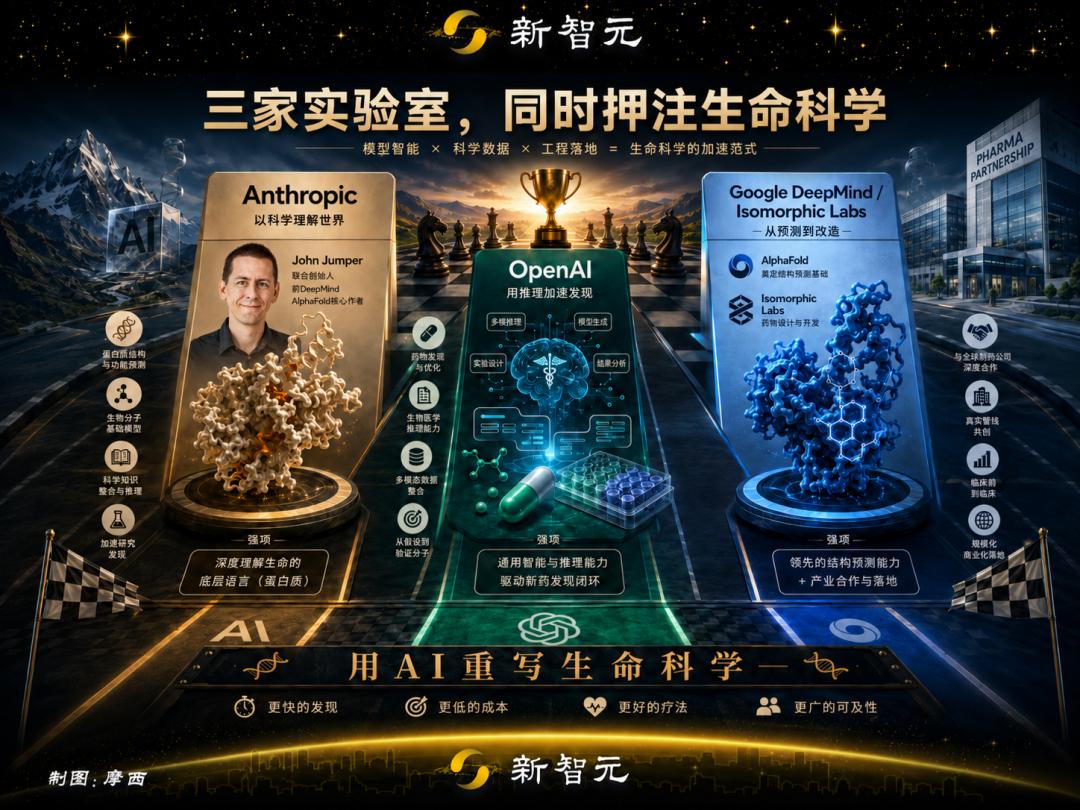
In April this year, OpenAI released the inference model GPT-Rosalind specifically for biomedicine, focusing on drug discovery, genome analysis, and protein engineering. It has already reached cooperation agreements with leading pharmaceutical companies such as Amgen, Moderna, and Thermo Fisher.
The OpenAI Foundation has even directly stated that it will invest no less than $1 billion in the life science direction in the next year. With Shazeer, who was just poached, in charge of architecture research, OpenAI is also very aggressive in this field.
On the side of Google DeepMind, Isomorphic Labs under Hassabis raised $600 million last year and signed cooperation agreements with Eli Lilly and Novartis with a total milestone value of up to $3 billion. The technical foundation of AlphaFold is still the industry benchmark.
The three labs are all placing their bets in the same direction - rewriting life science with AI.
Jumper's choice is just the latest move in this big game.
Reference materials:
https://x.com/JohnJumperSci/status/2068001285173834106
Editor: Moses
This article is from the WeChat official account "New Intelligence Yuan". Author: ASI Revelation. Republished by 36Kr with permission.