Chinese robots acting as spies and manipulating children? There's a business behind the US smear campaign
Robots can not only be hijacked for espionage activities but may also threaten and manipulate the most vulnerable groups such as children... These are the accusations made by some US congressmen and their followers against China's robotics industry recently.
In June, John Moolenaar, the chairman of the House Select Committee on Strategic Competition between the United States and the People's Republic of China, along with two other congressmen, introduced a bipartisan bill calling for a review of robots manufactured by China and other adversaries to assess potential national security risks.
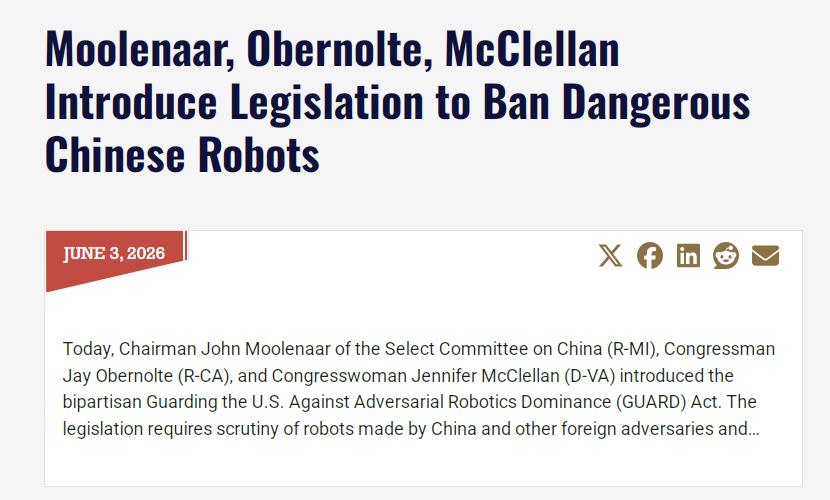
Source of the bill related to restricting China's robotics industry: Website of the House Select Committee on Strategic Competition between the United States and the People's Republic of China
The relevant accusations claim that Chinese robots have built - in backdoors that can be used for espionage. The accusation is specifically aimed at Unitree Technology, alleging that it sells products at low prices in the US market with huge national subsidies.
However, when Moolenaar and others try to label China's robotics industry as "dangerous" and "evil," they not only fail to provide any decent evidence but also expose the self - serving motives of various interest groups behind "America First."
Groundless Nonsense
"With the support of national subsidies, Chinese robot companies like Unitree Technology flood the market with artificially low - priced products, which may lead to the bankruptcy of our (US) companies," said Moolenaar.
In fact, if the US robotics industry chain were really on the verge of bankruptcy due to Chinese government subsidies, its practitioners could all "close up shop." Because the government subsidies received by Unitree Technology are negligible.
According to the prospectus, from 2023 to 2025, Unitree Technology received government subsidies of 6.62 million yuan, 9.8 million yuan, and 17.7 million yuan respectively. This figure is insignificant for US robot companies such as Tesla and Boston Dynamics.
After all, Tesla can earn more than this amount by selling dozens of cars.
During the same period, Unitree Technology's net profit after deducting non - recurring items was - 18.02 million yuan, 78.48 million yuan, and 590.75 million yuan respectively, and the net cash flow from operating activities was 4.94 million yuan, 192.39 million yuan, and 669.98 million yuan respectively. This means that Unitree Technology has turned losses into profits and has the ability to generate self - sustaining cash flow. Even without government subsidies, it will not affect its business operations.
Unitree Technology's comprehensive gross profit margins in the past three years were 44.75%, 57.22%, and 60.44% respectively, showing a continuous improvement in profitability. In addition, the average comprehensive gross profit margin of China's robotics industry increased from 40.98% in 2023 to 44.44% in 2025, showing an overall upward trend.
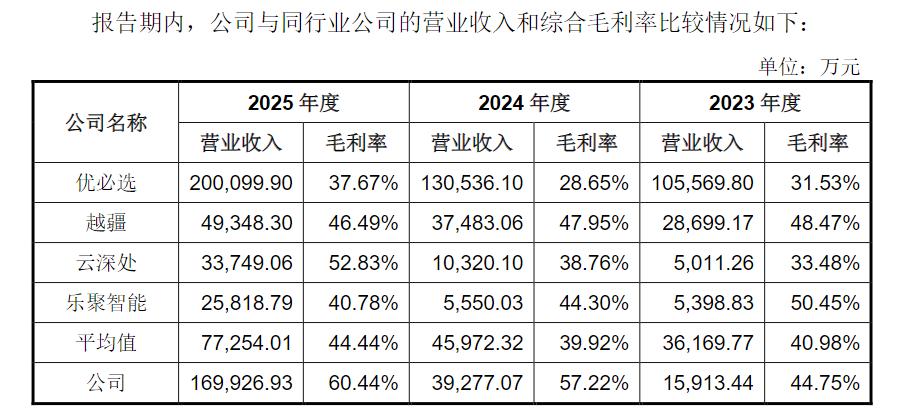
The overall gross profit margin of Chinese robot enterprises is increasing. Source: Unitree Technology's announcement
These data indicate that in the market competition in recent years, Chinese robot enterprises have not engaged in price - cutting wars by squeezing profits. The increase in the industry's gross profit margin directly refutes the false claims of "artificially lowering prices" to dump robots.
Surprisingly, the relevant accusations also worry that Unitree Technology's products may act as overseas spies and even manipulate vulnerable groups such as children.
In fact, the buyers holding the remote controls are the "highest - priority" controllers of the robots. Unitree Technology's customer service staff also clearly stated that all robot products are not recommended for children under 14 years old.

Unitree Technology's customer service said that it is not recommended for children under 14 to use the company's products. Source: Screenshot of the conversation with Unitree Technology's customer service
In terms of language interaction, Unitree Technology has connected its products sold at home and abroad to well - known domestic and foreign third - party large - language models respectively. The responsibility for solving potential problems such as the manipulation or exploitation of vulnerable groups should be borne by artificial intelligence companies such as OpenAI, rather than Chinese robot terminal enterprises.
These almost absurd accusations make people can't help but wonder what the intention is?
The True Intention Revealed
In recent years, the United States has increasingly emphasized "America First" and has not hesitated to wave the tariff stick to promote the return of manufacturing.
Republican Congressman Obernotte said without hesitation, "This bill is a wise move to protect national security, support US robot companies, and ensure that the United States maintains its leading position in the field of robotics."
The upstream and downstream industrial chains of robots are complex. The upstream includes optical cameras, lidars, communication modules, etc. The downstream applications involve industrial manufacturing, inspection and survey, warehousing and logistics, etc.
Such a manufacturing chain is exactly what the United States desires. However, the current situation in the robotics industry has severely hurt its pride.
Unitree Technology's prospectus shows that in 2025, the shipment volume of its pure humanoid robots (excluding two - armed wheeled ones) exceeded 5,500 units, ranking first in the world. In contrast, overseas humanoid robot enterprises currently mainly focus on small - scale deliveries, and their mass - production shipment scale is significantly lower than that of Chinese enterprises.
In 2025, the shipment volume of humanoid robots from major overseas manufacturers such as Figure and Agility Robotics was about 150 units. Tesla has not publicly released its humanoid robots, and its humanoid robots are currently mainly used for internal development and testing.
When the value of "America First" collides with the harsh reality, the US bill to restrict the development of China's robotics industry can hardly hide its anxiety.
This anxiety becomes even more evident when looking at the supporters of the above - mentioned bill.
The supporters of the bill include non - profit organizations such as the Bull Moose Project, the Association for Unmanned Vehicle Systems International (AUVSI), and Agility Robotics.
The Association for Unmanned Vehicle Systems International claims to be "a trusted authority in the unmanned autonomous systems industry." Its members include a large number of US robot companies such as Ford Robotics, Agility Robotics, FIRST Robotics, Ghost Robotics, MVP Robotics, Path Robotics, Real - Time Robotics, Reliable Robotics, Ocean Robotics, and Boston Dynamics.
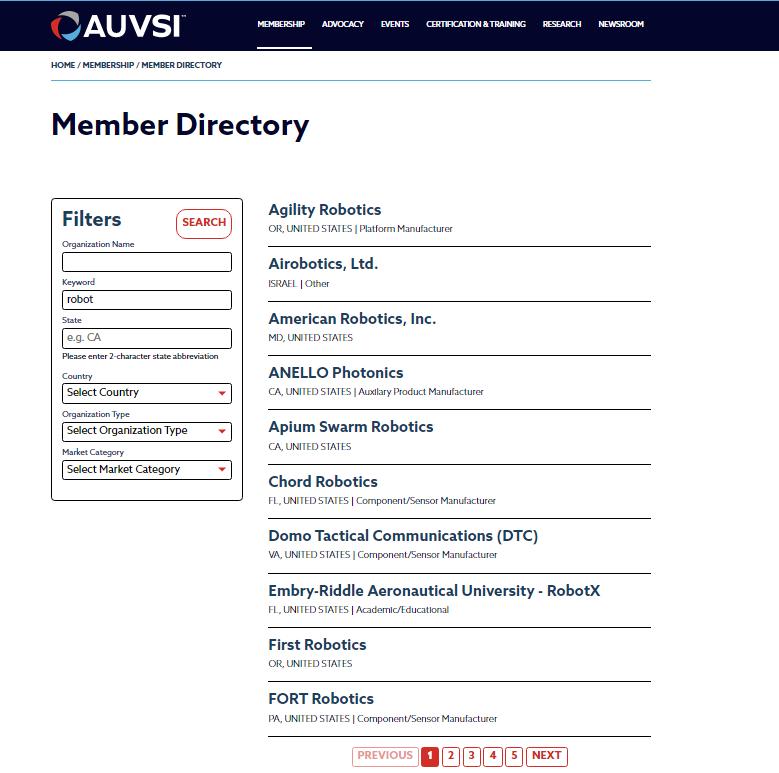
Searching for "robot" in the member list on the AUVSI website shows a large number of US robot enterprises. Source: AUVSI website
The association mentions in its member benefits that joining AUVSI can help members participate in policy - making, expand business, and obtain market intelligence. Member benefits include "participating in Capitol Hill Day, exclusive lobbying activities" and "funding and lobbying support for industry priorities."
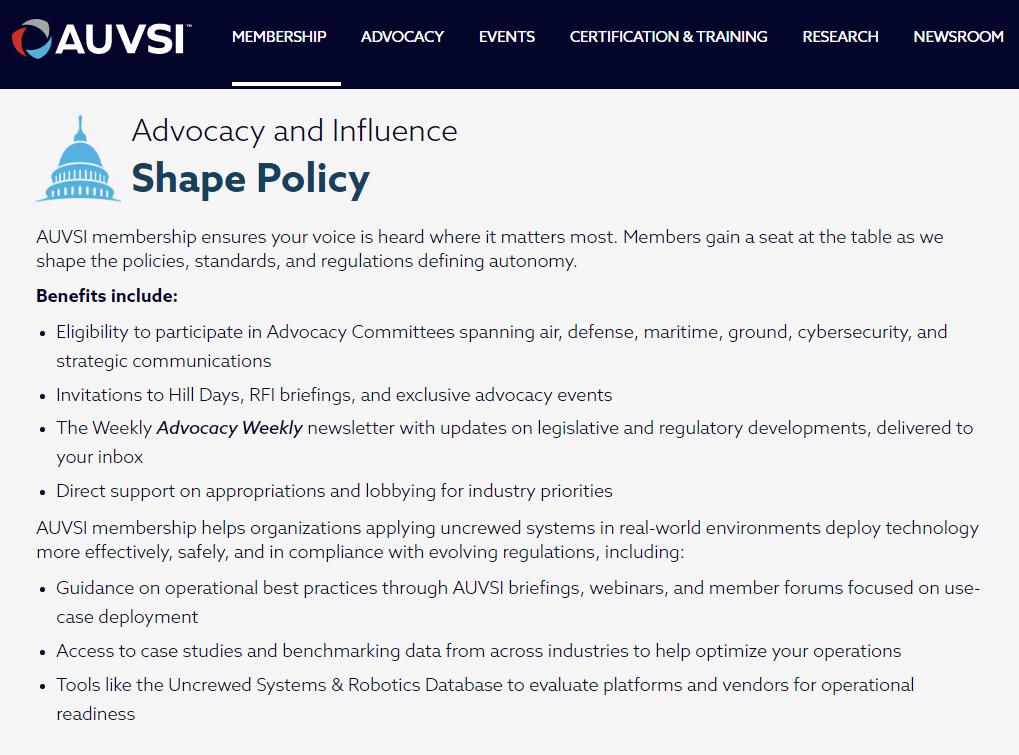
AUVSI claims that its members can participate in policy - making. Source: AUVSI website
Joining AUVSI requires payment. The annual fee for individual members starts at $125. The fees for enterprises and other institutions are "tailored" based on the nature of the organization, the number of employees, etc.
Agility Robotics is a competitor of Unitree Technology and a member of AUVSI. Its shipment volume of humanoid robots in 2025 was only about 150 units.
The Bull Moose Project claims that its mission is to "unremittingly advocate for the United States to dominate in the future." The organization believes that updating and expanding manufacturing will make the United States safer, and it is necessary to incentivize domestic US manufacturers. Re - industrialization will bring stable income to US workers.
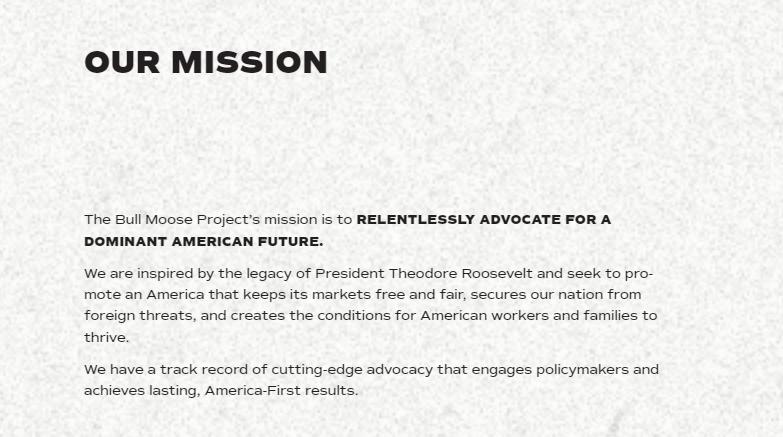
The Bull Moose Project says its goal is to "advocate for the United States to dominate in the future." Source: Bull Moose Project website
Obviously, the institutions or companies supporting the bill are either deeply involved in interests or have a strong political inclination such as "America First." They try to suppress China's robotics industry through policy forces and develop behind closed doors.
History has repeatedly warned that building a car behind closed doors is not a good strategy for development.
In this bill aimed at restricting China's robotics industry, the false accusations with dramatic elements such as "espionage" and "manipulating children" are just eye - catching appearances. When the true intention is revealed, it once again shows the short - sighted interest competition behind "America First."
Text: Chen Junming
Editor: Dong Wenbo
Executive Editor: Li Zhongyuan
This article is from the WeChat official account “Zhongxin Jingwei” (ID: jwview), author: Chen Junming, published by 36Kr with authorization.