Codex compatible with domestic open-source models, actual test of DeepSeek integration: the threshold is still too high
On June 17th, Tibo (@thsottiaux), the head of the OpenAI Codex team on X, posted a tweet. He reminded everyone that the Codex App, CLI, and SDK can now connect to any open - source models, not just limited to OpenAI's own models. He also directly posted the link to the official configuration document, pointing to the sections about OSS mode and local providers. When I saw this message, my first reaction was quite surprised because OpenAI has long given people the impression of being rather closed. Suddenly opening the door to custom model providers this time is really different.
Mainly, Codex is not an ordinary tool. In essence, it is a complete workbench that allows models to read files, write files, call the shell, crawl web pages, execute commands, and continue to reason and judge based on the results returned by tools, and finally output deliverable results. That is to say, in Codex, models not only need to be able to talk, but more importantly, they have to be able to actually do the work.
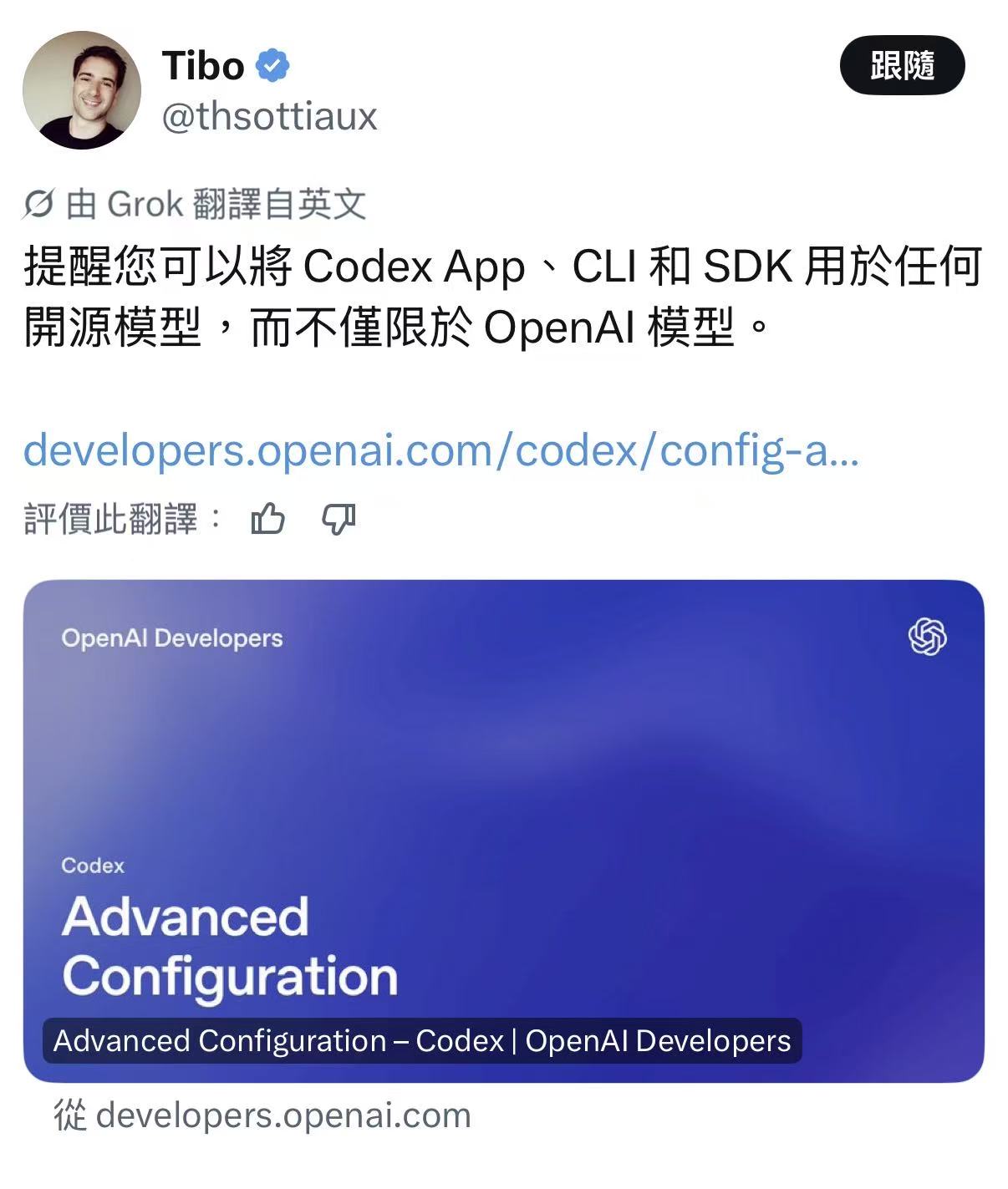
(Image source: X)
In the past, many people complained about OpenAI being closed. In fact, it's not just because the models are not open - source. The more core reason is that its tools, models, and workflows are all wrapped up in its own system. You can use them, but it's difficult to disassemble and reorganize them. Especially for an Agent tool like Codex, in essence, it is a combination of model capabilities, tool calls, context management, permission control, and the local environment. That is, the stronger the model and the more complete the workbench, the less likely users are to leave. Now OpenAI has left an entrance for custom model providers in Codex. At least in terms of the product stance, it no longer tightly binds Codex to its own models.
But do you think OpenAI has really suddenly and completely opened up? After actual testing by Lei Technology (ID: leitech), it turns out that it's not that simple at all.
Can you use third - party models just by filling in a key? It's not that easy
The most easily misinterpreted part this time is actually the statement "Codex supports third - party models". When many people see this, their first reaction might be that since models like DeepSeek, Qwen, and Kimi all provide APIs, and some even claim to be compatible with the OpenAI API, if I fill in the interface address and API Key in Codex, can I use them directly? That's how we tested it at the beginning. The official advanced configuration document of Codex does mention custom model providers. Simply put, a provider can define the way Codex connects to models, including the interface address, protocol type, authentication method, and some additional request information. You can add a new model provider in the configuration file and then let Codex point to it.
But our first attempt to connect to the API of DeepSeek V4 Pro failed.
After reading the official technical documentation, the answer is obvious. That is, Codex has indeed opened up, but only halfway, with certain conditions. The documentation clearly states that currently, the only publicly supported protocol for custom providers is the Responses API. When omitted, it is also the default protocol. In simple terms, Codex allows you to change the model provider, but currently, the publicly configured path uses the Responses API protocol. Whether a model provider can be included depends not only on whether it has an API but also on whether it can provide the Responses form that Codex needs.
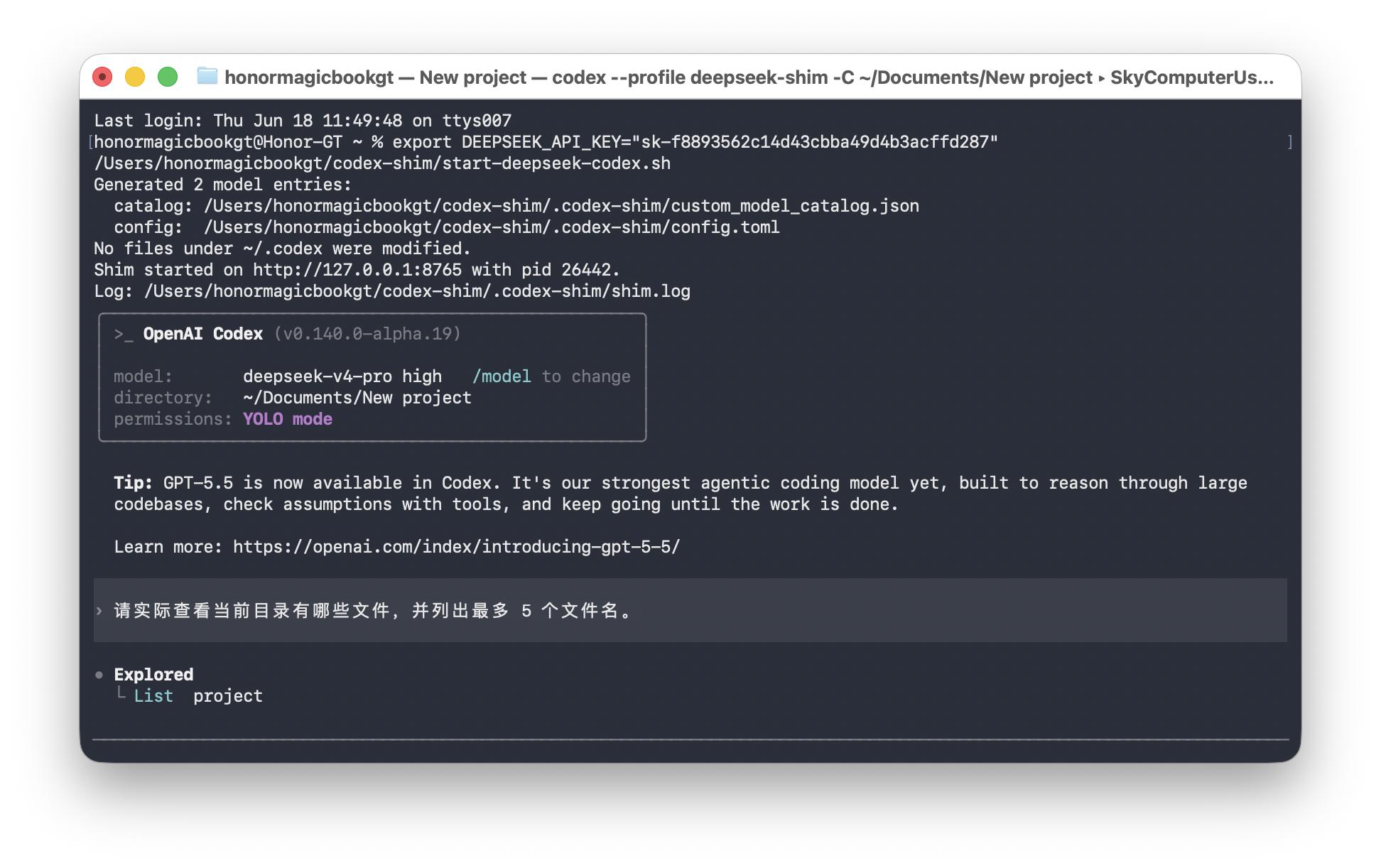
(Image source: Lei Technology's illustration)
The main entry of the DeepSeek official API is Chat Completions, which can be called using the OpenAI SDK, and the model can also be filled in as DeepSeek V4 Pro. For many chat applications, ordinary API calls, and scenarios compatible with the OpenAI SDK, this is fine, but Codex doesn't make requests in this way. When we tried to let Codex directly connect to DeepSeek, filled in the model as DeepSeek V4 Pro, and used DeepSeek's Key for authentication, after starting, Codex actually looked for a non - existent Responses interface on the DeepSeek official website, and the result was a 404 error.
Actually, the OpenAI - format entry on the DeepSeek official website does not provide the Responses API endpoint that Codex currently needs to access.
Although they are all called "compatible with OpenAI", there are many levels. Chat Completions is one set of interfaces, and Responses API is another set. The structures of ordinary chats, tool calls, streaming outputs, inference blocks, and function call result returns are not exactly the same in different protocols. For users, these differences are hidden behind the configuration. For an Agent workbench like Codex, they directly determine whether a task can run.
The real turning point came from another entry of DeepSeek, that is, the Anthropic API - compatible endpoint. In addition to the common OpenAI - format entry, the DeepSeek official documentation also provides an Anthropic - format entry, which is more suitable for carrying the structures required by Agent scenarios such as tool calls and tool return results, and is closer to the working mode of Codex. The path we finally got to work was not to let Codex directly access DeepSeek, but to add a lightweight "translator" on the local machine. Codex still initiates tasks in its familiar way. This translator then converts the request into a format that DeepSeek can understand. After DeepSeek returns the result, it is translated back into a form that Codex can continue to execute tools with.
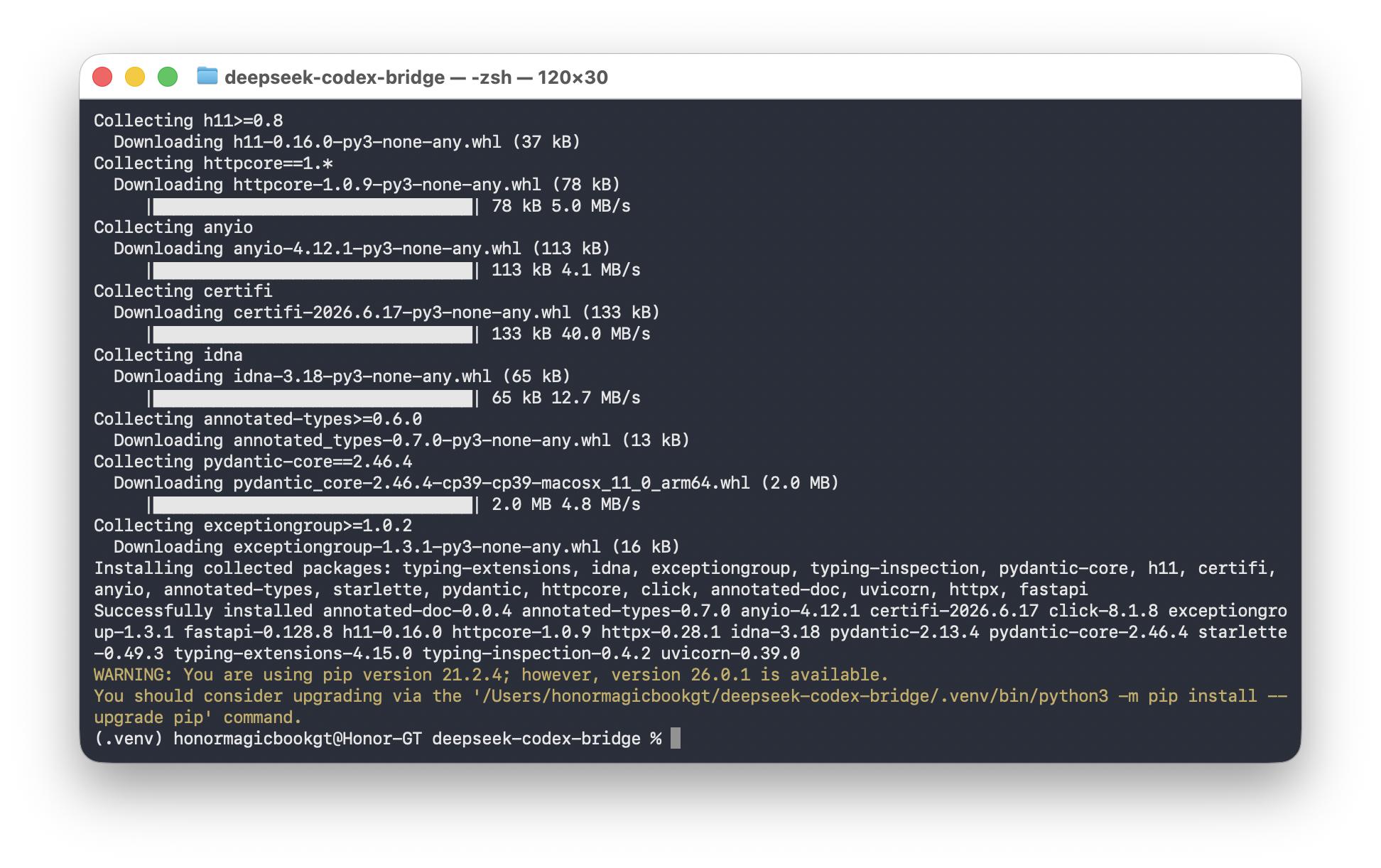
(Image source: Lei Technology's illustration)
More directly, currently, the DeepSeek, Mimo, Kimi, and Zhipu GLM that everyone is looking forward to cannot directly use the API Key to connect to Codex. They can only use a transfer bridge, which is not much different from the previously popular CC Swich solution. Of course, if you really want to try the "direct" way, Alibaba's Bailian large model currently provides a Responses interface. The price is 200 yuan per month. Friends with urgent needs can give it a try.
Is the experience of Codex driven by Deepseek really good?
After getting the configuration to work, we chose to let DeepSeek + Codex handle some tasks more in line with Lei Technology's daily work. In fact, it was mainly to see if the combination of a third - party open - source model and Codex would have any compatibility issues.
The first task was to search for Lei Technology - related information across the entire network. Combine the official website introduction, articles, and special reports, such as reports on exhibitions like MWC, IFA, and AWE, to create a business investment promotion document for Lei Technology and output it as a Markdown file. This task may seem like writing an article, but in fact, it involves several Agent ability points. It needs to find information first. If the search tool is not available, it should be able to change the strategy. After getting the web pages, it needs to extract useful information. The information cannot just be piled up but also needs to be re - organized according to the structure of the investment promotion document. Finally, it needs to write the result as a local Markdown file.
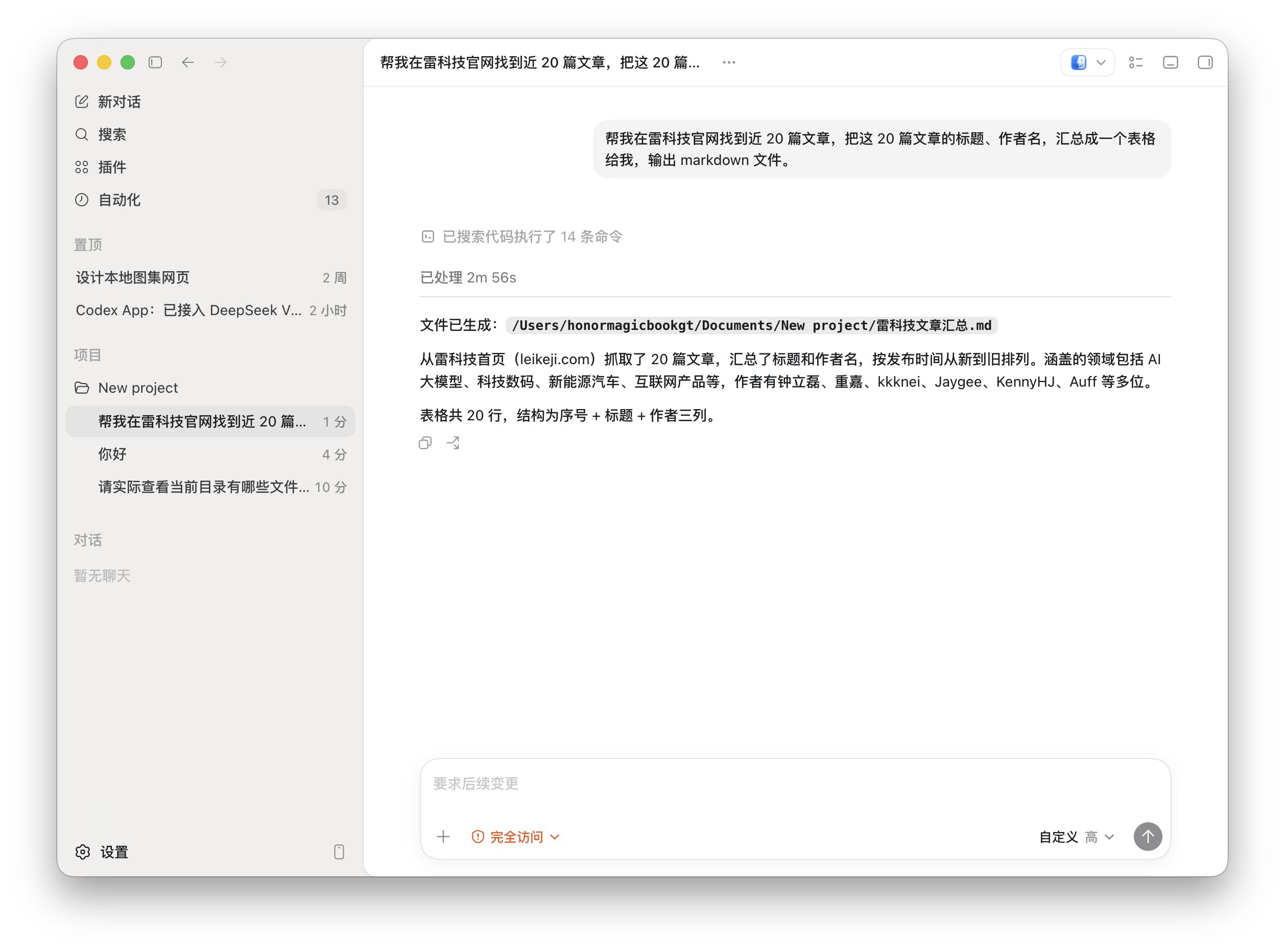
(Image source: Lei Technology's illustration)
At the beginning, when DeepSeek V4 Pro tried, the built - in web search tool was unavailable, and the web search ability was not smooth either. It directly changed the method and directly grabbed the first - hand pages of the Lei Technology official website from the local terminal, including the homepage, "About Us", "Contact Us", the list of historical special topics, the MWC26 special topic, the MWC26 triumphant report, the AWE2026 special topic, etc. Finally, it generated a 320 - line Markdown document. In terms of content, it sorted out Lei Technology's brand positioning, media matrix, user portrait, content columns, core data, exhibition reporting ability, video - based distribution, business cooperation model, cooperation cases, and contact information.
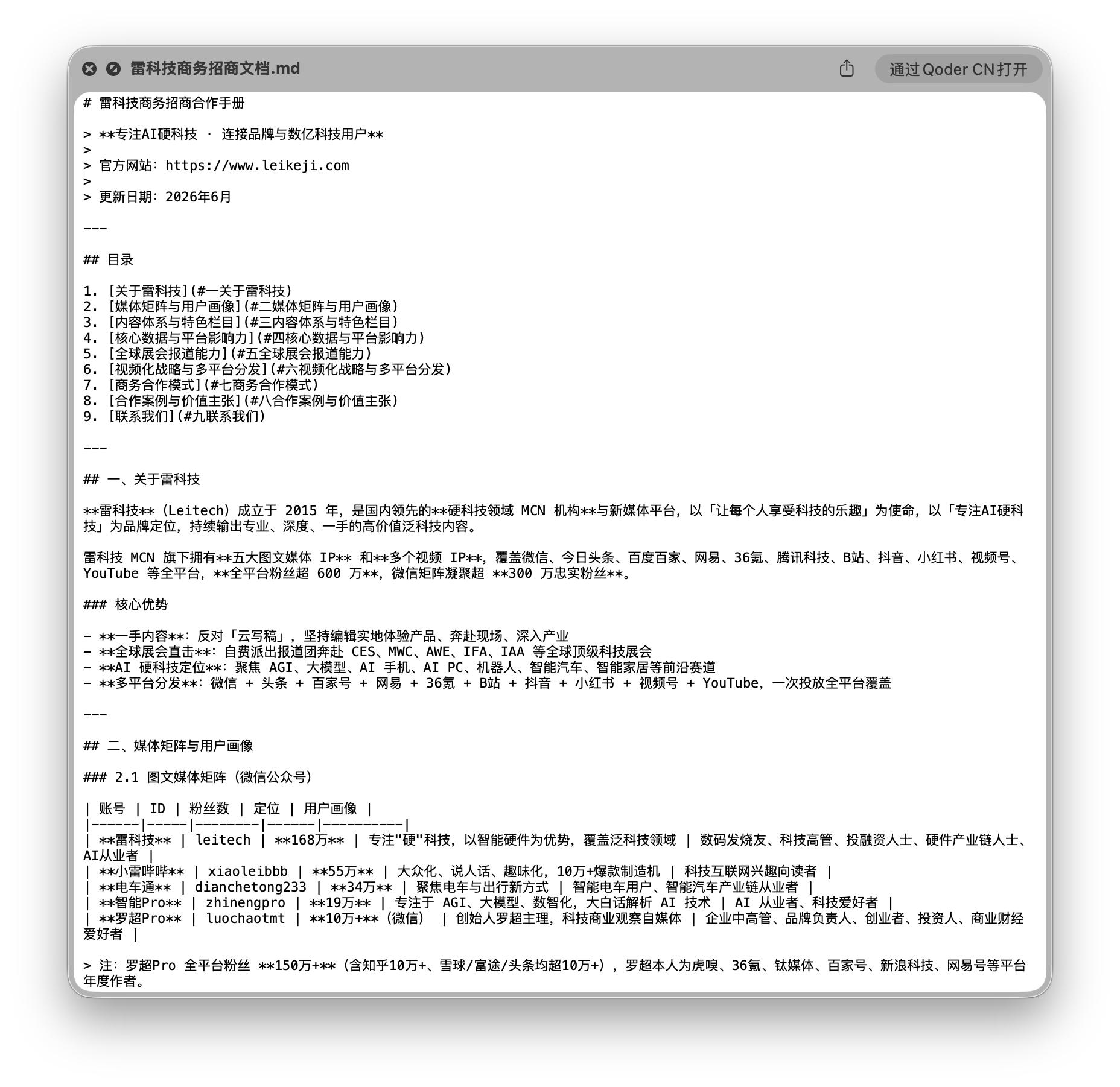
(Image source: Lei Technology's illustration)
Although the page is a bit rough, it is still usable.
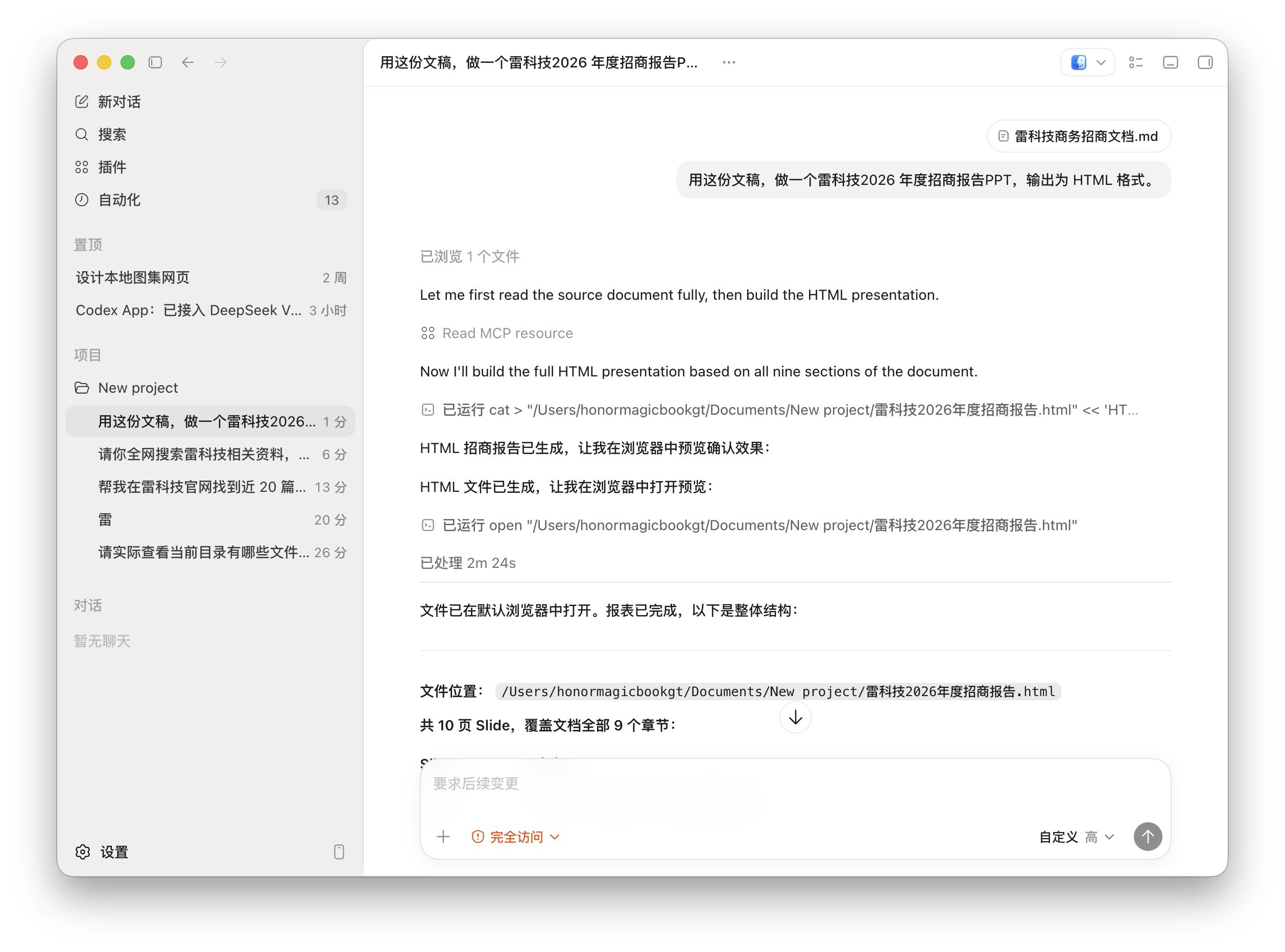
The second task went a step further. It was to read the investment promotion document generated in the previous step and then create a 2026 annual investment promotion report PPT for Lei Technology and output it in HTML format. This step tested the ability to handle consecutive tasks. If the first step was just from web pages to Markdown, the second step was from an existing document to a structured display. The model needed to understand the 9 chapters in the previous file and then transform them into 10 slides, including the cover page, "About Lei Technology", "Media Matrix", "Content System", "Core Data", "Global Exhibitions", "Video Strategy", "Business Cooperation", "Cooperation Cases", and "Contact Us".
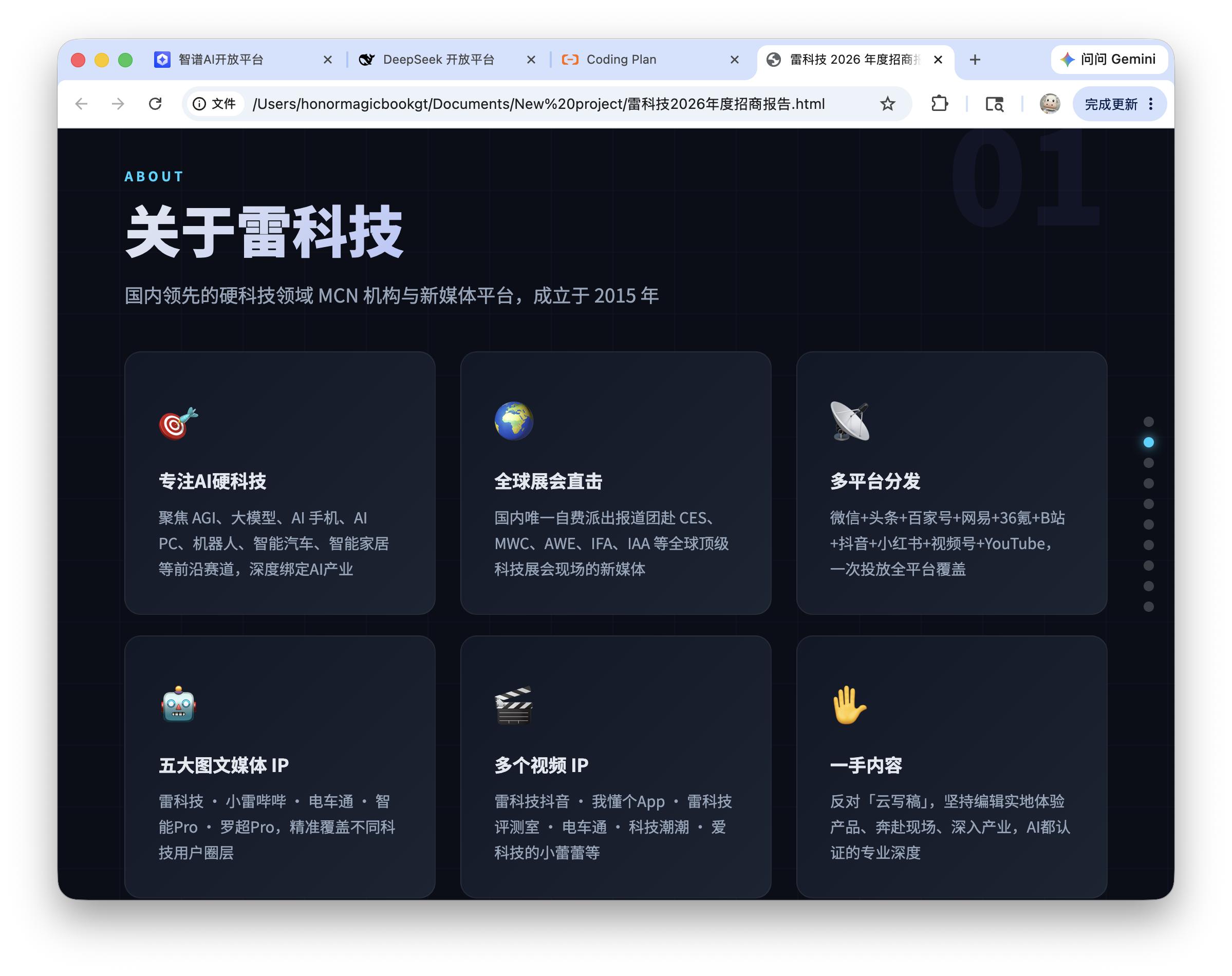
(Image source: Lei Technology's illustration)
The final output was a single - file HTML, about 790 lines, nearly 40KB, which included a dark - colored technology - style theme, blue - purple emphasis colors, scroll - triggered animations, a right - side dot navigation, keyboard up - and - down page turning, a responsive layout, and support for printing and exporting as a PDF. This is not a finely - polished design draft, but it is already a deliverable that can be opened, previewed, and further modified. Judging from the degree of completion, DeepSeek can be used in this set of lightweight tasks. Its strengths are obvious. It has a fast data - sorting speed, good long - document organization ability. When a tool is unavailable, it will try to find an alternative way. It is relatively smooth in generating text - type files such as Markdown and HTML. For tasks like "writing an introduction", "organizing a set of data", and "creating a display page based on a document", it can already take on the production of the first draft.
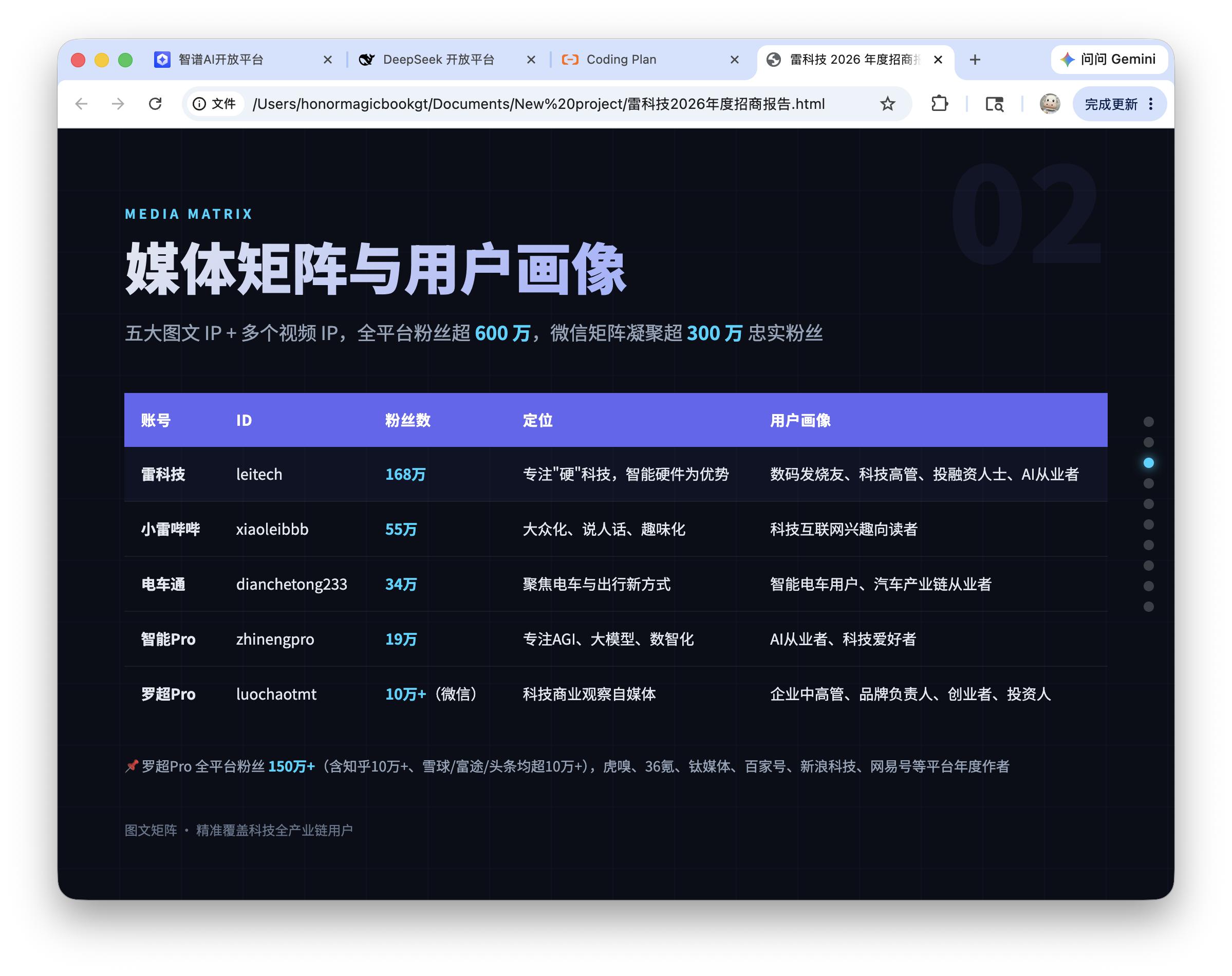
(Image source: Lei Technology's illustration)
However, in terms of experience, it is not as mature as the official model. All the capabilities of Codex + GPT 5.5 are in the same ecosystem, and the model, tool calls, context, visual capabilities, etc. can be smoothly invoked. But the link that Deepseek runs in Codex is very long, and it also goes through a transfer bridge in the middle. Naturally, the speed is not as fast as the "official" combination.
So in terms of response speed, DeepSeek is not so slow that it can't be used in simple text and data - sorting tasks, but it is indeed not as fast as the official model. Especially after entering the Agent workflow like Codex, it doesn't answer all at once. Instead, it has to call tools, wait for results, and continue to reason. With an additional layer of local translation in the link and the need for tool calls to go back and forth, the speed will naturally feel a bit slower.
In terms of consumption, the feeling this time is very direct. We charged 10 yuan to the DeepSeek account. After running these two tasks, with several rounds of chatting and debugging in between, there was still 9.27 yuan left in the balance. That is to say, this whole round of lightweight actual testing only cost a little over 70 cents. DeepSeek really deserves to be the king of cost - effectiveness. If all the tasks are of this type, then you can indeed abandon the monthly $20 subscription fee for ChatGPT Plus.
Will this wave make Zhipu and DeepSeek win big?
After the experience, for most ordinary users, whether Codex can support third - party models doesn't really matter that much. If you just want a simple and smooth experience, then subscribing to a Plus membership also has a good cost - effectiveness, after all, it is bundled with ChatGPT.
What is really beneficial are those open - source models.
In the past, for domestic and open - source models to enter the real workflows of developers, they needed to build many product - layer capabilities on their own. Releasing an API for a model is just the first step. There are also IDE plugins, command - line tools, file permissions, tool calls, project context, task memory, error recovery, collaboration interfaces, and review processes later. These things cannot be solved by model papers.
The value of tools like Codex is that it has built the workbench first. It is responsible for interacting with the local file system, executing commands, displaying tool calls, splitting tasks into multiple rounds, and allowing the model to work continuously in the context. Once a third - party model can be connected, it is equivalent to directly obtaining a mature Agent container. This is an opportunity for Zhipu, DeepSeek, Qwen, Kimi, etc.
(Image source: Lei Technology's illustration)
For example, Zhipu. Zhipu recently launched GLM - 5.2, directly emphasizing 1M lossless context and improved long - range task capabilities. Its performance in Coding and long - range task evaluations has reached the open - source SOTA level, and it performs