NIO has made up for the "intelligent driving lesson", Ren Shaoqing concluded: Technological innovation in intelligent driving will reshape competition
Text by | Xiao Man
Edited by | Li Qin
On June 18th, NIO simultaneously pushed the latest version of the world model to two generations of platform models (including 8 NT2.0 platform models, 4 NT2.5 platform models, and 6 NT3.0 models). This means that NIO can now run the same set of complex intelligent driving codes on different generations of chips.
The problem of software iteration rhythm being constrained by hardware has long been a headache for the industry. Many car manufacturers are unable to iterate the same software on models with different versions and configurations. As a result, for a long time, only cars with the latest version of hardware could use the best software, leaving old car owners at a disadvantage.
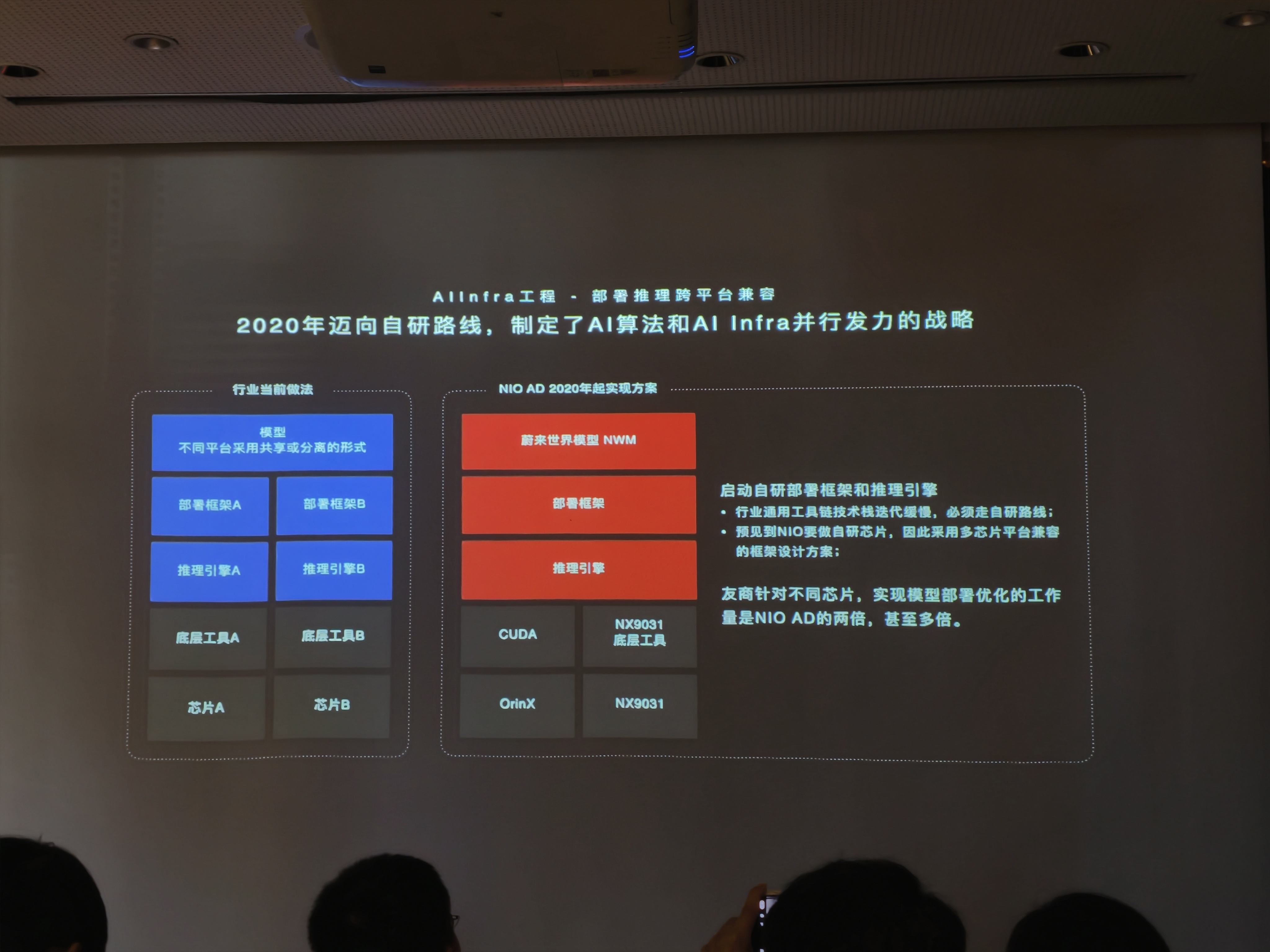
NIO's deployment of inference cross - platform compatibility
Ren Shaoqing's team started thinking about how to solve this problem in 2020. NIO's approach is to build an AI Infra - a self - developed toolchain to bridge the gap between different chips, an AI compiler to improve the vehicle's processing speed, and an AI Agent to automate the entire process.
At that time, the mainstream approach in the industry was to use NVIDIA's tools for upper - layer deployment. However, NIO judged that the engineering architecture of in - vehicle chips would continue to iterate rapidly, and the mainstream architecture would only be usable for 3 - 5 years. Based on this judgment, NIO decided to only retain the lowest - level hardware interface layer (such as CUDA) and fully self - develop the upper - layer deployment software, including the inference engine and deployment framework.
In addition, like most car manufacturers that self - develop chips, NIO also self - developed a compiler, achieving automatic operator optimization. This reduced the deployment time from 1 - 2 weeks to 1 - 2 days and increased the inference performance on the edge side by more than 20%.
Ren Shaoqing revealed that NIO has also introduced an automated workflow of AI Agent, taking over the cumbersome process that originally required engineers to manually monitor and execute step - by - step on the computer for a long time. This has compressed the time for a complete model deployment on the vehicle from one day or even several days to less than 2 hours.
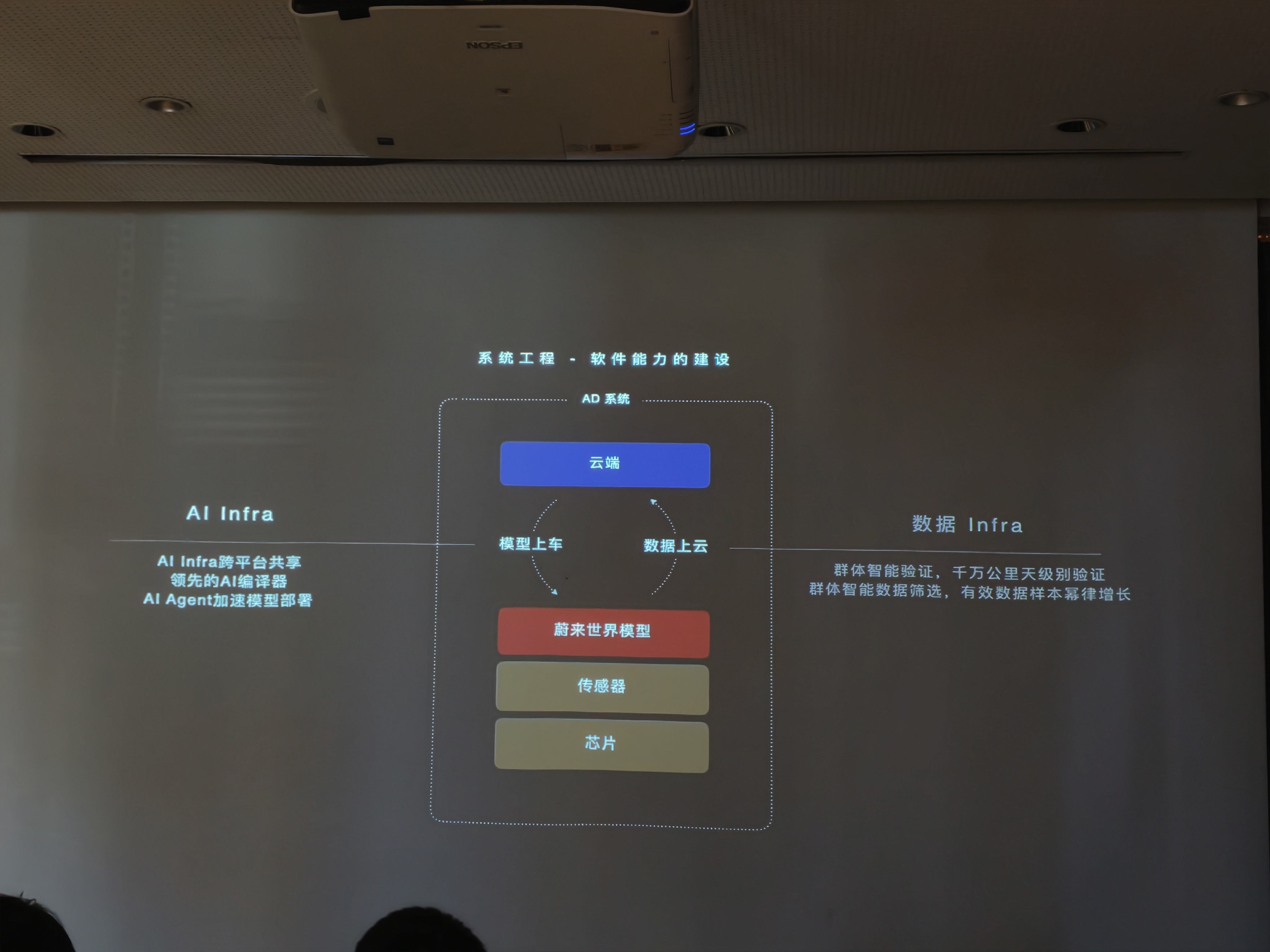
NIO's construction of intelligent driving software capabilities
The AI Infra enables the rapid deployment of models on the vehicle. The vehicle side collects high - value data in real - world application scenarios and sends it back for training. After the algorithm team trains a smarter model with this data, it is sent back to the AI Infra pipeline for packaging and deployment on the vehicle, achieving a data closed - loop.
Ren Shaoqing said bluntly: "In the era of large models, to improve performance by three points, the data needs to be increased tenfold; if you want to improve by 18 points, the data needs to be increased by a factor of 10 to the sixth power." That is to say, if you rely solely on increasing the number of dedicated test fleets and spending money to collect physical data, you will soon reach the physical limits of cost and scale.
Regarding the understanding of data, Ren Shaoqing believes that "the essence of data is computing power, the result of the operation of'model + computing power'."
NIO runs the latest large model to be verified in the "shadow mode" on mass - produced vehicles, without interfering with the user's driving, only performing real - time deductions. Once the model's judgment diverges from the human's real driving actions, this corner case is sent back to the cloud.
This verification system can span the NT2 and NT3 platforms and complete more than 40 million kilometers of active safety tests per week without the user's awareness, which is equivalent to the data volume of 1,000 test vehicles running continuously for a year.
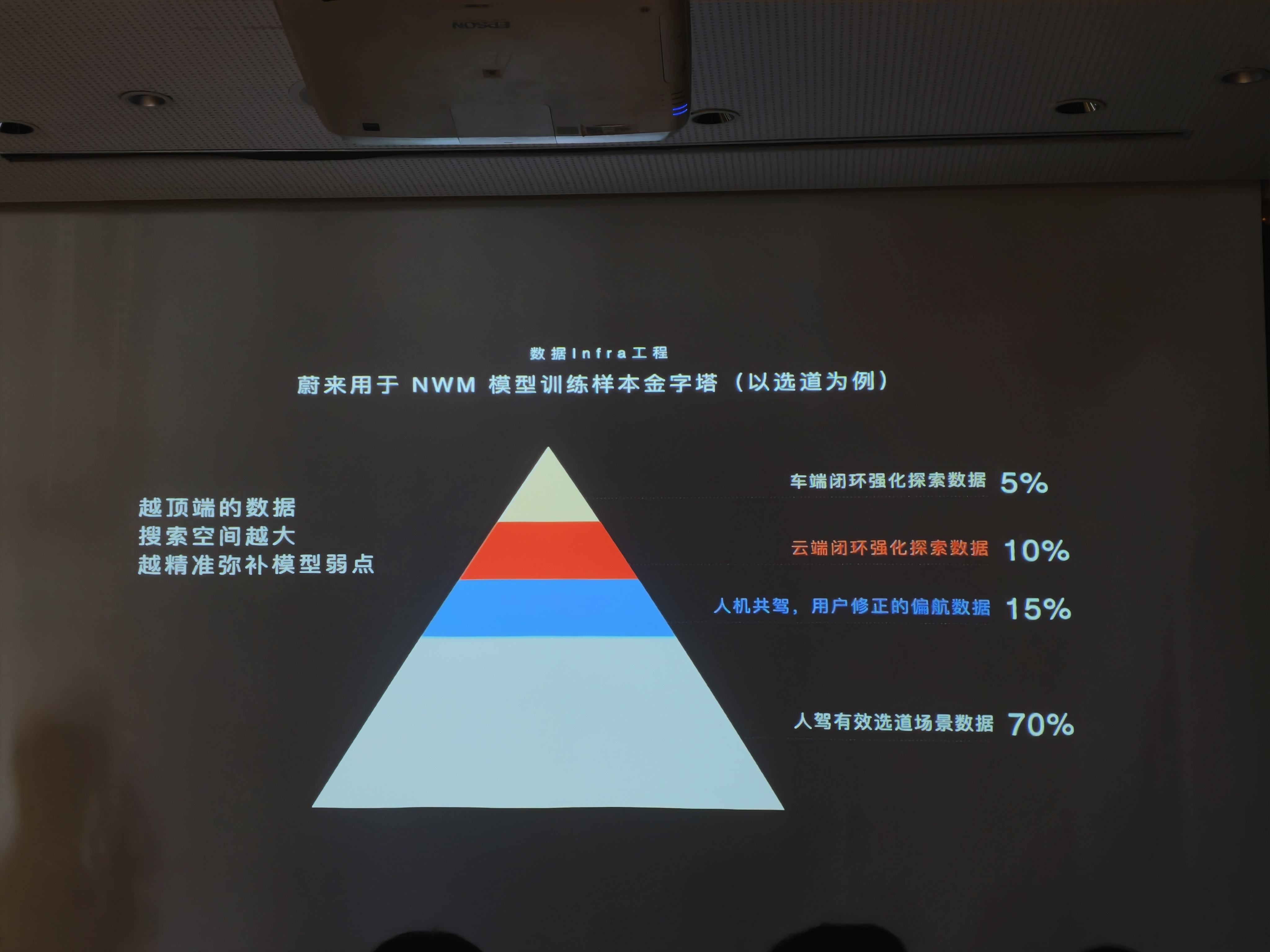
NIO's data Infra engineering
Ren Shaoqing believes that the corner cases screened out by the vehicle side may only account for 5% of the total data volume, but the training value they provide is greater than that of the underlying regular data.
In addition, in the cloud - based world model, NIO deliberately creates various extreme and unconventional traps for the AI, forcing the neural network to learn how to get the vehicle back on track in an error state.
Recently, the industry has generally noticed an improvement in NIO's intelligent driving capabilities. In Ren Shaoqing's view, this is not a sudden change in a single - point algorithm but the result of a new understanding of the "physical AI development cycle".
Ren Shaoqing divides the development of technology into four stages: the first stage with unclear goals, the second stage where there is a possibility of overtaking on a curve, the third stage where the technical route converges and human resources are crucial, and the fourth stage where the dividends disappear and details matter.
However, in 2023, with the emergence of the concepts of large models and world models, Ren Shaoqing judged that intelligent driving technology has regressed to the "second stage" that encourages underlying innovation. Therefore, NIO carried out a organizational structure reform two years ago, reorganizing the intelligent driving team into a "4x100 - meter relay race" (pre - research, main - line delivery, cross - platform adaptation, and mass - production delivery), and pouring resources into the pre - research of the "first leg".
The improvement in capabilities brought about by the "world model plus closed - loop reinforcement learning" that the outside world sees today is actually the result of this organizational structure change and the establishment of the Infra foundation.
On June 17th, 36Kr had a conversation with Ren Shaoqing and his team members at the NIO House in Zhongguancun. The content has been edited:
Question: Many car manufacturers are now self - developing high - computing - power chips. Why can NIO be the first to implement them on multiple platforms?
Ren Shaoqing's team: In fact, during the process of promoting the R & D and mass production of self - developed chips (the tape - out in 2024 and mass production by March 2025), we have done a lot of work. Although our competitors also started early, in terms of AI Infra, NIO started its layout in 2020, especially self - developing the inference engine, deployment framework, and AI compiler.
Thanks to the accumulation since 2020, when our self - developed chips were ready, the relevant engineering efficiency had reached a certain level. Therefore, after the chips were taped out, we quickly achieved cross - chip platform compatibility.
Question: Recently, the evaluation of NIO's intelligent driving has improved. Why can people experience a significant improvement in the version and capabilities at this time?
Ren Shaoqing: The improvement of intelligent driving capabilities is mainly composed of three things: new algorithms, underlying hardware, and the underlying data system.
If you ask what has happened in the past two years, it is indeed the change in the algorithm architecture (such as the world model and closed - loop reinforcement learning). However, beneath these surface changes, the deeper reason is that around 2023, we realized that the development stage of intelligent driving is different from previous years.
What people may see is the change from rule - based to end - to - end or world models. But what we see is the regression and reconstruction of the physical AI development stage. We define the development of technology into four stages:
Around 2020, intelligent driving had actually entered the third stage, where everyone was competing in terms of the number of people and the number of strategies (writing tens of thousands of lines of code). However, around 2023, with the emergence of large - model technology, I believe that intelligent driving has regressed to the second stage - we can start using underlying technological innovation to solve problems and create differentiation again.
So from that time on, we were not only working on new algorithms but also carrying out organizational structure reforms. About two years ago, we changed the organizational structure to a form similar to a "4x100 - meter relay race": the first leg is for pre - research, the second leg is for main - line state delivery, the third leg is for cross - platform adaptation, and the fourth leg is for mass - production delivery of specific models.
Since the technological development has regressed to the second stage that encourages innovation, we have invested a lot of resources in the "first leg (pre - research)". We have arranged different pre - research teams. The macroscopic result that people see is the "world model plus closed - loop reinforcement learning", but at the microscopic level, we have a lot of innovations to support the implementation of these architectures. This is the underlying logic for the explosion of capabilities at this node.
Question: Currently, most discussions about intelligent driving focus on VLA and world models. Is there a relatively clear trend in the competition?
Ren Shaoqing: It is very normal for algorithms to have different ideas. This is also the most interesting aspect of artificial intelligence entering the AI era or the new technology era. If everyone follows the same path, the world won't develop so fast.
In the past three years, the development of artificial intelligence has been very rapid. I started working on intelligent driving around 2016. From 2016 to 2022, the development of intelligent driving algorithms, or algorithms in the physical world, was very slow. The biggest change was probably BEV, and at most, OCC was added, and that was it.
However, since 2022, the overall technology has changed from being very certain to very uncertain, and various opportunities have emerged. We released the world model in July 2024, but the internal R & D started in the second half of 2023. At that time, the concept of the "world model" was not very clear, but our idea was simple:
First, we hope that this model can be trained in a completely unsupervised or self - supervised way, which means we don't need to label so much data, and some data can't be labeled manually; second, we hope it can be a multi - modal hybrid approach, that is, a unified network.
In the past three years, we have caught up with the period of rapid change in artificial intelligence in the physical world. People have jumped out of a very certain state where what they did every day was basically the same as in the previous three years. For example, students who used to write planning models and planning algorithm codes are now dealing with a few more scenarios than three years ago. Now, the entire model architecture, training architecture, and the data engineering architecture mentioned above are all undergoing major integrated changes.
Question: There are actually two different model adaptation methods in the industry. One is to retrain a small model with the screened data; the second method is to distill a small model from a trained large model. Which method does NIO think is the future development direction? And what is the current practice?
Ren Shaoqing: In fact, these two methods have been constantly switching in the development of various artificial intelligence models. Sometimes retraining is better, and sometimes distillation has better results, which is related to the model size and training method. For us, both are mature technology stacks, so we will specifically evaluate the model to see which method has a better effect for the current model.
For the model running on our vehicle side, the probability of using distillation is probably greater. However, I think that in essence, these two methods will not cause significant changes to the existing algorithm system.
Question: Has NIO experienced some competing models, such as Tesla's FSD? What is the expected position of NIO's 2.5 version in the industry?
Ren Shaoqing: Tesla is indeed world - leading in terms of data volume and training resources. I even think it far exceeds domestic companies, and the computing power may be more than an order of magnitude higher.
In terms of the progress of the architecture, we launched closed - loop reinforcement learning based on the world model in the first half of this year, and we will add an SFT (Supervised Fine - Tuning) to this version. We are not behind Tesla, especially in the closed - loop aspect, where we are relatively leading.
Question: We have talked a lot about data issues today. Is it possible in the future to develop to a stage where the model no longer has a strong dependence on data and can directly achieve stronger autonomous driving capabilities through stronger AGI (General Artificial Intelligence) capabilities?
Ren Shaoqing: Data is the root of AI in this era. As we can see, in addition to the improvement of computing power, including edge - side computing power and cloud - side computing power, it has increased significantly in the past 5 - 10 years, even by a million - fold. However, for all basic models, including large language models, intelligent driving, and some future models, the most fundamental problem is still data.
For language models, you can directly download data from the Internet, do a simple cleaning, and you will have dozens of terabytes or even more data. However, all other applications need to generate their own data and solve the problem of data acquisition, especially intelligent driving.
The problems that intelligent driving needs to solve are: first, it needs to be able to generate such a large amount of data; second, it needs to be able to generate results equivalent to the screening of one billion Internet users. Obviously, I don't have so many people to do this, so I can only rely on automation.
Only after this kind of data with a large volume and clearly containing corner cases is generated can the neural network play its role. Because until today, large models and neural networks are still "data - hungry", and the larger the model, the stronger the hunger for data. Therefore, we must solve the data problem in the real environment of the physical world.
Question: There is a saying in the industry that "if an autonomous driving system can only drive, it won't drive well". What do you think of this? It may mean that some other "general knowledge" data needs to be added to further improve the model's capabilities. Do you think this statement makes sense?
Ren Shaoqing: This actually consists of two parts. First, there is more data from other sources. For example, we also use some Internet data, mainly to increase the coverage of scenarios.
Second, it is the so - called "general knowledge". For humans, the so - called "general knowledge" when learning to drive is actually learning traffic rules. In these aspects, there are actually two ways to let AI learn:
One way is to add a large language model to solve this problem. I think this direction is useful, but as of today, it is not the mainstream route.
Our current solution is actually through closed - loop reinforcement learning, so that the model clearly knows: you can't cross the white line, you can't run a red light; or in a better situation, if the intelligent driving system sees that there are still 2 seconds left on the red - light countdown, it doesn't need to brake so hard. Through this way of continuous trial - and - error and reinforcement learning in the system closed - loop to get results, it is currently more efficient and has better effects.