8.5 million for one episode of Keep Running: How costly is the "traffic anxiety" of local cultural and tourism authorities?
A government procurement notice has once again put "Keep Running" in the spotlight of public opinion.
Jiangshan Tourism Development Co., Ltd. in Quzhou, Zhejiang, issued a single - source procurement notice, planning to spend 8.5 million yuan to purchase the recording of the Jiangshan episode of "Keep Running" and urban promotion services. After the news spread, it caused quite a stir: "Does it cost 8.5 million yuan to record one episode of a variety show?" "Why should taxpayers' money be used to record a variety show for celebrities?" "Is it really worth this price for celebrities to play a few games?"
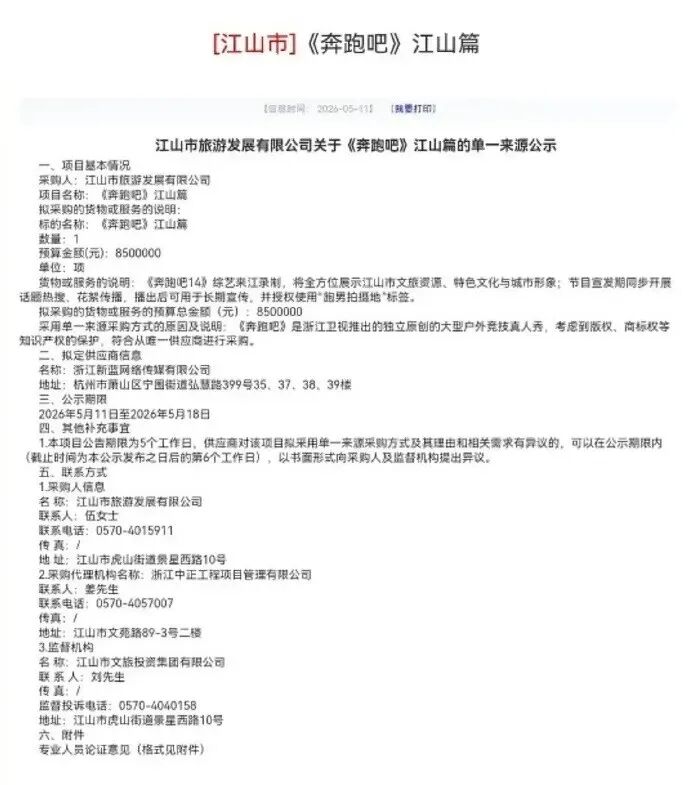
The alleged government procurement notice for the Jiangshan episode
Tracing back through the public information, the public found that this kind of cultural and tourism procurement, like that in Jiangshan, is not an isolated case. In 2023, the transaction amount for the Xinchang episode of "Keep Running! Xinchang" was 9.495 million yuan; the budget for "Keep Running" to record in Chongli District, Zhangjiakou, Hebei, was 8.5 million yuan; and the annual strategic cooperation amount between Jiaojiang District, Taizhou, Zhejiang, and the program for the "Running in the Mountains and Seas" cooperation reached 19.8 million yuan.
As the incident further fermented, the Internet information department in Anyang, Henan, publicly refuted the rumors, stating that no payment was made to the program for the recording of the Anyang station of "Keep Running"; the cultural and tourism department in Quanzhou, Fujian, also responded that the shooting locations such as Xunpu Village and West Street were all free - cooperation projects.
For the same variety show, some cities' cultural and tourism departments invest nearly ten million yuan, while others spend nothing. Why is there such a huge difference? Whether the huge government expenditure on variety show investment is in line with regulations and whether the decision - making needs further discussion have become the core questions of the public.
To solve these puzzles, DomoreDumou interviewed employees of leading variety show production companies and relevant personnel from local cultural and tourism departments, trying to restore the real operation logic of the "variety show + cultural and tourism" business targeting the government.
What exactly does the "8.5 million yuan" buy?
In the eyes of many viewers, "Keep Running" is ultimately an entertainment variety show. Just looking at the program presentation - several celebrities come to a city, experience local cuisine, visit scenic spots, and complete game tasks - it seems that the 8.5 - million - yuan promotion fee is overly expensive.
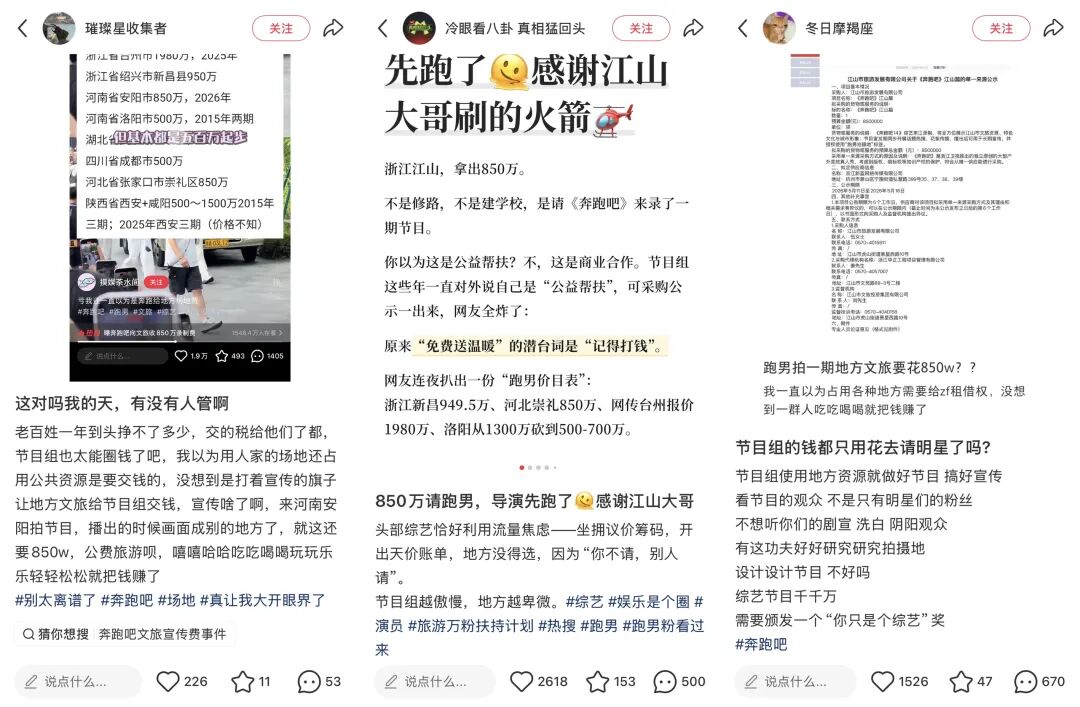
Relevant comments from viewers (Source: Xiaohongshu)
However, in the view of industry insiders in the variety show field, it is not the case. In a nutshell, this sum of money buys far more than just one episode of the program, but a whole set of content marketing services.
According to the public procurement document of Jiangshan, in addition to the program shooting itself, the procurement content also includes the display of urban cultural and tourism resources, the promotion during the program's publicity period, the authorization of bonus content, and the subsequent right to use for promotion.
"Maybe the cultural and tourism entity deviates from the general variety show clients in the public's perception, but in essence, it is still a 'client'. Compared with regular commercial clients, the rights and interests of cultural and tourism clients usually overflow a lot," Luo Hao (a pseudonym), an employee of a leading variety show production company, told DomoreDumou.
Luo Hao gave an example. "When a regular brand makes a deep - seated product placement in a variety show, it only corresponds to a ten - second shot, and even for factory - visiting and origin - tracing segments, it's only 4 - 5 minutes. However, the cooperation with cultural and tourism departments often involves an entire episode or even an entire season of content centered around the city."
According to public information, in the currently relatively mature cooperation model, a cultural and tourism procurement usually includes several core rights and interests: the outdoor shooting resources for the entire episode, the placement of urban culture and scenic spots, the topic - spreading resources during the broadcast period, the authorization of short - video and bonus materials, the authorization of the program shooting location label, and the right to use related to the program IP.
What is most easily overlooked is the subsequent authorization value. Procurement documents from multiple places show that the cooperating cities usually obtain the permanent authorization of the "program shooting location label". That is to say, after the program is broadcast, these labels will continue to appear on scenic - spot guide signs, promotional posters, new - media copywriting, tourism - route packaging, and OTA platform pages.
On social platforms, searching for "traveling with the Running Men" or "checking in at the same places as the Running Men" can yield results including the same shooting locations in Yunnan, Xinjiang, Chongqing, Tibet, Ningbo China Sea Movie Town, Hukou Waterfall, Guangzhou Library, etc., attracting many celebrity fans to check in at these places offline.
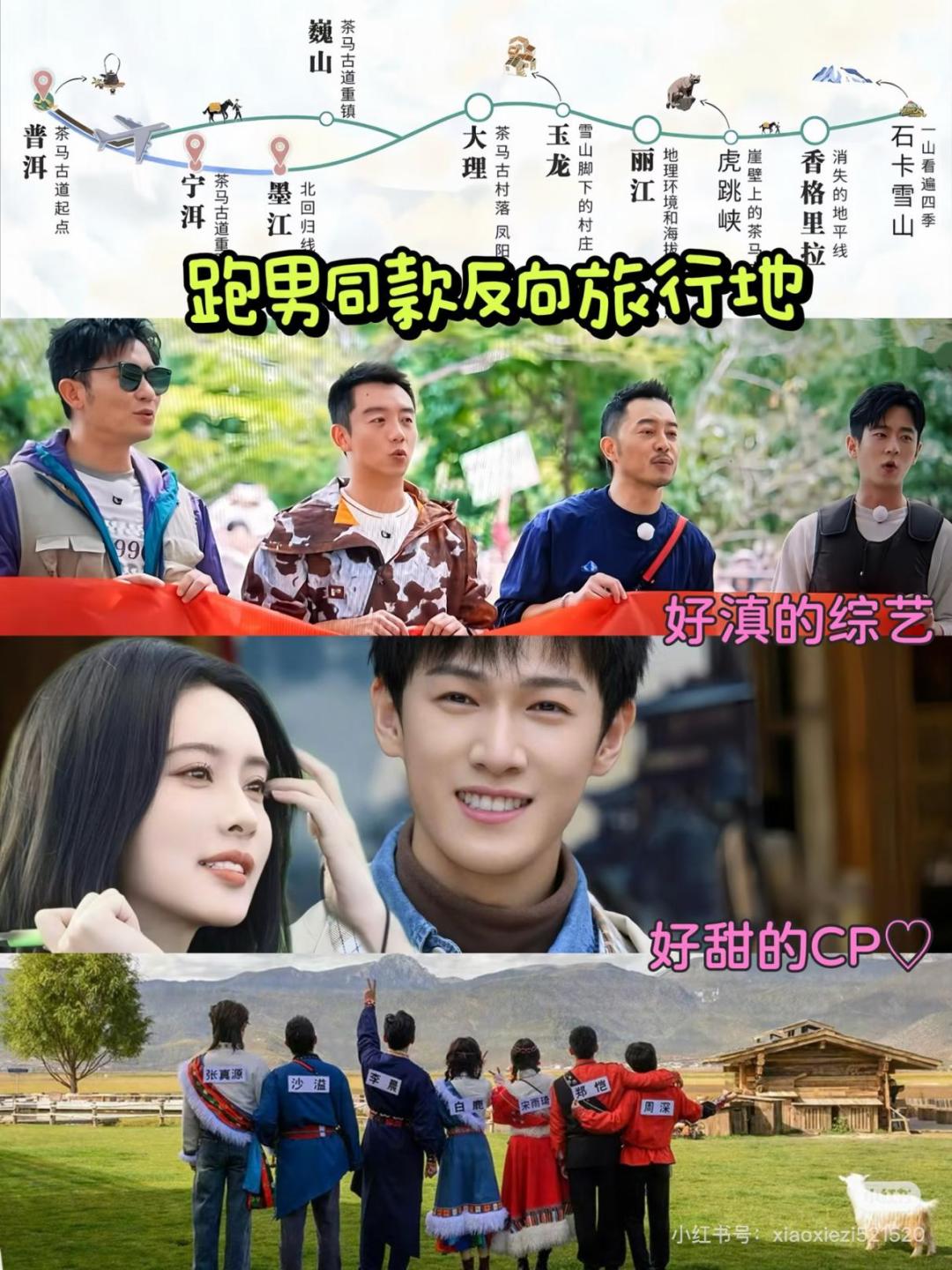
That is to say, the 8.5 million yuan doesn't just buy a one - time "advertising space", but also a set of customized urban marketing and long - term IP assets that can be used sustainably.
As for why the price is high, Luo Hao explained that it is determined by the production logic of variety - show content. The costs of artists, production, promotion, platform broadcast resources, and in - depth co - creation are all not low.
He even gave a direct formula: For a cultural and tourism client's 10 million yuan, for an ordinary commercial client, it would cost at least 20 million yuan, and even 30 or 40 million yuan might not be able to buy the equivalent content rights and interests.
If it is a commercial invitation for recording, "the commercial attribute accounts for 80%, and the support attribute accounts for at most 20%. This is a very reasonable range." In Luo Hao's view, as long as it doesn't use the guise of public welfare for commercial purposes, there is no problem with the price of 8.5 million yuan. "After all, the government's publicity and review are also very strict."
How is an episode of a variety show sold to local cultural and tourism departments?
Breaking down the cooperation process between a variety show and local cultural and tourism departments from the beginning is more valuable than a single number.
First of all, the implementation of an episode of a variety - show project can be roughly divided into two models: invitation and being invited. Li Juan (a pseudonym), a relevant person from local cultural and tourism, told DomoreDumou that because the cultural and tourism city she works in is quite well - known, variety - show projects will actively seek cooperation.
The business team of the program group will screen according to the program's positioning, shooting requirements, and the city's characteristics, and then promote the cooperation plan to local cultural and tourism departments or state - owned cultural and tourism enterprises.
"Well - known projects often have the project parties come to negotiate on their own initiative," she said. After reaching a preliminary intention, the two parties will then enter the formal cooperation process.
The currently common model is "the government provides the stage, enterprises participate, and cultural and tourism provides the impetus". The cultural and tourism department is responsible for overall coordination, resource docking, and public - service guarantee; the program production party is responsible for content production, artist scheduling, and communication and operation; local enterprises participate through sponsorship, co - branding, and scene cooperation. And it is state - owned platforms such as local cultural and tourism groups, tourism investment companies, and urban investment companies that actually sign the contracts and make the payments.
Since leading variety shows like "Keep Running" have exclusive program copyrights and production resources, most of the relevant cooperation adopts the single - source procurement method. According to public procurement documents, local governments usually conduct demonstrations on the grounds of "copyright uniqueness" and "the irreplaceability of program resources" and organize relevant experts to issue opinions.
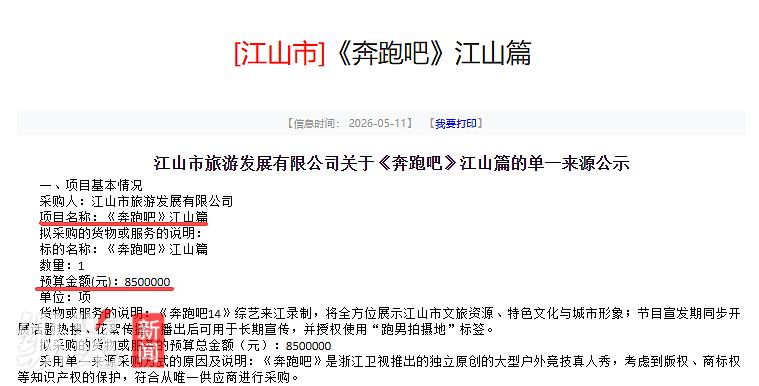
(Source: Quzhou Yangguang Transaction Service Platform)
To the outside world, a procurement notice may seem simple, but within the system, project decision - making is often far more complicated than expected.
Li Juan introduced that for cultural and tourism promotion projects worth millions or tens of millions, the internal budget is very strictly controlled. Besides the high cost, it is mainly related to the city's image, so the approval is extremely strict.
First, the business department writes a project proposal, submits a budget estimate, and designs performance goals. After being signed by three - level leaders, it also needs to go through links such as review by the Party group meeting.
Li Juan said that in the evaluation of promotion projects involving celebrities like "Keep Running", the most important thing is the exposure volume, including the full - network playback volume, hot searches, short - video likes, and the number of media reports. Data is the hard standard for testing the promotion effect. Secondly, it is the guest lineup. Eliminating artists with a bad record, the public reputation and past words and deeds of guests are mainly examined, and compliance is put in the first place. There is also whether the artists can cooperate with local cultural and tourism promotion, such as recording promotional videos and offline promotion.
On the other hand, Luo Hao, a leading variety - show practitioner, said that there are also some business customizations actively invited by local cultural and tourism departments. "The obvious commercial attribute can be seen in the main program by the audience."
When cultural and tourism needs traffic and variety shows need revenue
If we take a broader view, this controversy actually reflects the dilemmas faced by two industries simultaneously.
On one hand, the competition in the cultural and tourism industry is intensifying. In the past few years, from the barbecue in Zibo to the ice and snow tourism in Harbin, from the malatang in Tianshui to the Wansui Mountain in Henan, local cultural and tourism departments have come up with various strategies, and one "explosive city" after another has emerged, increasing the pressure on local cultural and tourism departments.
Meanwhile, cases such as Ding Zhen making Litang popular, "Go Where the Wind Blows" making Dali popular, "The Knockout" making Jiangmen popular, "My Altay" making Altay in Xinjiang popular, and "A Love Letter to Grandma" making Chaoshan popular have also made more and more local cultural and tourism departments realize the driving effect of content products and the star economy on tourism consumption.
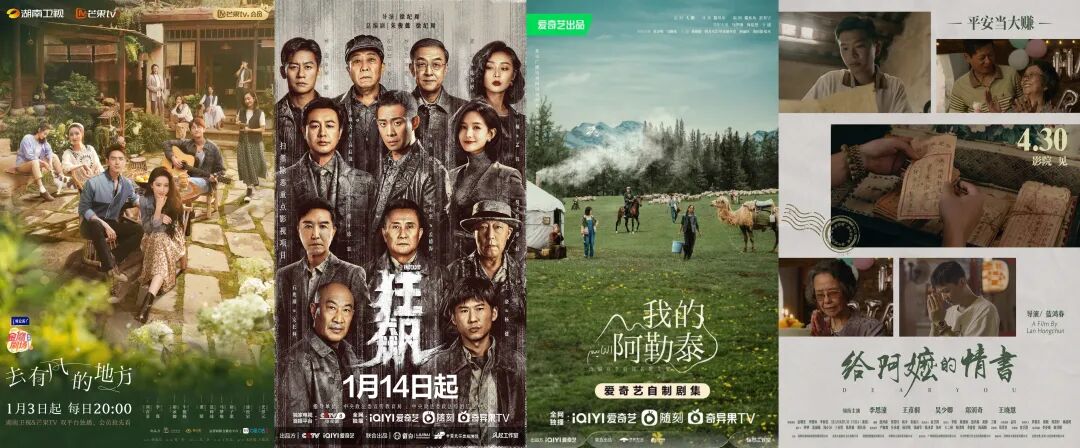
Li Juan, a relevant person from local cultural and tourism, admitted: "Under the intensifying industry involution, the pressure from performance assessment is huge." Against this background, how to attract national attention has become an important issue for small - scale local cultural and tourism departments.
Regions like Jiangshan, Xinchang, and Chongli, which are willing to make heavy investments, are mostly third - and fourth - tier small cities and county - level cities with limited popularity. They lack top - level national cultural and tourism IPs, and their natural tourist flow and online topic popularity have been weak for a long time. In the highly competitive national cultural and tourism environment, it is difficult for them to break through and attract tourist flow through traditional promotion alone. Leading variety shows like "Keep Running" are efficient channels to reach the national audience and create national - wide popularity in a short period. The cultural and tourism departments in these places are the "demanders" in the cooperation and have relatively weak bargaining power. They are willing to spend money actively to gain exposure.
In contrast, the zero - cost cooperation between Anyang, Quanzhou, and "Keep Running" is mainly because these two cities have world - class cultural heritages such as the Yin Ruins and the "World Maritime Commercial Center of the Song and Yuan Dynasties". They are top - level cultural and tourism landmarks with their own traffic. Their cultural and tourism foundation is stable, and they don't rely on variety shows to attract tourists. There is no need for customized exclusive content and a full - set of promotion services, so there is no cost.
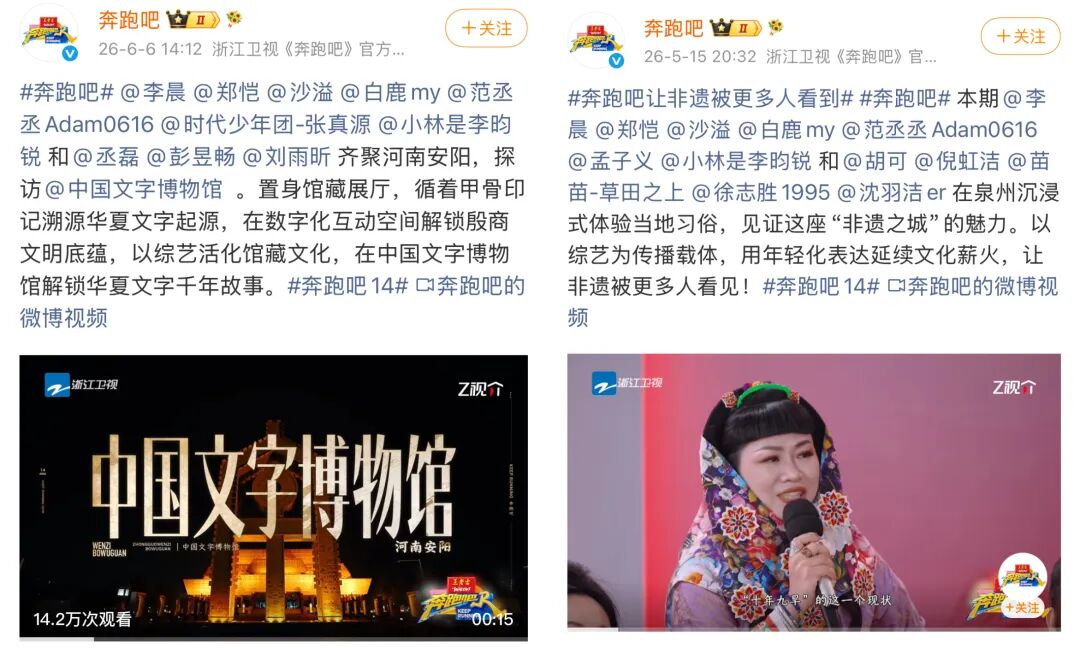
The Anyang and Quanzhou episodes of "Keep Running" (Source: Weibo @Keep Running)
On the other hand, the variety - show industry is facing survival pressure. In the past decade or so, leading variety shows mainly relied on brand sponsorships and product placements to operate. Brand sponsorships worth hundreds of millions of yuan were the norm for leading variety - show recruitment. However, with the downturn in the variety - show industry, recruitment has fallen into a dilemma, platform budgets have shrunk, and variety shows have "become poor".
Luo Hao told DomoreDumou: "In the past when the recruitment situation was good, leading variety shows wouldn't even consider cultural and tourism projects worth a few million yuan."
Now, the recruitment scale has shrunk, but the production cost has not decreased. The costs of artists, equipment, and operation are still increasing. Program groups have to look for new business models, and government - targeted revenue emerged in this context.
Local cultural and tourism departments hope to expand their influence with the help of leading variety - show IPs and the star effect, while variety shows hope to make up for the recruitment gap through government - targeted revenue. One needs traffic, and the other needs cash flow. The "variety show + cultural and tourism" model has heated up rapidly.
From this perspective, the "sky - high promotion fee" of 8.5 million yuan is not an isolated incident but a concentrated manifestation of the changes in the entire industry ecosystem.
However, a question still cannot be avoided - how much revenue can nearly ten million yuan of promotion fees for recording one episode of a variety show bring to local cultural and tourism?
From Luo Hao's perspective, he believes that "an investment of 8.5 million yuan can bring at least 30 million yuan in revenue to the local area."
However, from an external logical analysis, first of all, the natural discussion degree of variety shows is generally much lower than before. For leading variety shows with good data, it is often a conspiracy between traffic stars and their fans. Whether the fan profile is similar to the cultural and tourism customer groups going to different cities is an unclear account. After all, unlike Internet platforms such as short - video platforms, it is impossible to calculate the input - output ratio through targeted interest groups.
For ordinary tourists, even if they are within the scope of variety - show exposure, the core of the variety - show content is still the interaction between celebrities. Does the scenic spot really get