The "Made in America" that Trump is proud of is actually an HTC OEM-produced in Guangdong.
Nearly a year after its release, the golden Trump Phone T1 finally fell into the hands of those who could take it apart.
iFixit, in collaboration with NBC, placed the T1 into a Lumafield industrial CT scanner. Before removing a single screw, the X-ray images had already revealed the answer: its internal structure is almost identical to that of the HTC U24 Pro from 2024.
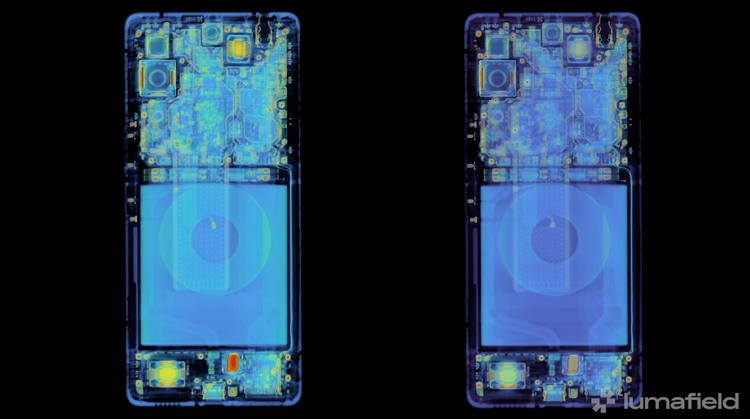
Image source: iFixit
To verify whether this was true, iFixit's disassembly team conducted a more direct experiment: they installed the motherboard of the HTC U24 Pro into the T1's body. This "hybrid phone" powered on smoothly and ran normally.
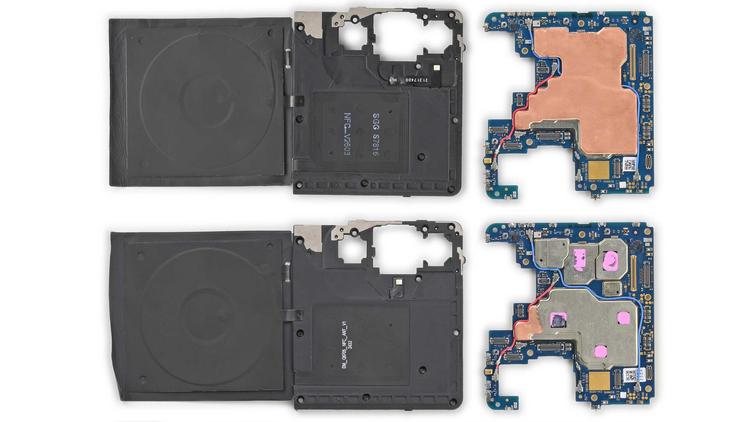
Image source: iFixit
At this point, the conclusion was basically confirmed. This phone, which Trump had initially promoted as "Designed in the USA, Made in the USA", was actually just an HTC with a changed shell; even more laughable is that this HTC wasn't even produced by a factory in Taiwan. According to the records in the NCC certification database, the manufacturer of the U24 Pro is Yuancheng Electronics located in Guangdong.
iFixit disassembly technician Shahram Mokhtari listed all the differences he could find, and there weren't many.
The position of the T1's flashlight was moved a few millimeters. This was achieved by lengthening the cable slightly, while the contacts themselves remained unchanged; the pattern of the speaker openings was adjusted, but the CT scan showed that the speaker itself and its position remained the same, only the hole patterns on the shell were different. Mokhtari speculated that the project party might have originally wanted more obvious appearance differences, but there wasn't enough time left for the manufacturer, so only limited modifications were made to the back cover in the end.
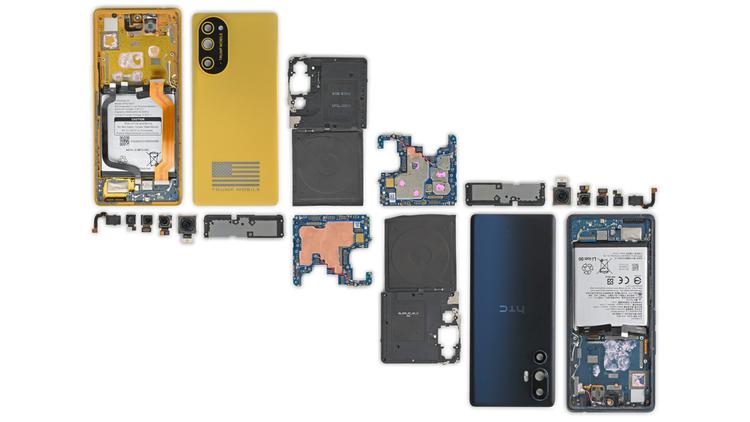
Image source: iFixit
At the chip level, both phones are equipped with the Qualcomm Snapdragon 7 Gen 3. The only difference is that the 12GB + 512GB storage package of the T1 comes from Micron, while the HTC uses SK Hynix. It's a common operation to change the storage supplier in mass - produced phones, so this actually doesn't count as a difference.
The only real substantial difference is the battery: the T1's battery cell has a slightly larger capacity (19.35Wh compared to 17.23Wh), but the charging power has been reduced from 60W to 30W, and the included charging head has also been correspondingly downgraded.
And this battery just reveals the most crucial information about the entire project.
The T1's battery cell is produced in the Philippines, and the manufacturer is Newlix Mfg Inc, which was registered in the Philippines in 2025, almost coinciding with the time when Trump announced that he was going to make a phone.
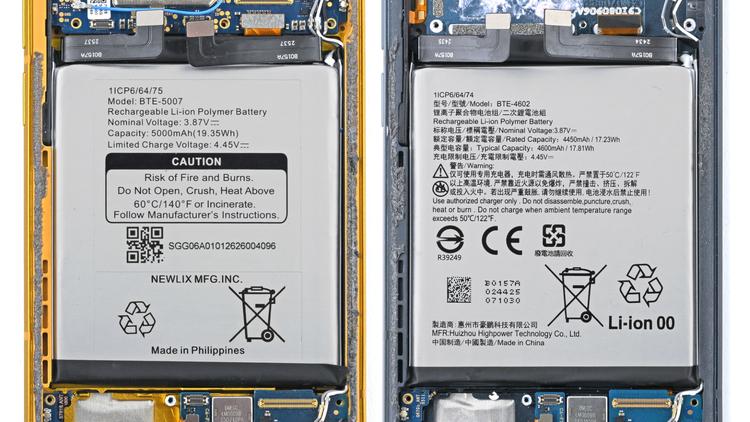
Image source: iFixit
This seems to be a very strange choice. The global consumer electronics battery production capacity is highly concentrated in the Chinese mainland, whether it's in terms of raw materials, scale, or price. Bypassing Chinese suppliers and turning to a new factory in the Philippines, the most reasonable explanation is actually this: the order volume for this phone is too small to enter the production lines of mainstream large manufacturers; that is to say, the orders for the Trump T1 weren't attractive to them...
Public information shows that the combined sales volume of the Trump Mobile phones and packages is about 30,000, while the officially announced pre - order volume was 600,000. In the mobile phone industry where production is often arranged in millions, an order of 30,000 units really can't easily open the door to the mainstream supply chain.
The Three Retreats of "Made in the USA"
Looking back, the promotional language of the T1 has clearly "loosened step by step".
When the project was officially announced in June 2025, Donald Trump Jr. and Eric Trump's slogan for the $499 T1 was "Made in the USA";
A few months later, the wording on the official website quietly downgraded to "American Proud Design";
By the time the actual phones were shipped, there was only "Proudly Assembled in the USA" on the packaging box.
In one year, there were three versions, and the scope of Trump's promise to his "followers" was gradually narrowing.
Regarding the place of origin, Trump Mobile executives said that the phones and components come from "preferred" or "friendly" countries, with the goal of "moving the supply chain out of China as much as possible". Considering that the manufacturer of the prototype is located in Guangdong, this goal obviously hasn't been achieved.
Another interesting detail is that the American flag on the back of the T1 only has 11 visible stripes (the American flag has 13 stripes). Neither Trump Mobile nor the White House has commented on this.
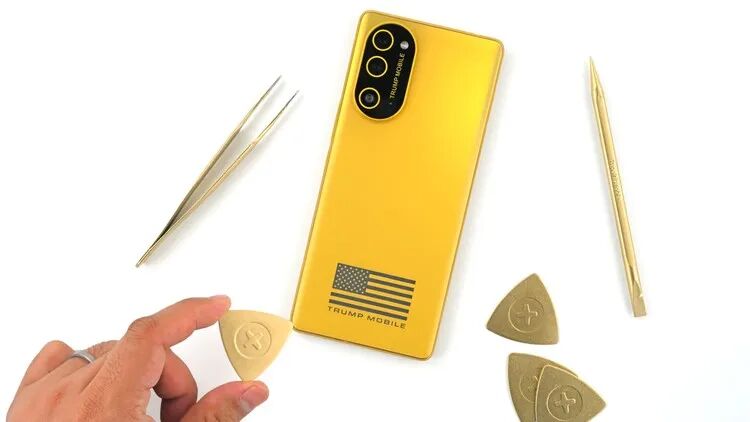
Image source: iFixit
What Role Did HTC Play in This?
In the whole incident, HTC had the most delicate attitude.
In response to an inquiry from The Verge, HTC said that the company "doesn't design or manufacture phones for third - parties", but refused to confirm the actual manufacturer of the U24 Pro.
HTC sold the main part of its smartphone business to Google in 2017. Since then, most of HTC's phones have relied on the ODM model and have long lost their "soul".
So the original design of the U24 Pro most likely belonged to Yuancheng Electronics in Guangdong from the beginning, rather than HTC. If Trump Mobile wanted to make a phone at the same price within a few months, there was only one realistic path: to go to Huaqiangbei to find a "white - label phone" and directly use the factory with the existing molds and production lines behind it.
That is to say, it's very likely that Yuancheng Electronics received two "OEM" orders from HTC and Trump Mobile one after another for the T1 and the U24 Pro, rather than a simple imitation relationship.
The Biggest Problem Is After - Sales Service
At the end of the report, iFixit gave the T1 a somewhat decent evaluation: compared with the HTC U24 Pro's 512GB version (the price through the import channel is about $490 - $525), the T1's price of $499 isn't a premium, because all you lose is 60W fast charging and two stripes on the flag.
The real problem is that, as a typical ODM white - label model, this phone doesn't have a publicly available repair manual. Trump Mobile also doesn't have an official spare parts channel, and the maintenance period for software updates and security patches is generally short.
iFixit gave both the T1 and the U24 Pro a repairability score of 3/10: Once the hardware fails, it probably won't have a chance to be repaired. Users who pay for the sentiment ultimately get a de facto "disposable device".
As for a truly "Made in the USA" phone, currently there is only Purism's Liberty Phone: it costs as much as $2000 and only claims that "part of the electronic components" are made in the USA. Judging from the current situation, it's not impossible for smartphone manufacturing to return to the USA, but it requires long - term investment in manufacturing, talent, and skills, rather than just a trade war and a slogan.
This ambitious golden phone ultimately proves exactly the fact that the USA can't manufacture phones on its own.
This article is from the WeChat official account "Unobjective Laboratory", author: Lu. Republished by 36Kr with authorization.