The Capital Landscape Behind Xie Na's Concert
A host announced that in order to fulfill her dream of becoming a singer, she would hold two concerts in Chengdu. Her fans and celebrity friends strongly supported her. However, when she announced the upgrade to a personal national tour, hundreds of netizens spontaneously organized real - name reports, which alerted the local cultural and tourism bureau to respond urgently, and the event completely evolved into a public opinion incident.
On June 6th, during the elimination round of the fourth public live broadcast of "Sisters Who Make Waves 2026", when everyone was nervously waiting for the results, Xie Na suddenly interrupted and announced that she would hold a national tour. The first stop would be in Beijing, and the ticket prices would range from 380 to 1,180 yuan.
Even though the ticket price range was on par with that of first - tier professional singers, 7,800 tickets were sold out on Damai.com within one minute of the ticket opening. This national tour was only one month apart from the Chengdu stop, which Xie Na described as "the only one in thirty years since her debut".
Some people think it's "an attempt to make money by crossing the border without sufficient ability", while others believe it's "turning a dream - fulfilling event into a money - grabbing one, with an ugly way of doing it". However, industry insiders are quite puzzled. Many celebrities have achieved both fame and fortune by holding cross - border concerts before. Why are the public particularly averse to Xie Na?
The split in public opinion exactly exposes a more worthy question to be explored: Who is paying for Xie Na's "singer dream"?
01
A 'Three - person Company' Handles Tens of Millions in Box Office
At first glance, the commercial chain of Xie Na's concert gives a rough feeling.
According to Qichacha data, the organizer of Xie Na's national tour, Shenzhen Saiheng Culture Media Co., Ltd., was established in October 2024 with a registered capital of only 500,000 yuan. It is wholly - owned by Ordos Xile Culture Media Co., Ltd., and the number of employees participating in social insurance in 2024 for this company was only 3.
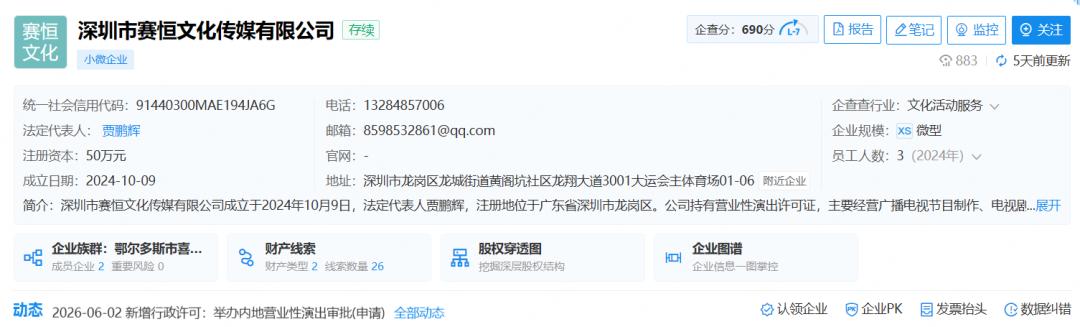
In other words, behind a tour that attracts tens of thousands of people, the legal organizer is a "micro - company" that has been established for less than two years and has only 3 insured employees.
In response to the doubts about "an amateur team handling tens of millions in box office", Saiheng Culture showed the performance approval document and stated that all processes were reasonable and compliant. The key lies in Ordos Xile Culture Media Co., Ltd., which has served as the organizer of Zhang Jie's "Un·LIVE" national tour multiple times and can be seen in many stops such as Hefei and Guangzhou.
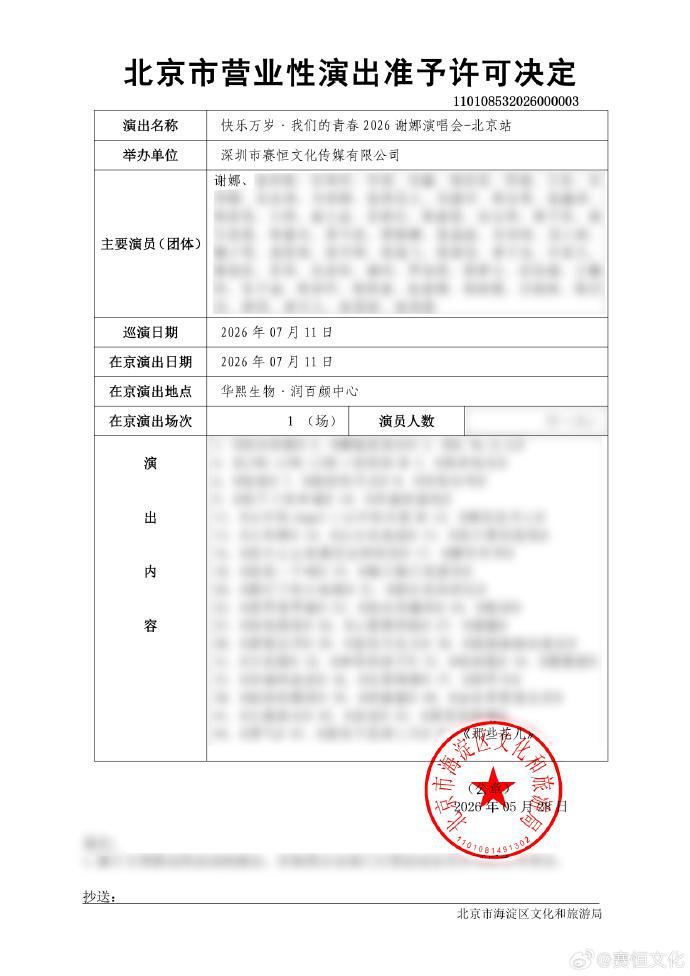
This shows that behind Xie Na's concert, which seemingly appears as a "personal act", there is a systematic "family - operated" framework.
Public information shows that Zhang Jie's single - venue concert at the Bird's Nest drove urban consumption of over 200 million yuan. 350,000 tickets for the Chengdu stop were sold out in one minute, making him the first Chinese mainland singer to exceed 200 concerts. In contrast, Xie Na's average box office per concert is about 10 million yuan, less than one - twentieth of Zhang Jie's Bird's Nest concert.
The huge gap in the input - output ratio between the two "concerts" implies a more interesting capital logic: Xie Na's tour may never have been a simple "singing act", but a delicately designed IP monetization project with low input and high leverage.
According to Tianyancha data, Xie Na is associated with 13 companies, and currently only 5 are in normal operation, including Shanghai Xicongtianjiang Culture Media and Chongqing Meikaiyanxiao Culture Media. Zhang Jie is associated with 12 enterprises, and 6 are still in existence. The two hold shares in nearly 20 enterprises in total. The only jointly - associated Beijing Xingyun'er Culture Communication Co., Ltd. has been cancelled.
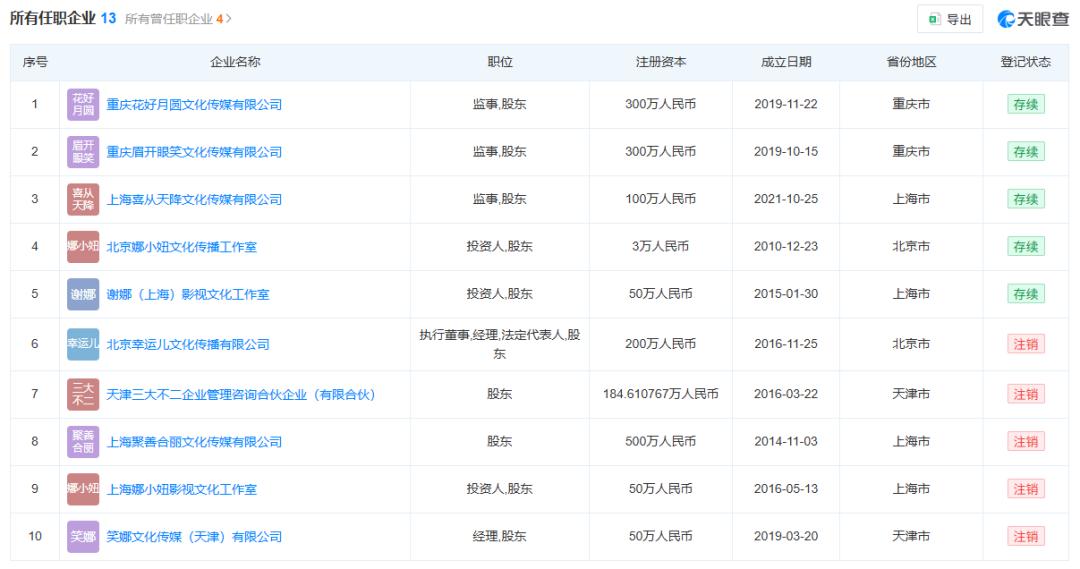
The high degree of commercial independence makes the arrangement of the organizers of this "husband - wife cooperation" particularly thought - provoking.
An event execution company in Chengdu told Chaojujiao that the production cost of a concert includes customized stages, venue rental, lighting, sound, execution, security, travel, publicity, ticket commissions, etc. It is normal for the total cost to exceed 10 million yuan. With a venue capacity of 20,000 seats and an average ticket price of 1,000 yuan, even if we don't consider the complimentary tickets, the maximum box office would be 15 million yuan.
Based on Xie Na's social recognition and commercial quotation, her commercial performance fee is about 2 million yuan per concert, and her advertising endorsement fee is about 10 million yuan for two years. It is indeed difficult to cover the costs.
However, if Zhang Jie's mature tour supply chain is specifically reused for Xie Na's project, the marginal cost can be significantly reduced. Saiheng Culture does not play the role of a conventional organizer but a legally compliant shell.
The artist of a concert for tens of thousands of people can get about 10 to 20 million yuan. The net profit from ten tours is close to "half of a small goal", not to mention the diversified revenues such as brand sponsorship, urban cultural and tourism subsidies, and official peripherals. From a capital perspective, this may not be a losing deal.
02
The Valuation Anxiety of the 'Mango Group'
What really makes Xie Na's tour an "annual phenomenon event" is not only the box office itself but also the valuation anxiety of the media group behind it.
Mango TV, a listed company under Hunan Radio and Television Group, is facing the most severe performance test in the past eight years.
According to the 2025 annual report, Mango TV's annual operating revenue was 13.813 billion yuan, a year - on - year decrease of 1.89%; the net profit attributable to shareholders was 1.227 billion yuan, a year - on - year decrease of 10.06%; and the non - recurring profit after deduction was 1.152 billion yuan, a year - on - year plunge of 29.93%.
In addition to the pressure on the profit side, what worries the capital market more is the trend of the advertising business: In the first half of 2025, the advertising revenue was about 1.6 billion yuan, a year - on - year decline of 8%. Mango TV, which has long been regarded as "the most profitable long - video platform", is experiencing a marginal decline in traffic monetization.
Just at this time, Xie Na appeared.
As one of the most core artist IPs of the Mango Group, Xie Na is almost fully bound to Mango TV. In 2026, Xie Na participated in the live recording of "Sisters Who Make Waves 2026" as a host.
At the live - broadcast site of this program, she suddenly announced her tour in a way that "interrupted the rhythm". This "live - streaming sales" strategy quickly pushed the topic onto the hot search and brought huge free exposure to "Sisters Who Make Waves 2026".
There is also a key background. According to the data of the cooperative brands of "Sisters Who Make Waves 7", there were only 5 cooperative brands in this season, the lowest in the "Sisters Who Make Waves" series. Mengniu Dairy, which had been the exclusive sponsor for five consecutive years, has also withdrawn.
That is to say, Xie Na's concert announcement happened to fill the embarrassing situation of the lack of popularity of "Sisters Who Make Waves 2026" at the right time, helping Mango TV's top - tier variety show to fill the topic gap.
It's hard to say that there is no acquiescence or even cooperation from the platform when a core artist of the Mango Group suddenly announces a personal commercial performance plan during a live broadcast. This "blurred line between public and private" announcement mode is quite thought - provoking.
The name of Xie Na's tour is "Long Live Happiness · Our Youth", and the first stop is in [location]. It targets the "post - 80s" and "post - 90s" groups who miss long - video variety shows in the short - video era.
Data shows that within one day after Xie Na's announcement, Zhang Jie lost about 65,000 followers on his social media accounts, and Xie Na lost about 10,000 followers. The large - scale loss of fans and the rapid sell - out of tickets happened simultaneously. This abnormal phenomenon precisely shows that the people paying for the tickets may no longer be the core "fan circle" fans but a broader group with a sense of nostalgia.
On a summer night in Sanlitun, Beijing, a 380 - yuan ticket not only buys the auditory experience of the concert but also a whole night of emotional fermentation of consuming "Happy Camp memories" on social media. The difference between the economic value of the ticket and the IP re - evaluation it brings to Mango TV may be the logical starting point for Mango TV to "acquiesce" in Xie Na's tour.
Mango TV's annual report clearly states that its artist management business "builds a commercial closed - loop through participation in film, television, and variety shows, commercial performances, and brand concerts". Xie Na's tour path is highly consistent with this: variety show drainage → personal IP monetization → topic feedback to the platform → artist management closed - loop.
In this seemingly personal event, there is a subtle co - conspiracy relationship between the platform's valuation pressure and the personal IP's commercial value.
03
The Time Mismatch of Xie Na's Tour
If we have explored the micro - capital operations and the macro - projection of platform pressure behind the event before, when we put Xie Na's tour into the entire industrial map of the current performance market, we can see a more disturbing industry truth.
In 2025, the scale of the national performance market reached 96.91 billion yuan, and the box office of large - scale concerts reached 29.558 billion yuan, a year - on - year increase of 13.7%. The number of audience reached nearly 38 million, a year - on - year increase of 30.8%. According to iiMedia Research, the scale of the Chinese performance market is expected to exceed 100 billion yuan in 2026, reaching 101.7 billion yuan.
The one - trillion - yuan market means incremental space and valuation imagination in the eyes of capital. But the problem lies here: When nearly 2,300 large - scale concerts flood in and the growth rate of the number of audience far exceeds the growth rate of the box office, the "supply - demand mismatch" in the performance market is emerging.
Xie Na appears precisely at this delicate node of "excess supply and mismatched demand". When the market's increment comes more from "non - professional singers" rather than professional musicians, it means that the "content - oriented" approach is being replaced by the "traffic - oriented" one.
Yue Yunpeng's "Must Sing" tour is a very typical example.
The tickets for the Beijing stop were sold out in 20 seconds and made it onto the hot search. However, it was soon revealed that only more than 4,000 tickets were released in the first round, while the actual capacity of the venue was nearly 17,000. The public opinion thought it was "exploiting consumers".
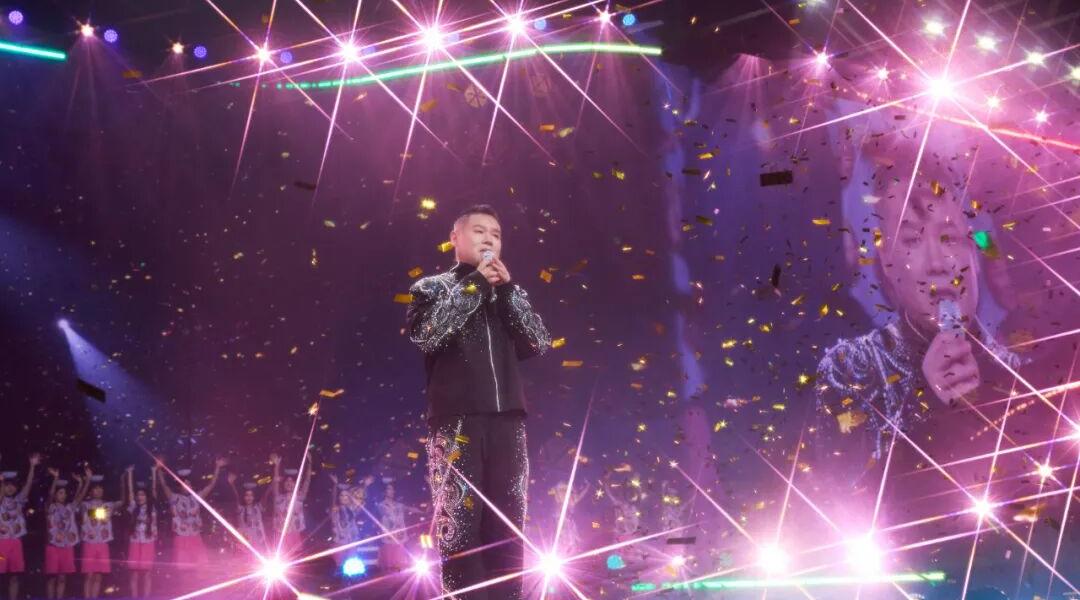
What's more embarrassing is that before the start of the Xiamen stop, the price of the inner - field tickets, originally priced at 1,280 yuan, dropped to more than 300 yuan. Some people who bought tickets at a high price found that it was better to buy them directly later. The frequent microphone - passing interactions, a large number of cover songs, and the cross - talk segments during the intermission in the performance content all raised questions.
In contrast, some professional singers are facing difficulties. Zeng Yike cancelled the Suzhou stop of her 2025 tour due to poor ticket sales. One month later, the Tianjin stop was also cancelled because "the box office could not cover the performance cost", and only 38 tickets were sold for the 1,680 - yuan ticket tier.
Dai Peini tearfully announced the cancellation of the Beijing and Guangzhou stops at her Chengdu concert. Zhou Yunpeng wrote in the announcement, "Admit defeat when it's time to". Thirteen stops were originally planned for the tour, but 5 stops were forced to be cancelled.
The focus of the controversy over Xie Na's concert exactly confirms the collective anxiety in this industry.
The netizens' doubts mainly focus on two aspects: First, the ticket prices ranging from 380 to 1,180 yuan contrast sharply with Xie Na's identity as a host - turned - singer. Second, some fans posted videos of the Chengdu concert, pointing out obvious signs of background music. For a large - scale performance named "concert", it undoubtedly fails to meet the consumers' needs.
Meanwhile, more radical changes are taking place in the industry. In 2025, the market scale of virtual idol and AI digital human concerts increased exponentially. Luo Tianyi's holographic tour in Guangzhou was a huge success, and the global virtual idol market reached 12 billion US dollars, with an annual compound growth rate of over 35%.
A virtual idol that can be technologically replicated, with controllable costs and no risk of reputation damage, and a real - life cross - border singer with thirty years of public memory, experiencing fluctuations in reputation, and a performance production cost of about 10 million yuan per concert will reshape the supply logic of the performance market in the next 3 - 5 years.
The fans have relived the past over the past thirty years, Mango TV has got an opportunity for IP re - evaluation, and Saiheng Culture and Zhang Jie's team have skillfully completed the technical execution.
And Xie Na herself, behind 13 associated companies, a luxury mansion worth over 100 million yuan, and a family asset of over 1 billion yuan, is still singing "Bo Luo Bo Luo Mi" on the stage in 2026.
This article is from the WeChat official account "Chaojujiao foci", author: Fang Wensan. Republished by 36Kr with permission.