Subsidies → Token-based billing → Price cuts, OpenAI launches a price war, is the inflection point of Token economics approaching?
When the Token price war truly begins, how can the AI industry make money? The entire valuation logic of AI commercialization has reached a moment when it needs to be rewritten. The era of competing on "cost - effectiveness" and "scarcity" may have arrived. For OpenAI, "the situation is further deteriorating." Analysts point out that "once OpenAI goes downhill, it is likely to bring down NVIDIA, Oracle, Coreweave, etc."
The commercialization narrative of generative AI is facing the most profound self - examination in three years. From using subsidies to acquire users and hiding costs in monthly subscriptions to triggering a corporate bill crisis by charging per Token, the AI industry has completed a three - stage leap in commercialization in three years. And a potential price war may reset the entire monetization logic.
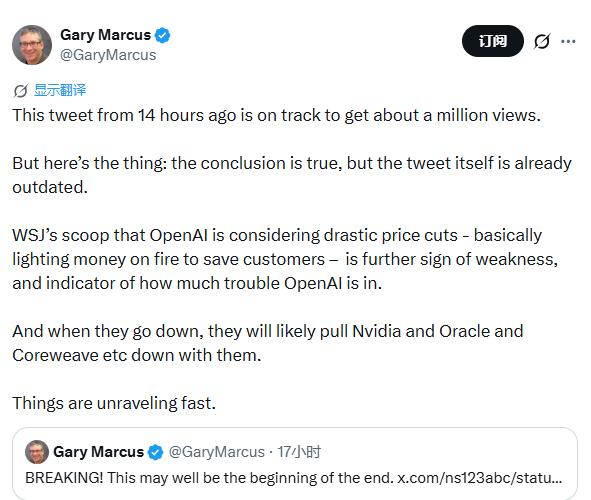
According to The Wall Street Journal, OpenAI is considering significantly reducing the Token fees charged to users to compete for corporate customers from its competitor Anthropic. According to people familiar with the matter, this move is partly to "seize the initiative." OpenAI expects Anthropic to take similar price - cutting actions. OpenAI CEO Sam Altman recently admitted at an event that the cost of using AI has become "a huge problem" and said that he will "help people get more value with less spending."
The timing of this news is particularly sensitive. OpenAI has secretly submitted an IPO application this week, and Anthropic is also in the countdown to going public. Meanwhile, the Bloomberg Silicon Data LLM Token Spending Index has fallen for seven consecutive trading days, setting the longest consecutive decline record since January this year, reflecting the market's deep - seated anxiety about the sustainability of AI bills. The report directly states that the price war will directly erode the profit margins of the two companies - and both companies have already lost billions of dollars due to the huge computing power required by AI systems.
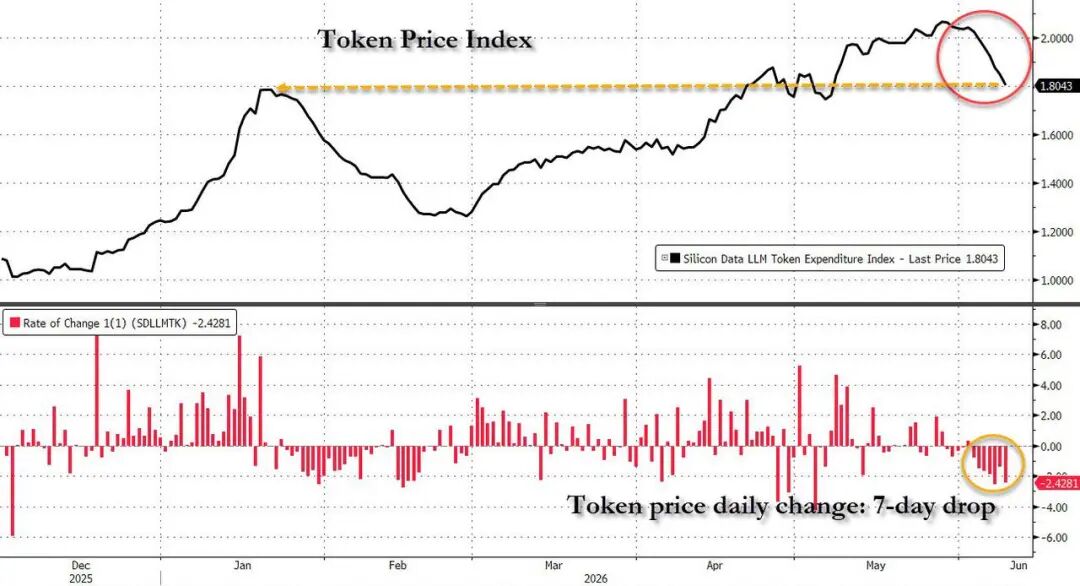
The core of this discussion is no longer just a price - cutting decision, but a more fundamental question: When the narrative of "the more Token consumption, the better" comes to an end, who will tell the next commercialization story of the AI industry and how?
01
Initial Three Stages: From Monthly Package Subsidies to Token Bills
The commercialization of generative AI has undergone three distinct stages of evolution in just three years.
In the first stage, monthly and annual subscriptions set the tone for the industry. In February 2023, OpenAI launched ChatGPT Plus with a monthly fee of $19.99, creating a precedent for C - end payment for large models. Baidu, Alibaba, and Tencent followed suit. Fixed - monthly - fee subscriptions became the standard for the primary business model.
In the second stage, a full - scale subsidy war broke out. To boost ARR (Annual Recurring Revenue), the core anchor for financing valuation, various manufacturers turned to large - scale subsidies: Google provided Gemini Advanced to students for free for 15 months, OpenAI launched a Team - edition membership with a $1 first - month fee, ByteDance's Doubao entered the market with a price "99.3% lower than the industry average," and Baidu announced that its core model would be free. The essence of subsidies is to exchange losses for growth. According to reports, Microsoft loses more than $20 per user per month on average under the GitHub Copilot subscription model, and some heavy users cause monthly losses of up to $80.
The third stage is the mandatory switch to pay - per - use. On June 1, 2026, Microsoft announced that all GitHub Copilot plans would officially switch to charging based on Token usage, and the monthly fee of $19 was directly converted into an equivalent Token quota. This change brought the real costs long hidden by the subscription system to the surface. According to Reddit community users' calculations, a single intelligent agent programming session can consume $30 to $40, and a monthly package is exhausted in a single use.
02
Out - of - Control Bills: When Tokens Are More Expensive Than People
The implementation of pay - per - use Token charging fully reveals the true nature of corporate AI spending.
The corporate bill figures are shocking. Uber Chief Operating Officer Andrew Macdonald publicly stated in May 2026 that "there is no connection" between the growth of Token consumption and the actual improvement of products, and he even coined a term: "tokenmaxxing" to describe employees performing valueless tasks to boost usage.
More direct data shows that Uber exhausted its annual Token budget in just the first four months of 2026, and Salesforce expects to pay about $300 million to Anthropic this year.
Anthropic's own developer documentation shows that the average cost for developers using Claude Code is about $13 per weekday, and 90% of users' daily costs are less than $30. Converted, the annual Token fees for a 10 - person development team could exceed $75,600.
The input - output ratio is also alarming. After aggregating data from 2,444 enterprises, the enterprise data platform Entelligence.AI found that for every $1 invested in AI Token fees, only 18 cents generate actual value that reaches users; 44 cents are used to fix bugs introduced by AI itself, 27 cents go to rework, and 11 cents are consumed in review frictions.
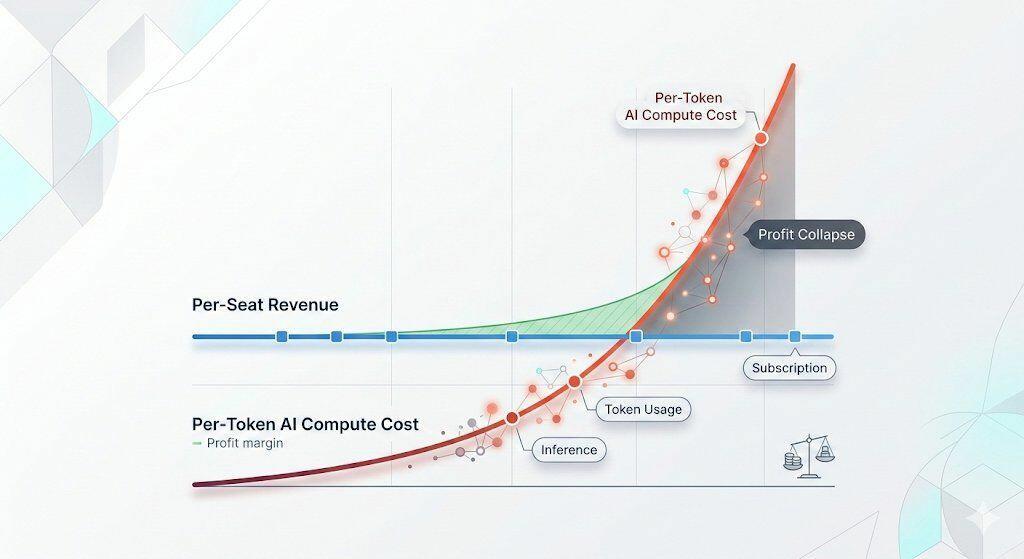
Facing the out - of - control bills, enterprises have begun to take the initiative to control. Amazon stopped its internal AI usage leaderboard and asked employees to "not use AI just for the sake of using it." Microsoft plans to gradually discontinue the Claude Code subscriptions of employees in some key product departments. Goldman Sachs pointed out that the AI Token spending of some enterprises has accounted for 10% of their total employee labor costs, and this proportion may further increase in the next few quarters. This is not the disappearance of demand, but the end of the era of extensive AI spending.
03
The Fourth Act: The Price War Begins, and OpenAI Considers a Significant Price Cut
It is against this background that the fuse of the price war was lit.
According to The Wall Street Journal, Altman's consideration of price cuts was directly triggered by the pressure to catch up with Anthropic. Anthropic's revenue has increased significantly recently, and its programming tool Claude Code has become popular among software engineers. The valuation of this five - year - old startup has even exceeded that of OpenAI for the first time.
However, the cost of this price war will be extremely high. A significant price cut will further compress the already negative profit margins of the two companies, and the room provided by the competitive landscape is extremely limited.
And the underlying risk identified by investors for a long time is that the products of OpenAI and Anthropic are highly substitutable, and customers can easily switch from one to the other. This means that even if price cuts retain customers in the short term, they cannot truly build a moat, but only delay the loss of market share.
This dilemma is also transmitted outward through the financial cycle between cloud - computing giants and AI labs.
According to corporate disclosure documents compiled by The Information, OpenAI and Anthropic together account for more than half of the approximately $2 trillion in future cloud - service commitments from Microsoft, Oracle, Google, and Amazon. If price cuts lead to a downward revision of revenue expectations, this transmission chain will be under pressure in both directions.
American neuroscience and AI expert Gary Marcus said: "This further exposes OpenAI's vulnerability and shows how serious the dilemma it faces is. Once OpenAI goes downhill, it is likely to bring down companies like NVIDIA, Oracle, and Coreweave. The situation is deteriorating rapidly."
There is an open confrontation between bulls and bears on Wall Street. Mark Schilsky, a TMT analyst at JPMorgan Chase, believes that the current bill anxiety is just "the smallest speed bump on the way to higher spending." If the average price per million Tokens decreases, but the AI payment penetration rate of American companies continues to rise, the overall Token usage will inevitably increase significantly mathematically. In addition, agentic AI will push the Token consumption of a single task to several times that of the traditional Q&A mode, and the long - term total spending is expected to be significantly higher than the current level.
Jim Covello, a semiconductor analyst at Goldman Sachs, holds a more pessimistic view. He believes that the current prosperity of the industrial chain has directed almost all value to semiconductor companies, and this phenomenon is "unprecedented and unsustainable in history." Once enterprises face the real price of pay - per - use, the capital flow supporting GPU procurement and model training will face a reversal.
04
The Fifth Act: What's the Next Story of Token Economics?
After the price war, the next chapter of AI industry commercialization has not been written yet, but its outline is emerging.
A report from Citadel Securities provides a directional framework: Hierarchical charging and pricing based on scarcity. The core logic is that inference - intensive cutting - edge AI will not disappear, but will become more and more concentrated in the hands of a few large enterprises capable of bearing the computing - power costs. For a wider range of enterprises, before the physical constraints are alleviated, simpler models may be a more productive path. This means that AI usage will become hierarchical - high - value, complex tasks will continue to use cutting - edge models, while daily and batch tasks will shift to cheap or local models.
JPMorgan Chase holds a relatively optimistic view. Even if the unit Token price decreases, the popularization of agentic AI will double the Token consumption of each task. Existing data shows that after business agentization, the Token consumption of each task can become 3.5 times the original. The overall spending scale is still expected to continue to expand, and the current bill anxiety may just be "the smallest speed bump on the way to higher spending."
Marc Boroditsky, the Chief Revenue Officer of Nebius, proposed the concept of "valuemaxxing," advocating that the industry shift from pursuing maximum Token consumption to making each Token truly generate value. This direction is gradually becoming an industry consensus. However, for real - world business implementation, AI labs still need to find a pricing system that can reflect real costs and be accepted by corporate customers, which is the core proposition that has not been resolved in all current debates.
However, the most overlooked variable in this price war may be Chinese models.
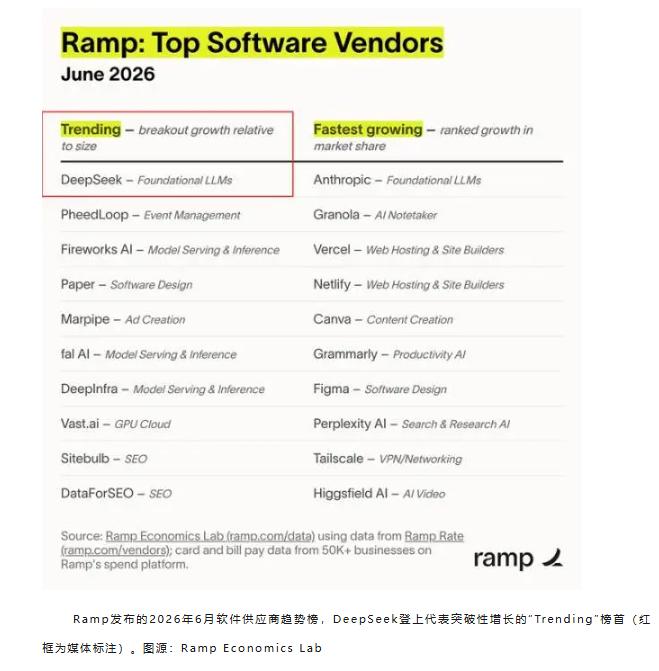
According to data from the American corporate spending management platform Ramp in June, DeepSeek has topped the list of the growth rate of software subscriptions for American enterprises. Ara Kharazian, the Chief Economist of Ramp, specifically emphasized that this is not the local deployment of open - source models. "Enterprises are directly sending and receiving data through DeepSeek," which is a real - paid direct - connection usage. He admitted that "he didn't expect American companies to use DeepSeek." According to third - party calculations, the average API price of DeepSeek V4 - Pro is about one - tenth of that of GPT - 5.5 and about one - eleventh of that of Claude Opus 4.7.
In the battle between OpenAI and Anthropic, the ultimate beneficiary may be the player that has "inclusive pricing" in its genes and does not need to explain its profit margins to IPO investors. This may not be the most popular outcome of this price war, but it is becoming an increasingly hard - to - ignore reality.
This article is from the WeChat official account "Hard AI", author: Xu Chao, published by 36Kr with authorization.