Tencent AI's secret "boat swap": Yuanbao falls out of favor, WorkBuddy takes over
Tencent has finally sent a competitive player in the large model race.
At the beginning of this year, with the popularity of OpenClaw, Tencent launched a series of lobster-like products. Among them, the most popular one is the AI AgentWorkBuddy, which is mainly designed for office scenarios.
If large models like Claude Code for code generation are more targeted at niche geeks with a certain programming background, then WorkBuddy is obviously more technology-friendly to a wider range of office workers. WorkBuddy incorporates the product function requirements of general office work in its product design, cuts out the complex code configuration steps, and supports single-sentence instructions to initiate tasks. The model automatically disassembles and plans and directly outputs complete and usable results, which are exactly what non-technical personnel need.
The lower usage threshold is also one of the reasons why WorkBuddy can quickly gain popularity.
According to the "China Office Intelligent Agent Platform Market R & D Report 2026", in March this year, the monthly visits of WorkBuddy reached 8.85 million, more than twice that of the second place, and the month-on-month growth rate reached 831%. In terms of the number of daily active users, it has become one of the most popular efficiency intelligent agent tools in China. In contrast, Codex, a desktop office intelligent agent launched by OpenAI for developers, has exceeded 5 million monthly active users since its launch in February 2026.
The ranking of WorkBuddy is also rising rapidly. Qimai data shows that since the launch of the WorkBuddy App on May 23, it has soared from outside the top 300 of the free tool app list to within the top 100 in just three days and is currently stable at around the 60th place. However, on the overall iOS list, WorkBuddy hovers around the 400th place.
For a long time, Tencent has always adhered to the strategy of striking only after the opponent has shown their hand. The battles from mobile payment to short videos have all proved the correctness of seizing territory with a huge social network when the technology is relatively mature. However, embarrassingly, in the fast-iterating general artificial intelligence (AGI) battlefield, Tencent's "half-step slow" in the basic model has made it an onlooker on the periphery of the AI arms race.
The popularity of WorkBuddy is Tencent's way of proving its combat effectiveness in the large model race to the outside world, and it also proves its strong product genes again. However, it is not a first-tier entry ticket - in a complex game ultimately composed of self-developed chips, underlying algorithms, and trillions of parameters, Tencent still has many shortcomings to make up.
01
The team has urgently expanded from 10 to more than 100 people, and its importance exceeds that of Yuanbao
WorkBuddy originally came from an AI code assistant team of about 10 people. Its product prototype was developed by Wang Shengjie, the person in charge of Tencent Cloud's developer AI products and the chief product manager of CodeBuddy, and an operator in two all-nighters on a weekend in January 2026.
At that time, there were already many AI coding tools for technical positions, but employees in non-technical positions also had a strong demand for AI to improve efficiency, but they suffered from the lack of suitable tools. WorkBuddy was born in such a background and was officially launched on March 9 this year. The number of user visits far exceeded expectations, resulting in excessive instantaneous pressure on the core service. The team urgently expanded tenfold.
After testing, a workplace person told Tech Planet that WorkBuddy doesn't require users to study functions or write instruction templates. Users can get a complete finished product by simply describing their needs in a colloquial and straightforward way. For example, when organizing scattered cross-department chat records, it can automatically split meeting resolutions, responsible persons, and deadlines. When planning an event plan, by providing two key information, the budget and the target audience, it can directly produce two sets of complete and modifiable execution plans, saving a lot of repetitive manual labor. Even a novice with zero foundation can master the full set of daily office usage methods after groping for a dozen minutes.
Graphic creators have also given feedback. For example, by pasting scattered topic ideas and a few draft materials into WorkBuddy and giving a simple instruction, it can sort out a complete outline for a tweet, automatically split the title, lead, and paragraph structure of the main text, and also generate matching typesetting copy for WeChat official accounts and Xiaohongshu platforms. It can also organize the picture captions and topic tags properly, eliminating the need for repeated splitting and modification and greatly reducing the time for creating the first draft of the content.
To meet the needs of more users, Tech Planet learned that WorkBuddy has expanded from the initial scale of more than 10 people to more than 100 people. An employee of WorkBuddy said that many people have been recruited internally recently.
The update rhythm of WorkBuddy was very frequent at the beginning. There were many places in the product that needed to be fixed. It was normal to update once a day, and sometimes even three or four times a day. It was still being updated during the "May Day" holiday. "During that time, we might not be able to get off work until 11 o'clock." At the Tencent Cloud AI Industry Application Conference on June 5, the official said that since the release of the personal version of the AI intelligent agent desktop workbench WorkBuddy three months ago, it has iterated 43 versions in total.
But now the rhythm is gradually returning to normal. An employee on the product side of WorkBuddy told Tech Planet that now they can basically get off work at 9 p.m.
Tencent is advertising WorkBuddy everywhere. It has even set up a check-in point at Chegongmiao Subway Station in Futian District, Shenzhen, which is the top four-line transfer comprehensive hub of the Shenzhen subway. Judging from the advertising intensity, another AI product of Tencent, Yuanbao, has not had such an offline advertising intensity as WorkBuddy except for giving out a lot of red envelopes during the Spring Festival this year. An employee of WorkBuddy described the current situation as "spending a lot of money on publicity".
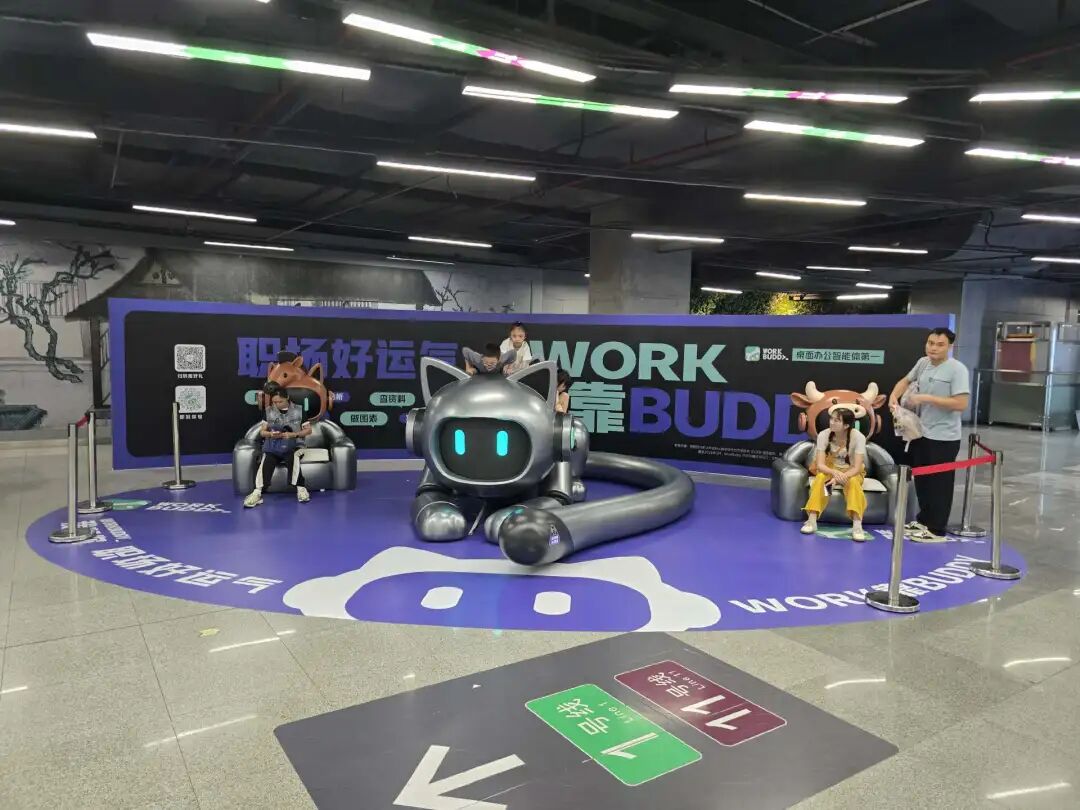
Caption: The check-in point of WorkBuddy at Chegongmiao Subway Station in Shenzhen. (Photographed by Tech Planet)
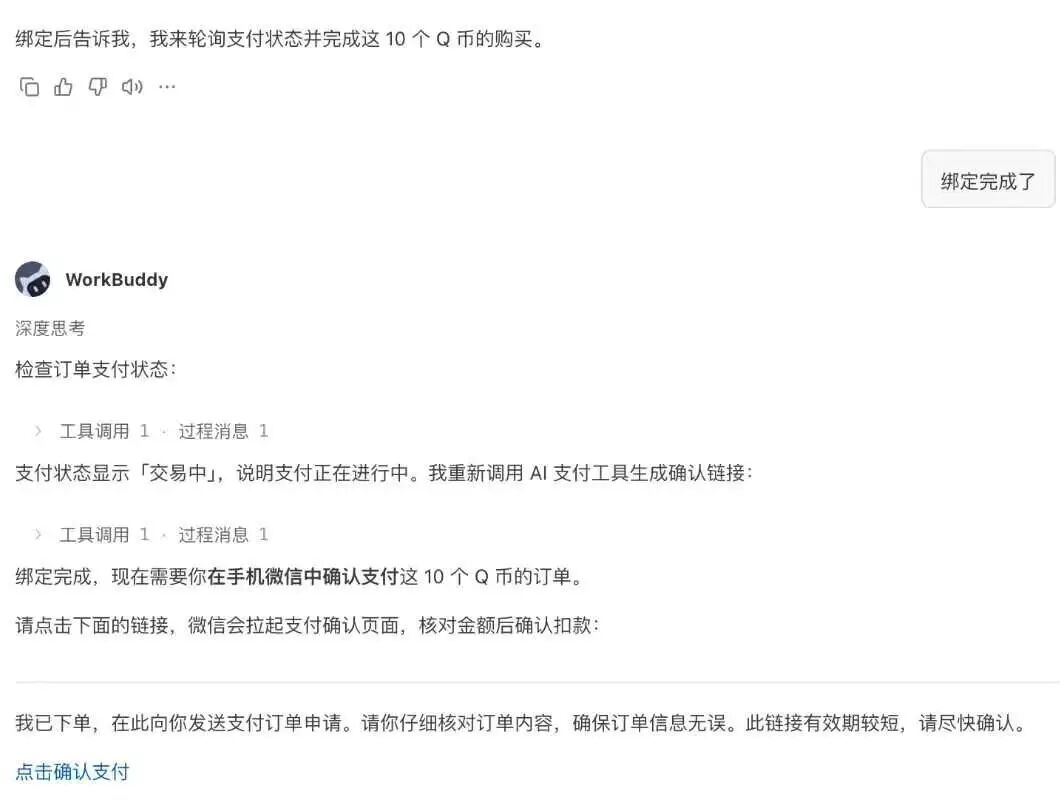
Tech Planet also learned that WorkBuddy is testing the connection with WeChat Pay, and users can directly purchase goods within WorkBuddy and pay through WeChat Pay. In addition, Tencent's self-selected stocks have also been connected to the expert center of WorkBuddy, and users can meet their stock trading needs through Tencent's self-selected stock research expert group. This means to some extent that Tencent has given enough support to WorkBuddy internally and broken through some departmental barriers.
A research report obtained by Tech Planet shows that WorkBuddy is the product with the highest strategic priority among all of Tencent's "Hunyuan" series of products. The priority order of resource investment is "WorkBuddy > DataBuddy > Others". An internal employee said that its importance should exceed that of Yuanbao.
In the Q1 financial report this year, WorkBuddy was repeatedly mentioned. Tencent President Liu Chiping named WorkBuddy three times when answering questions about the mini-program ecosystem. In the same conference call, Yuanbao was only mentioned once, and it was mentioned together with products such as ima and QQ Browser. This also proves from the side the importance of WorkBuddy among Tencent's AI products.
02
Tencent's AI "changes the boat" and gets out of the period of repeated trial and error and confusion
All along, Tencent is good at achieving business success through a profound understanding of products. The popularity of WorkBuddy is a victory of Tencent's product philosophy.
An AI industry insider believes that desktop office assistants like WorkBuddy will be installed on everyone's computer in the future, just like Office. "It may not necessarily be Tencent's product that will be installed in the end, but there will definitely be one installed. Although other companies will follow up, Tencent's ecological advantage is unmatched by Alibaba and ByteDance," he analyzed to Tech Planet.
In addition to the office field, Tencent also hopes to penetrate into everyone's life through AI. On June 8, WeChat, Tencent's biggest trump card, quietly released the "Guidelines for Developers to Access the WeChat AI Ecosystem", stating that WeChat officially opens the AI ecosystem access ability to all mini-program developers.
A report from CLSA pointed out sharply that Tencent has a huge WeChat ecosystem with more than 4 million mini-programs and 1 billion users, and has the strongest competitive advantage in the field of AI agents, even better than the Apple iOS ecosystem. It will "take at least more than 10 years" for competitors to replicate such an ecosystem.
A Tencent employee believes that WeChat has a complete scenario network composed of hundreds of millions of active users and millions of mini-programs. WeChat AI doesn't need to develop traffic entrances from scratch. It can connect segmented scenarios such as offline merchants, online tools, and private domain operations one by one, and embed intelligent capabilities into every operation of users, such as opening a mini-program, placing an order, consulting customer service, and filling out forms. The self-contained circulation closed-loop of the ecosystem can steadily speed up the large-scale implementation of AI capabilities.
If 4 million mini-programs are connected to AI agents, every call, every task execution, and every transaction behind them will consume the computing power and algorithm capabilities of the large model. The more mini-programs are connected, the deeper the dependence on the underlying model will be.
If Tencent cannot continuously narrow the gap with other leading players in self-developed models, it will face a passive situation: the more prosperous the ecosystem, the heavier the dependence on external models, and the smaller the bargaining space will be. In a more extreme case, once the underlying model supplier raises prices, cuts off supplies, or changes cooperation conditions, the entire ecosystem may be affected. This is not only a challenge for WeChat AI but also for all AI products.
Therefore, Tencent must make achievements in the basic model. Tencent has recruited Yao Shunyu, a research scientist from OpenAI, in the hope of catching up with its opponents in the basic model.
During his time at OpenAI, Yao Shunyu was one of the core contributors to the first batch of agents and led two important products, Computer-Using Agent (CUA) and Deep Research. The ReAct framework he proposed has become the most mainstream method for building language agents globally.
The Hy3 preview (Hunyuan 3.0 preview version) officially released on April 23, 2026, has achieved a qualitative leap in almost all key indicators compared with its predecessor, Hy2. With its ability of "strong reasoning + 256K ultra-long context", Hy3 preview has continuously topped the OpenRouter global weekly list. Its market share has risen to 12.8%, ranking third in the industry.
However, in terms of overall capabilities, especially in complex tasks, there is still a gap between Hy3 and models such as DeepSeek V4 Flash and Claude Sonnet 4.6.
An internal employee of Tencent admitted that in the past six months, the company's AI business has got out of the period of repeated trial and error and confusion, and has now stabilized its development direction. At present, applications such as Qclaw and WorkBuddy have achieved initial results at the application end, but the overall progress of polishing the underlying capabilities and transforming the ecosystem into an AI one is relatively conservative.
At the shareholders' meeting in May 2026, Ma Huateng used a straightforward metaphor to summarize Tencent's mental journey in AI: A year ago, we thought we had boarded a boat, but later found that the boat was leaking. Then we started to change to another boat. Now we feel that we are on it, but we still can't sit down comfortably. We still hope that the boat can go faster.
For Tencent, after changing the boat, only by truly surpassing in underlying technology can it truly sit firmly in the AGI era.
This article is from the WeChat official account "Tech Planet" (ID: tech618), written by Wang Lin and Chen Qiaohui, and is published by 36Kr with authorization.