Dreame Eclix Yu Lei: About to Launch an AI Smartphone Without an APP
On June 10, Jiemian News exclusively learned that the Eclix team, an ecological brand of Dreame, has reached in-depth cooperation with a leading domestic large model manufacturer. It is expected to release the first-generation AI mobile phone in September 2026 and launch it before Double Eleven. The product is positioned as high-end, priced at over 5,000 yuan. Currently, the R & D of the core team is nearly completed, and it is about to enter the whole-machine testing stage.
The Eclix mobile phone team was founded by Yu Lei, the former vice president of Gionee Group. Yu Lei officially joined MOVA in March 2026 and serves as the person in charge of mobile phone and AI hardware business.
Yu Lei is a senior practitioner in the mobile phone industry. In 2015, Yu Lei joined Gionee Group as the global vice president, in charge of marketing and channel sales business, and led the brand transformation during that period. It is worth noting that Yu Lei also founded a smartphone brand before, targeting the overseas market.
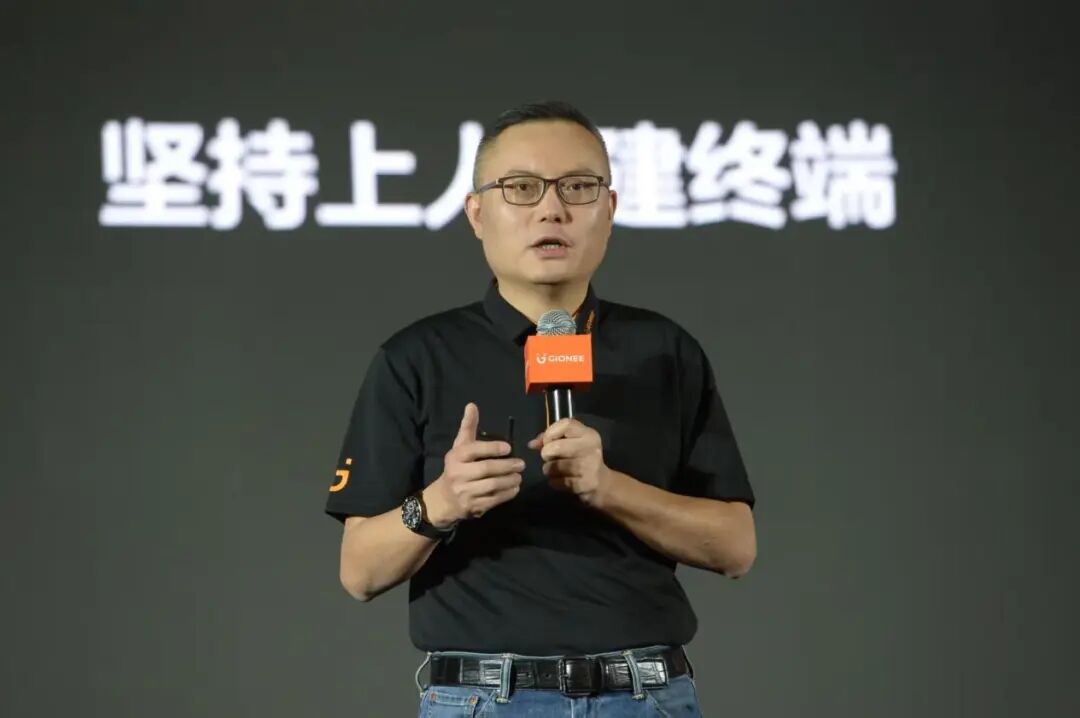
Photo of Yu Lei during his tenure at Gionee, provided by Eclix
Jiemian News exclusively learned from Yu Lei that Eclix will exist as an ecological brand of Dreame in the future and will no longer be affiliated with MOVA. The team has about 60 people. Most of the core members have a background in AI or operating systems. It is expected that the team size will reach about 300 by the end of 2026. The Eclix team is incubated by Dreame's ecosystem and is also open to external financing. The AI mobile phone project is currently in contact with multiple investors.
Yu Lei told Jiemian News that the first-generation product will actively control the shipment volume between 50,000 and 100,000 units and will be launched online on JD.com. The target users are tech-savvy and pioneering digital enthusiasts. He said, "We don't pursue large-scale shipments of the first-generation product. We hope to polish the product through small-batch delivery and lay a good foundation for subsequent iterations." At the same time, he revealed that thanks to Dreame's existing channel advantages, the number of orders received on the sales side has exceeded 100,000 units.
The Revolution of De-APPization
"Our recruitment preference can be summarized as 'rebels', that is, those who come from large companies, have excellent basic qualities, but are not satisfied with only working on a single module and are willing to fully commit to new product concepts. This talent structure ensures the team's combat effectiveness and innovation drive. I think when I was young, I was a typical rebel in a large foreign company," Yu Lei told Jiemian News.
Since joining the company, Yu Lei has spent a considerable amount of energy on recruitment. Yu Lei admitted that it is not easy to recruit talents related to AI mobile phones at present. Before Doubao launched its AI mobile phone, the annual salary for relevant positions was about hundreds of thousands of yuan. Now, the market price can reach up to 5 million - 8 million yuan, but the salary that the Eclix team can offer will definitely not be lower than the previous employer.
Yu Lei told Jiemian News, "When the model manufacturer and the team learned that I wanted to make a mobile phone without apps, they were very excited, and we also recruited a lot of talents because of this."
Jiemian News learned that Eclix's mobile phone project is internally called Project Quasar. It will use AI Agent as the native system kernel and adopt a full-stack self-developed route of integrating software and hardware OS to achieve a new interaction mode driven by natural language + multimodal interaction + intention prediction, which is different from the current market solutions of AI simulating app clicks and mobile phone + AI assistant. Tasks can be completed without simulating operations.
The core mechanism of the Eclix AI mobile phone is to replace apps with "atomic services". For example, users only need to say "Help me order a 25-yuan grilled chicken leg burger", and the system will directly call the connected life service capabilities to complete the order and automatically fill in the user's preferred address, taste and other information. Users only need to confirm at the end. The whole process does not require opening any apps or performing layer-by-layer operations within the apps.
Yu Lei revealed that the Eclix AI mobile phone has currently cooperated with leading large model companies and is completing the full-process development and testing from voice commands to atomic service calls. The specific functions will first cover high-frequency scenarios of eating, drinking and having fun. In his view, to do a good job in AI mobile phones at this stage, the support of large model companies is indispensable. Choosing to cooperate with a model manufacturer is the optimal solution to take the first step.
Gu Wei, the chief technology expert of Eclix AI, believes that the so-called "AI mobile phones" on the market are essentially traditional mobile phones with large model capabilities added. After users open them, they still see a desktop full of app icons.
The core change of the Eclix AI mobile phone lies in the interaction mode: users will not see the traditional app entrances. The main interface uses AI as the main interaction entrance, and most operations are completed through voice. The system directly calls atomic services to execute tasks according to user instructions without jumping.
Different from the "screen-reading control" mode, the cloud service direct docking method adopted by Eclix does not require reading the screen or controlling user apps, which can reduce the compliance disputes caused by screen reading and app control.
"We divide the risk levels into low, medium and high according to the current regulations of the Ministry of Industry and Information Technology. Medium and high-risk operations require explicit user authorization. All operation records are retained in the background and can be traced, supporting the withdrawal and restoration of wrong operations. Compared with the 'mobile phone + AI assistant' type of AI mobile phones, our next-generation AI mobile phone is more like a qualitative change from a feature phone to a smartphone. This is not a gradual upgrade, but a bottom-up reconstruction," Gu Wei told Jiemian News.
According to Gu Wei, the Eclix AI mobile phone adopts a cloud-collaborative architecture on the mobile phone side, internally named the "dual-brain architecture". Simply put, user needs are divided into two categories: one is execution tasks that require speed, accuracy and controllability; the other is dialogue tasks that require understanding, companionship and long-term memory.
Specifically, the left brain is mainly responsible for execution tasks, such as placing orders, querying, setting, and calling app capabilities. It emphasizes accuracy, stability and fast response, aiming to do the right things with certainty. The right brain is mainly responsible for long-term dialogue, emotional companionship and multimodal interaction. It pays more attention to the user's state, preference memory and continuous communication, making the AI more like a long-term personal assistant.
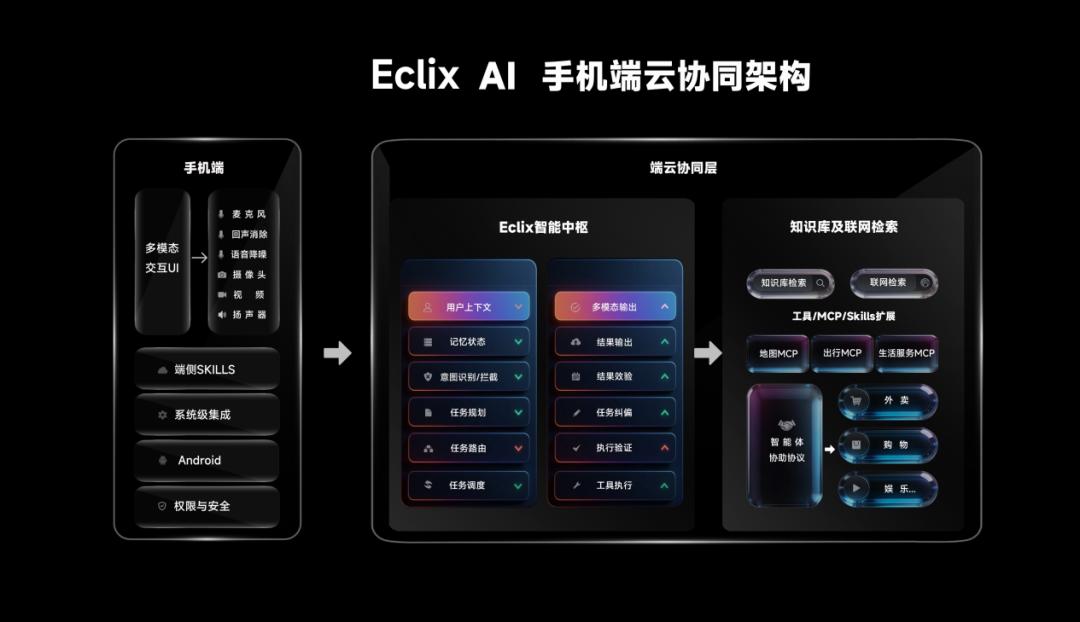
Schematic diagram of the Eclix AI mobile phone system architecture, provided by Eclix
Gu Wei further explained that the reason for creating the "dual-brain" is that it is difficult for a single model to simultaneously achieve "speed, accuracy and depth". When pursuing fast response, complex understanding will be limited; when pursuing in-depth experience, the response speed and certainty will decline.
The significance of this is to handle rational execution and emotional companionship separately. Through engineering-level scheduling, verification and permission control, the impact of large model hallucinations on key tasks can be reduced, enabling the AIOS Agent to not only chat but also truly handle affairs for users.
In addition, the authorized long-term memory will be stored in the self-owned account system. All user preference and habit memory data are stored on the project's self-owned cloud platform. No matter which underlying large model the user replaces, these memories will not be lost. The AI will understand users better as it is used - it may seem a bit "clumsy" in the initial stage, but with data accumulation and service integration, the intelligent experience will continue to improve.
According to Jiemian News, the "dual-brain architecture" is a key design of Eclix AI in the AIOS Agent architecture and relevant patents have been applied for.
Open Ecosystem, Not Relying on Hardware for Profit
Yu Lei told Jiemian News that the large model manufacturers currently cooperating with Eclix will bring their own ecological resources, and multiple applications have completed the docking. Its core profit model comes from the subscription of AI computing power services. Referring to the mature model of large models with monthly packages and token metering, real-time billing is based on the number of tokens consumed by users using different large models. Users pre-recharge, similar to the billing logic of operators for data usage.
In his view, this model can compress hardware profits as much as possible to cope with the competition from other mobile phone manufacturers. Traditional leading mobile phone manufacturers can obtain more than 8 billion yuan in revenue from app distribution alone each year, with extremely high gross profit margins. Transformation means negating past successful paths, and it is difficult for large mobile phone manufacturers to actively choose this path.
The current development stage of the industry is very similar to the eve of the smartphone explosion from 2006 to 2007. At that time, the market share of Android was only 6%, and four years later, it occupied 80% of the market share outside of iOS. More similarly, the current market pattern is far from being finalized. AI mobile phones are at a critical point, and there is still an opportunity for new giants to emerge.
"Large manufacturers are not unable to do it, but dare not do it because they make money from apps. And we want to eliminate apps and start from calling the atomic capabilities of apps. In the future, apps may not exist," Yu Lei told Jiemian News reporters.
In fact, the concept of AI mobile phones is getting hotter and hotter. In addition to traditional manufacturers such as Apple, Samsung, Xiaomi and Honor gradually increasing their layout of AI mobile phones, ByteDance is also expected to release the second-generation "Doubao Mobile Phone" this year. Jiemian News learned from the supply chain that the inventory of the new-generation Doubao mobile phone far exceeds that of the first generation, more than hundreds of thousands of units. Model manufacturers such as OpenAI and Jieyue Xingchen have also announced plans to release AI mobile phones this year.
Previously, there were reports that OpenAI's plan is to make a mobile phone without a screen. Yu Lei told Jiemian News that both brands are new entrants in the mobile phone industry, and their core competitiveness lies in the team's depth of thinking and execution ability. Eclix's plan is similar to OpenAI's, but the difference is that Eclix will still keep the screen, but it does not rule out the possibility of launching other forms of mobile phone products in the future. In terms of familiarity with the mobile phone supply chain, Eclix is more confident.
In terms of ecological strategy, Eclix is open to both hardware access and AI-native software. At the hardware level, it has completed the docking of multiple business units within the Dreame ecosystem, including automobiles. In terms of software, Eclix proposes "de-APPization". Through MCP open tools and data access, third-party applications, smart hardware and enterprise systems can be connected, and at the same time, it supports the access of ACP external intelligent agents, hoping to build a new AI-native software ecosystem with app manufacturers.
Yu Lei told Jiemian News that leading domestic large model manufacturers generally recognize this direction and are willing to cooperate deeply. With multiple conditions converging, the window period has opened. However, he also admitted that there will still be some compromises at present. The biggest compromise at present is the "escape window". It is still not possible to connect all apps, and "escape windows for the old world" will still be left for some super apps and bank apps.
"Rome wasn't built in a day. At present, it is really impossible to persuade super apps such as WeChat to connect natively, and we won't force them to do so, but we have reserved a compatibility plan. The first-generation product has a traditional app interface as a fallback plan, but this is a legacy of the previous generation," Yu Lei said.
Jiemian News learned that the sales channel for Eclix's first AI mobile phone has been opened. In addition, another brand, ACKA's outdoor sports mobile phone project is about to be launched in multiple regions around the world. Currently, the project has received orders and earnest money for millions of units, which will provide operating cash flow for the team. According to Eclix's estimate, the team will be able to achieve profitability in the fourth quarter of 2026.
This article is from the WeChat official account "Jiemian News", author: Li Jiaqi. Republished by 36Kr with permission.