New Rules for Organizations and Talent in the AI Era: Flattening, AI-Native, Super-Individual — Which Step Are You Missing?
AI is reshaping every industry at an unprecedented speed. However, for most enterprises, the real challenge is not "whether to use AI" but "how to use it". Based on in - depth research on 8 leading enterprises, this article extracts a practical framework from technology to organization. You'll find that the starting point of AI transformation is no longer the traditional strategy but the technology - driven industrial restructuring; the core difficulty lies not in the algorithm itself but in the cognitive upgrade and strategic determination of leaders.
These thoughts ultimately converge into a repeatedly verified practical system - "Yang's Five Rings" 2.0. From digital and intelligent technology to industrial restructuring, from strategic layout to organizational upgrade, and then to change leadership, these five links form a complete closed - loop for enterprises to implement AI. No matter which stage of transformation you are in, this framework can help you clarify the direction, avoid pitfalls, and find your own growth path.
The formation and iteration of the "Yang's Five Rings" theory
The earliest concept of "Yang's Five Rings 1.0" originated from a structural transformation of the Chinese Internet from 2018 to 2019. At that time, the traffic dividend and user growth were gradually peaking, the growth of the consumer Internet slowed down significantly, and the industry generally entered an adjustment period. During this period, there was a growing consensus on the value of the application of the industrial Internet in enterprises. At the same time, digital and intelligent technologies represented by cloud computing, the Internet of Things, and big data were gradually maturing, and their costs made them more accessible.
As a senior management consultant of Tencent, I was deeply involved in Tencent's "930 Reform" in 2018. In this strategic upgrade, we clearly proposed to root in the consumer Internet and embrace the industrial Internet. This strategy not only stems from the realistic understanding of the changing growth boundaries of the Internet industry but also from Tencent Group's long - term judgment that digital and intelligent technologies will reshape the operation mode of industries.
Empowering industries with digital and intelligent technologies is also the direction advocated by national policies. In 2021, "accelerating digital development" was written into the national "14th Five - Year Plan" outline. The state promotes the in - depth integration of the digital economy and the real economy at the policy level, and digital industrialization and industrial digitalization are clearly defined as new growth directions. The COVID - 19 pandemic has also accelerated the digitalization process of all industries.
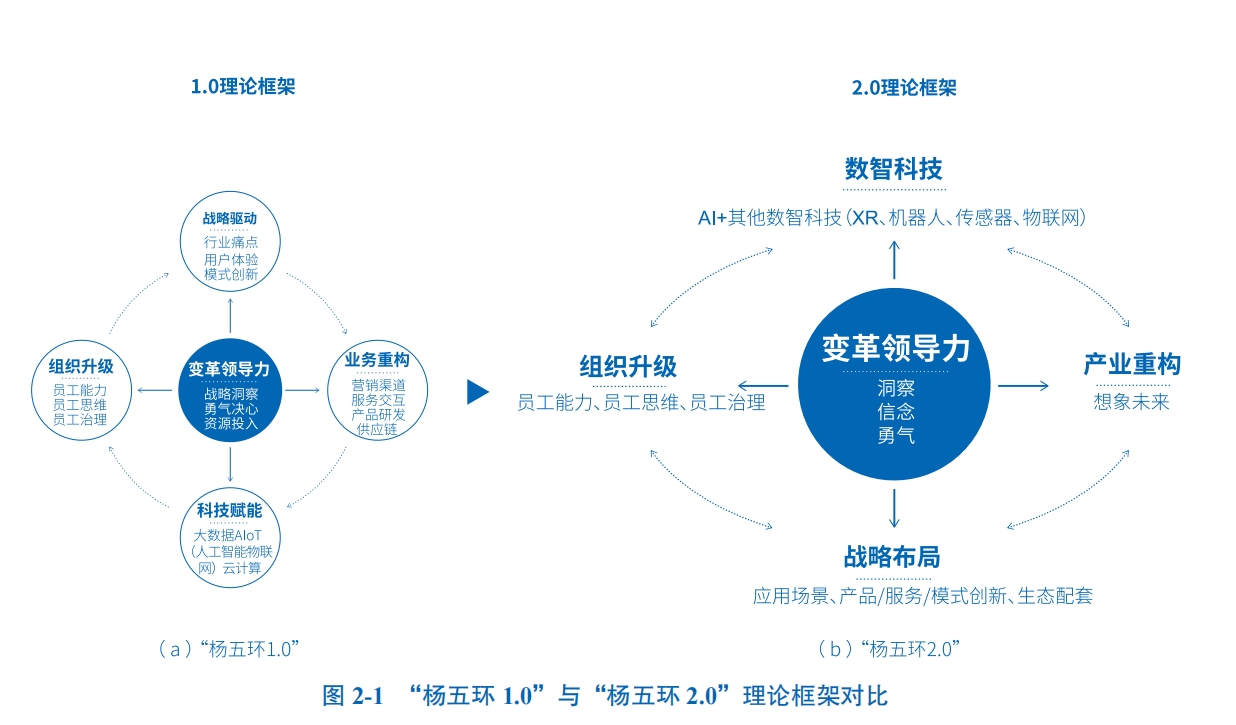
Since 2019, I have investigated a large number of enterprises actively seeking digital transformation (such as Belle in the retail industry, Midea in the manufacturing industry, and Beike in the real estate agency industry), and extracted the "Yang's Five Rings 1.0" framework. The "five rings" are: strategic drive, business restructuring, technology empowerment, organizational upgrade, and change leadership [see Figure 2 - 1(a)].
The starting point of "Yang's Five Rings 1.0" is "strategic drive". Entrepreneurs first clarify the environmental changes and industrial pain points faced by the enterprise, so as to achieve growth and differentiation. Then they choose key points in the value chain for "business restructuring", and then look for appropriate "technology empowerment" means. Finally, they adjust the organizational capabilities to promote the implementation of digital transformation. The determination and resource investment of leaders in promoting transformation run through the entire process of change.
Under this framework, digital and intelligent technologies play the role of tools. Their function is to help enterprises execute existing strategies more efficiently and nimbly. In other words, at that stage, the success of digital transformation largely depended on whether enterprises could use mature technologies (such as cloud computing, the Internet of Things, and big data) to make their existing businesses faster, better, and more cost - effective.
Around 2022, I noticed that the integration of digital and intelligent technologies and physical technologies entered an explosive period. From the booming intelligent driving industrial chain (such as XPeng Motors), XR (extended reality) glasses and headsets that bring a brand - new interactive experience (such as XReal), to intelligent manufacturing (such as Cooljia), smart agriculture (such as XAG), and smart energy (such as Trina Solar) and other fields, digital and intelligent technologies have been integrated into the core operation logic of the real economy, reshaping the production mode and boundaries of industries.
The digital and intelligent technologies mentioned in the era of "Yang's Five Rings 1.0" were mainly big data and cloud technologies. By this time, more cutting - edge technologies such as AI, XR, digital twins, and robots had become new technological engines. To respond to this new trend, I updated the theoretical framework, resulting in "Yang's Five Rings 2.0".
In "Yang's Five Rings 2.0", I summarize the five major links as: digital and intelligent technology (digital - real technology), industrial restructuring, strategic layout, organizational upgrade, and change leadership [see Figure 2 - 1(b)].
There are three changes in "Yang's Five Rings 2.0".
First, "digital and intelligent technology" replaces "strategic drive" as the starting point of the theory, emphasizing the leading role of technology - driven development. Cutting - edge technologies are no longer just supporting roles to help enterprises reduce costs and increase efficiency but the protagonists that change the industrial competition pattern and business models.
Nowadays, a breakthrough in a cutting - edge technology often leads to
innovations in business models, products, and services. Therefore, the first step for enterprises to think about is no longer "what I want" but "what new species can cutting - edge technologies create". Enterprises should not only use technology to execute strategies but should first focus on how new technologies reshape industries and what new strategic opportunities they provide.
Second, the perspective is elevated from "business restructuring" to "industrial restructuring". "Yang's Five Rings 1.0" focused on the "business restructuring" of the internal value chain of enterprises. "Yang's Five Rings 2.0" reminds entrepreneurs that they must think from the height of "industrial restructuring". Cutting - edge digital - real technologies have a more in - depth and subversive impact on industries, and they will rewrite the rules of the game. If entrepreneurs only focus on cost - reduction and efficiency - improvement of internal processes and ignore the underlying changes in the entire industry, even if they do well internally, they will not be able to resist the impact of industrial paradigm shifts.
Third, at the strategic level, it emphasizes forward - looking layout for the future. Based on the judgment of the trend of industrial restructuring, the core of enterprise strategy is no longer just to cope with the present but to make early layout around the industrial landscape that will be reshaped by technology. This layout is essentially an investment in the future: when the new industrial structure is not yet finalized, enterprises should clarify their own positions as early as possible and seize key positions. For enterprises with more ambitious goals, the strategic focus will go further, that is, to actively build and shape a new ecosystem through early layout.
In an environment where the technological path is highly uncertain, enterprises can only avoid being led by short - term fluctuations by inferring current decisions from the certainty of long - term goals. This process will test the strategic determination of enterprise leaders more than ever before.
The key application points of "Yang's Five Rings 2.0" in the AI era
In the past, when we talked about digitalization, technologies such as big data, cloud computing, AI, and the Internet of Things advanced side by side. Since the explosion of general generative AI technology, AI has evolved from a single technological ability to a general ability, driving collaborative innovation of cutting - edge technologies such as embodied intelligence, XR, and brain - computer interfaces from specific scenarios to multiple scenarios. Therefore, in the AI era, "Yang's Five Rings 2.0" will highlight the leading role of AI in digital and intelligent technologies.
For enterprises that apply AI (not those that promote the development of AI technology), the five links of digital and intelligent technology, industrial restructuring, strategic layout, organizational upgrade, and change leadership all have their own key points in the AI era.
Digital and intelligent technology: Industrial wisdom and AI infrastructure
AI is a combination of three elements: "computing power × algorithm × data". For AI - applying enterprises, an increasingly clear trend is that computing power can be purchased (through GPU cloud leasing), algorithms can be borrowed from open - source models (excellent models at home and abroad), but the enterprise - specific high - quality data are irreplaceable.
In the case of Meitu, the massive user data accumulated over 17 years of its establishment and its understanding of image and design aesthetics cannot be replaced by any general large - scale model; in the case of Gaotu, the data of various nodes precipitated during years of operation and its understanding of education are its core barriers in the AI era; in the case of United Family Healthcare, the data collection of patients' entire life - cycle health and the precipitation of medical knowledge are its most valuable assets.
After the pre - training of general models has almost exhausted all public articles, images, and data in the world, the next step of model evolution lies in post - training and reinforcement training. A pre - trained general large - scale model is like a college student who has received a world - class university education. Post - training and reinforcement training are like the process of a college student continuously accumulating knowledge of industries, products, operations, and customers during practical work in an enterprise after graduation.
Which model algorithm has more practical value for enterprises? Of course, it is the model algorithm that can integrate industrial wisdom and company data. This requires high - quality data scattered throughout the enterprise and the key "fuel" of years of industrial understanding. They are changing from business by - products to extremely important strategic assets. Enterprises should focus on data assets and pay attention to post - training of internal models.
In addition to having better algorithms, in the research, I also found that as AI enters the implementation era, the importance of AI - related engineering capabilities is becoming increasingly prominent. Those who can achieve a more stable and high - quality intelligent experience at a lower cost and faster speed under restricted conditions (for example, Li Auto needs to use the model on the vehicle end with limited computing power, and Rokid needs to break through the "impossible triangle" of display power, battery life, and wearing comfort of smart glasses) will have a competitive advantage.
Enterprises should also attach importance to the construction of AI infrastructure and platforms. For enterprises, building AI infrastructure is to build a digital and intelligent engine for the organization for the future. For example, Midea has built an intelligent agent platform internally to stimulate grass - roots employees to call and create intelligent agents on their own; Meitu has ensured that its AI capabilities can be accessed at any time through a series of constructions of AI - related middle platforms.
Several interviewed enterprises have also built a three - layer technology base: the bottom layer (model layer) is "computing power + algorithm + exclusive data" to train the enterprise's vertical large - scale model; the operation layer is equivalent to the operating system of AI, responsible for scheduling resources downward and driving applications upward. Its core value lies in linking different software, hardware, and intelligent agents to enable smooth coordination and communication; the application layer is all kinds of intelligent agents or applications directly facing different scenarios. These three layers are like Apple's "iOS system (mobile operating system) + App Store (application store) + rich App matrix".
Industrial restructuring: AI reshapes industrial boundaries and values
AI not only optimizes a certain link in the value chain but also breaks industrial boundaries at an unprecedented speed. For example, Li Xiang judged that in the future, a car with L4 - level autonomous driving will be equivalent to a high - end private space. At this time, the automobile industry will "absorb" the market share of drivers and also the share of space - related businesses.
Another example is that United Family Healthcare is using AI to break the boundaries between different specialties, different hospitals, and inside and outside the hospital. The traditional medical industry is often fragmented, with patients seeking treatment only when they are sick and the treatment ending after recovery. United Family Healthcare uses AI to integrate patients' data inside and outside the hospital, achieving full - life - cycle health management from "pre - disease prevention - in - disease diagnosis and treatment - post - disease rehabilitation".
Inside the enterprise, AI is restructuring the entire value chain from R & D, production, logistics, marketing, sales to service. For example, in the case of Gaotu, AI not only assists in the generation of teaching content but also comprehensively intervenes in multiple links such as teaching and research, teaching, answering questions, and operation, changing the organizational mode of "teaching" and "educating". In the era of AI implementation, the core issue is no longer which link can use AI. Enterprises should comprehensively sort out business work processes to see which work can be done by AI, which must be done by humans, and how humans and AI can cooperate.
Strategic layout: Determination of resource investment and ecosystem construction
Currently, the R & D and application of generative AI technology require a large amount of resources, which determines that the implementation of AI must be the "top - priority" project of enterprises. Decision - makers need to have the strategic determination for long - term investment.
As for the directions in which to invest time and resources, my suggestion is that enterprise decision - makers should have a reverse - thinking mode from the future to the present. That is, they should be able to imagine what your industry will look like and what your enterprise will evolve into when AGI (general artificial intelligence) is fully developed in the future.
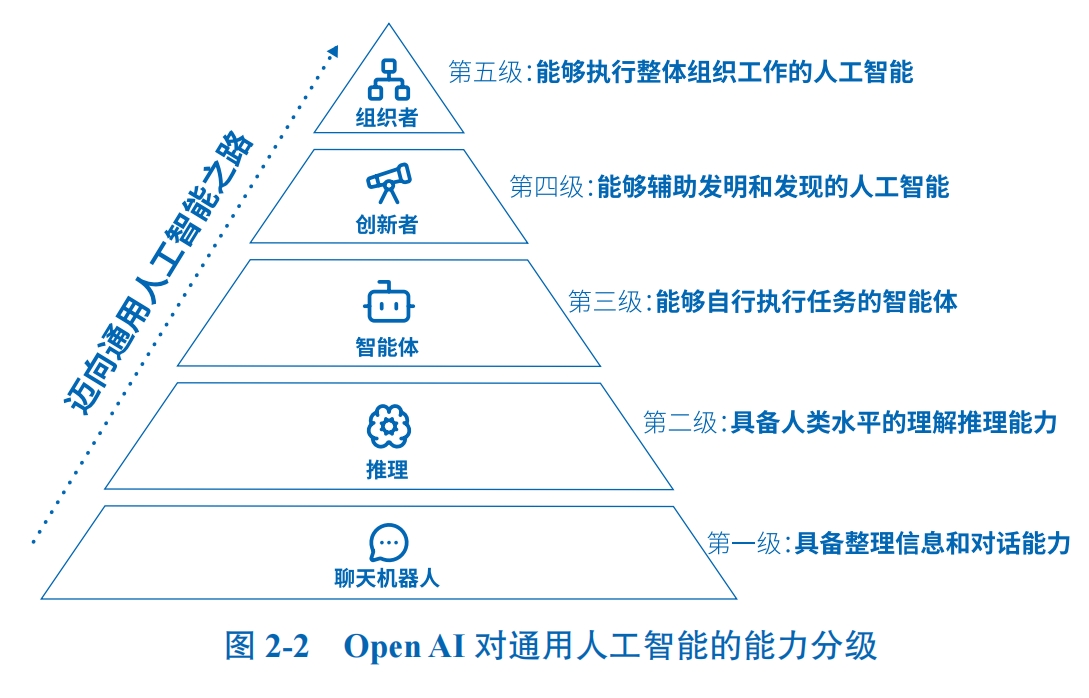
In 2024, OpenAI divided the development from AI to AGI into five stages, which has also become a consensus in the industry in recent years. These five stages are chatbot, reasoner, agent, innovator, and organization (see Figure 2 - 2).
We are currently in the early stage of the agent stage. If enterprises only make strategic layouts based on the current ability boundaries of AI, they are likely to be overtaken in the next round of AI ability leap. Enterprises need to have the imagination for the future. Without this imagination, it is impossible to make early layouts.
In addition, strategic layout also emphasizes ecosystem support more than in the past. In the long run, the promotion and application of new technologies must require a series of ecosystem support for coordinated development. Many leading enterprises have begun to lead the construction of ecosystems and integrate resources. For example, Rokid has built the Yoda OS developer ecosystem to attract 3D content creators; Strong Brain Technology is actively building an "industry - academia - research - government" ecosystem and has designed education programs through cooperation with schools to train future brain - computer interface talents. Leading enterprises' own efforts are not enough. They also need relevant ecosystem support such as policies and upstream and downstream industries. The most typical example is that when Strong Brain Technology promotes intelligent prosthetics in China, medical and insurance - related policies are crucial influencing factors.
Organizational upgrade: New characteristics of organizations and talents in the AI era
The liberation of productivity by AI inevitably requires the transformation of production relations. The organizational form will gradually evolve from the "human + tool" mode to the AI - native mode of "co - creation between humans and AI".
Generally speaking, the organizational upgrade in the AI era has the following four characteristics.
First, organizations recruit or train more AI - native talents. The core criterion for judging AI - native talents is whether they have an AI - first mindset: use AI wherever possible, and empower human - handled tasks with AI. This leads to the broadening of individual functional boundaries, breaking the clear - cut job responsibilities and position definitions in the past. Business - technology compound talents will receive higher salary rewards. The number of employees in the organization may decrease, but the talent density will increase.
Second, work processes are restructured and shortened, with more human - machine collaboration. It will become normal for a carbon - based employee to lead a group of silicon - based employees to form a team. Super - individuals will appear more commonly.
Third, in terms of cultural values, it is crucial to emphasize self - drive, encourage innovation, trial - and - error, and iteration, and embrace new things with a growth mindset. AI is still a field with a high degree of uncertainty. Only by establishing a culture that tolerates failure, embraces flaws, and rewards innovation can the organization keep up with the rapid iteration speed of AI technology.
Fourth, the organization has a flat hierarchical structure and agile, task - oriented teams with closed - loop capabilities. The evolution direction of organizations in the AI era is basically consistent with the market - oriented ecological organization (MOE) I studied in the past. The main components of enterprises include task - oriented closed - loop agile teams, shared platforms (including computing power, algorithms, and data) to support the implementation of AI, and closely - cooperating external ecological partners (including technology, content, manufacturing, and channel partners).
Meitu's organizational change in the AI era is a very typical example that conforms to the characteristics of a market - oriented ecological organization. Meitu has incubated an AI innovation studio internally, maintaining a small - team, closed - loop