The ex-factory price is only 6 cents, and "recycled material" toothbrushes are sweeping through homestays and small hotels.
Have you ever wondered how much the factory price of that disposable toothbrush you casually pick up when staying in a hotel is?
It's not 60 cents, nor 6 yuan. It's only 6 cents.
Moreover, you'll never imagine that the predecessors of these toothbrushes might be chemical waste barrels that once contained detergents, used old toothbrushes, or moldy slipper scraps.
Hangji, Yangzhou, known as the capital of hotel supplies in China, has recently been pushed into the spotlight of public opinion again because of a report on CCTV's "Financial Investigation".
Small workshops in Hangji, Yangzhou and other places are directly crushing and processing all kinds of unwashed and disinfected waste plastics into "recycled materials" to mass - produce inferior toothbrushes with a factory price of only 6 cents.
These inferior toothbrushes flow into the market through multiple hotel supplies cities and are mainly supplied to small independent hotels, homestays and budget hotels.
This is not an isolated phenomenon, but a black industrial chain spanning production, circulation and procurement. Why can these "recycled material" toothbrushes thrive in the market? And who is providing the living soil for this black industrial chain?
01
The "Recycled Material" Toothbrushes Come from the Toothbrush Capital
"Wherever there are people living, there are toothbrushes produced here." At first glance, this statement sounds quite arrogant and boastful.
Actually, this sentence is from the slogan of the China Toothbrush Museum in a small town.
This town, with an area of only 40 square kilometers and a population of less than 40,000, produces 7.5 billion toothbrushes annually, "accounting for" 80% of the national toothbrush market share and 90% of the total toothbrush export volume. It also occupies more than 65% of the national and 30% of the global hotel daily necessities market share.
Now, more than 4,000 toothbrush and hotel supplies production and supporting enterprises are clustered here, with an annual sales volume of over 30 billion yuan. The toothbrush industry has formed a complete industrial chain and is known as the "Capital of Chinese Toothbrushes" and the "Capital of Chinese Hotel Daily Necessities".
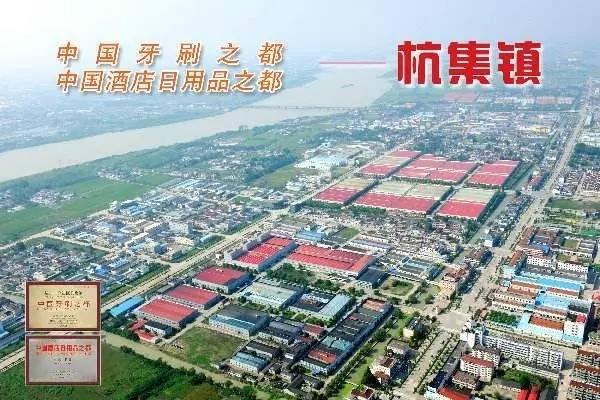
This town is Hangji Town in Yangzhou, Jiangsu.
The industrial cluster here has an annual output value in the tens of billions, but now there are also several hidden black industrial chains.
It's worth mentioning that this is not the first time Yangzhou has been named for the quality problems of hotel supplies.
In January and April this year, two batches of sub - standard toothbrushes were recalled locally. As a well - known toothbrush capital in the country, the products have continuously had problems.
In April this year, among the enterprises of sub - standard hotel toiletries reported by the National Medical Products Administration, many were Yangzhou hotel supplies enterprises, and quite a few were from Hangji Town, Yangzhou.
Why has the capital of hotel supplies become a hard - hit area for problematic products?
As the world's largest production base for hotel supplies, the annual output value of Hangji, Yangzhou is said to exceed 30 billion yuan. The industrial cluster has brought scale effects and cost advantages, but it has also buried huge safety hazards.
In recent years, the competition in the hotel supplies industry has reached a white - hot stage, and price war seems to be the only means of competition.
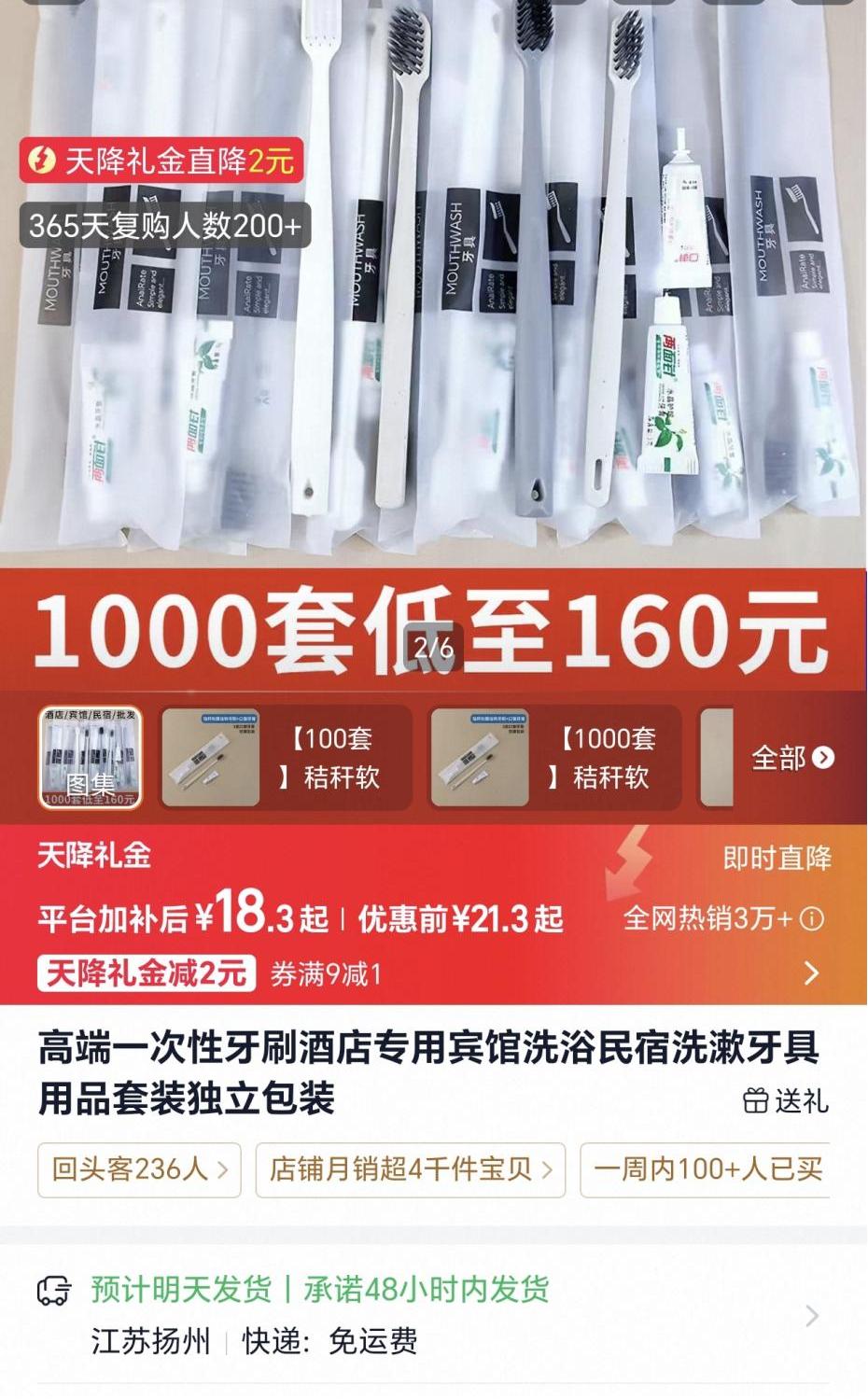
Enter "star - rated hotel supplies" on Taobao and randomly contact a Taobao store with an address shown as "Yangzhou, Jiangsu". The price of 1,000 sets of toothbrushes in the store is only 160 yuan, and the price of a single toothbrush is only 0.16 yuan.
With such a low price of toothbrushes in the regular channels, it's difficult for black workshops with even lower costs to use qualified raw materials and production processes.
In addition, a large part of the factories engaged in the production and processing of hotel supplies in Hangji Town, Yangzhou are family workshops. Some specialize in slipper processing, while others can produce a full set of hotel "six - piece" or "twelve - piece" supplies such as toothbrushes, toothpaste, slippers and combs.
Although each small workshop has its own main products, such as slippers, shampoo or soap, basically all small and large workshops can undertake the production of a full set of disposable hotel supplies.
Some small workshops package inferior products as big brands through the "brand - sticking" method, and even counterfeit the packaging and logos of regular manufacturers.
The lack of a traceability system makes it difficult to track the source of raw materials for these inferior products.
Most of the recycled plastic particles come from small workshops without qualifications and are typical products without production licenses, quality certifications and factory addresses.
From waste recycling to the finished toothbrush, there is neither a purchase ledger, nor raw material testing, nor batch tracking in the entire raw material chain. Moreover, the current national standard GB/T19342 for disposable toothbrushes is a recommended standard, which has relatively little restraint on the source of raw materials. There is currently a lack of targeted mandatory regulations on material safety in this segment of disposable hotel supplies.
Even if sub - standard products are found, the punishment is very limited.
According to the "Product Quality Law", for those who adulterate, pass off fakes as genuine, pass off inferior products as good ones, or pass off sub - standard products as qualified products, a fine of not less than 50% and not more than three times the value of the illegally produced or sold products shall be imposed.
For a toothbrush priced at 6 cents, even if the fine is tripled, it's only 0.18 yuan per toothbrush. For enterprises with annual sales of millions or even tens of millions, such a fine is just a drop in the bucket.
02
Who Should Be Blamed?
The existence of a black industrial chain in hotel toothbrushes is by no means just a problem in the production process.
Most of us consumers generally think of hotel free toothbrushes as "just make do with them".
Few people will carefully check the rounding rate of the toothbrush bristles, smell for any strange odors, or care whether it meets the national standard GB - 19342 for toothbrushes.
The low - attention nature of these consumables and information asymmetry happen to provide a natural protective color for inferior toothbrushes.
Of course, don't rush to scold only the unscrupulous manufacturers. There is another group worthy of attention behind this: small independent hotels and homestays.
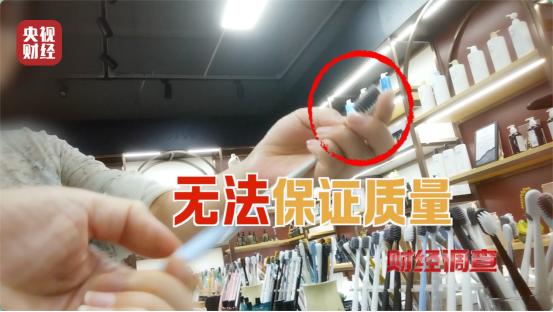
CCTV reporters traced the delivery notes to Hefei Zhongcaishi Hotel Supplies City and Zhengzhou Yufeng International Hotel Supplies City and found that most wholesale merchants in the market were selling these recycled - material toothbrushes, which were mainly supplied to small hotels and homestays.
For large - scale chain hotels, disposable supplies are basically purchased through group or regional procurement. Suppliers need to go through qualification review, provide product test reports and batch traceability. Even if it's not perfect, at least someone can be held accountable when something goes wrong.
What about small independent hotels and homestays?
Their procurement volume is small, and suppliers don't take them seriously at all. They give inflated quotes and are indifferent.
Especially for small - scale properties with less than 50 rooms, most of them don't have a procurement department at all, and they basically pick and buy supplies on the spot in the local hotel supplies city.
As of now, small independent hotels still account for more than half of the domestic hotel market. Especially in many non - core cities, county - level markets and some specific scenarios, small independent hotels are still the main supply form.
However, in the past two years, cost - cutting in the hotel industry has reached an almost crazy level.
In 2025, the RevPAR (Revenue Per Available Room) of the entire industry only recovered to 95% of that in 2023. The occupancy rate of some mid - range hotels even directly dropped below 60%.
According to a report by Soochow Securities, the actual RevPAR of budget hotels in the first three weeks of March 2026 was about 83 yuan, and the occupancy rate was about 58.8%.
In the price war of trading price for volume, many hotels are not making money themselves and don't know how to make money, so they can only cut costs.
Let's do a calculation, and you'll understand how attractive the "6 - cent toothbrush" is.
Assume that a small hotel with 30 rooms consumes about 30 - 60 sets of toothbrushes per day, which is 11,000 to 21,000 sets a year.
If each set of toothbrushes is purchased through regular channels, the price of decent - quality toothbrushes is about 0.35 - 0.6 yuan per set. Just for toothbrush sets, the hotel has to spend 3,850 - 12,600 yuan a year.
What if you use 6 - cent toothbrushes? The cost can be as low as 660 yuan.
To put it bluntly, bad money doesn't need to beat good money. It just needs to be cheap enough.
03
From the Supply Chain to the "Win - win Chain"
The "recycled - material" toothbrushes exposed by CCTV are just the tip of the iceberg of the chaos in the hotel supply chain.
From the mixed washing of hotel linens with hospital linens to the repeated recycling and cleaning of slippers, price competition has made some enterprises lose their bottom line.
For a long time, the hotel industry's understanding of the supply chain has been relatively simple.
For most small independent hotels or early - stage chain brands, the core of the supply chain is "procurement". This model was feasible in the stage when the number of hotels was limited and the competition was not fierce.
According to data from the China Hotel Association, as of the end of 2025, the hotel chain rate in China was 41.8%, and nearly 60% of small independent hotels had no access to the supply chain procurement system of hotel groups.
At the same time, hotel franchising business is widespread across the country. Especially hotel investors in the sinking market are used to purchasing hotel supplies locally to save delivery costs.
As the domestic hotel industry enters the stage of chain operation and large - scale development, this decentralized procurement model has begun to expose problems.
The large quantity of materials required for the construction and operation of a hotel and the dispersion of suppliers make the hotel highly dependent on the wholesale channels. The hotel supplies wholesale market connects upstream suppliers and downstream hotels with a business model of "small profit but large sales volume". Through the industrial cluster effect, it undertakes many functions such as market information feedback, price discovery, product display, procurement and distribution.
However, the pain points of this model are very obvious. That is, it is a mixed bag, the entry threshold is very low, and overall it shows the characteristics of a large market, small - scale operations, a wide variety of products and difficult management.
This is also the main reason why these "recycled - material" toothbrushes can flow into wholesale markets such as Hefei Zhongcaishi Hotel Supplies City and Zhengzhou Yufeng International Hotel Supplies City.
The hotel industry's supply chain has never been a simple procurement problem. It is not only about product selection and material handling, but also involves the cooperation, adjustment and optimization of countless links.
The real competitiveness of the supply chain does not lie in the ability to lower prices, but in the ability to build an industrial ecosystem where all participants can evolve together.
It's worth noting that in March this year, Huazhu announced the opening of its supply chain to the entire industry, and small independent hotels can also get the same procurement prices as Huazhu's direct - operated stores, All Seasons and Hanting.
Last year, Huazhu just launched nine service commitments: guarantee of genuine products, on - time delivery, compensation for over - priced products, refund of price difference for price cuts, seven - day no - reason return and exchange, 30 - day replacement, and pre - payment by the platform.
For small independent hotels, a more efficient, cheaper and more reliable supply chain is what they need at present.
In the future, the hotel supply chain will no longer be just about "sufficient goods and low prices", but a "win - win chain" that can reassure investors, suppliers and provide collaborative efficiency for the entire ecosystem.
This article is from the WeChat official account "Hotel Management Finance", author: Nanchuan. Republished by 36Kr with permission.