The public version of Mythos is launched, and Claude's most powerful model is now available in tiered sales.
Anthropic has finally launched Mythos to the public market, but with a tiered release.
Early in the morning, Anthropic officially released Claude Fable 5 and Claude Mythos 5. The former is open to ordinary users, while the latter remains restricted to "trusted security partners."
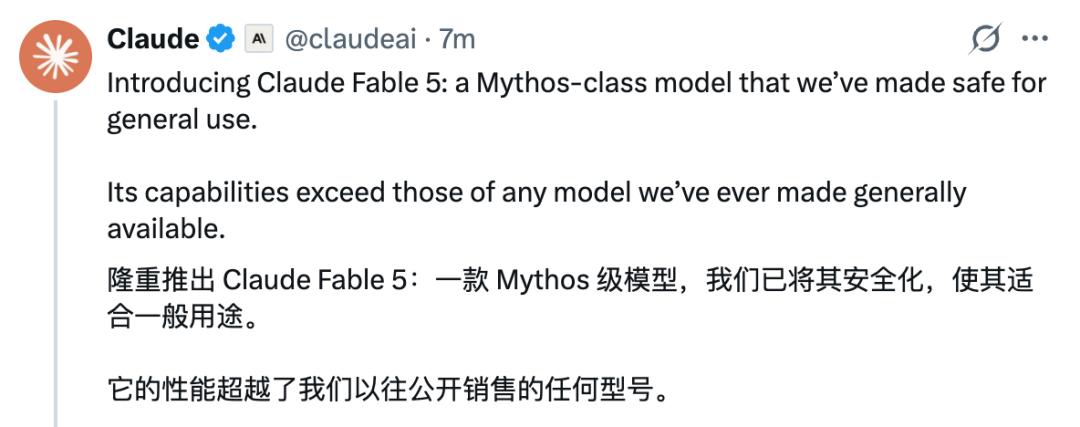
The naming of the new models is very much in line with Claude's consistent style.
From Haiku to Sonnet and then to Opus, Anthropic has been using literary and artistic concepts to tier its models. With Mythos, the name has expanded from literary works to "mythology" itself.
Fable comes from the Latin word "fabula," meaning "something told," and is cognate with the Greek word "mythos." It is usually translated as "fable." This name is in line with the positioning of the new model, a "Mythos-level" model, a "public myth."
According to Anthropic's description, Fable 5 and Mythos 5 share the same underlying model but are placed in a security shell more suitable for public distribution. In terms of the model capabilities provided by the official, they are placed in the same position.
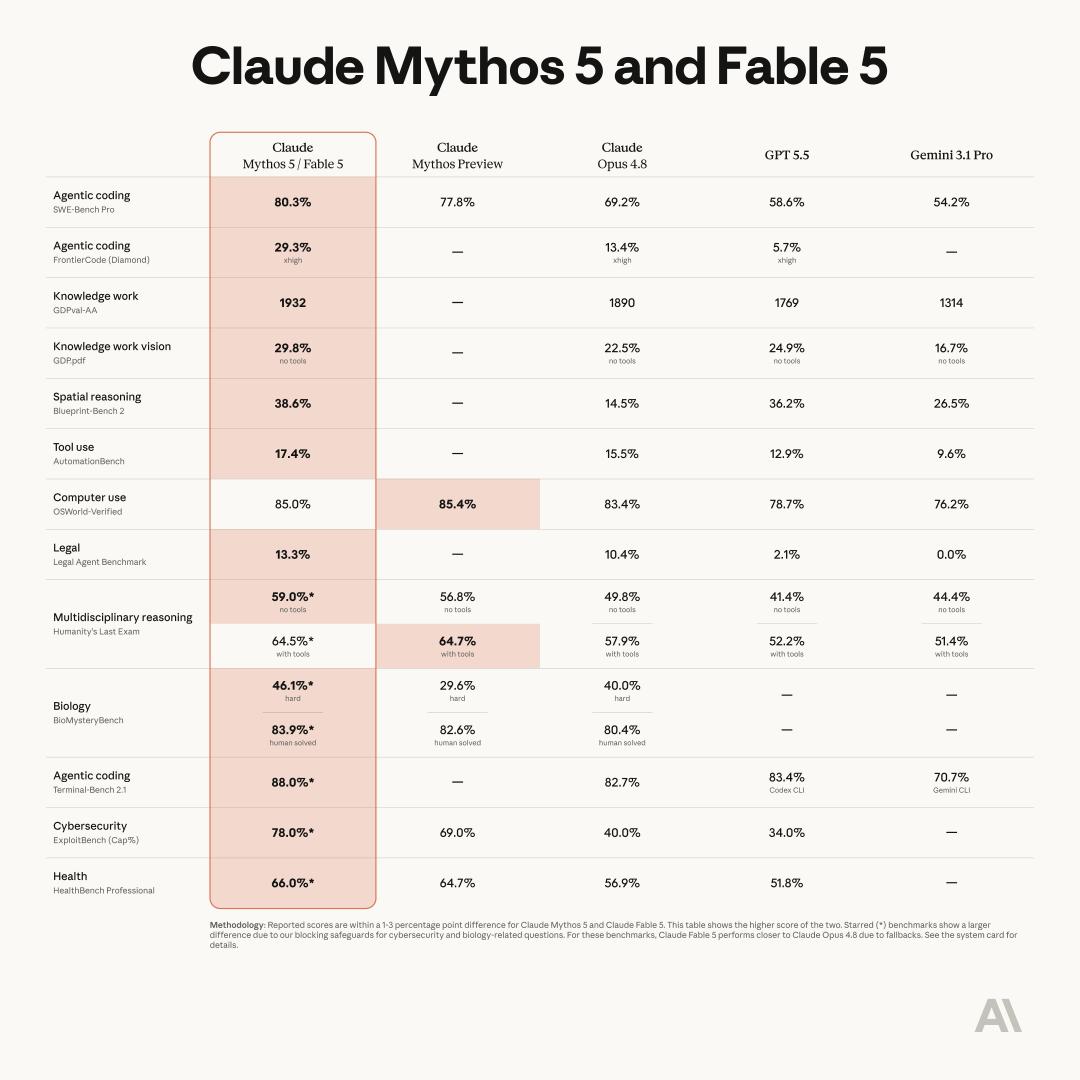
However, scores are one thing. If the performance of Fable and Mythos is exactly the same, I think there's no need to have two different names.
01
The Rewritten "Myth"
After being rewritten, compressed, and given a moral lesson, a myth becomes a fable.
According to the official documentation, Fable 5 is the public version. It is open to ordinary users and developers, but in high-risk areas such as network security, biology, chemistry, and model distillation, an additional security classifier will intervene. Once the system determines that a request may involve these sensitive areas, the response will not be completed by Fable 5 but will automatically fall back to Claude Opus 4.8.
Mythos 5 is based on the same underlying model but removes some of the safeguards of Fable 5 in certain areas. Anthropic says that network security partners in Project Glasswing can use the "full-powered" Mythos 5; in the future, some life science researchers may also use the version with biological and chemical restrictions removed through the trusted access program.
Let's not talk about Mythos for now. Let's focus on something more practical.
First, the pricing. In one word, it's expensive.
The pricing of Fable 5 is $10 per million tokens for input and $50 per million tokens for output. Developers can now call claude-fable-5 (the model name) through the Claude API.
This price is exactly twice that of Opus 4.8 and the same as the fast mode of Opus 4.8. Anthropic clearly places it in a higher price tier than Opus.
However, Anthropic says that this price is less than half of the previous Claude Mythos Preview. But since the Mythos Preview is not a public API model, the official has not provided a standard price for the public, so this statement cannot be verified.
Subscribers also need to note that Fable 5 may not be directly included in the basic subscription package in the long term.
Anthropic mentioned in the official statement that after June 23, even if users have subscribed to Claude, Fable 5 may be provided on a metered basis depending on the computing power situation and may not be directly included in the basic subscription service.
The company is becoming more and more stingy, but at least it offers a half-month trial period. The official also left some leeway: if there is enough computing power after June 23, Anthropic will try to continue including Fable 5 in subscription services such as Pro and Max.
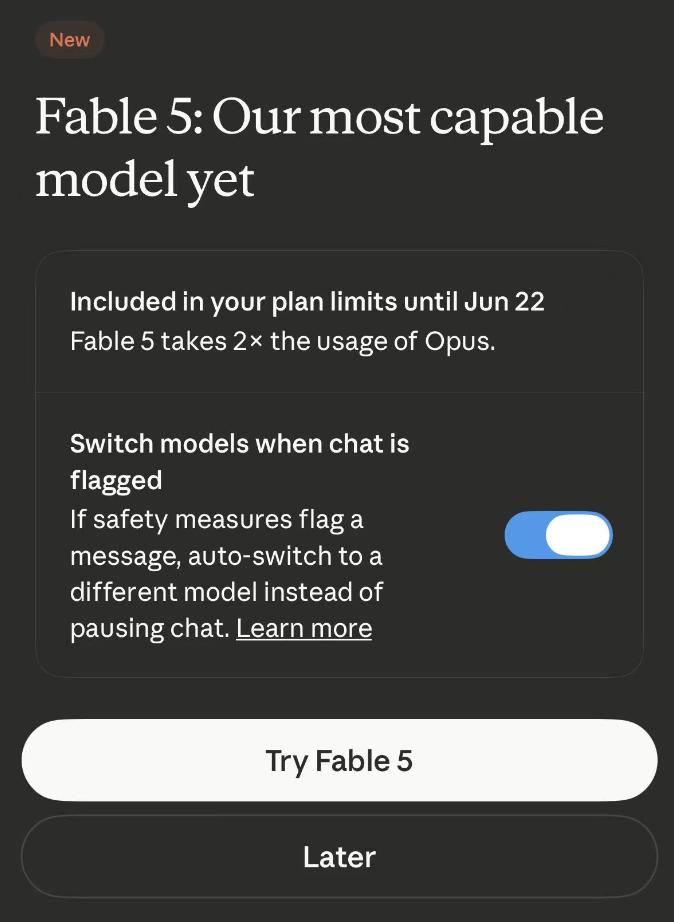
High pricing itself is not hard to understand, but it had better ensure that its capabilities match its price.
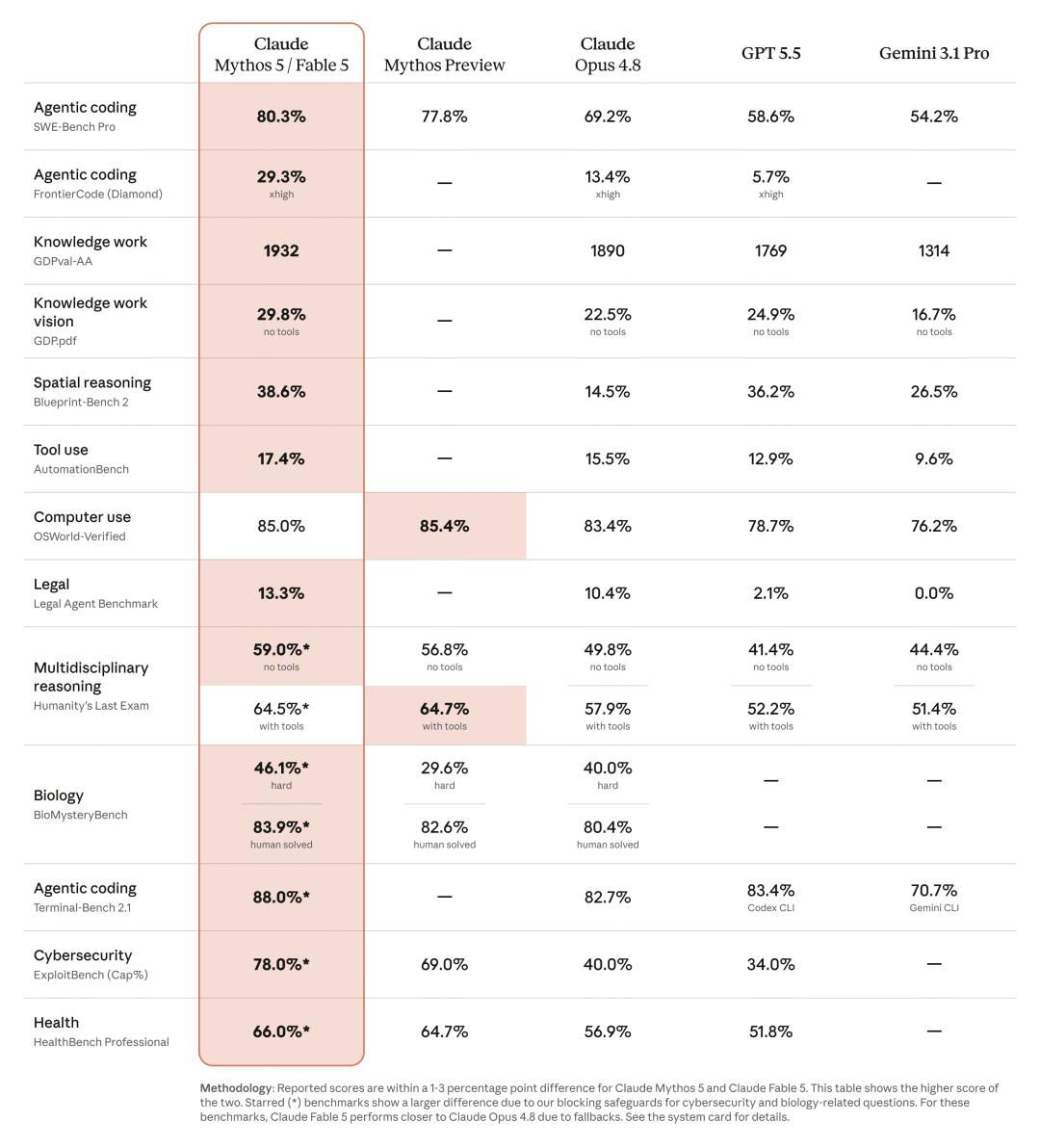
In terms of scores, Fable 5/Mythos 5 is basically the strongest among Anthropic's current public models.
However, the official table has a note that the scores of Claude Fable 5 and Claude Mythos 5 generally differ by only 1 - 3 percentage points (except for the network security and biology-related tests marked with an asterisk), so the table shows the higher score of the two. This is really hard not to complain about.
Anthropic focuses Fable 5 on several directions: software engineering, knowledge work, vision, long-context memory, and life science research.
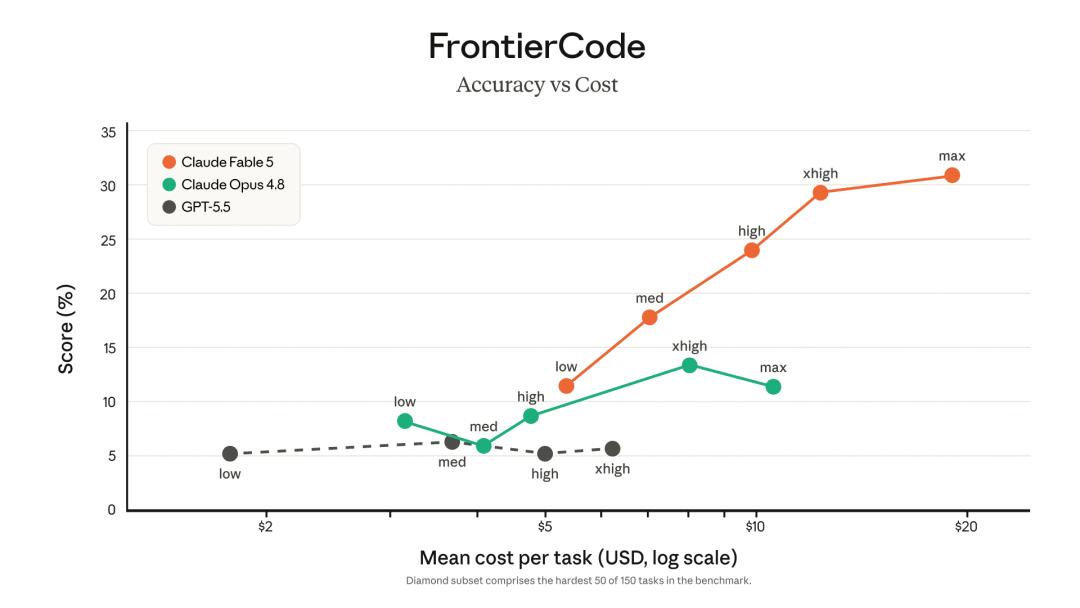
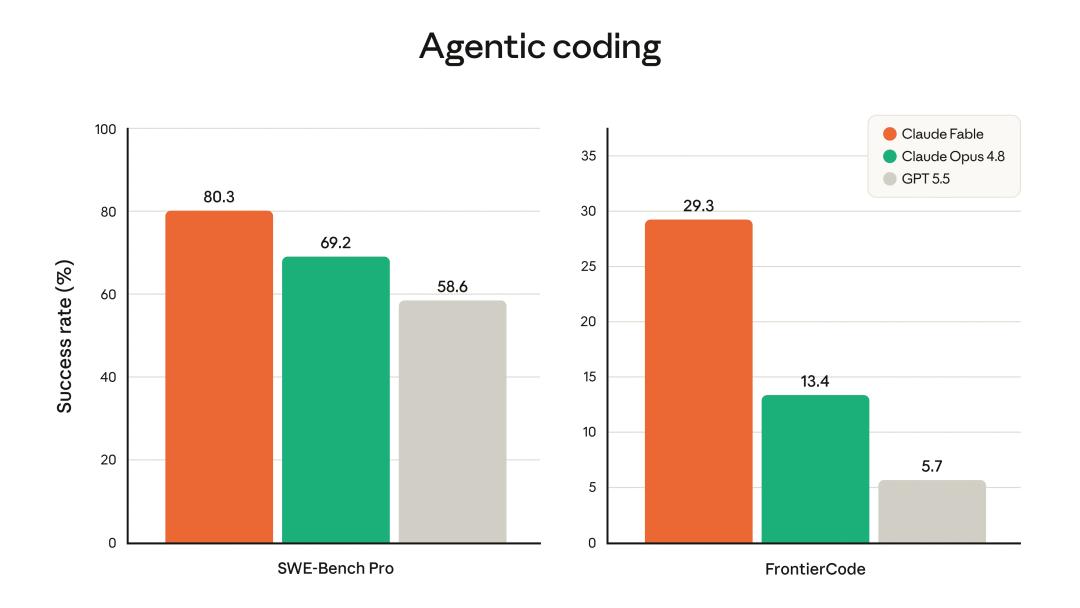
Software engineering is one of the most prominent scenarios. According to the table, Fable/Mythos 5 achieved 80.3% on SWE-Bench Pro, significantly higher than Opus 4.8's 69.2%. On the more difficult FrontierCode Diamond, it got 29.3%, while Opus 4.8 only got 13.4% and GPT-5.5 only got 5.7%.
For knowledge work and visual tasks, Anthropic provides two types of evidence.
One is the standardized benchmark. The official table shows that Fable/Mythos 5 scored 1932 on GDPval-AA, higher than Opus 4.8, GPT-5.5, and Gemini 3.1 Pro. On the document task with visual understanding like GDP.pdf, it reached 29.8%, also exceeding other major models.
The other is the early customer testing. Anthropic says that Fable 5 achieved the highest score on Hebbia's advanced financial reasoning benchmark, with advantages concentrated in document reasoning, chart and table understanding, and problem-solving. IMC also reported that it almost passed the trading analysis evaluation comprehensively.
To demonstrate Fable 5's visual ability, Anthropic gave an example: previously, the Claude model needed complex auxiliary tools to play "Pokémon FireRed," while Fable 5 can complete the game just by visual input.

In terms of long tasks and memory ability, Anthropic says that Fable 5 can stay focused in long-term tasks with millions of tokens and use its own notes to improve the output.
In games like "Slay the Spire" that require continuous decision-making and long-term strategies, if Fable 5 is connected to persistent file memory so that it can record previous choices and experiences, its performance will be significantly improved. The improvement is three times that of Opus 4.8, and the number of times it reaches the final level also triples.
By the way, Fable is also the name of a classic RPG game, translated as "Fable" in Chinese. Maybe one day we can see Fable playing "Fable."
In addition, in terms of network security ability, Fable/Mythos 5 reached 78.0% on ExploitBench Cap%, exceeding Claude Mythos Preview's 69.0% and approaching twice that of Opus 4.8.
The score here should be that of Mythos 5 because Fable 5 will fall back to Opus 4.8 for high-risk requests.
02
Powerful Models Must Be Tiered
Anthropic has put the intuitive demonstration of the model's capabilities in a slide similar to a "portfolio," and each demo only has a short annotation.
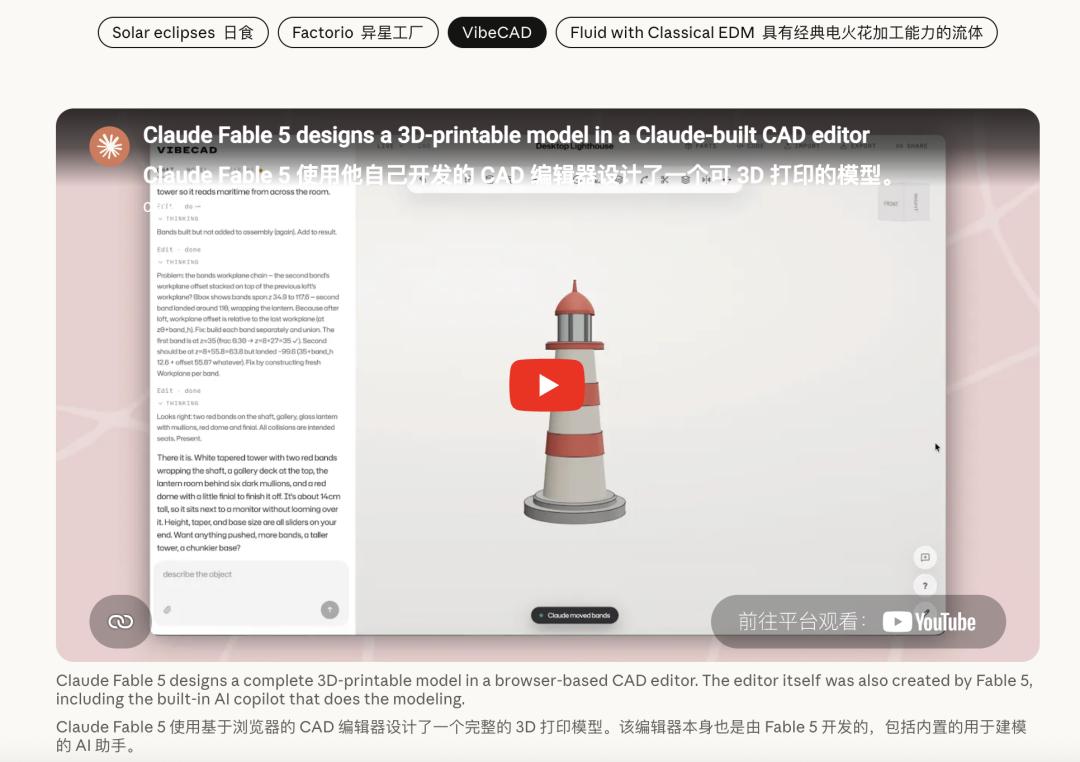
For example, Fable 5 created a solar system simulation, deduced the orbital motion of planets from the first principles of physics, and used it to predict solar eclipses.
Another example is that it can play "Factorio" autonomously. This is a factory automation game loved by engineers, where players need to collect resources, plan production lines, and build logistics and energy systems.
Anthropic uses this example to show that Fable 5 can formulate strategies in an open environment and continuously promote the construction of a complex system.

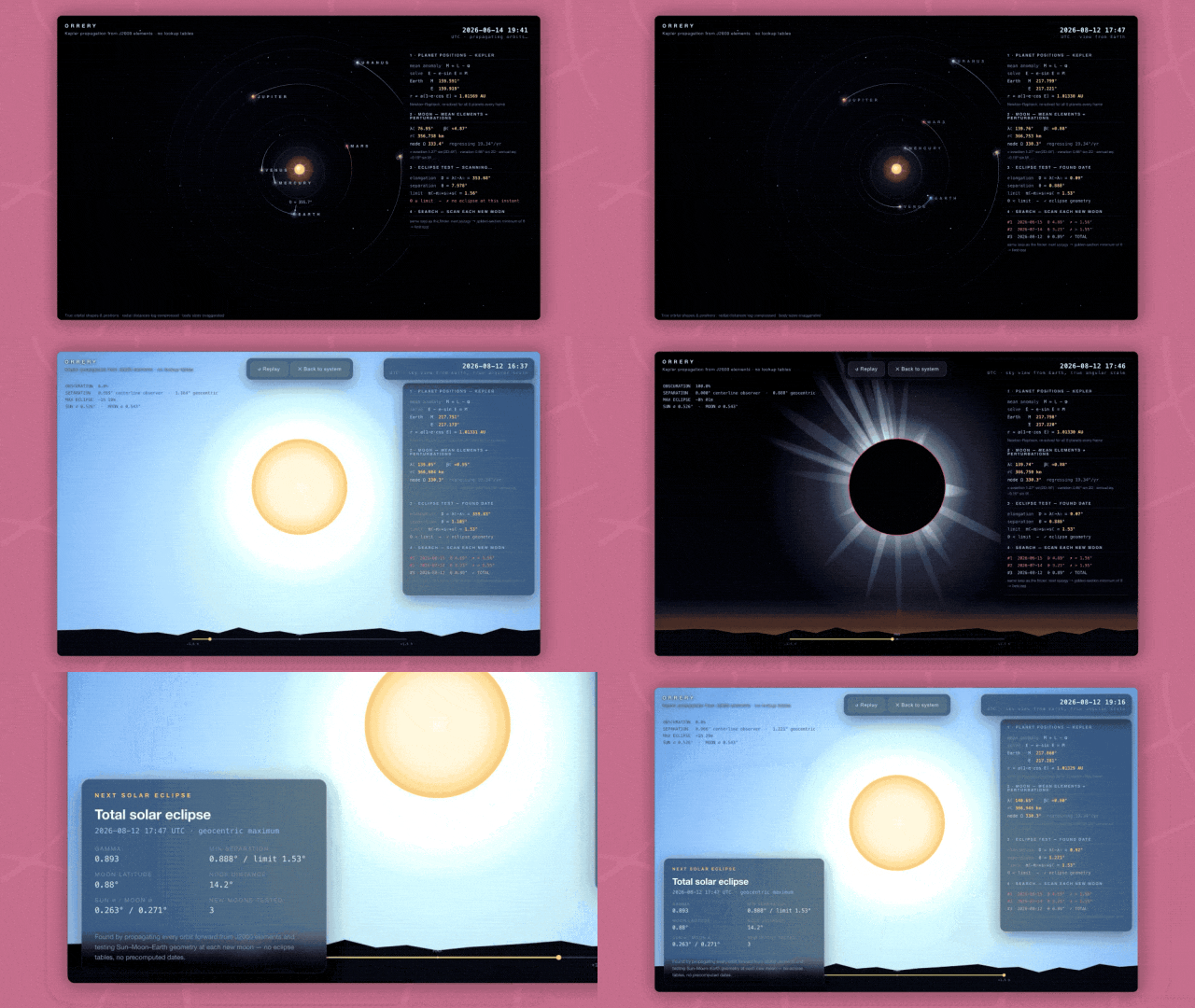
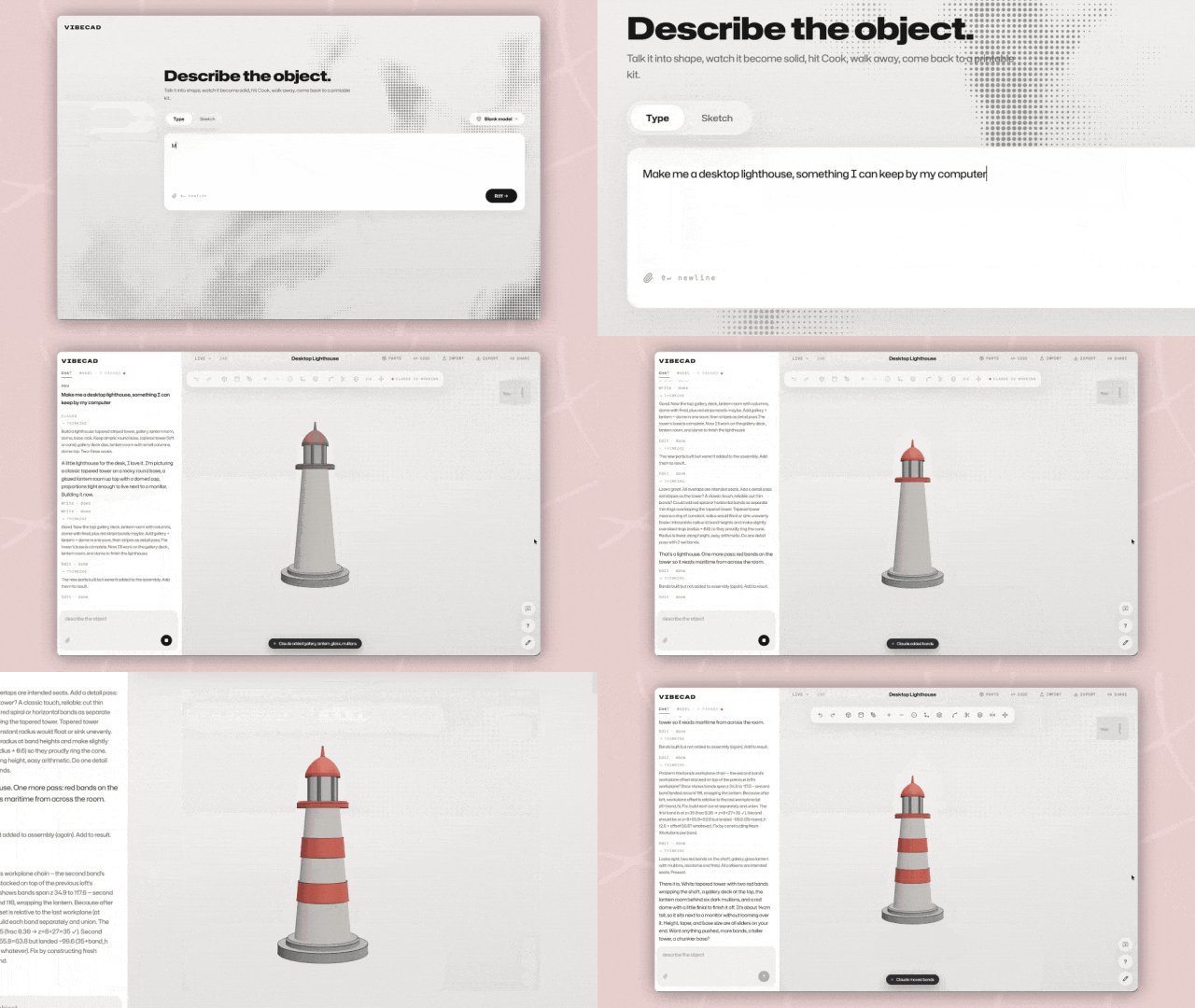
In another demo, Fable 5 first created a browser-based CAD editor and then used this CAD tool developed by itself to design a complete 3D-printable model. This editor also has an AI copilot built-in to assist with modeling.
The key point of this demo is that Fable 5 completed a closed loop: first creating a tool, then using the tool, and finally completing a physical design task.
In the last demo, Anthropic showed a fluid simulation written by Fable 5, with the movement rhythm synchronized with a classical music EDM remix. The official also specifically mentioned that the music was also generated by Fable 5 using code.

These cases may seem flashy, but the message is the same: Fable 5 is very good at combining code, vision, physics, design, and long-term planning to complete tasks.
If the previous part shows what Fable 5 can do in the hands of developers, the following part talks about what Mythos 5 can do in the hands of researchers - and why Anthropic separates Fable and Mythos.
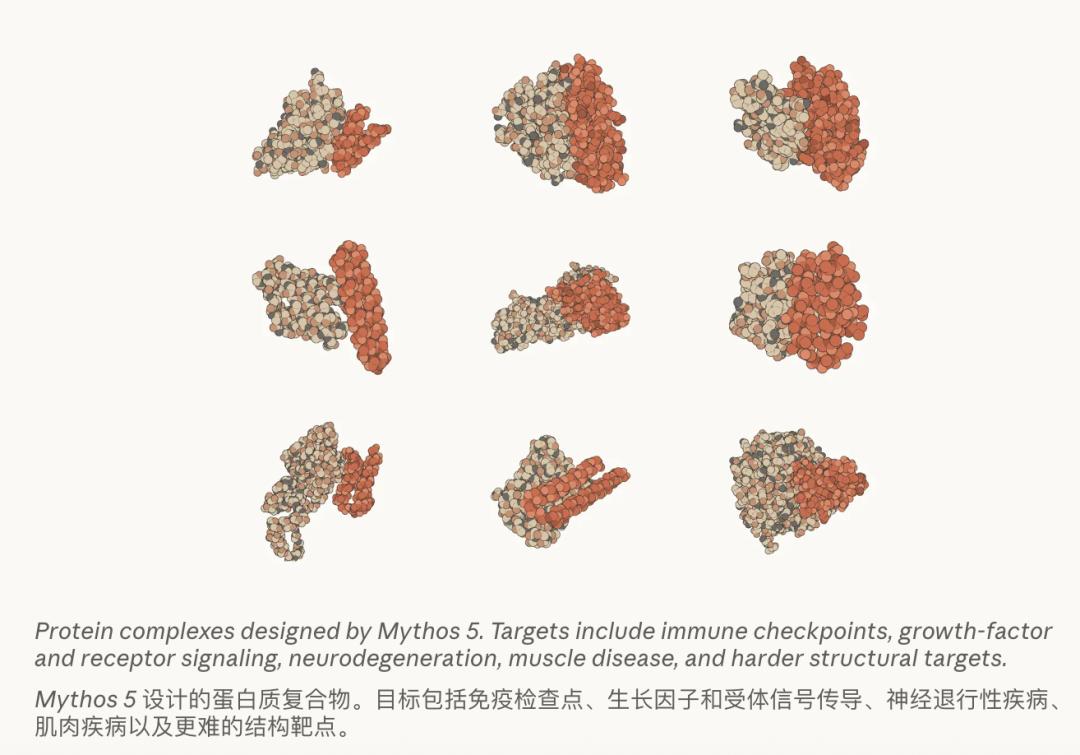
Anthropic says that in the evaluation by internal protein design experts, Mythos 5 accelerated some parts of the drug design process by about 10 times. In one case, Mythos 5, connected to protein design and bioinformatics tools and without human assistance, can match or even exceed skilled human operators.
In this task, Mythos 5 does not just answer simple questions but completes an entire scientific workflow: selecting binding sites, choosing and running protein design tools, and recovering on its own after failure. The official says that among the 14 protein targets in this study, 9 have produced strong candidate molecules, which are currently under further research.
Anthropic also mentioned that Mythos 5 can stably propose novel and attractive molecular biology hypotheses. In a blind test comparison with Opus-level models, internal scientists preferred the hypotheses proposed by Mythos about 80% of the time, and some of them have entered experimental evaluation.
Meanwhile, a hypothesis of Mythos 5 about a new mechanism of E. coli protein was confirmed in the research of another independent laboratory studying the same problem.
It even conducted a genomics study.
Anthropic says that in a little over a week, Mythos 5 almost independently completed a new genomics study. It organized single-cell data across 138 animals and millions of cells and designed and trained a customized machine learning model to identify cells performing the same roles in different species.
Even more amazingly, Anthropic says that the model trained by Mythos 5 outperformed a model recently published in "Science," even though its scale is only one-hundredth of the latter. Anthropic says it plans to publish these results in the next few months.
Of course, this part still needs to wait for the paper and external review. But just looking at the information provided by Anthropic, the capabilities demonstrated by Mythos 5 in life science are close to those of a scientific research agent: it can read problems, use tools, process data, train models, propose hypotheses, and advance a research to the point of publication.
Once the model can truly