Apple hands Siri over to Gemini
On October 4, 2011, Tim Cook hosted a press conference as the CEO of Apple for the first time. This was also Siri's debut at Apple.
Fifteen years later, on June 9, 2026, Cook stood at the center of the stage at WWDC (Apple's Worldwide Developers Conference). It is widely believed that this was the last developers' conference during his tenure. Siri once again became the focus.
However, it is no longer the same Siri as before.
Although restricted by regulatory requirements, the new version of Siri and other new Apple AI intelligent features are not yet available in mainland China, but it still excited many people. In a one - take demonstration, this "new Siri" can directly access, index, and read chat records in most scenarios, support cross - app task execution, and generate browser plugins and shortcut commands through natural language.
But what drives its thinking is no longer entirely Apple's own capabilities. At the press conference, Apple clearly incorporated Google Gemini into the Apple Foundation architecture for the first time. According to Bloomberg, Apple needs to pay Google $1 billion annually for this.
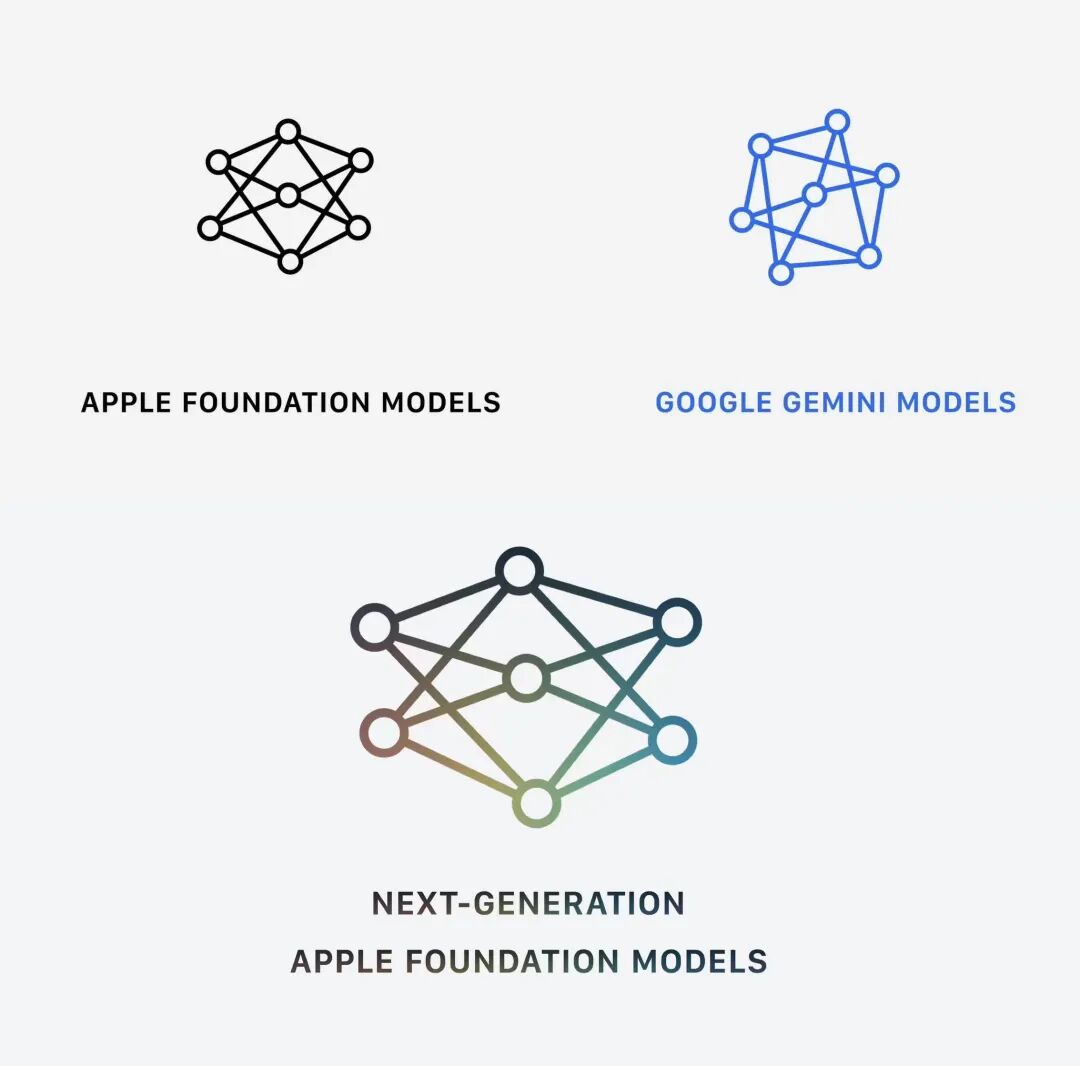
● Apple's third - generation Apple Foundation Models (AFM). Image source: Screenshot from the press conference
Meanwhile, Apple simultaneously launched the Core AI framework, through which third - party models such as ChatGPT and Claude can also access Siri and the Apple system.
Over the past fifteen years, Siri has always represented Apple's understanding of artificial intelligence: closed, self - developed, and cautious. All capabilities are developed within the Apple ecosystem. The Apple Intelligence concept first proposed by Apple in 2024 was also a fully self - developed AI architecture. However, in the competition of AI models, Apple failed to take the lead.
Fifteen years ago, Siri initiated the era of voice assistants; fifteen years later, it became the witness of another turning point in Apple's destiny. This time, Apple is no longer the pioneer but a follower.
The New Siri
At this year's WWDC, Apple spent most of the press conference talking about AI.
On stage was Mike Rockwell. This executive, who has long been in charge of the Vision Pro system architecture, took over the Siri reconstruction project at the beginning of 2025. Apple presented a new set of AI concentric circle architecture: the user is at the center, the middle layer consists of multimodal and execution tools, and the outermost layer is Siri, software, and the system ecosystem.
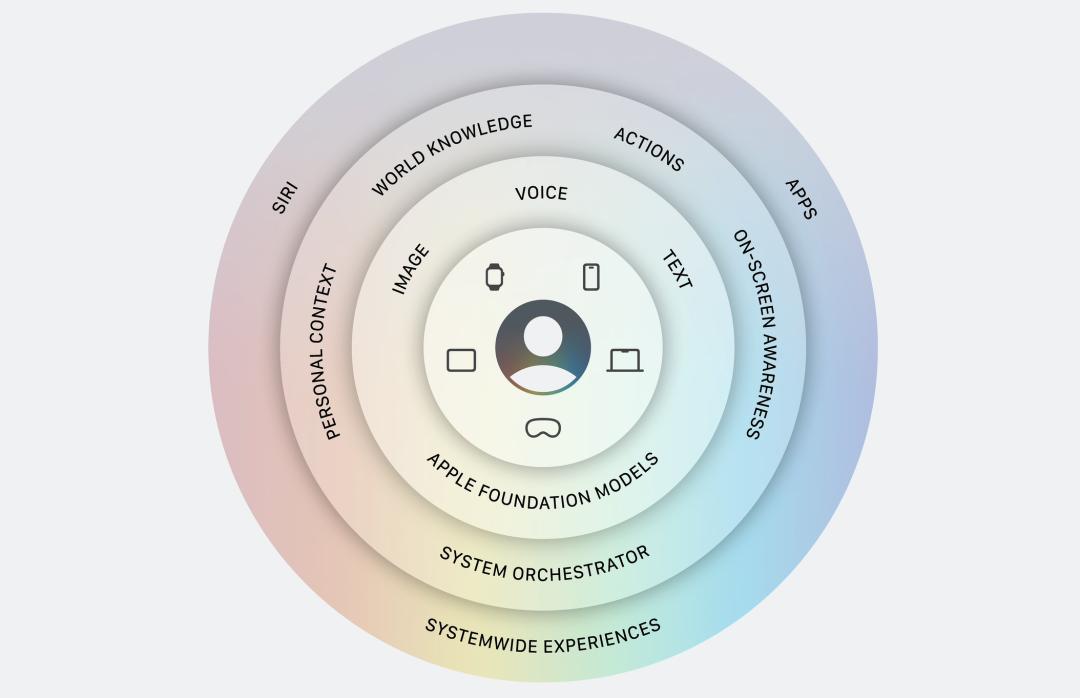
● Apple's new AI architecture. Image source: Screenshot from the press conference
Siri's new functions can be roughly divided into several major parts, such as screen perception, image understanding, text processing, and app collaboration. Users no longer need to switch back and forth between different apps: when they see a picture, they can directly identify the location in the picture; when they see an address, they can directly ask Siri to plan a route; when browsing a webpage, they can directly select text and ask Siri questions; when receiving an event invitation, they can directly ask Siri to identify the time and add it to the calendar.
The key to this change is not being smarter, but being smoother and more convenient. On Mac, users can directly select multiple files to ask questions without uploading; on iPhone, they can directly ask Siri about objects in the real world through the camera; in apps such as Photos, Mail, Notes, and Safari, AI is directly integrated into the original workflow, allowing users to reset the composition of taken photos, organize browser tabs, and embed proofreading and optimization functions in the keyboard for easy access.
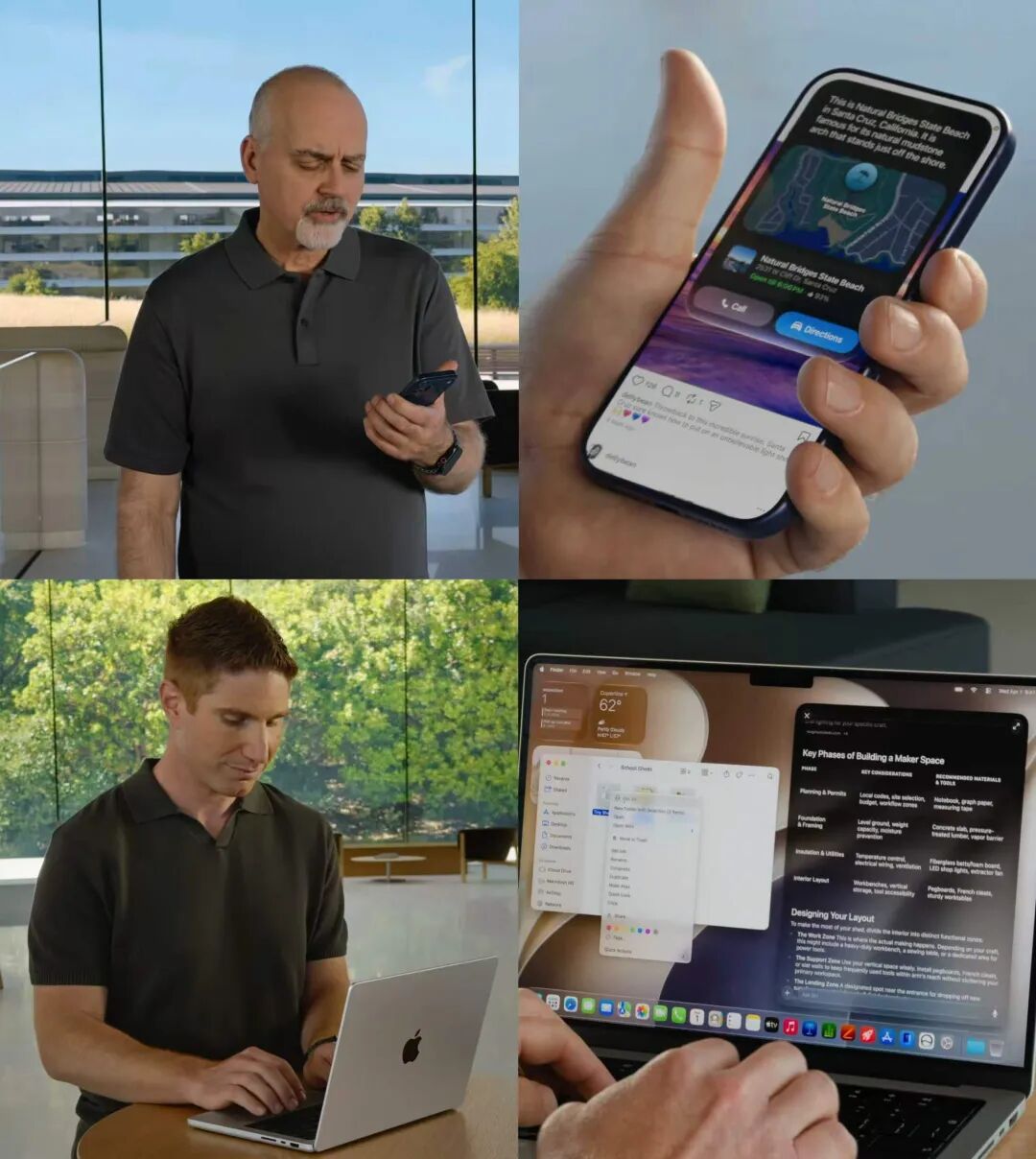
● Invocation of Siri on iPhone and Mac. Image source: Screenshot from the press conference
More importantly, the logic of the old - version Siri was single - round Q&A, while the new - version system starts to understand "what the user is doing". It can use different tones of conversation according to the chat partner and past chat records, actively prompt the next operation based on the email content, or predict the user's intention in cross - app scenarios and provide an execution path in advance.
Apple is trying to redefine Siri, transforming it from a customer service into a scheduling center, and has launched an independent Siri app. This also means that Apple has overturned many of its previous stances: it didn't want to make a chatbot before, but now it has; it was previously reserved about using AI for photo retouching, but now it has added this feature.
In the past, Apple was hesitant about whether to use a self - developed model or an external model for Siri. Now, the team has abandoned the plan of fully self - developed Apple Foundation Models and instead chosen to integrate external technologies. Among the three companies Google, Anthropic PBC, and OpenAI in the negotiation for cooperation, Apple finally chose Google.
Today's third - generation Apple Foundation Models include 2 edge - side models and 3 models running on a private cloud computing platform, several of which are "refined" with the help of the Google Gemini model. The local model and private cloud architecture are designed to ensure that data cannot be accessed by Apple and other third - party companies.
The signal conveyed by this year's WWDC is that Siri has learned to read the screen, summarize webpages, and understand photos. But more importantly, it is a strategic shift for Apple: in the AI era, it is no longer obsessed with being a provider of underlying capabilities, but more inclined to be an organizer of these capabilities.
From Being Ignored to Being Highly Anticipated
Back in 2011, Siri was a product full of imagination. Its origin was not at Apple, but an independent app developed by Siri.Inc, which was launched on the App Store in 2010. It was positioned as a "personal secretary" that could help you book restaurants, check the weather, and integrate information. Its basic technology came from a virtual agent technology development project funded by the U.S. Defense Advanced Research Projects Agency with about $150 million since 2003.
Three weeks after Siri was launched, Apple co - founder Steve Jobs became interested in it and invited the founder for a meeting. Two months later, Apple announced the acquisition of Siri for $200 million and integrated it into the iPhone 4S released in 2012, making it one of the most important features of the latter.
However, from 2011 to 2015, Siri's updates were almost all minor adjustments, such as adding multi - language support, simple information queries, access to encyclopedia content, and the "Hey Siri" wake - up feature. Even in iOS 15, Apple removed functions in Siri related to notes, photos, ride - hailing, and payments. To this day, the most frequently used function on Siri is still the ability it had when it first appeared in 2011 - setting an alarm.
Siri's technological moat is not very solid. In 2012, Samsung's S Voice was close to Siri in terms of functionality; in a comparison test in 2014, Google Now surpassed Siri in information understanding and recommendation capabilities; by 2017, the U.S. technology media The Verge directly evaluated Siri as "significantly behind the times", and its leading window period was actually extremely short.
In 2018, the U.S. technology media The Information disclosed a long - form report on the changes in the Siri team. According to the recollections of former employees interviewed, in the early days, Siri was launched before it was fully prepared, and the backend architecture was not adapted to large - scale user traffic. An Apple employee later rewrote a piece of code, which reduced the server requirements for a certain backend component of Siri from about 500 to 5.
There was also no consensus within Apple on the positioning of Siri. One faction believed that the core of Siri should be search and retrieval, while the other insisted that Siri must become a real assistant.
A former Apple employee said, "Jobs died the day after Siri was launched, and Apple thus lost its direction." As a result, the development of Siri was in a fragmented state for a long time. Some people were in charge of voice recognition, some were responsible for system integration, and others were responsible for optimizing the experience layer. In this context, the Siri team worked independently without a unified evolution logic.
This fragmentation also extended to the product level. The Siri team didn't learn about the plan to integrate Siri into HomePod until 2015. At that time, in order to compete with Amazon's Echo released at the end of 2014, Apple hastily applied Siri to the project. After its release, The New York Times commented, "Siri on HomePod is embarrassingly poor." The poor market performance of HomePod later was also considered by some insiders to be due to the insufficient capabilities of the Siri team.
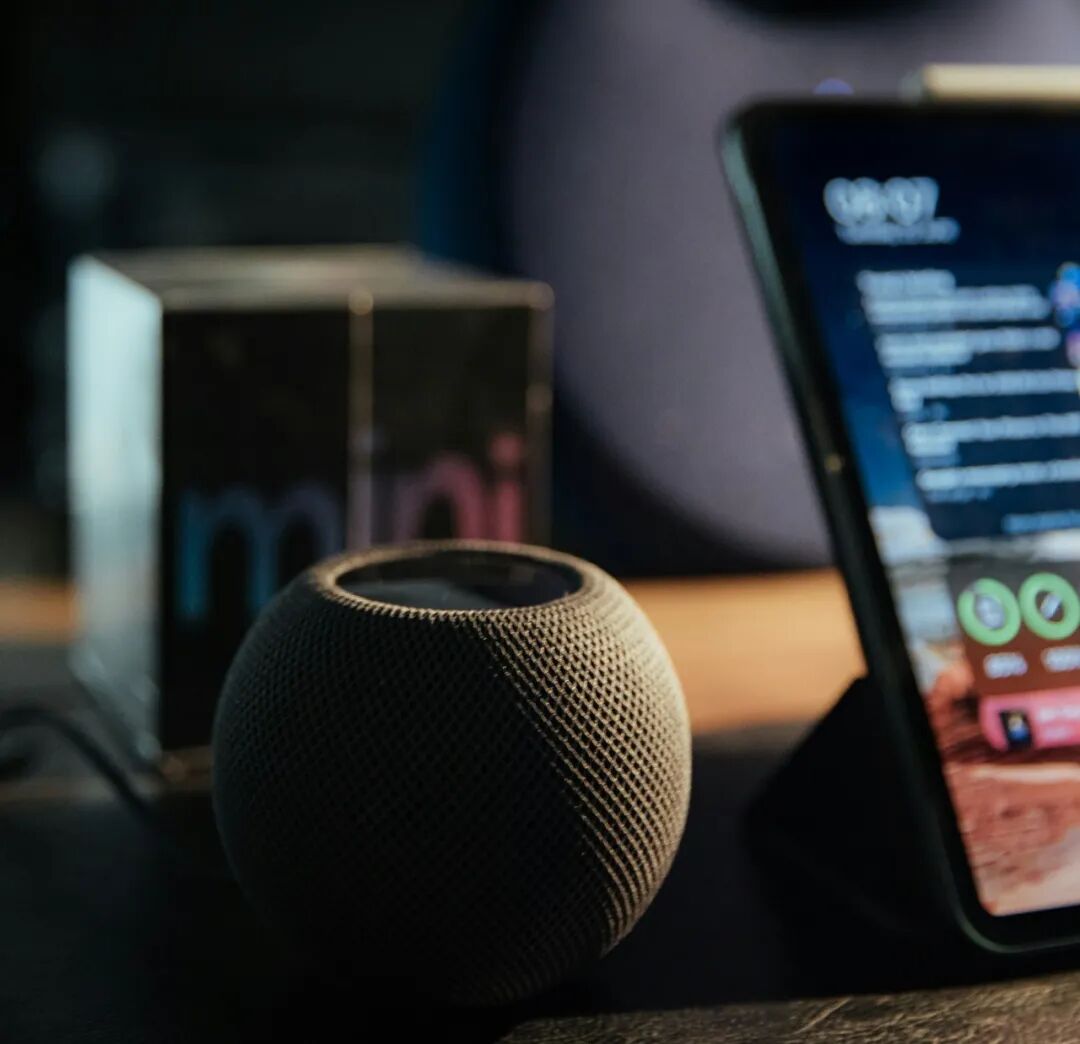
● In 2017, Apple launched the smart speaker "HomePod" with built - in Siri. Image source: Unsplash
Meanwhile, privacy disputes have long cast a shadow over Siri. In 2019, Siri was accused of recording audio when users did not actively wake it up and sending the clips to outsourced contractors for manual listening, which led to a class - action lawsuit. At the beginning of 2025, the California court in the United States approved the settlement agreement reached by Apple in this case. Eligible users received about $8.02 in compensation for each device, with a maximum compensation of no more than $40.1 per person.
The Siri project has also undergone several leadership adjustments within Apple. It was initially led by the iOS team, then an independent team led by Bill Stasior in 2012, and then the machine - learning team got involved in 2018...
It wasn't until the wave of generative AI arrived that the importance of Siri was brought forward again. The turning point in the fate of the new Siri was a meeting at the beginning of 2025. This meeting brought together most of Apple's core leaders except CEO Cook. The meeting confirmed that the performance of Apple Intelligence did not meet expectations, and the iteration of the new - generation Siri would be postponed.
At that time, Cook lost confidence in John Giannandrea, the then head of AI. Rockwell, who led the birth of the new Vision Pro product, volunteered to take over Siri.
After that, Rockwell brought the team that was previously in charge of Vision Pro and the VisionOS operating system to be the new team in charge of Siri and immediately launched the plan to use third - party models. Thus, the new route for Siri was established.
Stop Focusing on Software and Return to Hardware
For this cooperation between Apple and Google, Apple needs to pay Google about $1 billion annually for using its AI technology and infrastructure capabilities.
Over the past twenty years, Apple's technological path has been almost based on the principles of self - developed chips, self - developed systems, and self - built services. This time, the official explanation for using Gemini is that based on a technical evaluation, it is considered that Gemini provides the "most capable foundation model" at present.
In 2022, several large - language models were built by Apple's internal team, but they were shelved because the company's senior management questioned their "lack of practicality". Since then, Apple's investment rhythm and scale in AI have also been conservative. In fiscal year 2025 (from September 2024 to September 2025), its R & D investment was about $34.5 billion, while Meta's was about $57.372 billion and Google's was about $61.087 billion during the same period.
After Siri was postponed several times, Apple essentially gave up its obsession with building a full - stack large model and instead returned to its ecological advantage rooted in hardware. John Ternus, a popular candidate for the next Apple CEO, is currently the senior vice - president of Apple's hardware engineering.
For Apple, the original track is more stable and safer. Even if it doesn't master the model itself, it can still benefit from the distribution layer. It is reported that in 2025, Apple earned nearly $900 million in commissions from generative AI apps through the App Store alone, and it is expected to exceed $1 billion in 2026.
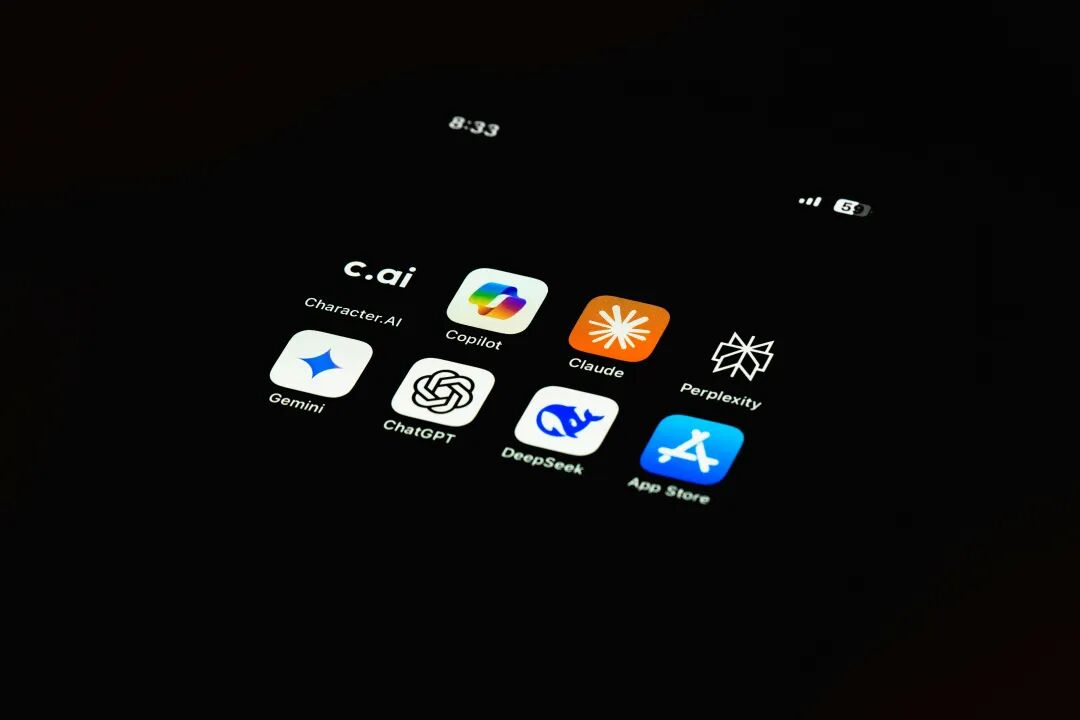
● Multiple AI apps are available on the App Store. Image source: Unsplash
Now, Apple is still increasing its investment in AI, but the direction has changed. The first - quarter earnings report this year shows that for the first time in 30 years, Apple's R & D expenditure as a proportion of revenue exceeded 10%. The R & D expenditure in a single quarter reached $11.4 billion, a year - on - year increase of 34%. When talking about the R & D data, Cook said that one of the reasons for the company's increased investment was the growth potential of artificial intelligence that it saw.
However, Apple's investment structure is significantly different from the paths of Google, Microsoft, or Meta. Some analysts believe that this increase in R & D investment may be largely related to talent training, modeling experiments, in - device AI, private cloud computing, customized chips, and privacy protection, rather than large - scale data center deployment. It is an AI strategy that prioritizes the edge side rather than a cloud - based model competition.
As for why Google Gemini was ultimately chosen, it may be due to overall strategic considerations.
According to official disclosures in May 2026, Google Gemini has reached 900 million monthly active users, and its traffic scale in non - English - speaking regions is already close to 70% of ChatGPT's. Google has calculated that if enterprises replace 80% of their top - model invocations with the latest - generation Gemini 3.5 Flash, they can save $1 billion a year.
In addition, Gemini has been systematically integrated into Google's core products such as Search, Maps, Gmail, YouTube, and Chrome. Just a few weeks before Apple's press conference, Google renamed the new Gemini features on its operating system as "Gemini Intelligence" at its own developers' event, aiming to transform Gemini from a chatbot into an operator across mobile phones, browsers, cars, and laptops.
Another alternative was OpenAI. However, the relationship between the two sides was not stable. According to Bloomberg, an anonymous OpenAI executive said, "We have done everything from a product perspective. They haven't, and worse, they haven't even really tried." Moreover, since last year, OpenAI has poached dozens of Apple engineers from the iPhone, Vision Pro headset, audio technology, and almost all hardware and design departments in order to develop hardware, which has weakened the willingness for long - term cooperation between the two sides to some extent.
In contrast, Google also seems more active and consistent in cooperation. In the process of AI transforming from a tool to an agent, the one who controls the system - level entrance controls the distribution right, and iOS is one of the most stable and high - value entrances in the world. As long - term search partners, the two sides have already formed