Super US-listed IPO reshapes the valuation anchors of MiniMax and Zhipu AI
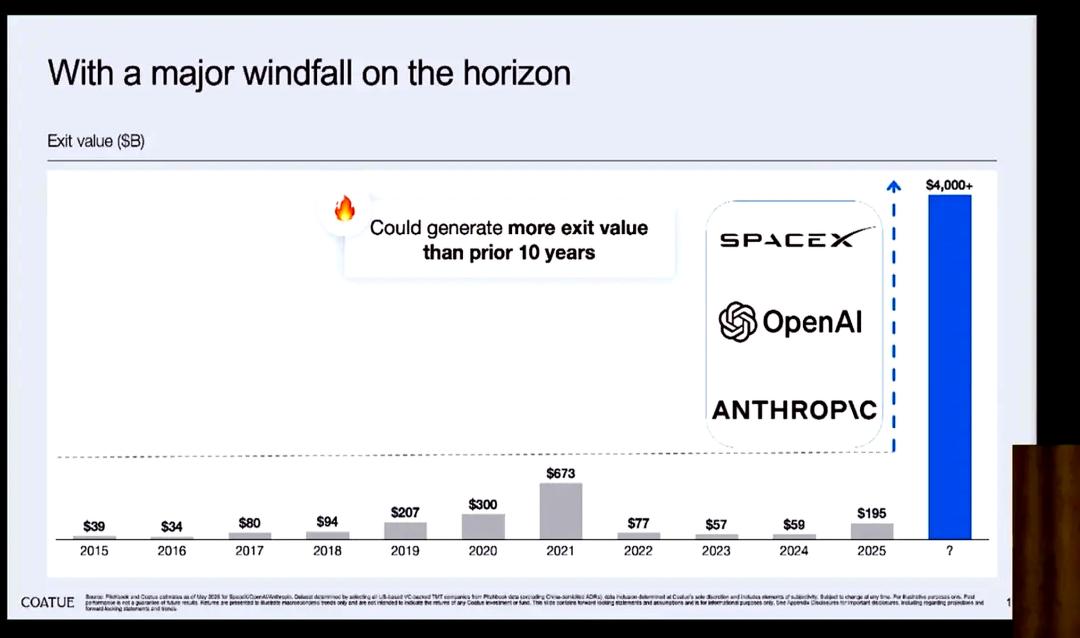
Following Anthropic's announcement on June 1st that it had confidentially submitted a draft S-1 registration statement, OpenAI also announced on the 8th (local time) that it had confidentially submitted its draft S-1. With SpaceX's listing this week, the global capital market will welcome three trillion-dollar companies. Data from Coatue shows that the listings of these three companies mean an unprecedented scale of exits in history. The valuations of the three companies sum up to more than $4 trillion, which is equivalent to the total exit scale of the previous decade.
Source: All-in Podcast
Some analysts also point out that the listings of Anthropic, OpenAI, and SpaceX may "siphon off" the liquidity of funds in the global capital market and impact the valuations of related targets in overseas markets, affecting the valuations of MiniMax (00100.HK), Zhipu (02513.HK), and AI large model companies in the primary market.
The more concentrated bets of investors on large companies are also reflected in the changes in market value. Coatue also points out that the market value growth of technology companies in the past period has shown a phenomenon of "power-law distribution". The larger the company, the higher the probability that its market value will increase tenfold. The probability for companies with a market value of over $100 billion to increase tenfold is 31%, while for companies with a market value between $10 billion and $100 billion, the probability is only 13%. The expected return on investing in unicorns in the primary market may be lower than that of investing in giants in the secondary market.
From a fundamental perspective, the listings of leading AI large model companies will also "revalue" the already-listed Chinese AI large model companies.
Taking Anthropic as an example, if it lists on Nasdaq in the second half of this year as market expectations, its ARR, revenue growth rate, gross profit margin, computing power cost, customer structure, and loss situation will all be laid bare, becoming the valuation anchor for global large model companies.
Currently, public information shows that Anthropic has a valuation of approximately $965 billion and an ARR of approximately $47 billion, corresponding to a P/ARR of about 20 times.
Under this "benchmarking", the valuations of MiniMax and Zhipu have also been adjusted.
As of the close on the 9th, the stock prices of Minimax and Zhipu have declined. They fell 8.58% and 13.55% respectively on the 9th. MiniMax has a total market value of approximately HK$145.7 billion, equivalent to approximately $27.4 billion; Zhipu has a total market value of approximately HK$506.5 billion, equivalent to approximately $64 billion.
Currently, compared with Anthropic, the valuation pressure on MiniMax and Zhipu comes from their P/ARR being much higher than that of the former, and Anthropic's valuation is still a primary market pricing.
Fundamental Narrative: When the Market Pays More Attention to ARR Growth Rate
Judging from the 2025 annual reports, both Zhipu and MiniMax are still in the investment stage, but differences have emerged in their revenue structures, product focuses, and commercialization paths.
In 2025, MiniMax's revenue was $79.04 million, a year-on-year increase of 158.9%. Its gross profit was $20.08 million, and the gross profit margin increased from 12.2% in 2024 to 25.4%. This shows that the company has achieved results in model efficiency and infrastructure optimization. Its adjusted net loss was $251 million, a slight increase from $244 million in 2024. The net loss of $1.87 billion in the annual report was mainly affected by the change in the fair value of convertible redeemable preferred shares and does not fully reflect the operating loss.
In terms of revenue structure, MiniMax is more inclined towards consumer-grade AI native products. In 2025, the revenue from the company's AI native products was $53.08 million, accounting for 67.2% of the total revenue; the revenue from the open platform and enterprise services was $25.96 million, accounting for 32.8%. The former includes AI companionship, video, voice, music, and other products for C-end users, while the latter corresponds to APIs, enterprise customers, and developer ecosystems. The company has a high degree of internationalization. In 2025, the revenue from the international market accounted for 73.0% of the total revenue, serving more than 200 countries and regions. It has accumulated more than 236 million users, and the number of enterprise and developer customers has reached 214,000.
From the above financial data, MiniMax's commercialization has two characteristics: first, the high proportion of To C application revenue and the large user scale provide a global traffic foundation; second, the open platform and enterprise services are growing faster, with a year-on-year increase of 197.8% in 2025, and are becoming a key source of future ARR expansion.
Zhipu's revenue structure is more inclined towards enterprise-level and local deployment. In 2025, Zhipu's revenue was 724 million yuan, a year-on-year increase of 131.9%. Its gross profit was 297 million yuan, and the gross profit margin was approximately 41.0%. The adjusted net loss was 3.182 billion yuan, and the annual net loss was 4.718 billion yuan. R & D expenses reached 3.18 billion yuan, more than four times the revenue of that year, indicating that the company is still in a stage of high-intensity R & D and computing power investment.
In terms of business form, Zhipu's revenue in 2025 mainly came from three parts: the revenue from enterprise-level general large models was 366 million yuan, the revenue from the open platform and APIs was 190 million yuan, and the revenue from enterprise-level intelligent agents was 166 million yuan.
Among them, the open platform and APIs increased by 292.6% year-on-year, and the enterprise-level intelligent agents increased by 248.8% year-on-year, making them the two fastest-growing sectors. In terms of deployment methods, the revenue from cloud deployment was 190 million yuan, and the proportion increased from 15.5% in 2024 to 26.3%. The revenue from local deployment was 534 million yuan, accounting for 73.7%, and it remains the main source of revenue.
This shows that Zhipu's revenue mainly comes from ToB, ToG, and local deployment, but cloud MaaS is growing rapidly. According to media information, in the first quarter of 2026, Zhipu's MaaS API ARR has reached approximately $250 million. Products such as GLM Coding Plan and Claw Plan have begun to bring more subscriptions and token consumption. The company also disclosed at the earnings conference that the API price in the first quarter increased by 83% compared with the end of 2025, and the paid tokens increased by approximately four times compared with the fourth quarter of 2025.
In contrast, MiniMax's ARR in February 2026 was approximately $150 million, and it approached $300 million by the end of May, doubling in about two months. It has set a target of an ARR of over $1 billion by the end of the year. Zhipu's ARR in March was approximately $250 million, and it has also proposed a target of an ARR of $1 billion by the end of the year.
If in 2026, the key fundamental indicators of both companies have shifted to ARR (which also conforms to the current core narrative of the market), but the market has shown obvious differences in their pricing.
Based on the latest data, MiniMax's current market value is approximately $18.6 billion, corresponding to an ARR of approximately $300 million, with a P/ARR of about 60 times. If the ARR reaches $1 billion by the end of the year, the P/ARR will be about 19 times.
Zhipu's current market value is approximately $64 billion. Corresponding to an ARR of approximately $250 million - $500 million, the P/ARR is about 128 - 270 times. If the ARR reaches $1 billion by the end of the year, the P/target ARR will still be about 64 times.
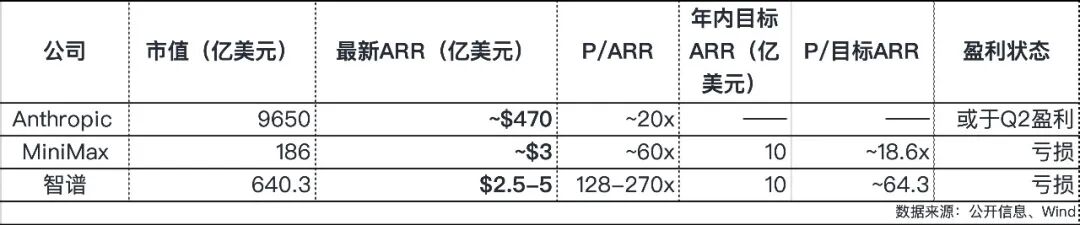
In contrast, Anthropic's latest ARR is approximately $47 billion, a significant increase from approximately $9 billion at the end of 2025, and it is expected to achieve profitability for the first time in the second quarter of 2026. Its valuation in the latest round of financing is approximately $965 billion, corresponding to a P/ARR of about 20 times, and the valuation is still in the primary market.
If Anthropic is used as an "anchor point", the P/ARR of Zhipu and MiniMax is significantly higher. With Anthropic's entry into the secondary market, its valuation "anchor point" will also have an impact on MiniMax and Zhipu:
First, it is the direct comparison in the secondary market valuation. In the past, the valuations of Chinese large model companies could rely more on scarcity, domestic substitution, A-share listing expectations, and the scarcity of the Hong Kong stock floating stock. After Anthropic's listing, investors will directly compare the ARR scale, growth rate, profitability, and cost structure.
The second layer is the diversion of funds. After Anthropic's listing, global AI-themed funds will have a basic model target with better liquidity, more complete information disclosure, and a clearer industry position. For example, some analysts point out that previously, some funds allocated to Hong Kong stock AI because of the scarcity of tradable large model targets globally. Once Anthropic is listed, this scarcity premium will decline.
Company Value Narrative: "Intelligence Density" and "Intelligence Upper Bound"
Beyond the fundamentals, the descriptions of company value by the two companies also reflect some differences between them. This difference in narrative may also be an explanation for the current valuation gap between the two companies. In their financial reports, both companies are trying to redefine themselves from "model companies" to "AI platform companies", but MiniMax emphasizes "intelligence efficiency", while Zhipu emphasizes the scale of intelligent calls.
The biggest change brought by Anthropic's Claude Opus 4.5 is to maximize the scale of Token calls through programming scenarios. Data shows that since 2026, more than 50% of the new Token consumption actually comes from programming scenarios. From the perspective of the "scale" narrative, Zhipu is indeed closer to Anthropic, which may be one of the reasons why the market has given Zhipu a higher valuation despite the similar annual ARR targets ($1 billion).

Next, let's look at the specific differences in expression.
MiniMax mentioned in its 2025 annual report that the platform value is equal to "intelligence density x Token throughput capacity".
First, look at "intelligence density". It refers to the intelligence level that can be achieved per unit of computing resources and per unit of parameter scale. It emphasizes not simply expanding parameters but enabling smaller or more efficient models to achieve capabilities close to those of cutting-edge models through sparse attention, linear attention, high-quality data matching, and model engineering optimization under limited computing power.
Then, look at "Token throughput capacity". It refers to the total capacity and speed of the system to process or serve Tokens, and it emphasizes more on how many users or scenarios the platform can serve, how large-scale traffic it can handle, and how to support massive concurrency and high-frequency use.
The commercial orientation of this route is very clear: to reduce inference costs, improve concurrency capabilities, and enable the model to be called frequently in real production environments.
MiniMax's annual report discloses that the M2 series of models have made progress in programming, tool calls, in-depth search, and long-term conversations. After the release of M2.5 in February 2026, the company further emphasized cost-effectiveness. The company disclosed that at a Token output speed of 100 per second, the cost of continuous operation for one hour is approximately $1. This kind of expression shows that MiniMax emphasizes "cheaper with the same capabilities and stronger with the same cost". Its platform value comes from large-scale calls brought by efficient models.
This may also explain why MiniMax's valuation is more dependent on the climb of ARR. Its core logic is that if the improvement of intelligence density can significantly reduce call costs, then complex programming, Agent tasks, multi-modal creation, and AI applications can be more widely commercialized. In other words, MiniMax needs to prove not only the model capabilities but also whether the low-cost, high-throughput model can be converted into continuous revenue.
Zhipu uses another set of language. The company proposes that the commercial value of AGI is equal to "intelligence upper bound × Token consumption scale" and further emphasizes the Token architecture ability, which is a combination of unit call volume, intelligence quality, and conversion rate.
Compared with MiniMax, the keyword here is "intelligence upper bound", which focuses on the highest level that the large model's capabilities can reach under the constraints of computing power, energy, and data, especially in complex reasoning, long-term tasks, intelligent agent engineering, and underlying architecture innovation.
From this point of view, Zhipu's technical narrative is closer to "breaking through the ability ceiling".
In the annual report, the company emphasizes the GLM - 5 architecture, the dynamic sparse attention mechanism, the asynchronous reinforcement learning framework Slime, long-term tasks, continuous learning, self-reflection, and the adaptation of domestic chips. It hopes to prove that it is not only an application-layer service provider but also a model infrastructure company that can provide basic cognitive intelligence.
The business model corresponding to this route is also different. Zhipu's main revenue still comes from enterprise-level general large models and local deployment, and cloud MaaS is rapidly catching up. Its customers are more inclined towards government, enterprises, industries, and developer ecosystems, and the model is regarded as the underlying ability of all industries. Therefore, Zhipu needs to prove whether a higher intelligence upper bound can bring higher-value enterprise payments and ultimately increase the proportion of cloud API and intelligent agent revenue.
Conclusion: Will the Listings of the Three Giants Mark a Market Inflection Point?
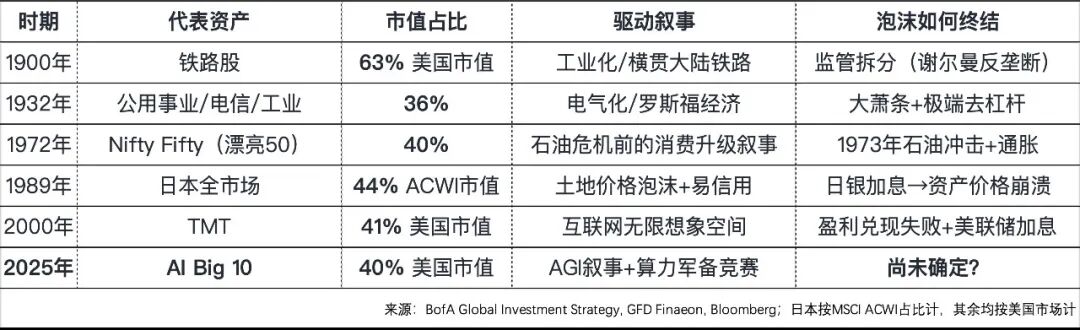
According to research by relevant institutions such as BofA, the top ten AI companies currently account for 40% of the market value of the US capital market. Compared with previous "bub