Put unlisted unicorns into ETFs and sell them to retail investors
In the past, the path for ordinary investors to participate in the growth of a startup was clear and simple.
Startups would go public through an IPO at a certain stage of development. Investors could buy stocks and experience the subsequent growth with the company. However, this logic has been changing in recent years.
More and more star startups are choosing to remain unlisted in the primary market.
SpaceX maintained this unlisted status for a full 24 years before deciding to go public. Many giants are also not in a hurry to enter the public market. Therefore, by the time these companies actually go public, they are often no longer small - scale, high - growth companies, but rather giants with valuations of nearly hundreds of billions or even trillions of dollars.
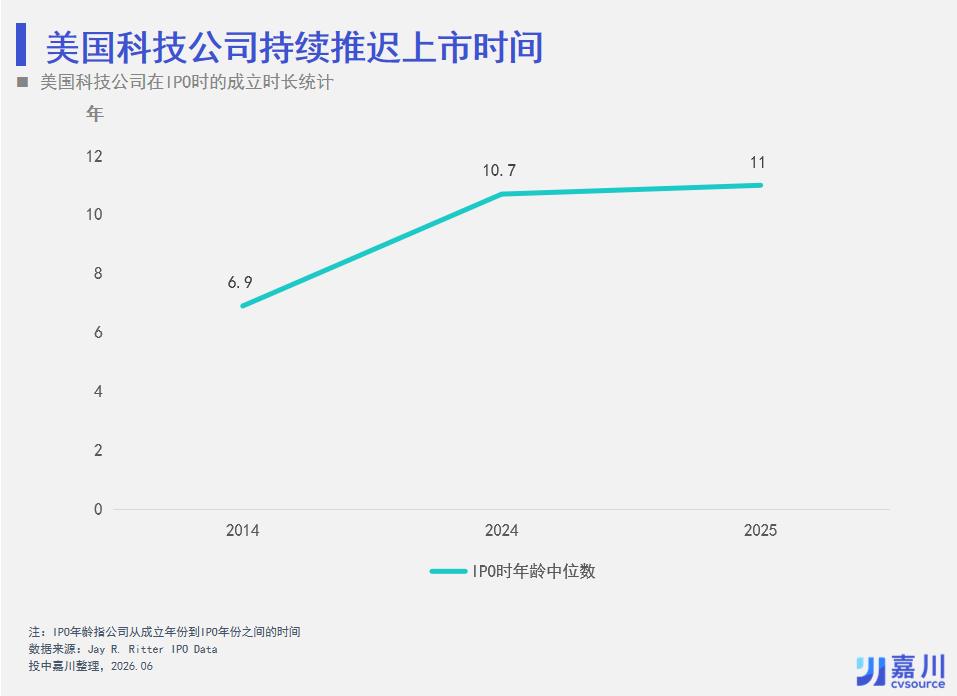
That is to say, the most attractive growth stages are increasingly taking place in areas where ordinary investors cannot directly participate. Judging from the data, this change is quite obvious. The median age of IPOs has risen from 6.9 years in 2014 to 10.7 years in 2024 and is further approaching 11 years in 2025.
As a result, a new type of product has emerged in the US market - Venture Capital Fund ETFs.
They package unlisted star companies like SpaceX, OpenAI, Anthropic, and Anduril into publicly - traded products that ordinary investors can buy, to meet the growing investment needs of retail investors in the public market.
Recently, with the high - profile IPOs and soaring valuations of some unicorns, the scale and returns of these ETFs have also increased. Today, Touzhong Jiachuan will analyze how these ETFs help ordinary investors chase star unicorns.
01. How does the delayed listing of star unicorns give rise to venture capital ETFs?
The continuous emergence of ETF products for investing in star unicorns first reflects the systematic enhancement of the functions of the US primary market.
The most direct change is that the private market has the ability to undertake ultra - large - scale financing. As growth - oriented equity funds, sovereign wealth funds, pension funds, mutual funds, family offices, and strategic investors continue to enter the late - stage private market, top non - listed companies can obtain billions or even tens of billions of dollars in financing without going public.
Especially in fields such as artificial intelligence, aerospace, defense technology, fintech, and enterprise software, leading companies are scarce. As long as the market believes in their long - term growth potential, private capital is willing to continuously provide funds before they go public.
The change in the institutional environment has also provided room for companies to delay their listing. The US JOBS Act has relaxed the threshold for the number of shareholders that triggers the public reporting obligation for some companies, allowing private companies to remain unlisted with more shareholders and a more complex equity structure.
This change has reduced the pressure on large private companies to "be forced to go public" and enables unicorn companies to maintain their private status even as the number of financing rounds increases, employee option pools expand, and early investors transfer their shares.
Meanwhile, the exit mechanism in the US primary market is also improving. In the past, not going public meant that it was difficult for early investors and employees to cash out, so IPOs played an important role in providing liquidity.
However, in recent years, mechanisms such as secondary share transfers, secondary share trading, and SPV transfers have gradually matured, allowing employees, early investors, and some institutional shareholders to obtain partial liquidity before the company goes public.
For example, SpaceX has long provided opportunities for employees and early shareholders to sell their shares through secondary trading and tender offers; companies such as OpenAI, Stripe, and Databricks have also used similar mechanisms to relieve the liquidity pressure on employees and early investors. Although the transparency, participation threshold, and price discovery mechanism of these transactions are still far weaker than those in the public market, they have to some extent reduced the necessity of IPOs as the only exit channel.
Therefore, star startups choose to remain private for a long time not just because the founders "don't want to go public", but because the relative necessity of going public has decreased. Financing can be completed in the primary market, and partial exits can be resolved through the secondary market. A company's brand and customer recognition no longer necessarily depend on an IPO. For the rarest companies, the private market has largely replaced some functions of the public market.
Against this background, ETFs for investing in star unicorns have begun to attract market attention.
The purpose of these products is to address a new investment need: When star unicorn companies do not go public for a long time, how can ordinary investors obtain shares in these unlisted growth assets through public - market tools? Venture capital ETFs, private equity ETFs, or Pre - IPO thematic ETFs are essentially product responses to this need.
They repackage primary - market assets that were originally mainly held by VCs, PEs, sovereign wealth funds, and high - net - worth investors through fund structures, secondary shares, SPVs, valuation arrangements, and custody mechanisms, and then put them into publicly - traded tools that ordinary investors are more familiar with.
From the perspective of asset management companies, this is also part of the trend of retailizing alternative assets.
The competition among traditional stock and bond ETFs is fierce, with fees constantly decreasing and it becoming increasingly difficult to differentiate products. Alternative assets such as private equity, private credit, infrastructure, real estate, and non - listed technology companies still have strong scarcity and high potential for product packaging.
For asset management institutions, embedding star unicorns in ETFs can not only cater to investors' interest in high - growth assets but also create new sources of fees and differentiation outside of traditional public - offering products.
Therefore, the rise of ETFs for investing in star unicorns is not simply a theme hype but a result of changes in the capital - market structure.
On the one hand, the enhanced financing ability of the primary market, improved secondary - market liquidity, and relaxed regulatory environment allow excellent companies to remain private for longer. On the other hand, public - market investors have realized that the value creation of more and more innovative companies occurs before they go public, so they hope to gain exposure to these growth assets through new product forms.
Venture capital ETFs are the product form that emerges between "the delayed listing of star companies" and "ordinary investors' eagerness to participate in primary - market returns".
02. What are the difficulties for ETFs to buy private equity?
However, venture capital ETFs in the market still have some differences from the traditional understanding of ETFs.
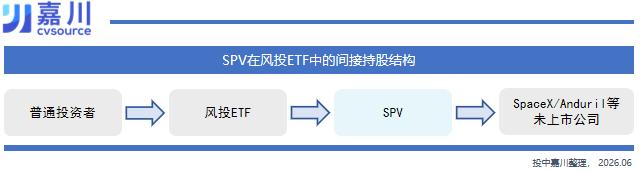
VCs invest in low - liquidity, unlisted, and opaque - valued equity, while ETFs usually require daily trading, high liquidity, and daily net asset values. There is a natural contradiction between the two.
First, traditional ETFs are usually open - ended funds, and investors can trade daily. If an ETF faces large - scale redemptions, it needs to provide cash or deliver securities. However, private equity cannot be quickly liquidated and is difficult to include in the standard redemption basket. This results in the liquidity of the underlying assets not being able to meet the daily liquidity requirements of ETFs.
Second, US ETF funds usually cannot allow non - liquid assets to exceed 15% of the net assets after purchase. Unlisted equity has no public quotes, secondary - market trading is discontinuous, and its valuation depends on models or the latest financing price, so it is easily classified as a non - liquid asset. For an ETF, if it holds too many such assets, it may exceed the 15% limit on non - liquid assets.
Finally, there is the problem of daily valuation. Traditional ETFs need to calculate the NAV every day. Listed stocks have market prices, but unlisted equity has no continuous quotes. The fund can only use valuation models or financing valuations. So although the fund's net value is updated daily, the real price of the underlying private assets is not re - priced on a daily basis.
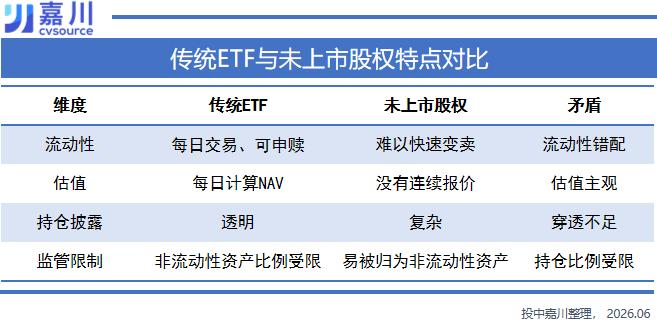
At this time, a special - purpose vehicle (SPV) is needed to indirectly hold unlisted equity.
The role of an SPV is not to turn private equity into public stocks but to provide an intermediate vehicle that can be purchased by the fund.
For example, it is inconvenient for an ETF to directly purchase SpaceX equity, so it purchases shares of an SPV that holds SpaceX equity. In this way, what the ETF holds on its books is not SpaceX common stock but the equity of a certain SpaceX SPV.
The selling point of an SPV is that it packages private equity into an intermediate security. By using an SPV, the fund's position disclosure can show that it holds a certain SPV, and the valuation can refer to the secondary trading of the SPV. This can, to a certain extent, avoid some restrictions of traditional ETFs.
However, it should be clear that an SPV is essentially just a layer of packaging that allows an ETF to indirectly access the equity of unlisted companies but does not turn them into real public - market assets.
03. Not all venture capital ETFs are the same
Due to the above - mentioned contradictions, venture capital fund ETFs are not a simple upgrade of traditional ETFs but a hybrid product with structural risks.
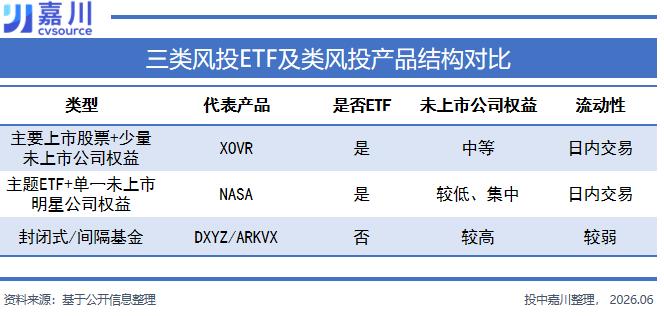
Currently, relevant products can be roughly divided into three categories:
The first category focuses on listed companies + a small position in private equity.
It allocates most of its assets to listed technology companies and a small portion to the SPV equity of unlisted star companies such as SpaceX and Anduril. The attractiveness of this type of product is that it is a real ETF, easy to trade, and has no long - term lock - in period like traditional venture capital funds. However, the proportion of private equity it holds is still restricted by the 15% limit on non - liquid assets, and there are problems such as opaque SPV valuation.
The representative ETF of this category is XOVR, which belongs to the ERShare product system. XOVR officially defines it as a Private - Public Crossover ETF. The private securities part has no quotes and needs to be fairly valued according to the fund's valuation policy. Its structure is closest to that of an ordinary ETF, with intraday trading, no qualified - investor threshold, and no minimum investment amount. However, there may still be problems with liquidity mismatch.
The second category is a thematic ETF + shares of a single star unlisted company.
The theme usually refers to a specific industry, such as the space economy or defense technology. The fund mainly holds the equity of relevant listed companies and then adds the SPV equity of one or a few unlisted star companies.
It emphasizes the industry theme more than the first category. Private equity is only used to enhance the product's selling point. It has a strong theme risk, with highly concentrated private equity, but the proportion of the position is relatively low, so the structural pressure is smaller than that of the first category.
The representative product of this category is an ETF called Space Innovation (NASA). It is a space - industry ETF launched by Tema ETFs LLC, covering space business opportunities such as rockets, propulsion systems, and satellite technology. However, since it includes the unlisted equity of SpaceX, it has the characteristics of a venture capital ETF.
The third category is closed - end/interval funds.
This type of product is actually the retailization of venture capital funds, not ETFs, but it is more suitable for holding a large amount of unlisted company equity. Since ETFs have strong requirements for daily trading and liquidity, while venture capital funds have poor liquidity and opaque valuations, they are more suitable for this type of fund.
The representative products are DXYZ issued by Destiny Tech100 Inc and ARKVX managed by Cathie Wood. Their holdings almost cover all the hot companies in the current primary market. Currently, ARKVX has total assets of about $1 billion, with SpaceX being the largest holding, accounting for 11.38% of the net assets.
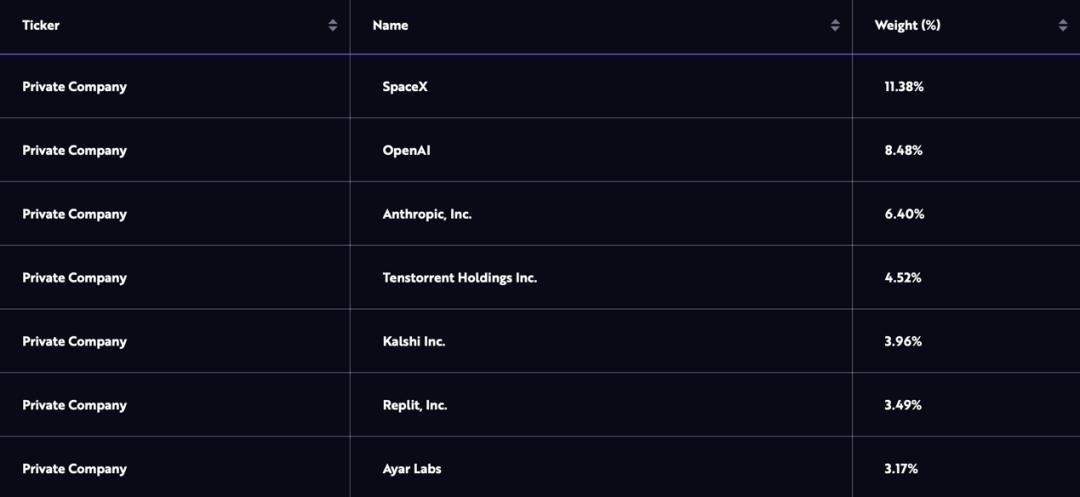
The difference between DXYZ and ARKVX is that DXYZ is a completely closed - end fund. Investors buy and sell the fund through the exchange but face the risk of the price deviating significantly from the NAV. ARKVX is an interval fund with regular open redemptions. Investors subscribe and redeem based on the fund's net value, but the liquidity is restricted by time and redemption limits.
The underlying assets of these two are closer to a real VC portfolio, with the investment goal of covering the company's life cycle from the private stage to the listing stage. However, the issues of liquidity, fees, valuation, and premium/discount are more complex.
04. Buying shares in star companies does not equal getting excess returns
So, how much money can investors actually make by buying venture capital ETFs?
Let's take XOVR, a venture capital ETF with the model of "focus on listed companies + a small position in private equity" as an example. As of March 31, 2026, XOVR officially reported an AUM of $459.7 million, with 33 holdings and a management fee of 0.75%. In addition, XOVR holds about $205 million in SpaceX equity through an SPV.
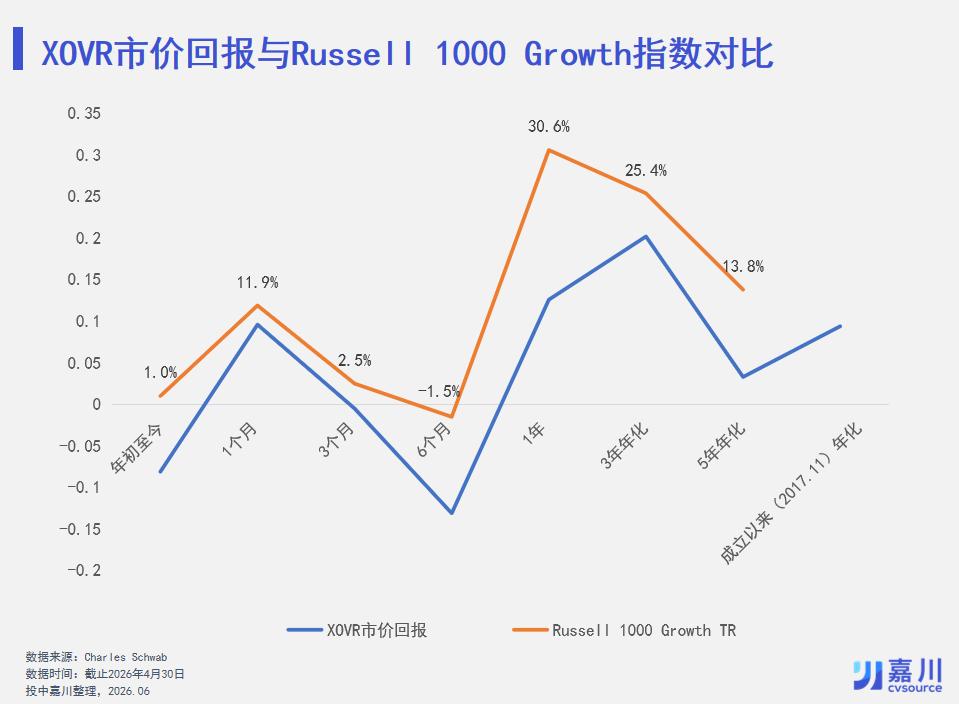
However, data shows that XOVR's returns have not outperformed the mainstream growth - stock index because of its holdings in unlisted star companies. As of the end of April 2026, XOVR's market - price return in the past year was 12.6%, while the Russell 1000 Growth Index was 30.6%.
This shows that buying a partial stake in an unlisted star company does not necessarily mean that the fund as a whole will obtain excess returns.
Next, let's look at the NASA ETF with the model of "thematic ETF + shares of a single star unlisted company".
Data shows that NASA has an asset - management scale of about $1.3 billion, with SpaceX being the largest holding, accounting for about 11.1% of the portfolio. The fund was established on March 30, 2026. Benefiting from the expectation of SpaceX's IPO and the popularity of the space economy, it rose by about 35% in the two months after its listing. However, due to its short establishment time, its returns seem to be driven by the space - economy theme and the expectation of