WeChat AI officially announced: The developer beta test has been launched
[Introduction] Developers don't need to write a single line of code, and the mini-program will automatically become a "skill" that AI can call! WeChat is completely "Agentizing" its entire ecosystem.
Just now, WeChat has taken action on AI again!
On June 8th, WeChat officially released the "Guidelines for Developers to Access the WeChat AI Ecosystem".
Starting today, developers who have obtained the internal test can authorize WeChat to allow its AI to read your mini-program, operate your mini-program, and help users evoke your mini-program services.
Hundreds of millions of mini-programs are becoming the hands and feet of AI.
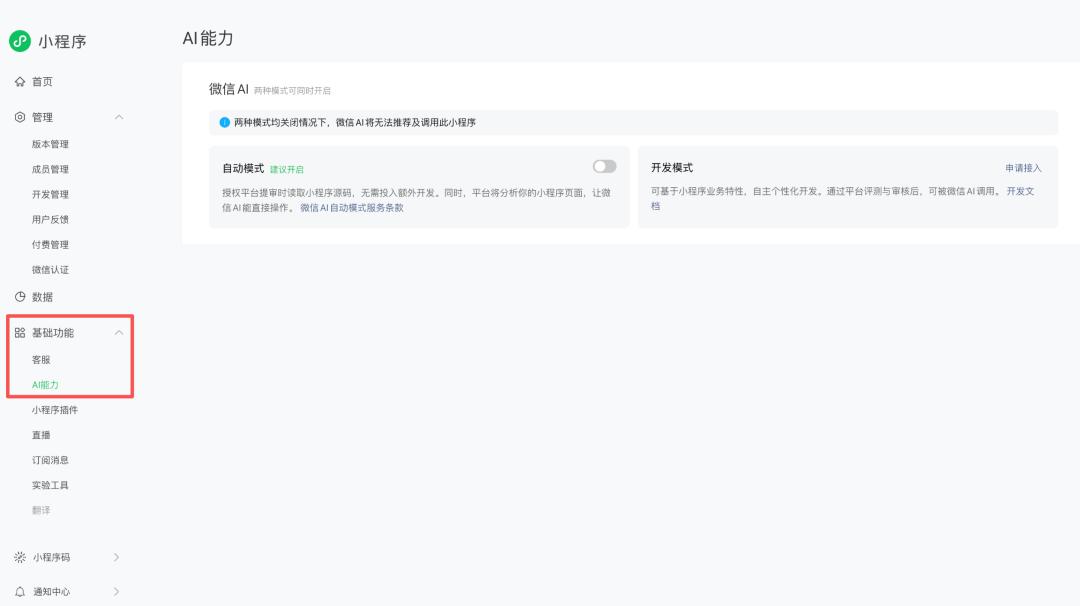
One authorization, millions of mini-programs become Agents
Specifically, WeChat provides developers with two modes to access the AI ecosystem. They can choose according to their needs or enable both at the same time.
The automatic mode has almost zero threshold.
Turn on a switch, and the platform will take care of the rest. WeChat will read the source code, disassemble the pages, and figure out what your mini-program can do in the background, and then the AI can directly start operating. Developers don't need to touch a single line of code.
With one authorization, your mini-program will enter the AI's toolbox.
The development mode offers more space.
Developers can independently develop customized skills based on their own business characteristics. After passing the platform's evaluation and review, they can be called by WeChat AI.
For teams with complex interaction logic and unique business scenarios, this path is more suitable.
According to the service terms, the "WeChat AI Automatic Mode" allows users to call, access, and operate mini-programs through WeChat AI, and automatically generate and call skills based on the code.
WeChat officially emphasizes that whether to access is entirely up to the developers' independent decision and will not affect the existing mini-program services.
What ASI lacks is not just a brain
The significance of this update is not just an upgrade of a developer tool. It addresses a problem that the global AI industry is facing.
On the road to ASI, there is a frequently overlooked bottleneck: AI can think but can't act.
Large models can write poems, reason, and pass the lawyer qualification exam, but it is still difficult to call a car, buy a cup of coffee, or complete an order for you today.
What is lacking between "being able to think" and "being able to do" is an execution layer that connects to the real world.
Globally, the implementation paths of AI Agents are diverging into two lines.
One is to perfect the model first and then connect to services one by one.
ChatGPT connects with Shopify for e-commerce, DoorDash for takeout, and Stripe for payment. Each connection is built from scratch.
The other way is the opposite. Add a layer of AI scheduling on top of a service ecosystem that has been operating for many years.
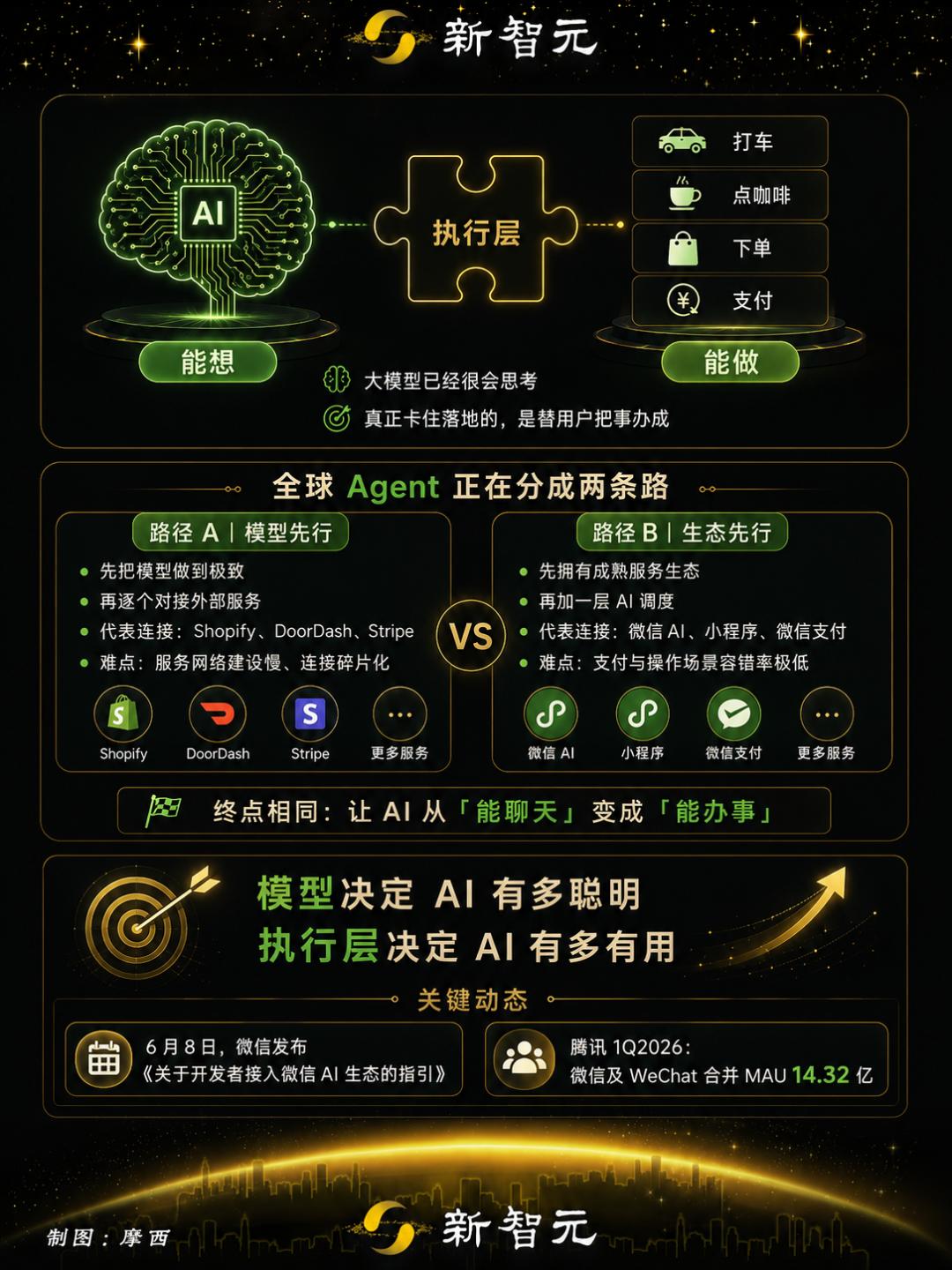
Both paths have their own difficulties.
The problem with the former is that the service network is built too slowly. Even today, the proportion of transaction-related queries on ChatGPT is still less than 3%.
The problem with the latter is that the model's capabilities need to keep up. When AI operates on behalf of users in payment scenarios, the tolerance for errors is almost zero, and the accuracy requirements for the underlying model are much higher than those for conversations.
There is no answer yet as to which path will work.
But the end goal of both paths is the same: to make AI go from "being able to chat" to "being able to do things".
The model determines how smart AI is, and the execution layer determines how useful AI is.
There will be an AI that can do things in the phones of 1.4 billion people
WeChat's trump card in becoming an Agent is its ecosystem.
As of the first quarter of 2026, the combined monthly active users of WeChat and WeChat International reached 1.432 billion.
Mini-programs cover hundreds of niche fields, and WeChat Pay, official accounts, video accounts, and service notifications are all available.
There is a prerequisite for the automatic mode to achieve this.
Different from independent apps, the code of mini-programs runs in WeChat's technical environment from submission, review to launch. The platform has complete visibility of the code and page structure of each mini-program.
With this prerequisite, WeChat doesn't need to discuss with developers one by one how to access AI. It can directly solve the problem from its end.
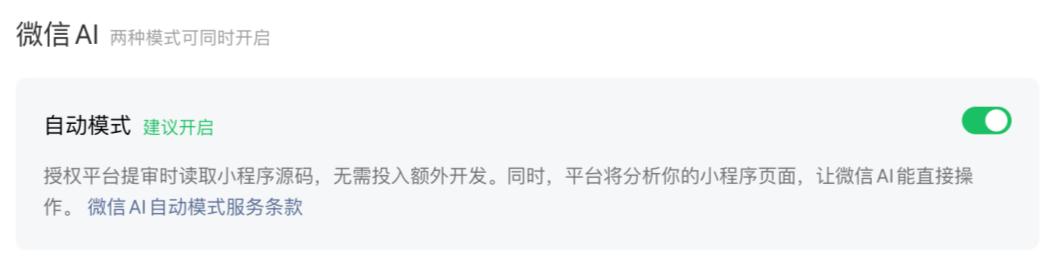
Combined with WeChat Pay, a complete link from demand to transaction is formed.
Users just say a word, the AI disassembles the intention, selects a suitable mini-program to execute, and WeChat Pay completes the transaction. The entire link is within WeChat.
For ordinary people, the change is very intuitive.
In the past, to check a courier, you had to open the corresponding mini-program, enter the tracking number, wait for the page to load, and then look through the logistics details. In the future, it may just be a sentence like "Where is the pair of shoes I bought yesterday?"
For the elderly who are not good at operating mobile phones, this change may be more practical than any interface redesign.
Now, the pieces of the puzzle such as technology, ecosystem, and computing power are being completed.
When there is an AI in the WeChat of 1.4 billion people that can call mini-programs and help you run errands, the starting gun has been fired.
Reference materials: Guidelines for Developers to Access the WeChat AI Ecosystem
This article is from the WeChat official account "New Intelligence Yuan", author: ASI Revelation; editor: Moses. It is published by 36Kr with authorization.