36Kr Exclusive | The only domestic team with industrialization experience in POD materials has launched a new startup, focusing on thermal management for 3C devices and AI chips, with world-leading technological accumulation
Author | Qiao Yujie
Editor | Yuan Silai
Hard Kr has learned that Suzhou Mofeng New Material Technology Co., Ltd. (hereinafter referred to as "Mofeng Technology") recently completed a new round of tens of millions of yuan in financing, invested by Xianfeng Fund and Chengdu Science and Technology Innovation Investment Group. The funds will be mainly used for production line expansion and capacity expansion.
Mofeng Technology was established in 2023. Its technology is derived from nearly 20 years of research results on polymer materials at Sichuan University, focusing on the industrialization of high-performance POD (polyaryloxadiazole) films.
As a high-temperature-resistant polymer, POD attracted attention as early as the 1960s and 1970s. However, due to process problems and equipment corrosion problems during the processing and forming process, the industrialization was extremely difficult, and related research stagnated for a long time.
The systematic research on POD in China started relatively late but progressed rapidly. Around 2006, the team of Professor Xu Jianjun at Sichuan University began to continuously promote the research on POD materials. In 2008, Jiangsu Baode New Material established a POD fiber pilot line using relevant technologies from Sichuan University and achieved mass production in 2011, becoming the only enterprise in China to realize the industrialization of POD fibers.
The core team of Mofeng Technology all comes from the research group of Professor Xu Jianjun at Sichuan University. Li Wentao, the founder of the company, once participated in and presided over the whole process from small-scale testing, pilot testing to mass production and market development of POD fibers at Jiangsu Baode New Material, with rich industrialization experience. Jiang Mengjin, the co-founder, is a professor at the College of Polymer Science and Engineering of Sichuan University, and has long been deeply involved in the research on high-performance POD.
In the traditional POD film process, the first-generation products can only be cut into pieces for firing and cannot be fired continuously in a roll-to-roll manner, resulting in low loading capacity, high cost, and poor efficiency. At the same time, the surface of the graphitized film powders seriously, which also affects the end-use experience.
In response to the above problems, Mofeng Technology has optimized the forming process to improve the modulus and crystallinity of the material, significantly enhancing the rigidity of the film, which can support roll firing without deformation and greatly reduce the firing cost. At the same time, the compactness of the material is improved, effectively reducing internal defects and holes, significantly improving the powdering problem, and meeting the requirements of high-end applications.
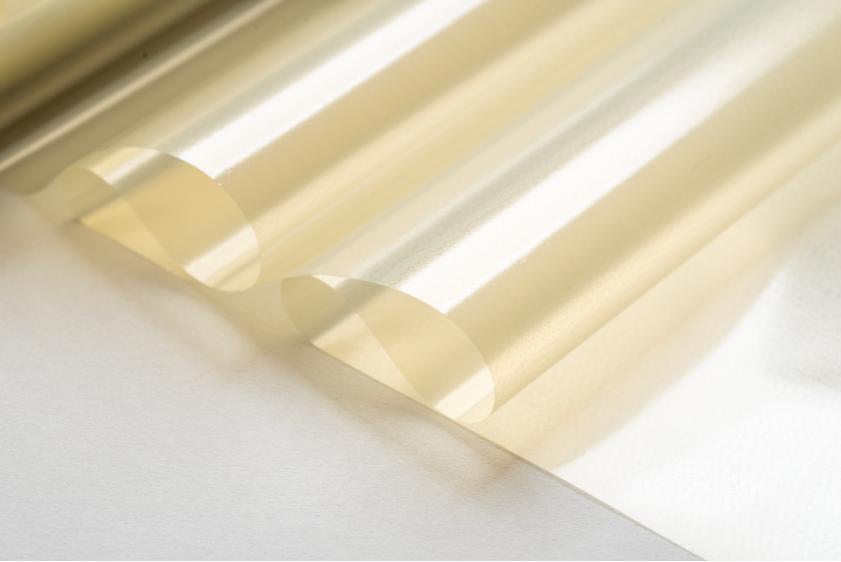
At present, the performance of the POD film products mass-produced by Mofeng Technology is at the leading level in the industry. The original film has good mechanical properties, with an initial modulus of up to 4.0 GPa, a tensile strength of more than 200 MPa, a film-forming thickness of more than 400 μm, and a maximum thickness of up to 200 μm after graphitization and calendering. Ultra-thick products can be prepared. Verified by downstream customers, the thermal diffusion coefficient of the POD graphite film is greater than 1000 mm²/s, and the thermal conductivity of the product after graphitization can reach 2000 W/(m·K).
(Image source/Enterprise)
On the application side, Mofeng Technology currently adopts a "dual-track layout" strategy, taking the consumer electronics market as the basic market and simultaneously expanding into the fields of AI chips and TIM materials for optical modules, covering high-growth and high-value-added downstream scenarios.
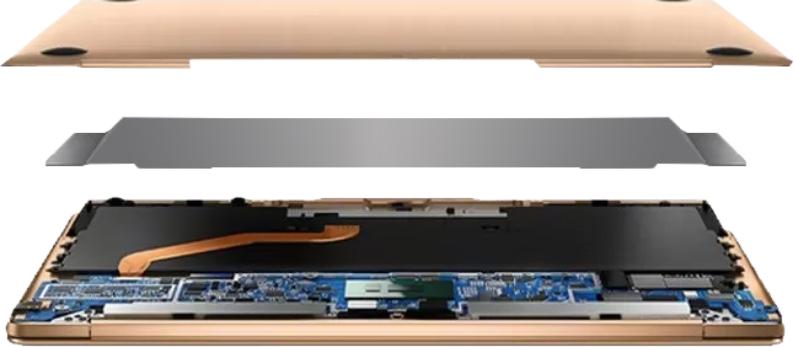
In the field of consumer electronics, the company provides graphite film precursor solutions for the heat dissipation upgrade needs under the trend of thinning of 5G mobile phones, foldable screen devices, and high-performance laptops. For the heat dissipation film products of mobile phones and tablets, thickness and thermal performance are the core indicators that customers are most concerned about. Mofeng Technology can prepare extra-thick and ultra-thick products with high thermal conductivity, which are superior to domestic and foreign competitors in terms of thermal diffusion ability and overall heat dissipation performance.
(Image source/Enterprise)
In the field of upstream original film materials for AI chips and optical module TIMs, the company prepares chip thermal interface materials through the processing of high-foaming products to solve the heat dissipation problems of high-power and large-area chips.
According to the company, many leading mobile phone manufacturers have shown a strong willingness to introduce the products, and the market demand is being rapidly released.
At present, the company's annual production capacity is about 100 tons, and the scale of a single order has reached dozens of tons. Therefore, the company is planning to add a new POD film production line with an annual capacity of 300 - 500 tons.
The following is an excerpt from an interview between Hard Kr and Li Wentao, the founder of Mofeng Technology (slightly edited):
Hard Kr: What core barriers has Mofeng Technology established in the preparation of POD film products?
Li Wentao: The core barriers of POD film products are mainly concentrated in two aspects: the film-making solution and the film preparation. These are also the key directions that the team has focused on breaking through after years of research and development.
Among them, the film-making solution is the most core and complex part of the entire POD film manufacturing process. In essence, it is a system that highly depends on process experience and process control. It requires precise control of the ratio of different reactants, the feeding sequence, and the temperature and pressure at each reaction node. At the same time, specific film-forming auxiliary agents need to be added. This involves a large amount of long-term accumulated know-how, which is also the most core formula and process ability of Mofeng.
In the film preparation process, for the POD acid-containing film, Mofeng has developed a unique "wet one-way diffusion" process through continuous research, which can improve the solidification efficiency and effectively reduce the defects generated during the phase separation process.
Mofeng has also independently designed and built a complete production line. Through multiple cyclic treatment processes, it can improve the water washing efficiency and significantly reduce the amount of wastewater generated. In the subsequent processing, the company's unique double-stretching process and heat-setting process can further improve the strength, modulus and other properties of the product, and reduce the problems such as powdering and bubbles in the graphitization process.
Hard Kr: Why is the POD material particularly emphasized in the field of AI chips in addition to the 3C field?
Li Wentao: At present, the power consumption and heat generation of computing chips are very large. The thermal conductivity of traditional TIM materials such as thermal grease and thermal gel is usually less than 10 W/(m·K), which is difficult to meet the rapid heat dissipation needs of AI chips.
We have developed a new thermal foam solution based on POD materials. After downstream post-processing, the overall performance is very good, and it can initially reach the level of the graphene solution.
Although graphene is also a popular heat dissipation solution, its cost is relatively high, and it is difficult to further improve the thermal diffusion performance. At present, it is usually difficult to reach about 900 W/(m·K). Our POD solution can reach more than 1000.
In addition, PI materials cannot be fired into thermal foams with both high thermal conductivity and good elasticity. The fired products will be relatively hard and difficult to be applied in the TIM material scenario. POD has better processability and comprehensive performance advantages.
Hard Kr: In which other fields may the POD material be applied in the future?
Li Wentao: At present, POD is mainly used as a thermal conductive material in the 3C and chip fields, and its core value comes from the performance after subsequent graphitization processing. The products made by our second-generation technology have higher orientation and crystallinity. Therefore, in addition to thermal conductivity, their mechanical properties are also very outstanding.
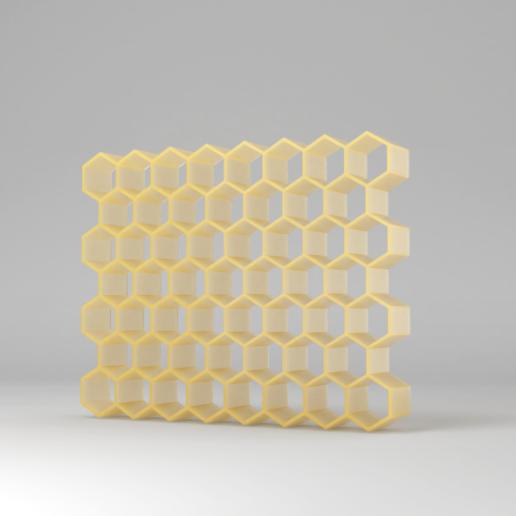
For example, in the aerospace field, we value its high strength and lightweight characteristics. At present, a honeycomb material called aramid paper is widely used in the aerospace and high-speed rail fields for weight reduction and structural reinforcement. We are trying to use POD films to replace such materials. Compared with paper-based materials, POD films are lighter in weight, higher in strength, and better in heat resistance. We have cooperated with downstream processing enterprises to process POD films into honeycomb structures, and the overall performance is very good after testing.
(Image source/Enterprise)
However, the development cycle of such new applications will be relatively long and requires continuous investment. At present, we will still focus on the 3C field first and seize the market opportunities that can be quickly implemented.