20 stores opened in one city within a week, Pinduoduo's Douyin-style e-commerce sparks a physical store expansion spree
Like the otaku merchandise stores, frisbee businesses, and all the other ventures popularized on social platforms, bean art is ultimately a temporary hot - spot emerging from the combination of the interest - based economy and low - threshold entrepreneurship.
At the Youth Plaza in Chaoyang, Beijing, the elevator doors opened, and two girls who looked like junior high school students stepped out. As they took out their phones to confirm the reservation information, a clerk from a bean art store approached them and said, "Which bean art store are you going to? I'll take you there."
This is a core commercial area near Joy City in Chaoyang, with a huge flow of people. In the past two months, bean art stores have mushroomed in the surrounding area. There was initially one store, then three on the same floor, and now there are at least ten in the whole building. Some clerks even wait at the elevator entrance to attract customers, saying, "You can cancel your other reservation and do it here instead. It's the same."
The fierce competition stems from the rapid popularity of bean art. This handicraft activity, which involves creating patterns with plastic beans and then fusing them by ironing, has become one of the hottest offline consumption choices for young people in 2026. The #bean art hashtag on Douyin has been viewed nearly 30 billion times. Bean art ranked second among Taobao's top ten products of the year, and the group - buying order volume has skyrocketed by 9018% year - on - year.
The intensive promotion content on social platforms has continuously channeled online traffic back to offline stores. As a result, bean art has become an entrepreneurial entry point for many people to open stores.
Currently, there are more than 2,200 companies related to bean art across the country, and 90% of them were newly established within the past six months. In Beijing alone, there are already more than 240 bean art stores. A store owner in Shanghai once mentioned in a public event that more than 20 specialized bean art stores were newly opened in a week, not including those handicraft stores that offer bean art as one of the experiences. A handicraft store owner in a third - tier city in Sichuan mentioned that there was only one handicraft store offering bean art experiences during the Spring Festival, but now there are thirty or forty new stores.
A group of eager young people quit their jobs, took out their savings, and opened their own small bean art stores in their hometown towns or office buildings in first - tier cities. On social platforms, stories of "recouping the investment in 30 days" and "earning 30,000 yuan a month" are everywhere.
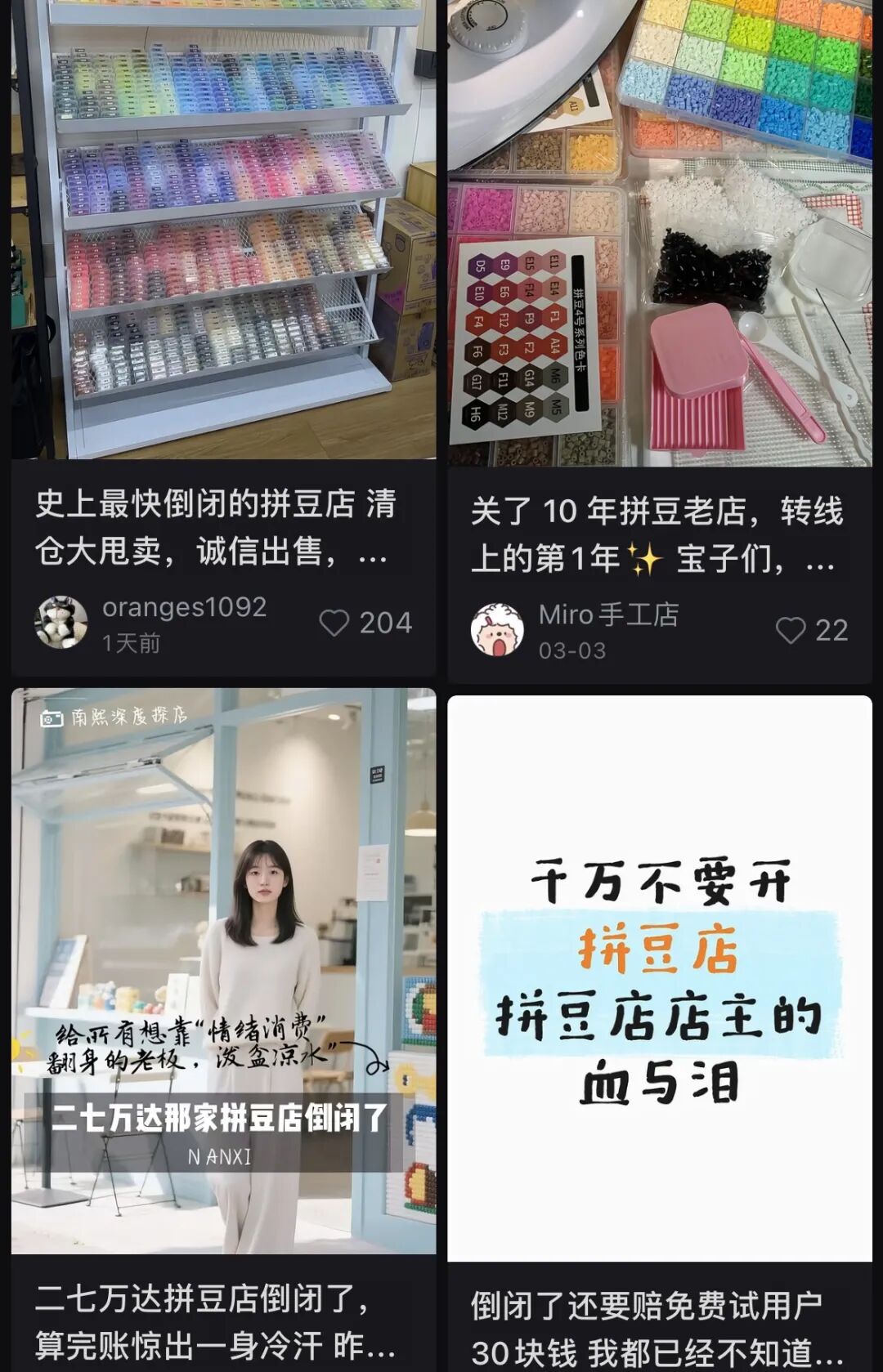
Most of them are also enthusiasts of bean art. This entrepreneurial boom based on interest is not new. Otaku merchandise stores have gone through the same trajectory in the past two years: becoming popular online, being followed blindly due to low entry barriers, an expansion of stores, price wars, and mass closures. In 2025, more than 155 otaku merchandise stores closed across the country in just half a year, and more than half of them were run by individual entrepreneurs. The same story is accelerating in offline bean art stores. Searching for "bean art entrepreneurship: avoid the pitfalls" on social media, the screen is full of stories of losses, store transfers, and inventory clearances. Those store owners who couldn't make it through the first month have already cleared their inventory on Xianyu and left the market.
Most new consumption trends among young people are short - lived. Some store owners have clearly realized the ultimate business principle of "speed is key". Those who enter the market need to be sober - minded: know that they are riding on the wave, calculate the pay - back period accurately, and see the exit path clearly. In this sense, bean art entrepreneurship is more like an ultimate test of judgment and execution.
1
The entrepreneurial dream achievable in a week
Although it is jokingly called the cross - stitch for young people, bean art is obviously more likely to become an offline business than the latter.
It is stress - relieving and therapeutic, with a low operation threshold. You just need to arrange the beans according to the pattern, which can cover a wider age range and different groups of people. It is also suitable for taking photos and sharing, meeting the offline social needs. On the other hand, it requires beans of different colors and materials, as well as professional tools like a bean - ironing machine. Its materials are much more complex than cross - stitch, and ironing the beans also has a certain technical threshold for ordinary players, providing a necessary space for offline experiences.
With a hardware cost of a few thousand yuan and a daily turnover of more than 2,000 yuan on weekdays and more than 3,000 yuan on weekends, the bean art business has low costs, quick returns, and a flexible model, which makes many young people see the attractive possibility of "becoming a boss with a small investment".
In February this year, Xiao Ye, who lives in the suburbs of Taizhou, Zhejiang, first came into contact with bean art. He went to an offline store with his friends in Hangzhou. He found it more interesting to adjust the parameters when ironing the beans and make the pattern flat and seamless than the process of arranging the beans. After returning home, he decided to buy a Leleke automatic ironing machine worth more than 2,000 yuan and a batch of beans to do it at home.
After getting the machine, he realized that "it's a bit of a waste to use it alone". Since there was no bean art store in his hometown town, he keenly sensed a market opportunity. So he invited his high - school classmate, and they opened a bean art store together near their junior high school.
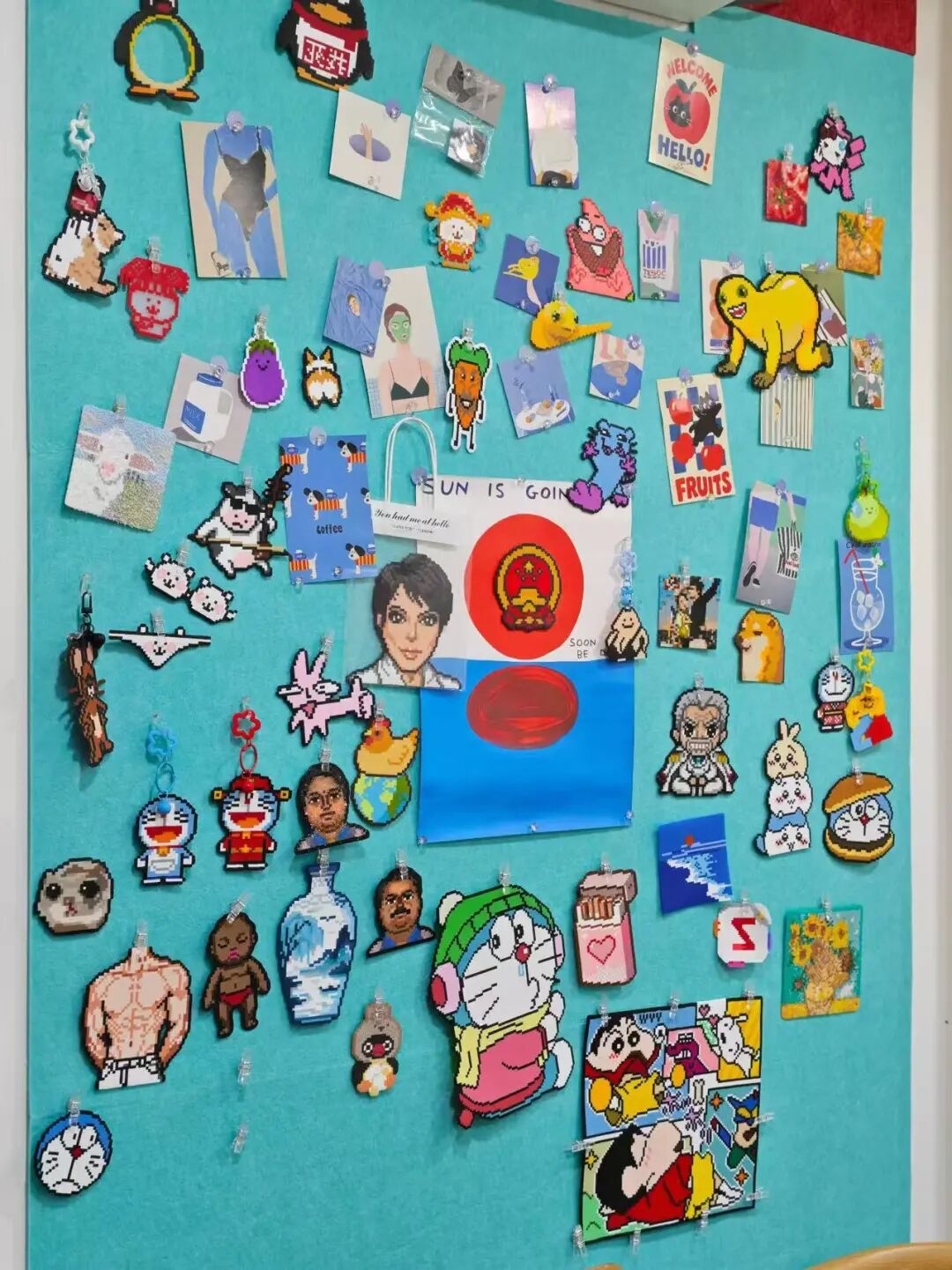
The bean art wall in Xiao Ye's store
"The bean art project may not be popular for a very long time. It's a short - term and fast - paced business, so we pushed it forward very quickly," Xiao Ye said. He usually procrastinates a lot, but this time, it only took three or four days to choose the store location, one week for decoration, and the store started its trial operation in less than 10 days. On the third day of opening, all 16 seats in the store were fully occupied, and he had to replenish the black and white beans, which were in the highest demand.
Xiao Ye is about to go to King's College London to pursue a doctorate in sociolinguistics. He originally only planned to run the store until June. Before opening the store, he and his partner calculated the profit model backward based on the time he would leave in June and only invested after confirming that they could recoup the investment. As a result, they recouped the investment in the first month, and the store's popularity remained high. So he decided to postpone his trip to the UK until September.
They have a very clear self - positioning. In first - tier cities, bean art stores are highly competitive and engaged in fierce price wars, and some stores even have very low prices. As the only bean art store in the local area, Xiao Ye finally set the price at 15.9 yuan per hour on weekdays and 69 yuan for the whole day, which is cheaper than the stores in the urban area but not in the low - price competition. Their total initial investment was only 12,000 yuan, and the monthly rent was less than 1,700 yuan. Now, Xiao Ye thinks that the store might be able to operate for a longer time.
Almost at the same time, the plans to open several bean art stores in the Youth Plaza in Beijing are also being gradually promoted.
Different from Xiao Ye's low - cost operation based on geographical advantages, opening a store in Beijing incurs much higher costs in all aspects. For example, opening a store in the Youth Plaza in Chaoyang requires an initial investment of nearly 100,000 yuan. The major costs include not only the more expensive rent in the core commercial area but also the decoration materials and tools, and the furniture is also a significant expense.
In order to reduce costs and open the store as soon as possible, the decoration of many offline bean art stores only meets the basic needs.
A small number of stores provide a complete set of beans and tools for each seat. Most bean art stores only have a material wall, and customers can pick up beans of different colors by themselves. The handicraft operation tables are also placed together, requiring little arrangement and design. In the Youth Plaza area, the price of bean art stores is generally twenty or thirty yuan per hour, and the full - day price ranges widely from 50 yuan to 100 yuan.
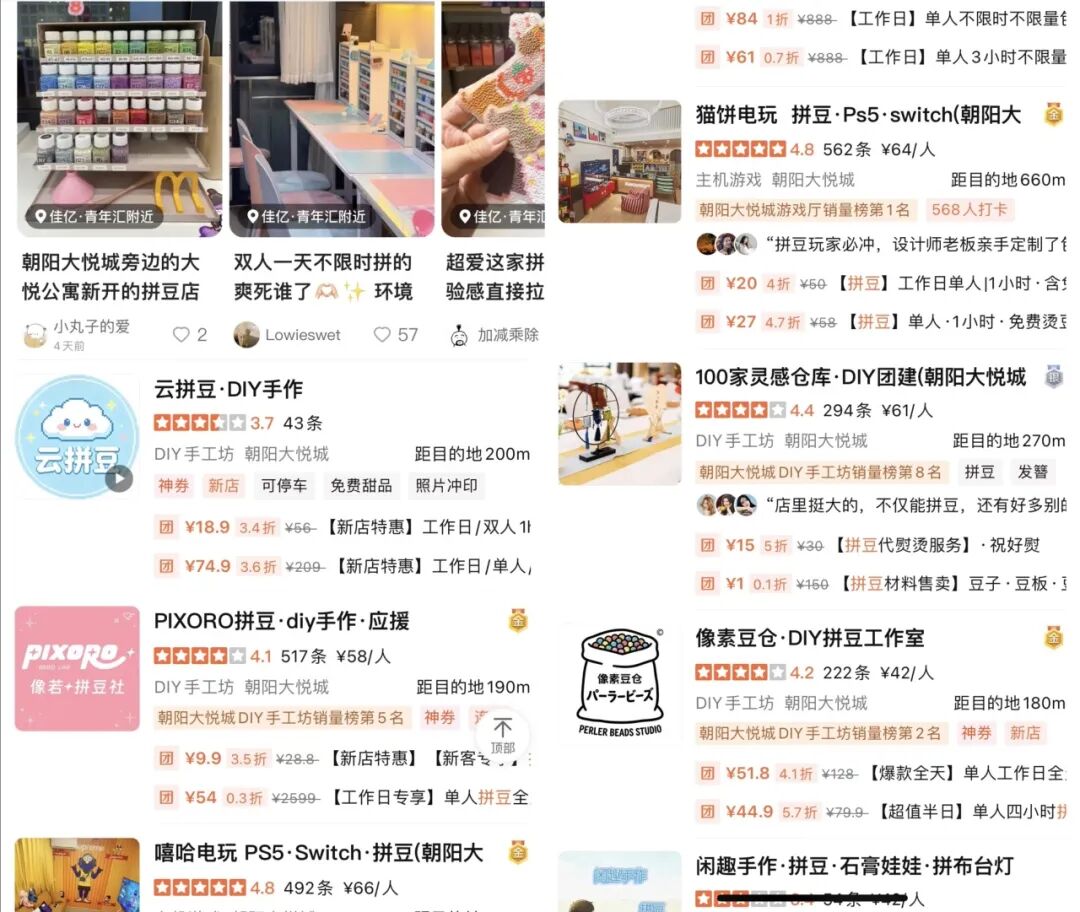
From "having a try" to "opening a store", these young people made the decision in a very short time. The entry threshold is low, and the business can be launched with just a few tens of thousands of yuan. The process is fast, and some people only need two weeks from preparation to opening. The stories are appealing, and there are posts about "recouping the investment in 30 days" everywhere on social platforms. However, under the boom, the real business situation is much more complicated than expected.
2
The market quickly entering the involution stage
What drives these people to make the same decision is almost the same judgment: low entry threshold. Compared with the catering and beverage industries, bean art doesn't require large - scale inventory, and there is almost no cost for material storage. The beans are standardized products, and enthusiasts themselves understand the products. In Xiao Ye's words, "Compared with traditional catering or beverage industries, the investment is relatively small, and there is no cost for material storage. At least the losses can be minimized."
On a weekend at the end of May, there were more than a dozen customers in Xiao Ye's small store. Most of them were junior high school students, and there were also a few office workers and parents with children. On weekdays, he reads literature in the store. When he gets tired, he sorts and mixes the beans and tests new ironing methods. "I don't feel that old anymore," he said with a smile. "I'm in contact with young kids."
He and his partner take turns during the busy weekends when they are too busy to eat. At the busiest time, all 16 seats are fully occupied, and he even has to ask friends to come and help. He even had an unexpected surprise. "My mom scoffed at it at first, but she fell in love with bean art in the second week after the store opened and comes to do it three times a week." Now, his mom doesn't want the store to close.
However, in a more competitive market like Chaoyang in Beijing, bean art store owners face a completely different situation.
After our on - site visit, we learned that there was only one bean art store in the Youth Plaza at the beginning of the May Day holiday. By the end of May, there were already three stores on the same floor, and at least ten in the whole building. A Xiaohongshu blogger specifically counted that in the more concentrated area of Shuangjing Youshige, there were about 15 bean art stores in March, and now there are more than 20.
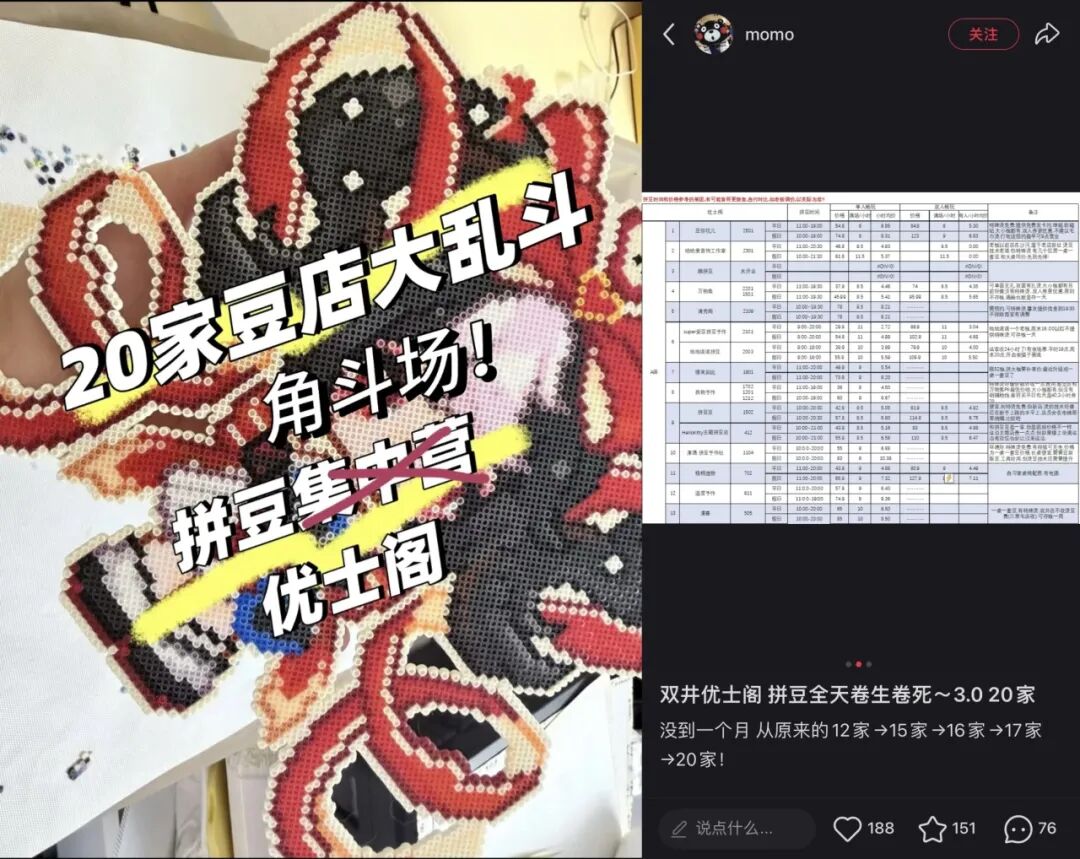
The entry threshold for opening a store is low. Many people open a store when they think the project is popular, and it may only take two weeks from preparation to opening. Some stores even directly convert a self - study room into a handicraft workshop and can start business by just ordering beans. However, if the pre - opening preparation is more elaborate, it may take one or two months, including testing different beans, optimizing the layout of tables and chairs, and other details. For example, providing each person with a set of 221 - color beans, which are packed into more than 10,000 small bottles. At the same time, the seats are spacious, and each table is equipped with a charging port and a small desk lamp, and an electrician is hired to do the wiring.
Most bean art stores charge by the hour, and there are also all - day packages. The prices are cheaper on weekdays and higher on holidays. It is understood that the peak number of customers in most bean art stores on weekends is about thirty or more, but the customer flow on weekdays is extremely unstable. Therefore, some store owners have started to offer group - buying deals at a low price of 9.9 yuan, while others adhere to the quality - oriented route. "Entrepreneurship is not easy," a store owner sighed. "Previously, at work, I only needed to consider the company. Now, I have to think about everything in the store, even a power strip."
Most bean art store owners who have been in business for one or two months have not recouped their investment yet. Some are considering adding other handicraft projects, taking on team - building activities, and offering monthly or weekly cards. Facing the newly opened stores in the same building and the increasingly fierce competition for customers at the elevator entrance, no one knows how long each store's advantage can last.
Xiao Ye knows that his advantage lies in being the only store in the area. He also knows that this advantage is not long - lasting. "If I had opened the store two months later, there might have been a second or third store in the town." In fact, less than two weeks after opening the store, he found that someone was calculating the table - turnover rate in the store and discussing with friends whether it was worth opening a store.
3
Not making money becomes the norm
Putting all these business details together, we can find that the stores that can operate well almost all rely on craftsmanship, timing, and patience. The problem is that more and more people are pouring into this market, but the trend of interest - based consumption always changes rapidly.
The competition for customers in that building in Chaoyang is just a microcosm of the cut - throat competition in this business. Even more difficult opponents are not in the stores. A group of extremely active individual players have bypassed the physical stores: some set up stalls in their residential areas and rent out the whole set of equipment to their neighbors, and some do "bean art on behalf of others" on Xianyu. A player can earn 5,000 yuan a month by taking orders, and on the best days, they can receive six or seven hundred yuan a day. They have no rent pressure and offer more flexible services.
Third - and fourth - tier cities are not as safe as expected. Although Xiao Ye's store is the only one in the town, it only takes twenty or thirty minutes to drive from his home to the urban area, where the market is already saturated with low - price competition. He often goes to Hangzhou across the district and sees a more intense situation. "There might be seven or eight bean art stores in one office building in Hangzhou. It's really too competitive. Some of them offer all - day bean art for 19.9 yuan. I really don't know where their profit point is."
In the end, the low - price competition comes down to who can persevere. What often makes people give up are the hidden costs that are not included in the "light entrepreneurship with a few thousand yuan" narrative. On Xiaohongshu, a prospective store owner in Anhui calculated an account: saving 9,000 yuan by finding workers for the decoration himself, testing beans from more than twenty stores and thinking he didn't waste money, but he had already invested more than 40,000 yuan excluding rent and beans. He still needed to spend more than 20,000 yuan on air - conditioners, tables and chairs, and accessories, and it was estimated to cost 130,000 yuan by the time of opening.
In Weicun,