How is the implementation of the 60-day payment term? The latest data from 18 automakers shows that their total accounts payable and notes payable exceed 1 trillion yuan, with the average turnover days rising to 216 days, and more than half of the automakers have extended their payment cycles.
As of the end of the first quarter of 2026, the total accounts payable and notes of 18 listed automobile companies mainly engaged in passenger cars reached 1.034407 trillion yuan. The scale still remained above one trillion yuan, but the average payment turnover days in the industry rose to 216.68 days, an increase of 27 days compared with the end of last year, showing a divergent trend of a decrease in the total amount and an extension of the payment period. In this statistics, only 4 automobile companies achieved a shortening of the payment period, and more than half of the enterprises further extended their payment cycles. Haima Automobile, Zhongtai Automobile, and Seres ranked among the top in terms of payment period in the industry.
It is not easy to implement the commitment of a 60 - day payment period. On the one hand, there are problems such as non - standardized settlement rules and unreasonable additional terms. On the other hand, some automobile companies are under pressure on cash flow, and the cash on the books is difficult to cover the payable items. Fund management and internal coordination have become the main obstacles. At present, many automobile companies have introduced measures such as process optimization and the establishment of special funds to improve the payment period. However, judging from the data of the first quarter, the whole industry still faces considerable challenges in fully fulfilling the goal of a 60 - day payment period.
With the end of May, the first - quarter financial reports of domestic mainstream listed automobile companies have all been disclosed, and the commitment of automobile companies to compress the payment period to less than 60 days has ushered in a new round of testing.
After sorting out the financial reports of 18 listed automobile companies (all with passenger car business), a reporter from Daily Economic News found that as of the end of the first quarter of this year, the total accounts payable and notes of 18 listed automobile companies totaled 1.034407 trillion yuan, a decrease of 87.548 billion yuan compared with the end of the second quarter of last year (since the starting point of the first complete implementation quarter after the commitment of 17 automobile companies was the third quarter of last year, a comparison was made with the end of the second quarter). However, the average turnover days rose to 216.68 days, an increase of 27 days compared with the end of last year, showing a divergent trend of "a decrease in the total amount and an extension of the payment period".
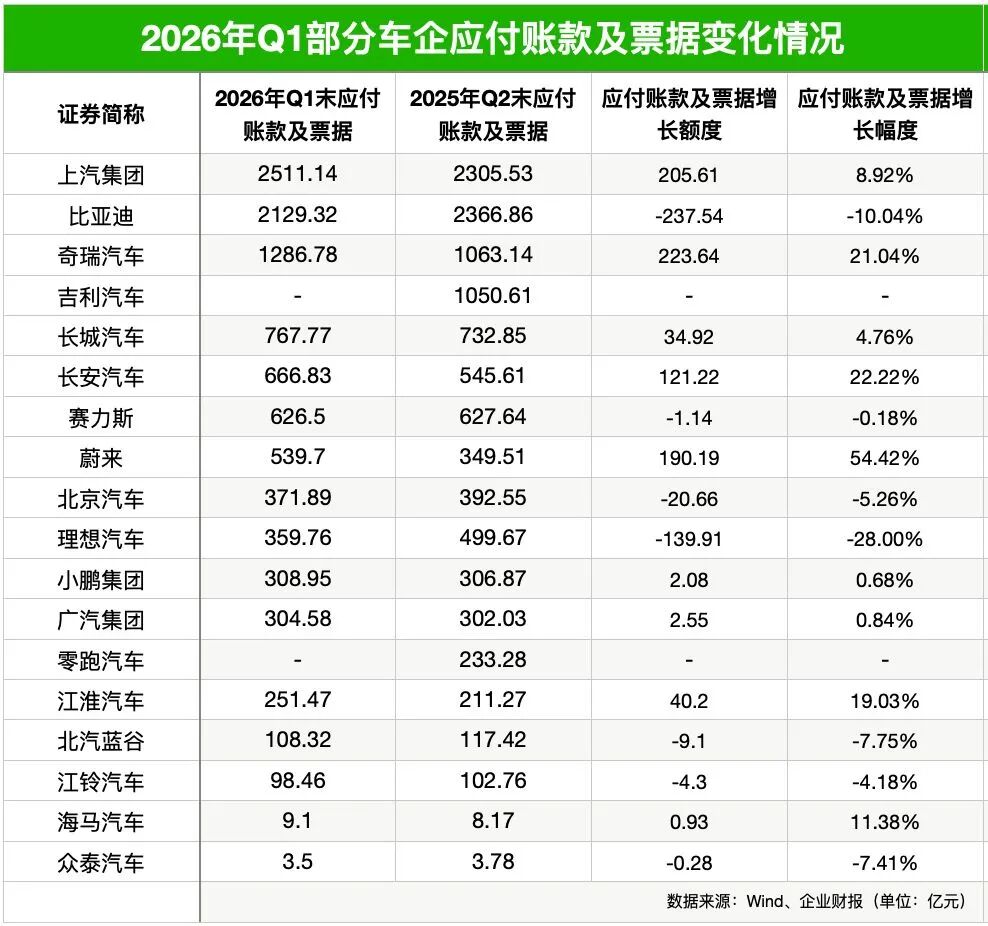
Looking at individual companies, SAIC Group, BYD, and Chery Automobile ranked in the top three in terms of the amount of accounts payable and notes. Data shows that as of the end of the first quarter of this year, the accounts payable and notes of the above - mentioned three automobile companies were 251.114 billion yuan, 212.932 billion yuan, and 128.678 billion yuan respectively, all exceeding the 100 - billion - yuan mark. If measured by the corresponding turnover days, Haima Automobile, Zhongtai Automobile, and Seres ranked in the top three in terms of payment period.
Only 4 Automobile Companies Reduced the Turnover Days of Accounts Payable and Notes
As of the first quarter of this year, the amount of accounts payable and notes of 7 automobile companies decreased compared with the end of the second quarter of last year. Among them, BYD and Li Auto decreased by 23.754 billion yuan and 13.991 billion yuan respectively.
Compiled by Sun Lei, a reporter from Daily Economic News
The accounts payable and notes of Chery Automobile, SAIC Group, NIO, etc. as of the first quarter of this year increased compared with the end of the second quarter of last year. Among them, SAIC Group increased by 20.561 billion yuan in three quarters, an increase of 8.92%; Chery Automobile increased by 22.364 billion yuan in three quarters, an increase of 21.04%; NIO increased by 19.019 billion yuan in three quarters, an increase of 54.42%.
Some analysts said that with the growth of sales, the procurement scale of SAIC Group and Chery Automobile from the upstream supply chain has also expanded accordingly, resulting in a corresponding increase in accounts payable and notes. At the same time, with the growth of delivery volume, NIO's bargaining power in the supply chain has increased, enabling it to more effectively utilize the funds of suppliers, thus increasing the scale of accounts payable and notes.
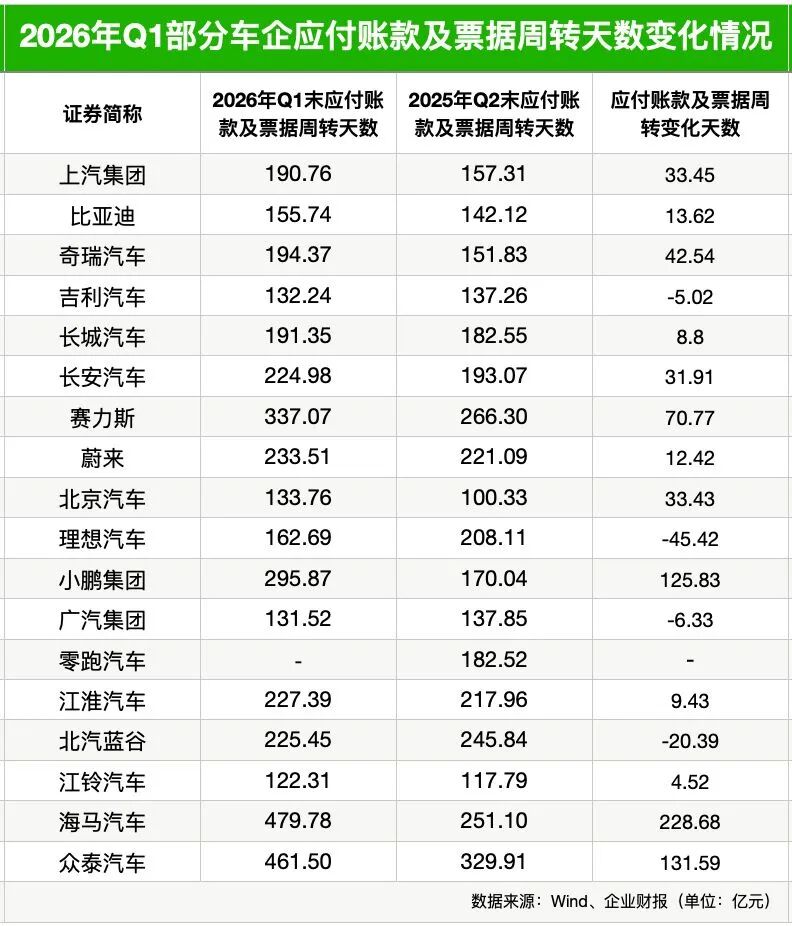
From the perspective of the corresponding turnover days, as of the end of the first quarter of this year, only 4 enterprises improved compared with the end of the second quarter of last year, namely Geely Automobile, Li Auto, GAC Group, and BAIC BluePark. Among them, the turnover days of accounts payable and notes of Li Auto were 162.69 days, about 45 days shorter than the end of the second quarter of last year, making it the automobile company with the largest reduction in the payment period.
Compiled by Sun Lei, a reporter from Daily Economic News
Except for the automobile companies that could not be included in the statistics, the turnover days of accounts payable and notes of other automobile companies were still increasing. Among them, the turnover days of accounts payable and notes of Haima Automobile and Zhongtai Automobile as of the end of the first quarter of this year were about 480 days and 461 days respectively, an increase of about 229 days and 132 days compared with the end of the second quarter of last year; XPeng Group increased by 125 days compared with the end of the second quarter of last year; Seres increased by nearly 70 days to about 337 days.
The turnover days of accounts payable and notes payable, also known as the average payment period, are not completely equivalent to the payment cycle of automobile companies to suppliers, but they are also an indicator to measure how long a company needs to pay off its debts to suppliers. Zhang Nawei, an analyst of new - energy vehicles at Wuguang Securities, said that affected by seasonality in the first quarter, the turnover days in the automobile industry rebounded slightly to 80 - 130 days, which is a normal seasonal disturbance.
Optimization Measures for the Payment Period of Some Automobile Companies Have Entered the Implementation Stage
After removing the seasonal fluctuations in the first quarter, the comparison of the turnover days of accounts payable and notes between the end of last year and the middle of the year clearly reflects that the optimization measures for the payment period of some automobile companies have entered the implementation stage. In terms of this indicator, only a small number of enterprises saw an increase in the indicator at the end of last year compared with the end of the second quarter of last year, and the turnover days of most enterprises were shortened.
It is worth mentioning that some automobile companies have clearly stated in their financial reports that they have taken corresponding measures to shorten the turnover days of accounts payable and notes. For example, BYD mentioned in its 2025 annual report that the turnover days of its accounts payable and notes payable are at a relatively low level in the automobile industry and are continuously improving, and they were further shortened in this reporting period compared with the same period in 2024.
In February this year, the China Association of Automobile Manufacturers (hereinafter referred to as CAAM) released a research report on the implementation of the commitment of key automobile companies to the payment period of suppliers' loans. It pointed out that since 17 automobile companies promised that the payment period to suppliers would not exceed 60 days, the vast majority of key automobile companies have compressed the payment period to within 60 days, with an average payment period of about 54 days (about 10 days shorter than the same period last year). There are 4 enterprises with an average payment period of less than 50 days, and this improvement was mainly concentrated in the second half of 2025.
CAAM said in the research report that all 17 automobile companies surveyed attached great importance to the implementation of the payment - period commitment. Many enterprises established special working groups to promote it, issued special institutional documents, established a long - term mechanism for the implementation of the commitment, and had completed the adjustment of the payment period including existing contracts.
"Some enterprises have further optimized their financial processes and improved their information systems to achieve regular automatic payments, reducing delays caused by manual operations. Some enterprises have changed the starting date from the posting date to the delivery acceptance date, and changed the settlement frequency from monthly to ten - day settlement, optimizing the process to improve settlement efficiency. Many enterprises are preparing special funds of over 10 billion yuan to improve the payment period of loans." CAAM added.
In the view of Yan Jinghui, a member of the Expert Committee of the China Automobile Dealers Association, the payment period is an important condition for the virtuous cycle of the automobile industry and a basic condition for the healthy and standardized development of the industry. At present, a series of requirements and measures against unfair competition in the automobile industry, such as the payment period of automobile companies, have achieved certain results.
The 60 - Day Payment - Period Commitment: A Tough Cash Battle
However, judging from the financial reports as of the first quarter of this year, some automobile companies still have problems in terms of the payment period. CAAM also mentioned in the research in February this year that some automobile companies still have some problems in the payment of suppliers' loans, which need to be continuously promoted and solved.
"There are different ways to calculate the starting point of the payment period, such as goods delivery and acceptance, centralized reconciliation, invoice receipt, and loading verification. Although the nominal payment period is 60 days, the time difference for suppliers from delivery to receiving payment is relatively large, and the process management is not standardized enough, resulting in a situation of a disguised extension of the payment period. A small number of enterprises require suppliers to lower product prices or accept other unreasonable terms on the grounds of shortening the payment period." CAAM said.
Cui Dongshu, the secretary - general of the Passenger Car Association, said: "The biggest obstacle to implementing the 60 - day payment period may lie in the fund management ability and internal coordination mechanism of some automobile companies. For example, how to adjust the cash flow in a short time to ensure timely payment to suppliers is a considerable challenge. In addition, the coordination among the finance, procurement, production and other departments within automobile companies also needs to be further strengthened to ensure the timely allocation and payment of funds."
Regarding the fact that some automobile companies have not fulfilled the commitment of a "60 - day payment period", Wang Peng, an associate researcher at the Beijing Academy of Social Sciences, also believes that "automobile companies are under pressure on their own cash flow and have to give priority to ensuring the stability of their own capital chain, thus delaying payments."
This also shows that shortening the payment period is first and foremost a "tough cash battle". Whether the cash on the books can fully cover accounts payable and notes is the critical line for the real implementation of the "60 - day settlement" commitment.
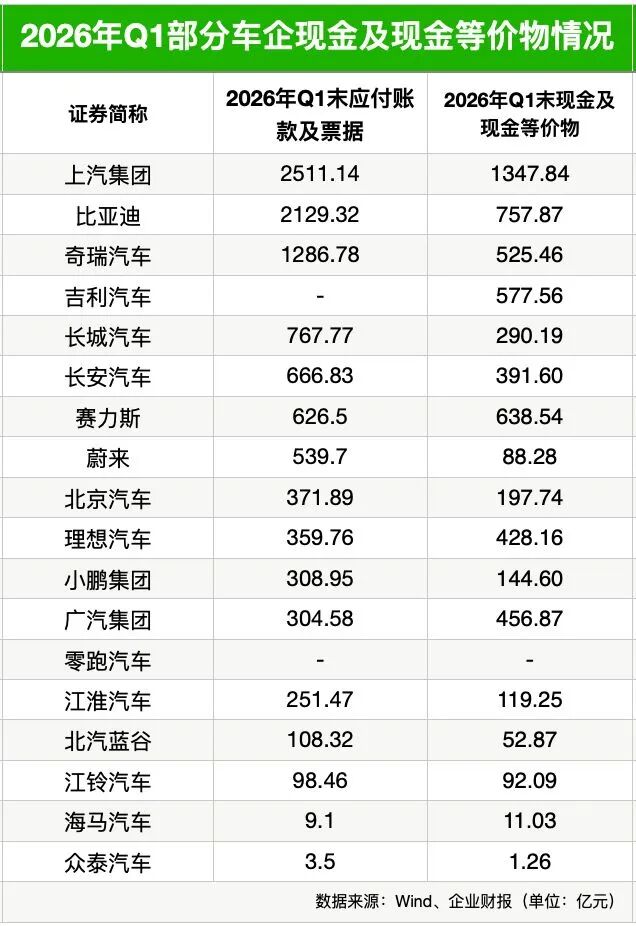
From the perspective of cash and cash equivalents, among the automobile companies counted by the reporter, only 4 companies, namely Seres, Li Auto, GAC Group, and Haima Automobile, have sufficient cash on their books to fully cover accounts payable and notes. If restricted cash, short - term investments, and time deposits are also included in the "cash reserve" statistics, the cash reserve scale of XPeng Motors and others can fully cover their accounts payable and notes.
Compiled by Sun Lei, a reporter from Daily Economic News
However, even when estimated by the cash reserve scale, some automobile companies still cannot fully cover accounts payable and notes. For example, the reserve scale of companies such as SAIC Group, BYD, and Chery Automobile is still lower than their corresponding accounts payable and notes, and their short - term solvency is under pressure. Looking at the industry as a whole, the "60 - day payment - period" commitment is still an unfinished "tough cash test".
(Disclaimer: The content and data in this article are for reference only and do not constitute investment advice. Please verify before use. Any actions taken based on this are at your own risk.)
This article is from the WeChat public account "Headlines of Daily Economic News", author: Sun Lei, editors: Cheng Peng, Pei Jianru, Du Hengfeng. Republished by 36Kr with permission.