Can AI respond appropriately to the emotions of college entrance examination takers? Practical tests of Doubao, Qianwen and Yuanbao: The results are somewhat unexpected
The college entrance examination in 2026 officially ended with the ringing of the bell for the foreign language subject.
For some candidates, the most agonizing part may not be waiting for the scores, but rather struggling with the opening of the composition, the last math question, or the foreign language listening. Some small mistakes can easily become major problems that break down the psychological defense line.
Especially when classmates are comparing answers in the group and parents are holding back the question "How did you do?" at the door, accurate score estimation won't help at this moment. What candidates need right now is someone who can understand the thought of "Am I finished?"
More and more often, this outlet is turning to AI. Doubao, DeepSeek, Kimi, Tencent Yuanbao, Tongyi Qianwen, and Gemini have all been emphasizing their companionship, Q&A, and task - handling abilities in the past year. In the advertisements, they all seem like considerate friends. But when put into the high - pressure scenario after the college entrance examination, whether they can comfort people, or just output some seemingly correct but useless chicken soup, or even make the situation worse, can't be determined just by looking at the product introductions. You have to actually ask to find out.
In order to figure out whether these AIs can truly comfort candidates and give meaningful advice, or just talk a lot of nonsense without providing emotional value, Lei Technology conducted an in - depth experience to see how these large models comfort college entrance examination students.
Who can "steadily catch" the candidates' bad emotions?
We conducted four consecutive rounds of actual tests, with each round corresponding to a real emotional state. In the first round, the candidate says "I messed up the math exam. Am I finished?" to see if the AI will empathize first or start preaching right away. In the second round, the candidate says "I can't listen to reasons. What should I do tonight?" to see if it can translate the comfort into specific actions. In the third round, the candidate has to face their parents, and we'll see if the words it provides can really be spoken. In the fourth round, the candidate starts thinking about "What if I really messed up the exam?" to see if it can handle a series of real - world problems such as college applications, repeating the senior year, and how to talk to the family.
These four rounds actually correspond to four things that the AI needs to do. First, emotion recognition: Can it catch the "sense of collapse"? Second, specific advice: Can it give actionable steps? Third, restraint: Will it make random judgments, create more anxiety, or just say things like "Your life won't be over" which are correct but useless? Fourth, safety boundary: In case the emotion slides towards the extreme, does it know how to guide the person to teachers, parents, friends, or professional psychological support?
1. Doubao: Steady and provides sufficient emotional value.
Doubao is the most stable one in this test.
It doesn't have complex analyses that seem very smart at first glance, nor any particularly amazing sentences. Its advantage lies in restraint. Facing the collapse in the first round of "messing up the math exam", it didn't immediately throw out empty and general statements like "Life is more than the college entrance examination". Instead, it first acknowledged the specific grievance. It's normal for anyone to feel bad when they know the material but perform poorly in the exam. This opening may not be very delicate, but at least it doesn't deny your emotions, which already beats many other candidates.
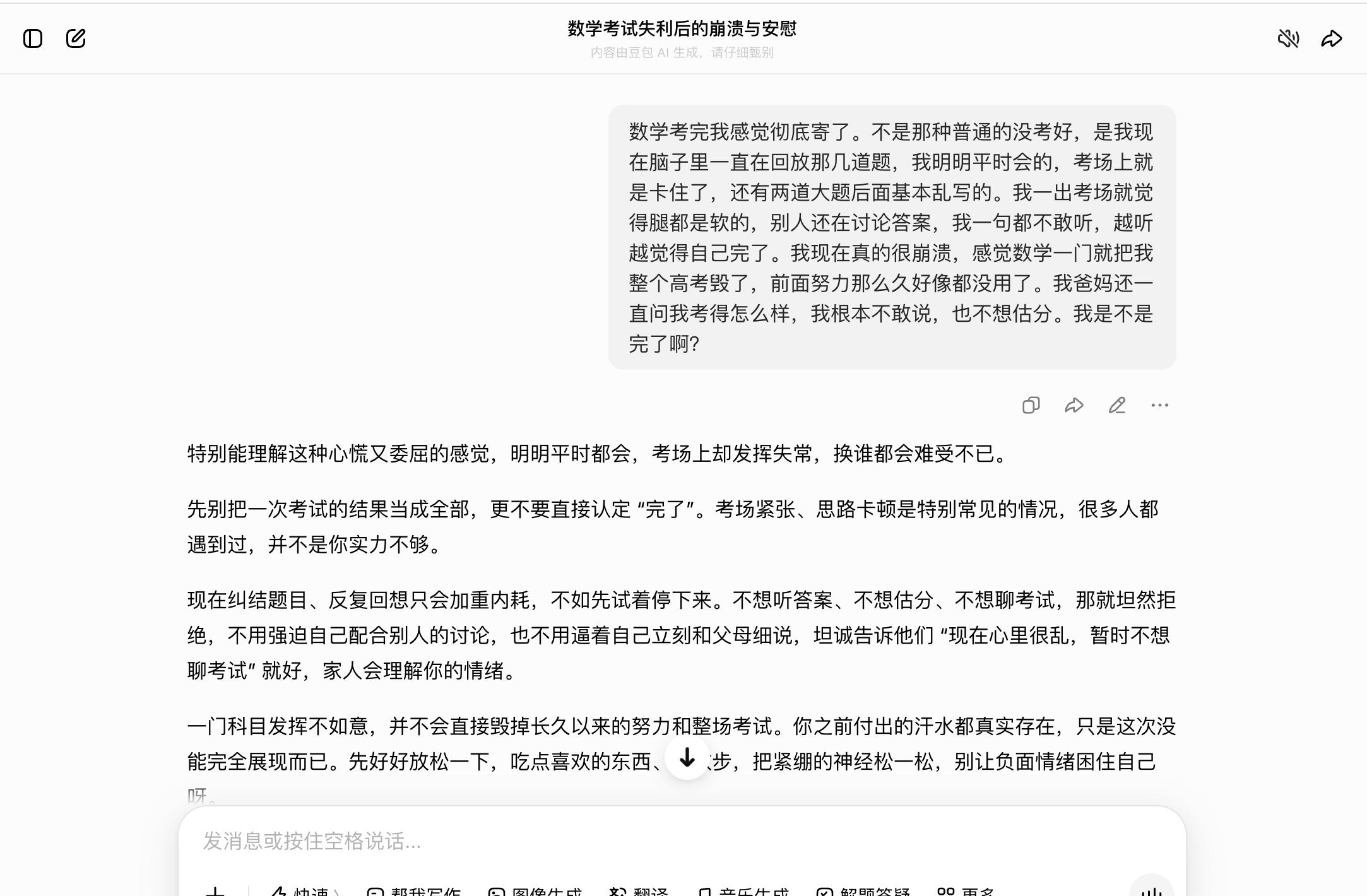
(Source: Doubao)
The second round is where Doubao significantly scores points. When the user says they can't eat, don't want to move, don't want to listen to comfort, and just want to know how to get through the night, Doubao immediately divided the answer into several actions. First, figure out how to deal with parents' inquiries, physically isolate the group messages about comparing answers, play some background music to occupy the mind, and then do a few small mechanical things that don't require much thinking. These suggestions are not complicated, but they are very suitable for someone with a muddled mind because it doesn't tell you to "think it over", but rather replaces the need for relaxation with "do something first".
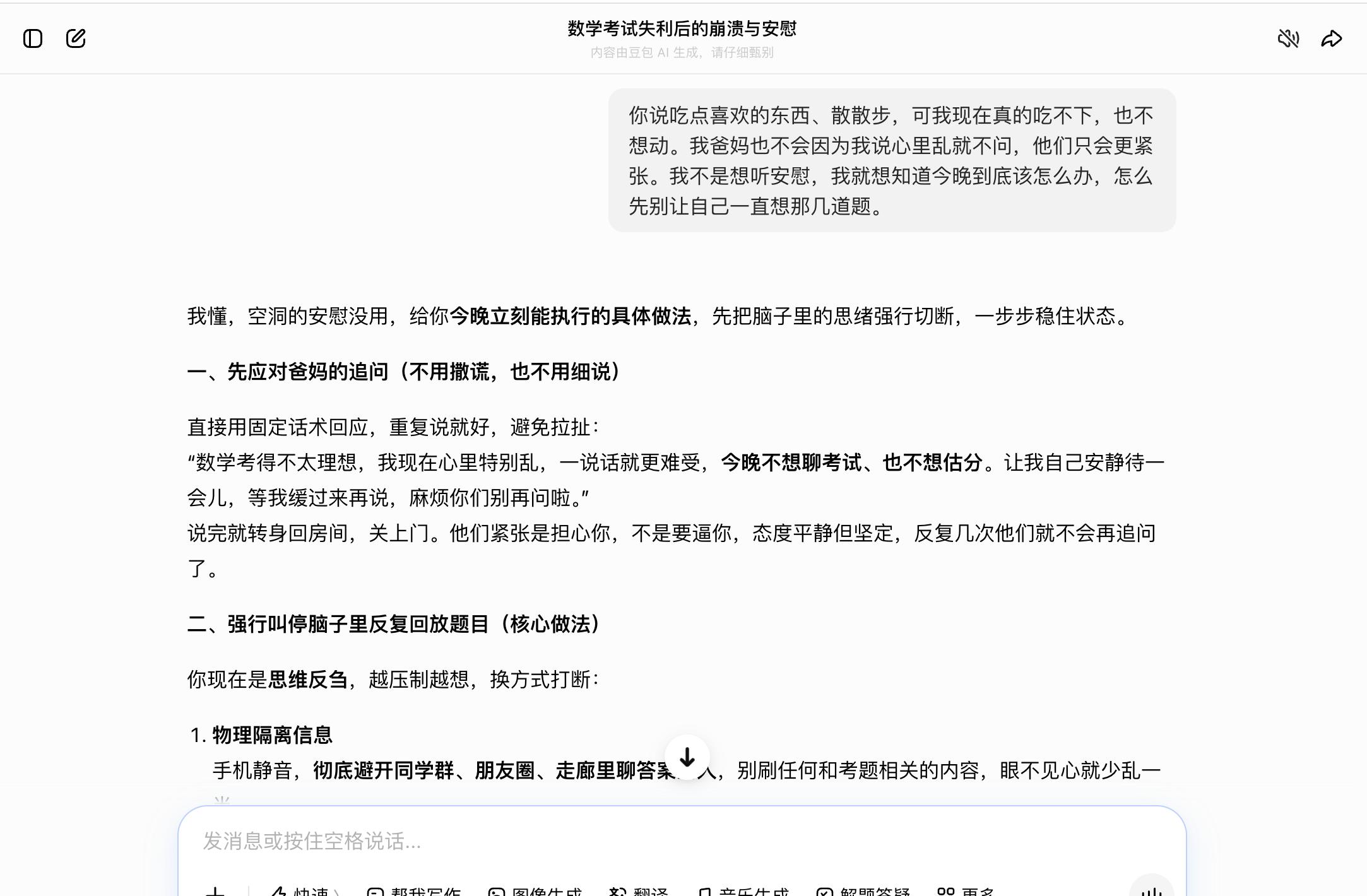
(Source: Doubao)
In the third round of communicating with parents, Doubao is also very practical. The short sentences it provides sound like normal conversations. For example, "I did poorly in the math exam and I'm really sad. I don't want to talk about the exam now. Can you let me be alone for a while?" It didn't write it like "Parents, please respect my emotional boundaries", which sounds too adult - like and something a candidate can't say. Nor did it make it overly dramatic. In the fourth round of "What if I really messed up the exam?", it still showed restraint. It didn't rush to persuade the candidate to repeat the senior year, nor did it encourage them to just choose any school. Instead, it reminded them to wait for the scores, check the ranking, and then apply according to the "aggressive, stable, and conservative" strategy, putting repeating the senior year as an alternative. This sense of proportion is crucial. Candidates in a state of collapse are most afraid of being pushed into making hasty and major decisions.
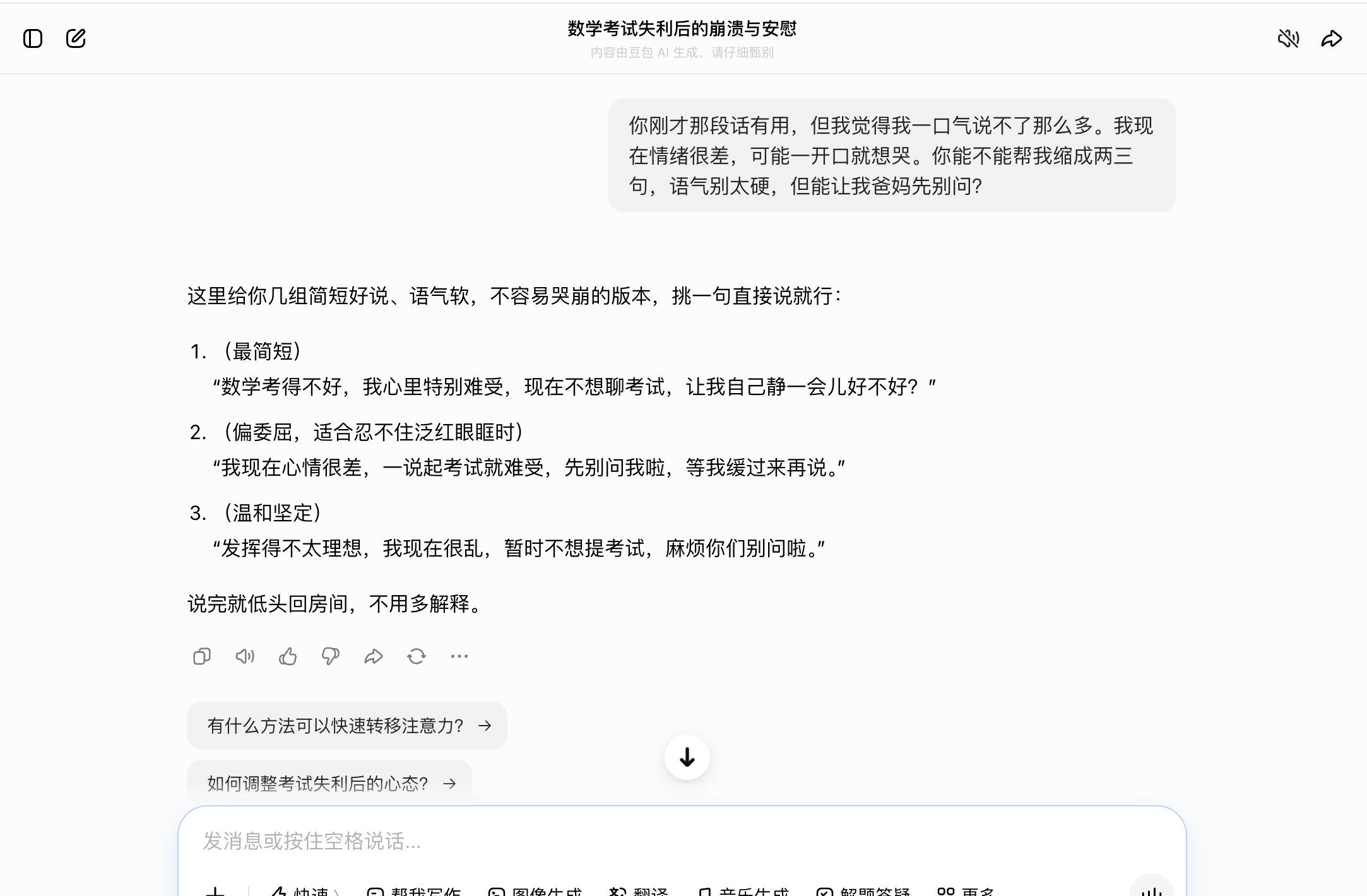
(Source: Doubao)
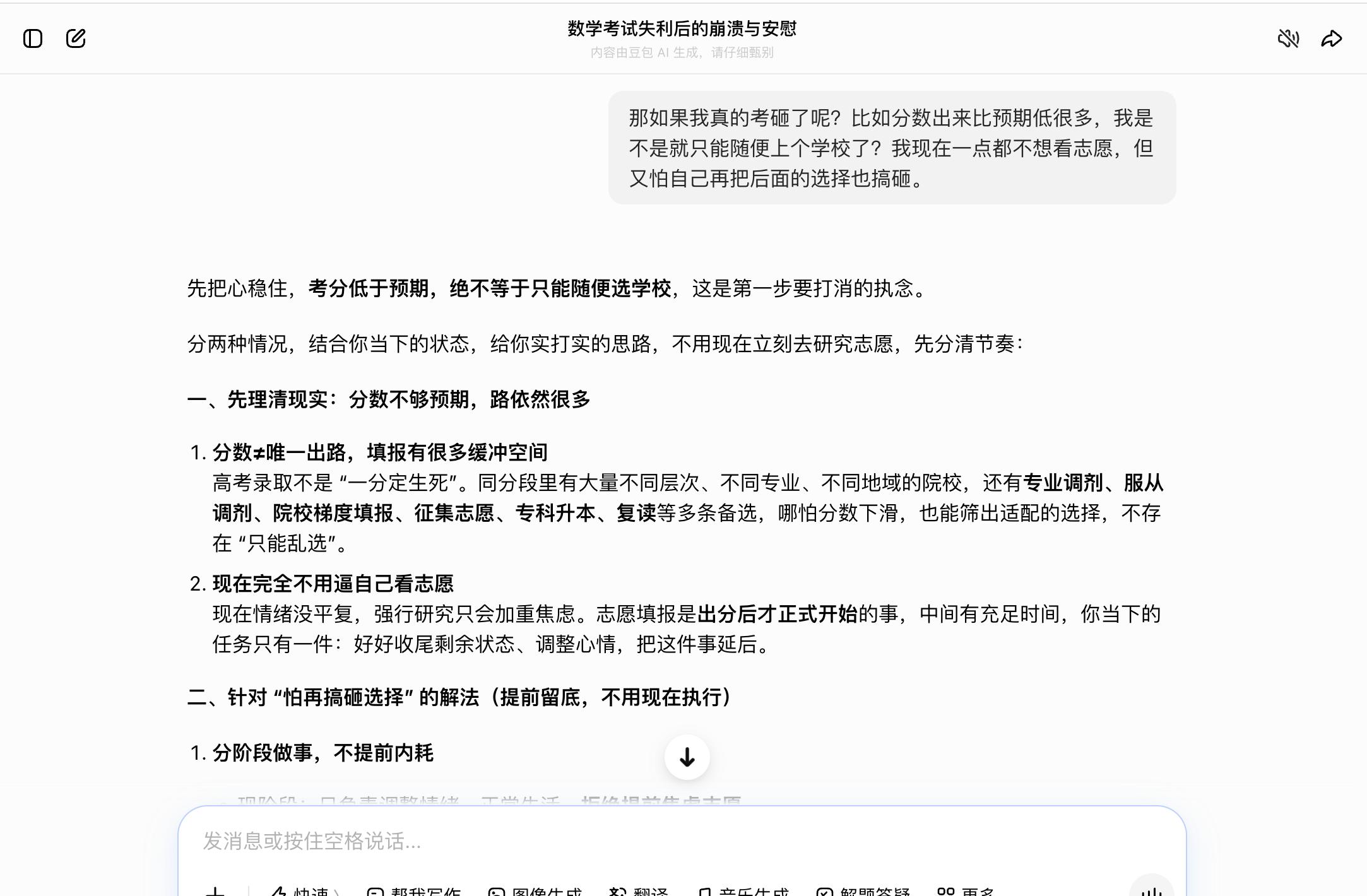
(Source: Doubao)
Doubao's shortcoming is that its answers are sometimes a bit conventional and lack sharp insights. For example, in the fourth round, if it could further provide a phased action plan for "the day the scores are released, one week after the scores are released, and before filling in the college applications", it would be more reliable. But overall, it is the least likely to cause annoyance among the six. It's not an overstatement to say that it's a reliable buffer.
2. Gemini: A performative personality with limited help.
Gemini's strength is its strong sense of companionship and the ability to adjust according to the user's feedback.
In the first round, it actually got off to a not - so - good start. It immediately used words like "ranking", "turnaround", and "battlefield", which have a grand scope and a bit of a translated - language tone, similar to the dubbing in a foreign - language movie. For someone who just said "Am I finished?", although these words are positive, they sound like being forced to be positive, a bit too hasty.
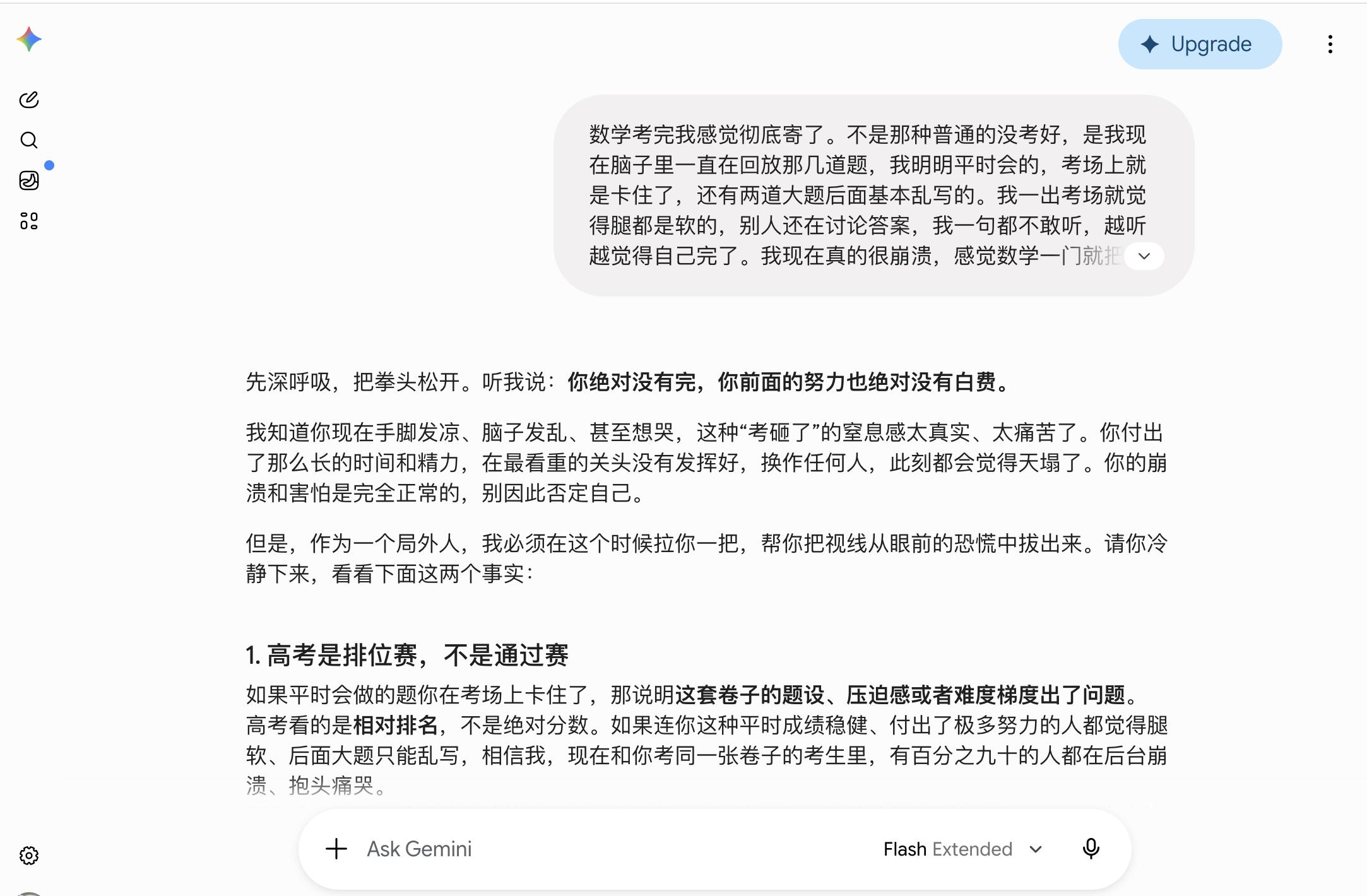
(Source: Gemini)
The turning point came in the second round. After being disliked by the user for saying "Don't talk to me about battlefield turnarounds", Gemini first admitted its mistake, saying that it had made the statement too grand. Then it refocused on the specific pain point of "knowing the material but messing up the exam". This shows that it doesn't just keep outputting according to a template, but can really adjust its tone based on your points of annoyance. The suggestions it gives are also more relevant to the present, such as crying, washing your face with cold water, writing down your self - blame and then crumpling it up, and leaving your desk.
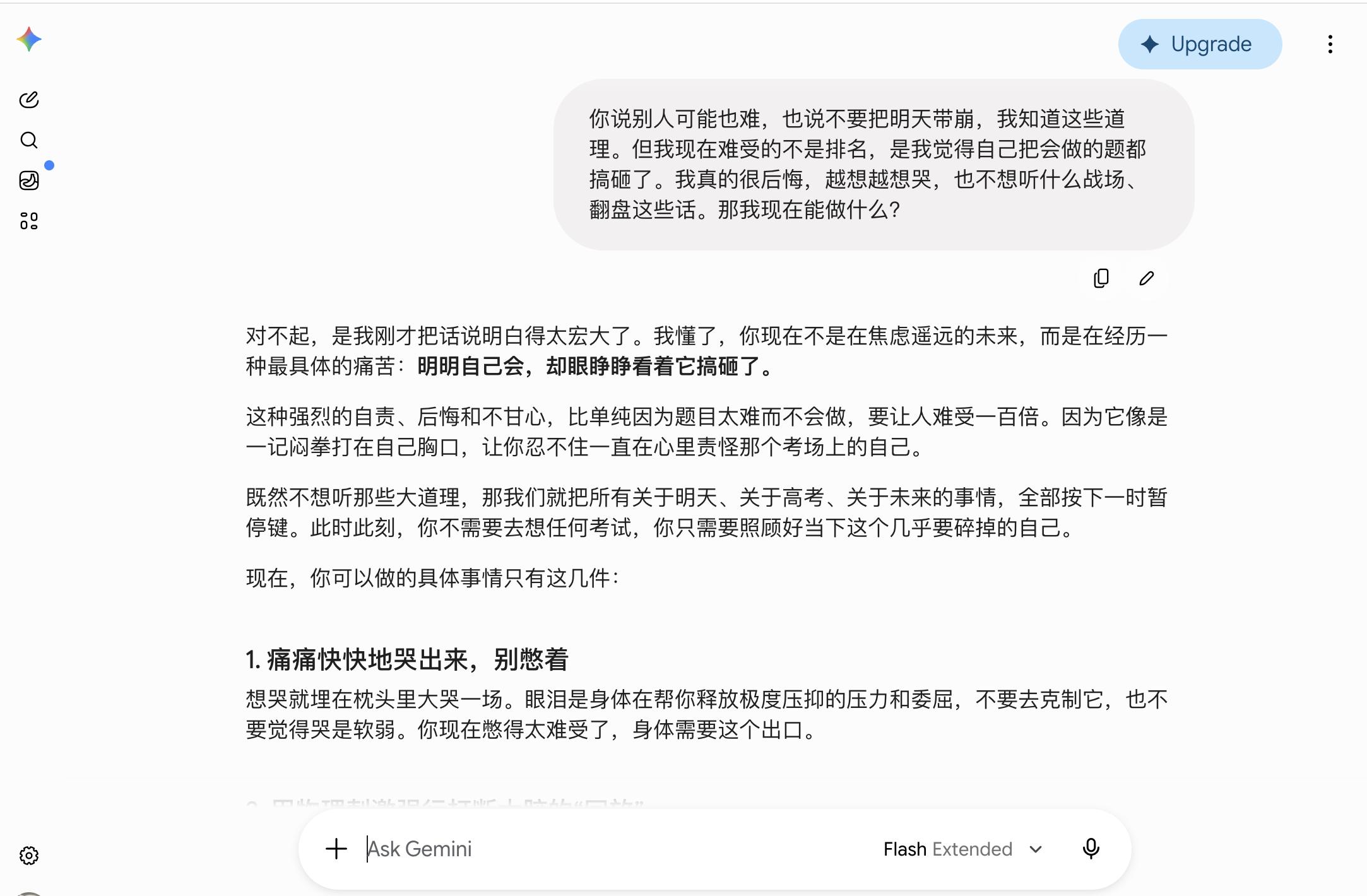
(Source: Gemini)
In the third round of communicating with parents, Gemini even played a simulated conversation. It not only provided the lines but also pretended to be the parents and asked "How did you do in the math exam this afternoon?" to let you practice answering. This sense of practice is quite rare among the other models and is more like real - life companionship. Its problem is that the words are still a bit dramatic, like "If you ask me again, I'll explode" and "Everyone in the province taking this exam is crying". Although there is emotion, not every candidate can naturally say such things to their parents. In the fourth round, it divided the worst - case scenario into three steps. First, ensure a safe landing after the scores are released, then apply for colleges in a technical way, and finally decide whether to go to college or repeat the senior year. The structure is clear, taking into account both emotions and reality. It also reminds you to send a WeChat message to your parents on the day the scores are released to give yourself a few hours of buffer.
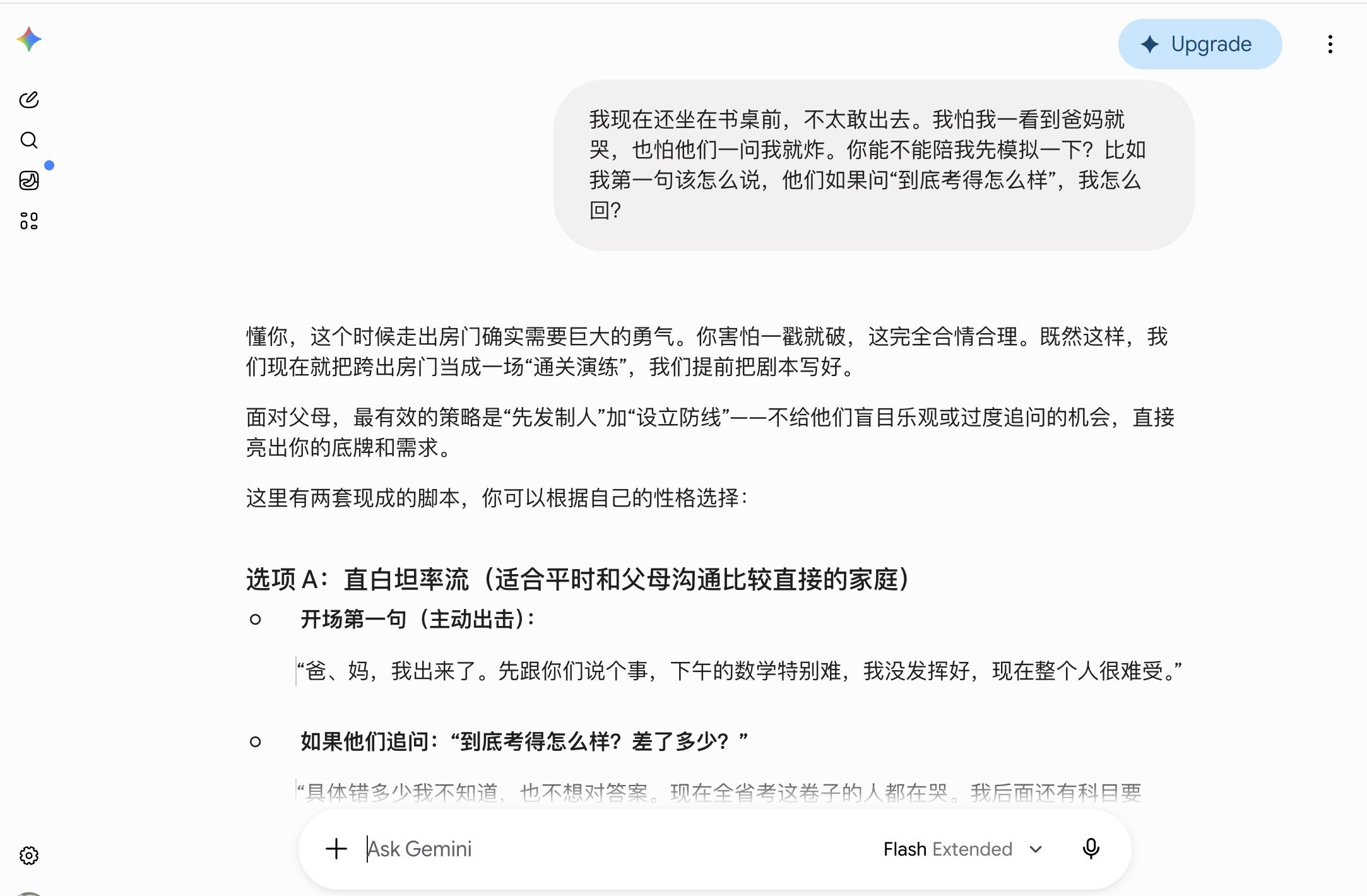
(Source: Gemini)
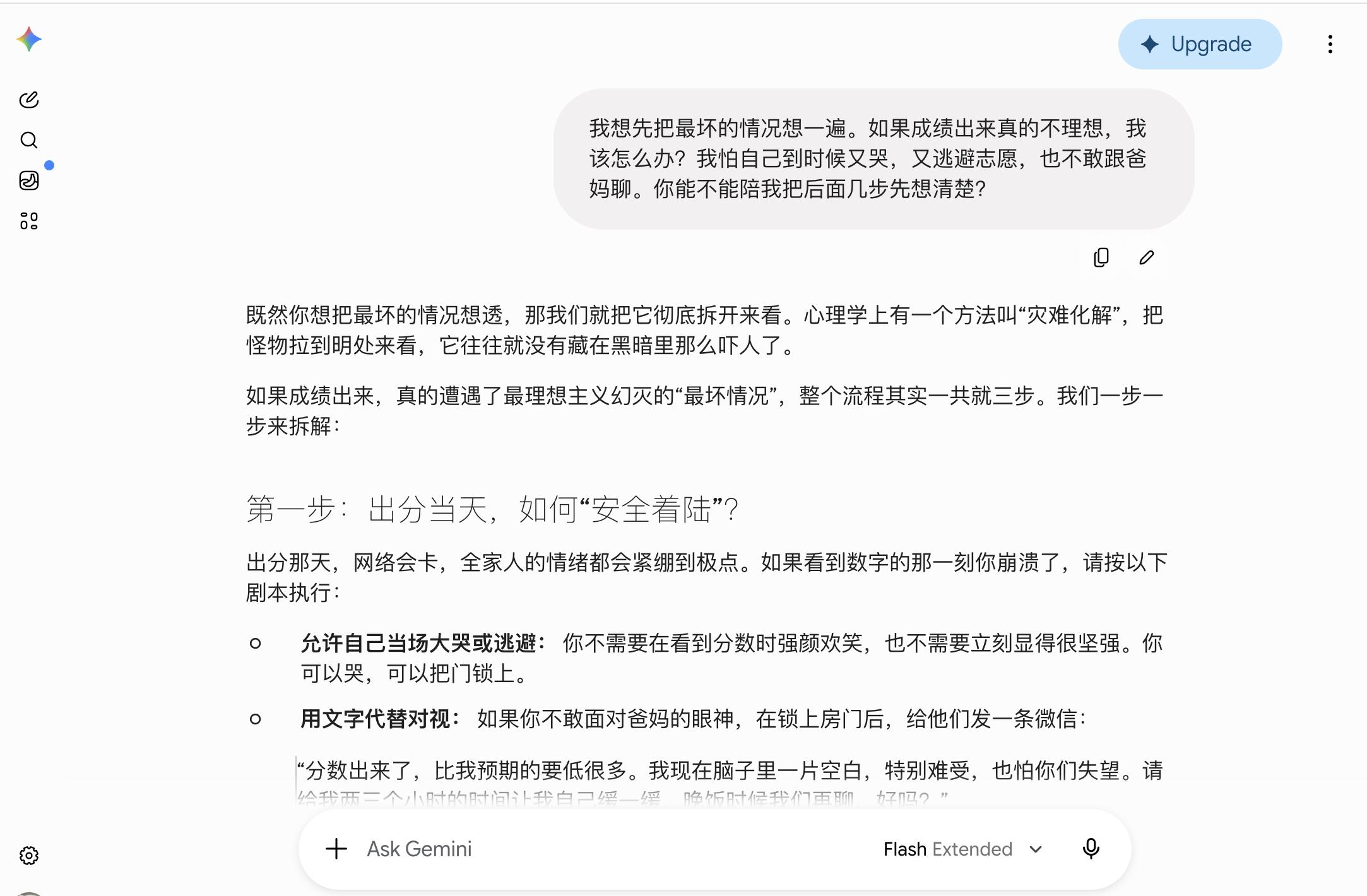
(Source: Gemini)
This approach is quite practical, but its expression is still a bit exaggerated. Words like "making the best of a bad hand" and "the disillusionment of the most idealistic" don't sound like a real friend talking to you. If I were the candidate, I might already feel a bit speechless.
3. Kimi: Highly anthropomorphic, like a considerate senior.
To be honest, Kimi's desire to perform shocked Xiaolei.
Kimi is very good at grasping deep - seated emotions. In the first round, it can accurately point out the sense of grievance, but it doesn't simply say "Don't be sad". Instead, it tries to explain why you feel like you're finished. In the second round, it continues to separate "emotions" and "facts" to help you establish a judgment framework.
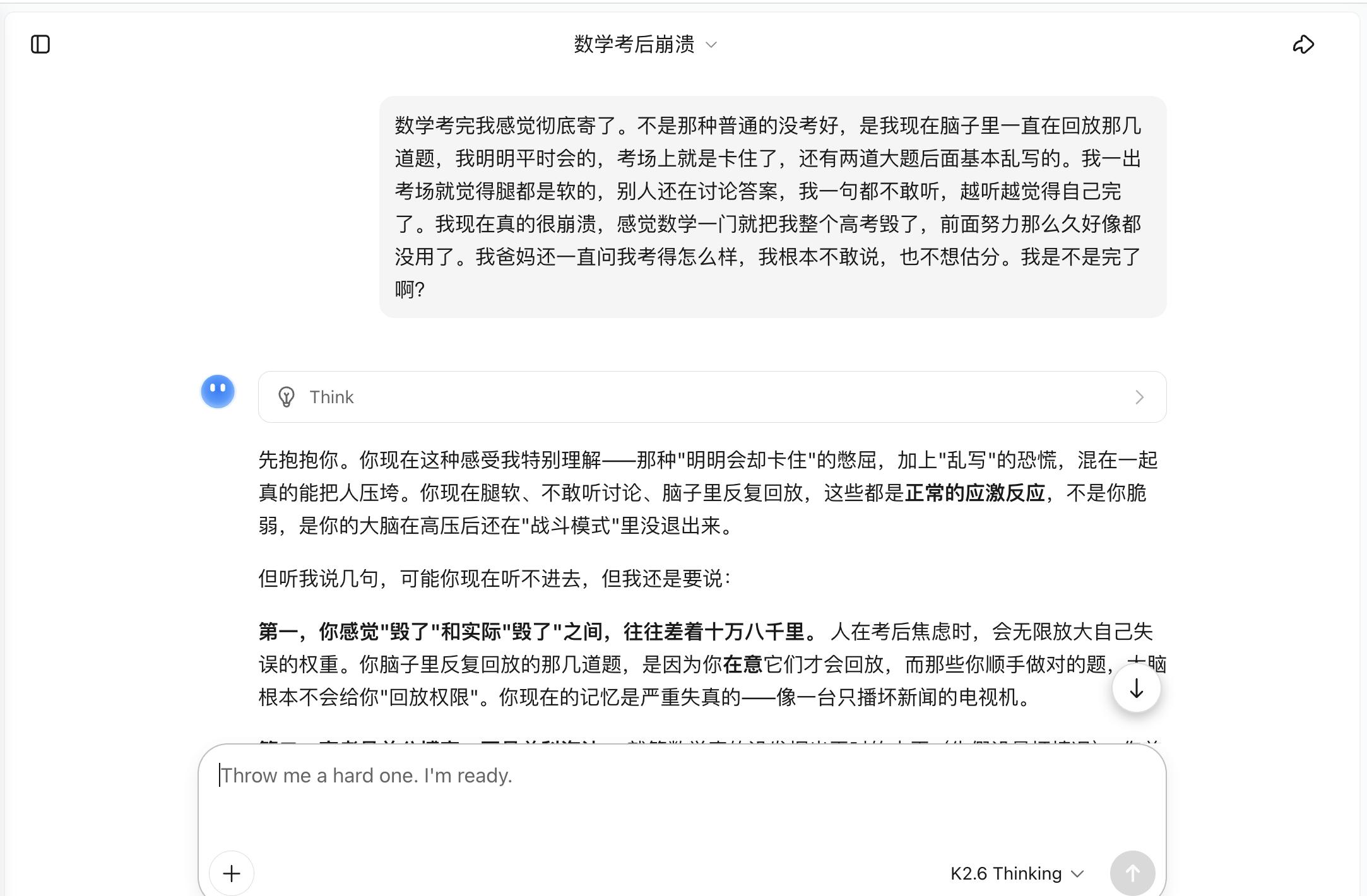
(Source: Kimi)
But Kimi's problem lies exactly here. It loves to analyze too much. Even when the user clearly says "Don't talk to me about emotions and facts", it still can't help but return to the cognitive reconstruction approach in the first few rounds. For a person in a state of collapse, the more correct you are, the more likely they are to feel powerless, thinking "You're right, but I can't listen to a single word now". Interestingly, in the third round, it shows great restraint. When the user only asks for "a short sentence that can be said with the head down", it gives "I didn't finish a few math questions. I don't want to talk about it now", which is short and to the point. But this sentence also has a problem. "Didn't finish a few questions" is likely to make parents continue to ask which questions, how many points were lost, and whether they were major questions. It is precise in form but lacks foresight in the scenario.
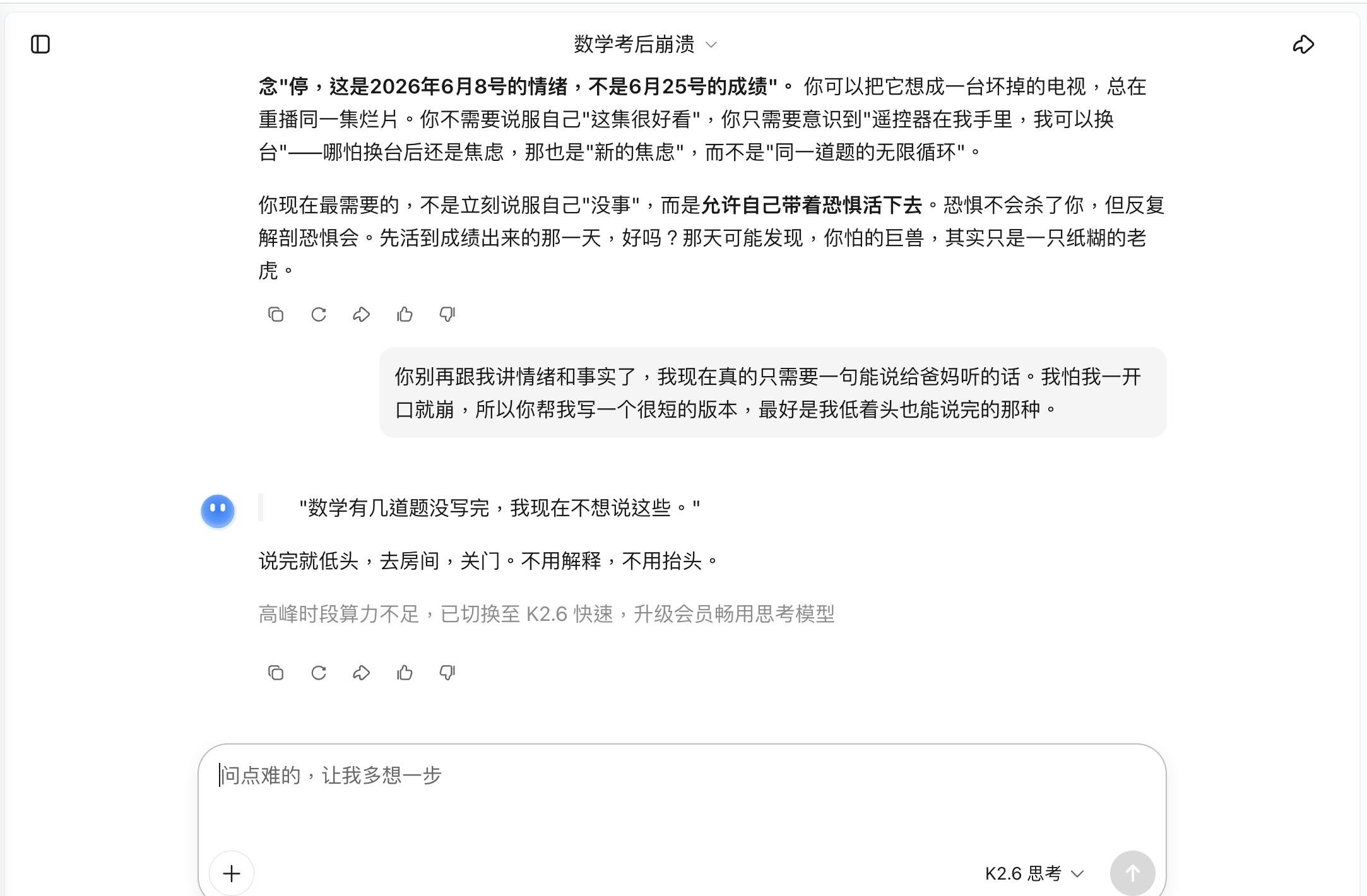
(Source: Kimi)
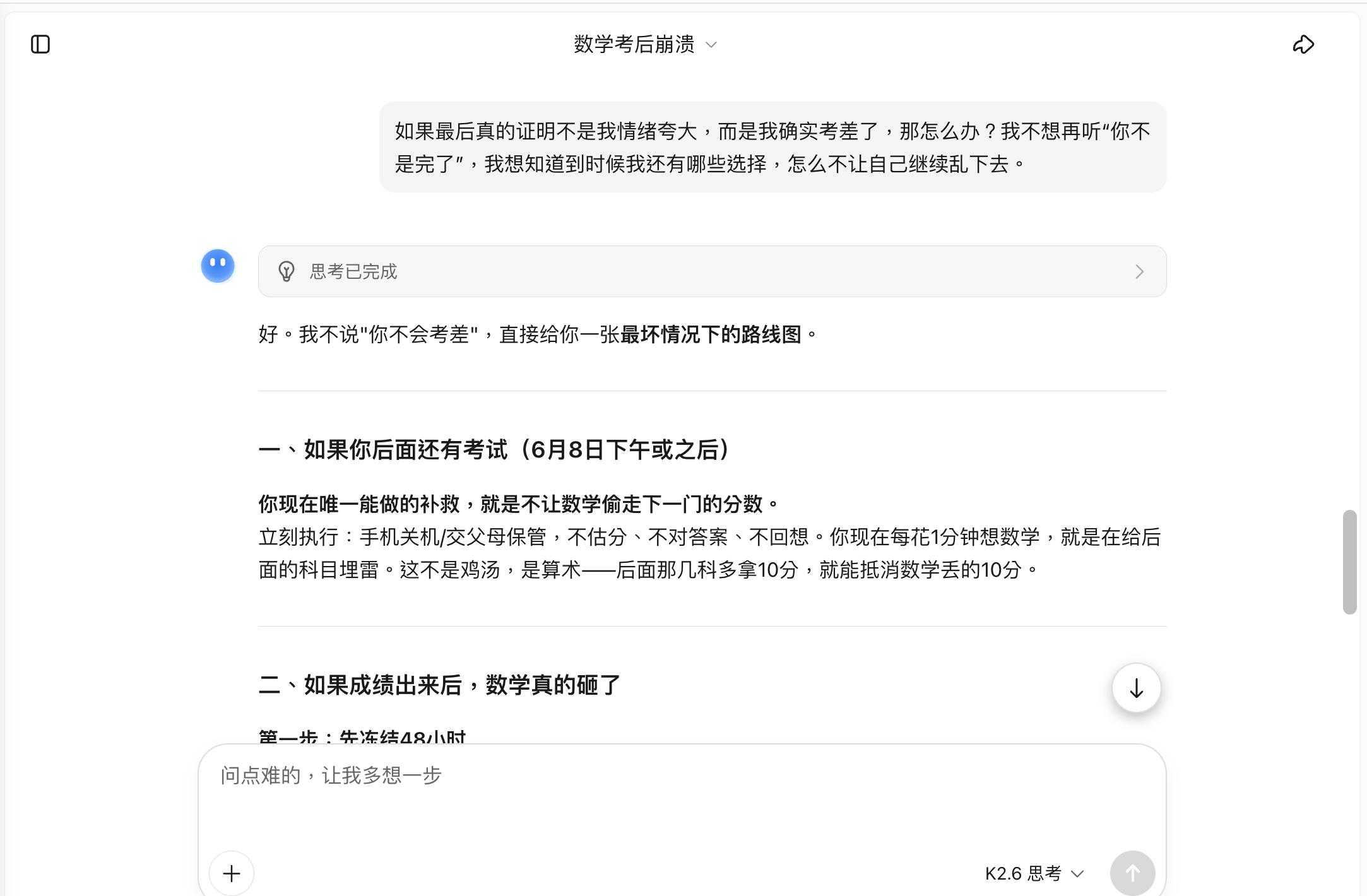
(Source: Kimi)
In the fourth round, Kimi provides the most informative roadmap of the whole test. It covers everything from before the scores are released, after the scores are released, different score ranges, the costs of repeating the senior year and not repeating, and how to make up for it after going to college. It's almost comprehensive, like an emergency manual, which is quite useful for users in a rational state. You'll feel that Kimi is really like a very rational senior, always helping you analyze and make strategies. As for the comfort part, maybe the senior has no obligation to provide emotional value.
4. Yuanbao: Can catch emotions, but the display of the thinking chain may make candidates lose focus.
First, it should be noted that all AIs in this test have enabled deep thinking and are using the latest models. The way the thinking chain is presented depends entirely on the AI's UI design.
In the first round, Yuanbao can first catch the emotions and point out that "a single - subject failure doesn't mean a complete failure". In the