The expansion of the manufacturing sector is slowing down, while the profits of industrial enterprises are continuously recovering.
Investment Highlights:
- Domestic Macroeconomy: Manufacturing expansion slowed in May, and the development of AI drove the improvement of industrial enterprise profits
Manufacturing expansion slowed, while the service industry's prosperity rebounded. In May, the Manufacturing PMI dropped by 0.3 percentage points month - on - month to 50.0%. Looking at the sub - items, both supply and demand declined, with external demand declining more. From the perspective of major industries, the prosperity of high - tech and equipment manufacturing continued to expand, while the prosperity of high - energy - consuming and consumer goods industries continued to decline, and the structural differentiation further increased. In terms of prices, the purchase price index of raw materials and the ex - factory price index remained at relatively high levels, but the upward price increase was not smoothly transmitted to the downstream, and the profit margins of mid - and downstream enterprises continued to be under pressure. The business activity index of the service industry in May was 50.3%, up 0.7 percentage points from the previous month, mainly driven by the concentrated release of residents' consumption demand during the "May Day" holiday. The Construction PMI index rebounded by 0.8 percentage points from the previous month to 48.8%, but it was still weaker than the seasonal level.
The rise in international oil prices and the rapid development of the AI industry have continuously improved industrial enterprise profits. From January to April 2026, the profits of industrial enterprises above a designated size increased by 18.2% year - on - year (previous value: 15.5%), and in April alone, they increased by 24.7% year - on - year (previous value: 15.8%). From the perspectives of volume, price, and profit margin, price recovery and profit margin improvement were strong supports for the improvement of profitability. From the perspective of the profit structure, the profits of the mining industry accelerated their recovery, the manufacturing industry maintained a high growth rate, and the profits of public utilities continued to decline. Overall, industrial enterprise profits have performed well since the beginning of this year, but there are differences within the industry. The mid - and upstream sectors have recovered, mainly driven by the rise in oil and copper prices and the development of the AI industry, while the downstream sectors have continued to be under pressure.
- Overseas Perspective: The expectation of peace talks between the US and Iran has increased, and most global stock markets have risen
Last week, Trump said that the US and Iran had reached a consensus on secondary issues other than the nuclear issue and Strait passage. However, as Iran refuted the US statement over the weekend and Trump postponed making a final decision, the situation may become complicated again. Overall, the market's expectation of peace talks between the US and Iran has increased. Coupled with the downward revision of the US economic growth forecast, the market's expectation of the Fed's interest rate hike has weakened.
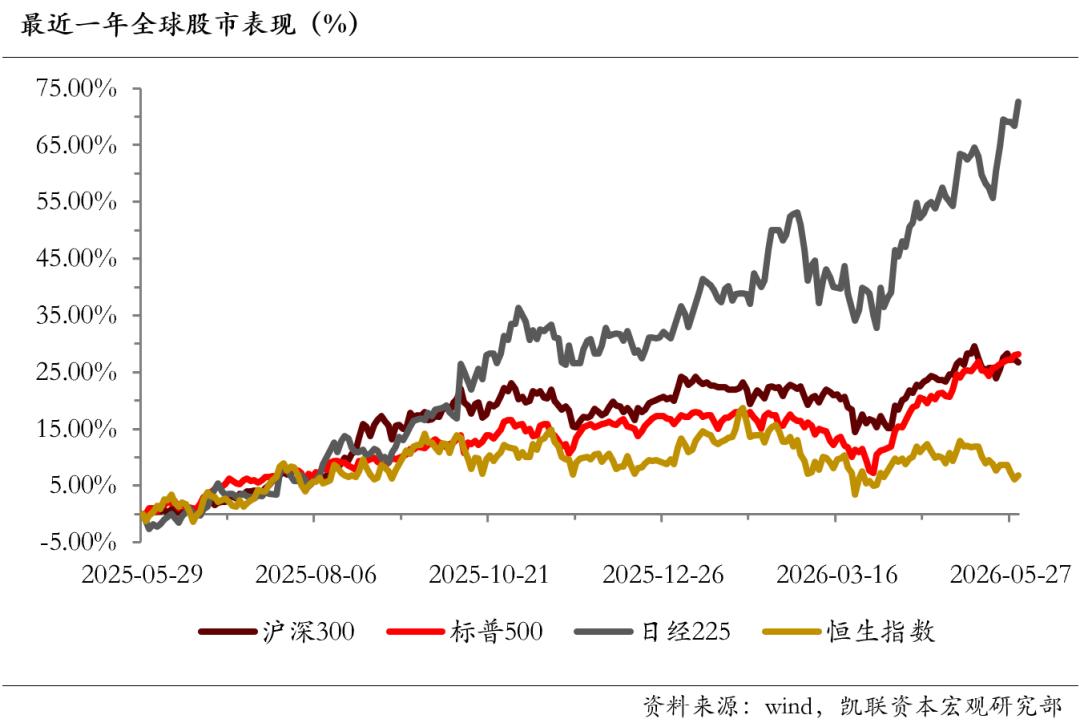
In May, in terms of major asset classes: Most global stock markets rose, with the South Korean Composite Index leading the rise by 28.4%; The 10 - year government bond yields of major overseas economies generally remained at high levels. At the end of May, the yield of the US 10 - year government bond reached 4.45%; The US dollar index rebounded by 0.84% to 98.9259, and the US dollar against the Chinese yuan closed at 6.7685; WTI crude oil dropped by 16.7% to $87.76 per barrel, and the gold price fell by 1.4% to $4569.9 per ounce.
Report Text:
I. Domestic Macroeconomy: Manufacturing expansion slowed, and industrial enterprise profits continued to recover
1.1 Domestic Economy: Manufacturing expansion slowed in May, and the development of AI drove the improvement of industrial enterprise profits
Manufacturing expansion slowed, and the service industry's prosperity rebounded
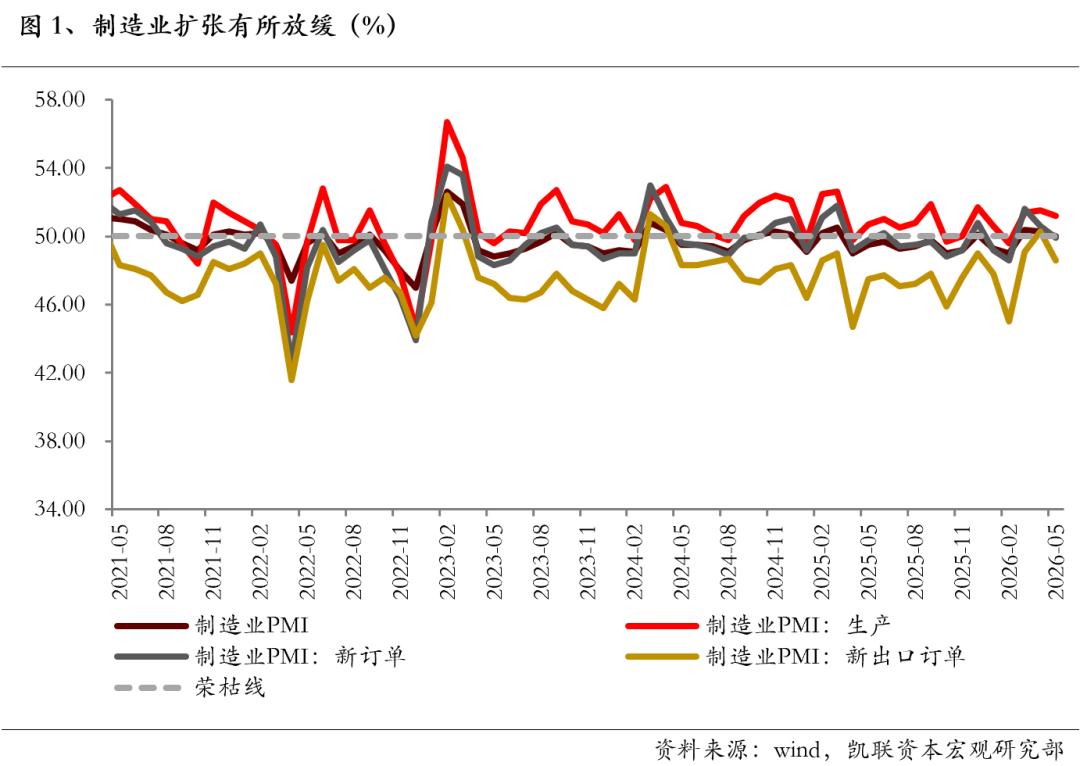
On May 31, the National Bureau of Statistics released the PMI index for May. The Manufacturing PMI was 50.0% (previous value: 50.3%), the Non - Manufacturing PMI was 50.1% (previous value: 49.4%), and the Composite PMI was 50.5% (previous value: 50.1%).
Manufacturing expansion slowed, and external demand declined significantly. In May, the Manufacturing PMI dropped by 0.3 percentage points month - on - month to 50.0%. Looking at the sub - items, both supply and demand declined, with external demand declining more. The production index and the new order index dropped by 0.3 and 0.7 percentage points month - on - month to 51.2% and 49.9% respectively, dragging down the PMI index by 0.1 and 0.2 percentage points respectively. Among them, the new export order index dropped significantly by 1.7 percentage points to 48.6%, which may be related to the overdraft effect after enterprises stocked up in advance and rushed to produce and export under the disturbance of the previous Iranian situation.
From the perspective of major industries, the prosperity of high - tech and equipment manufacturing continued to expand, while the prosperity of high - energy - consuming and consumer goods industries continued to decline, and the structural differentiation further increased. In May, the PMI of high - tech manufacturing was 52.9% (previous value: 52.2%), the PMI of equipment manufacturing was 52.1% (previous value: 51.8%), and the PMIs of the consumer goods industry and high - energy - consuming industries dropped by 1.0 and 0.8 percentage points month - on - month to 49.7% and 47.1% respectively.
In terms of prices, in May, the purchase price index of raw materials dropped by 3.2 percentage points to 60.5%, and the ex - factory price index dropped by 3.2 percentage points to 51.9%, indicating that the pressure on enterprises' raw material costs has been alleviated to some extent, but it still remained at a relatively high level. It is expected that the PPI in May will continue to increase positively, but the period of the fastest month - on - month increase in the PPI should have passed. However, the purchase price index of raw materials was still significantly higher than the finished product price index, indicating that the upward price increase was not smoothly transmitted to the downstream, and the profit margins of mid - and downstream enterprises continued to be under pressure.
From the perspective of enterprise scale, after briefly experiencing the situation where the PMIs of large, medium, and small enterprises were all in the expansion range in April, in May, the PMIs of medium and small enterprises dropped again to 48.6% and 48.5% respectively, while the PMI of large enterprises rose by 0.9 percentage points to 51.1%.
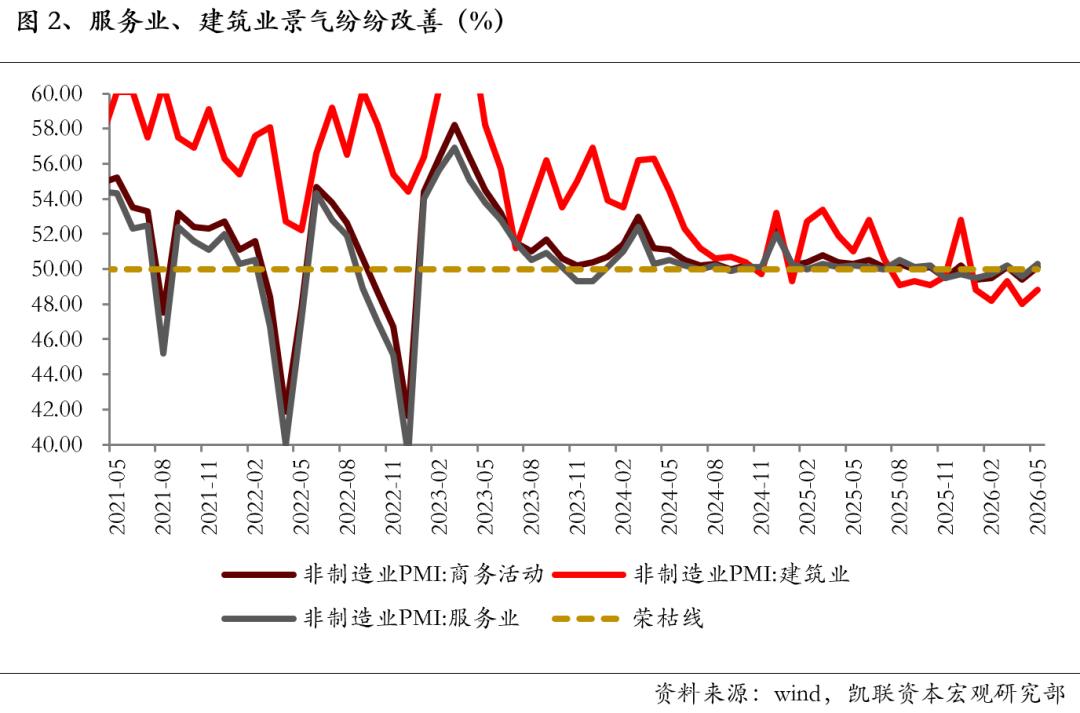
The release of holiday consumption demand pushed the prosperity of the service industry into the expansion range. The business activity index of the service industry in May was 50.3%, up 0.7 percentage points from the previous month. This was mainly driven by the concentrated release of residents' consumption demand during the "May Day" holiday, and the prosperity of service industries related to travel activities increased. In addition, new - energy - related industries represented by information services still maintained a relatively fast growth momentum. The business activity index of the telecommunications, radio, television, and satellite transmission service industry has remained above 55% for three consecutive months, and the business activity index of the Internet and software information technology service industry has remained above 54% for two consecutive months.
The Construction PMI index in May rebounded by 0.8 percentage points from the previous month to 48.8%, but it was still weaker than the seasonal level. In the future, focus on the construction progress of the "Six Networks". If the construction of the "Six Networks" speeds up, the prosperity of the construction industry may continue to rebound.
The rise in international oil prices and the rapid development of the AI industry have continuously improved industrial enterprise profits
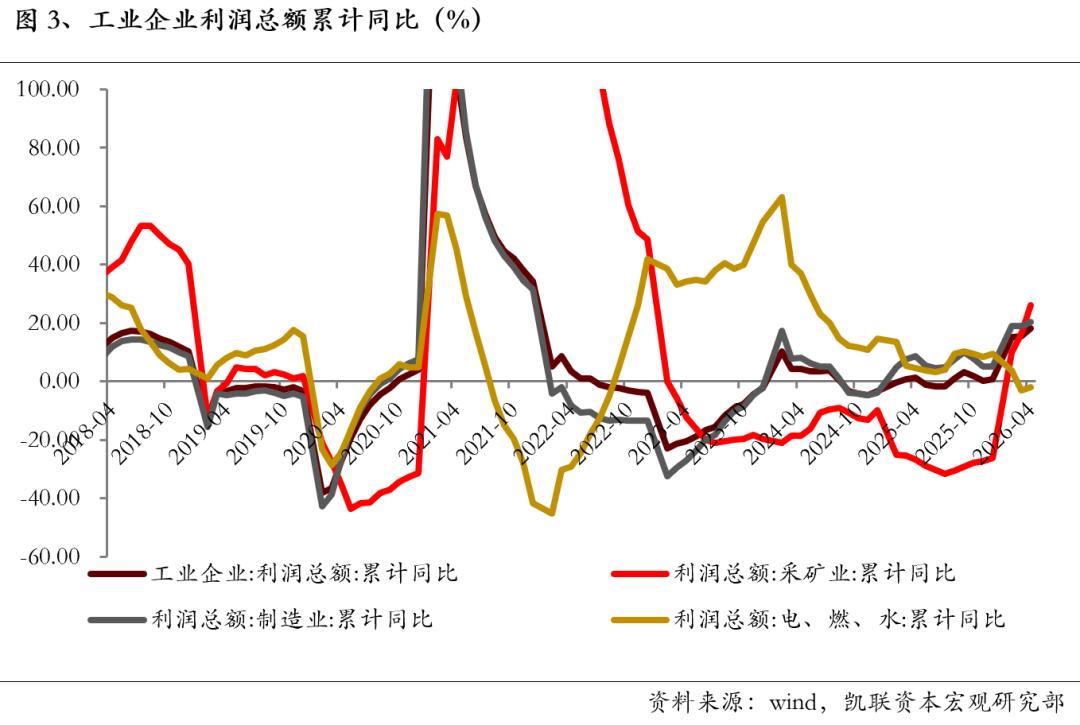
On May 27, the National Bureau of Statistics released the performance data of industrial enterprises above a designated size across the country. From January to April 2026, the profits of industrial enterprises above a designated size increased by 18.2% year - on - year (previous value: 15.5%), and in April alone, they increased by 24.7% year - on - year (previous value: 15.8%).
From the perspectives of volume, price, and profit margin, price recovery and profit margin improvement were strong supports for the improvement of profitability. In terms of volume, the year - on - year growth rate of industrial added value in April dropped from 5.7% to 4.1%; in terms of price, the year - on - year growth rate of the PPI in April accelerated from 0.5% to 2.8%; the monthly profit margin of industrial enterprises in April was 6.32%, up 0.95 percentage points year - on - year, the highest value in the same period since 2023, which was related to the fact that the revenue growth rate of enterprises was faster than the cost under the upward trend of the PPI.
From the perspective of the profit structure, the profits of the mining industry accelerated their recovery, the manufacturing industry maintained a high growth rate, and the profits of public utilities continued to decline.
In the mining industry, from January to April, profits increased by 26.0% year - on - year (previous value: 16.2%). Among them, benefiting from the rise in international oil prices, the profit growth rates of oil and coal mining increased by 9.5 and 14.3 percentage points respectively, and non - ferrous metal mining benefited from the high growth rate of copper prices (94.9%).
In the manufacturing industry, the mid - stream manufacturing and upstream raw materials still performed well, while the downstream manufacturing was under pressure. From January to April, the profits of raw material manufacturing increased by 88.1% year - on - year (previous value: 77.9%). First, it was driven by the rise in international oil prices; second, under the background of the expansion of AI infrastructure, energy transformation, and supply disturbances, the profits of the non - ferrous metal smelting and rolling processing industry continued to grow relatively fast. There was obvious differentiation within the mid - stream manufacturing. From January to April, the year - on - year growth rate of the profits of the electronics industry reached 107.7%, contributing 43.8% to the profit growth of all industrial enterprises above a designated size, reflecting the continuous pull of AI - related demand and the equipment renewal cycle on the electronics manufacturing industry; the year - on - year growth rates of the general equipment, special equipment, and electrical machinery industries were all negative, indicating that the demand recovery of the traditional equipment manufacturing industry was still weak. In the downstream consumer goods manufacturing industry, most industries were under pressure.
In the public utilities, from January to April, the profits of the production and supply of electricity, heat, gas, and water decreased by 1.9% year - on - year (previous value: - 3.2%).
Overall, industrial enterprise profits have performed well since the beginning of this year. Price recovery and profit margin improvement have played a positive role in pulling, but there are differences within the industry. The mid - and upstream sectors have recovered, mainly driven by the rise in oil and copper prices and the development of the AI industry, while the downstream sectors have continued to be under pressure.
1.2 Liquidity Outlook: Short - term interest rates are relatively stable, and market liquidity is reasonably loose
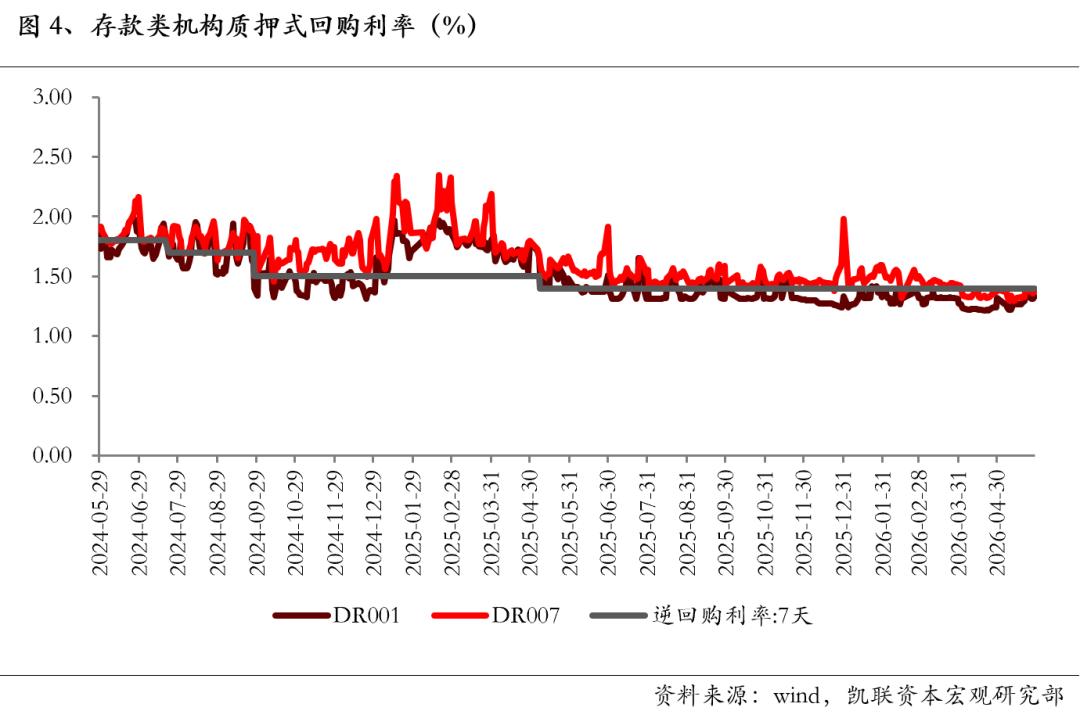
In May, short - term interest rates were relatively stable, and market liquidity was reasonably loose. In terms of the monthly average, DR001 in May rose by 5bp from April to 1.28%, and DR007 dropped by 1bp to 1.34%.
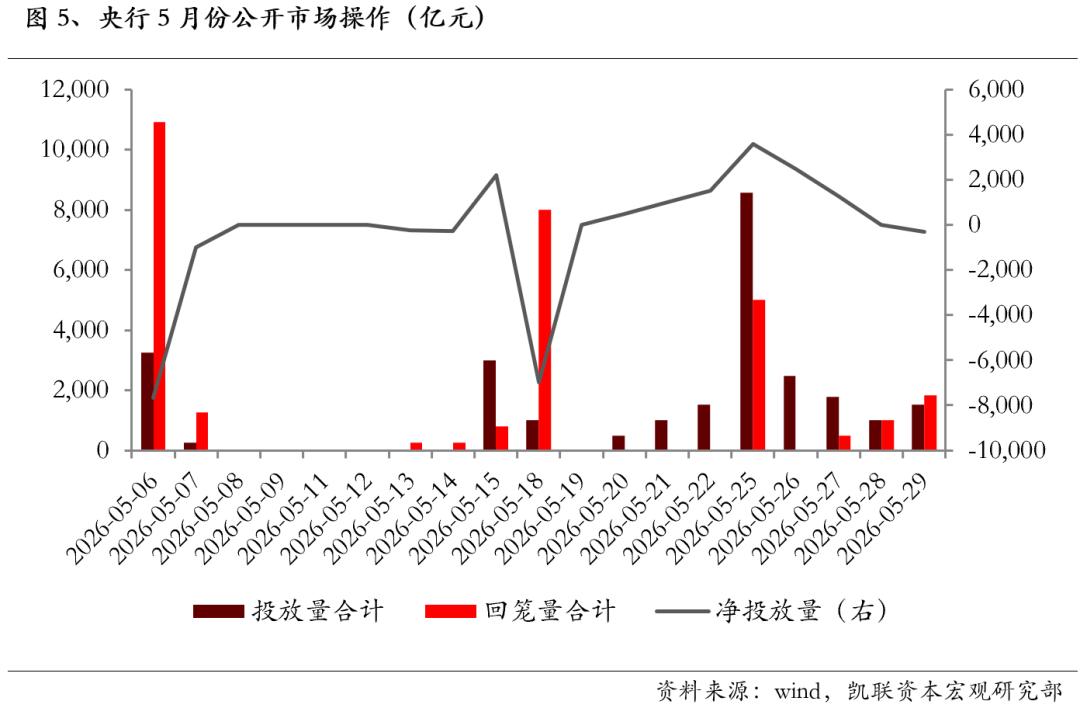
In terms of open - market operations, in May, the central bank injected 300, 18,699, 6,000, and 1,000 billion yuan through bill maturity, reverse repurchase, MLF, and treasury cash fixed - term deposits respectively, and withdrew 300, 23,801, 5,000, and 800 billion yuan through bill issuance, reverse repurchase maturity, MLF maturity, and treasury cash fixed - term deposit maturity respectively, achieving a net withdrawal of 390.2 billion yuan.
II. Overseas Perspective: The expectation of peace talks between the US and Iran has increased, and most global stock markets have risen
2.1 Overseas Macroeconomy: The expectation of peace talks with Iran has increased, and the market's expectation of interest rate hikes has weakened
Last week, Trump said that the US was about to lift the maritime blockade on Iran and resume navigation in the Strait of Hormuz, and claimed that the two countries had reached a consensus on secondary issues other than the nuclear issue and Strait passage. The US would also make a final decision on this round of confrontation, which triggered a rapid increase in market optimism. However, as Iran refuted the US statement over the weekend, stating that its remarks were half - true and half - false; Trump also postponed making a final decision, and the differences between the two sides were further highlighted, and the situation may become complicated again.
In terms of monetary policy, as the expectation of peace talks between the US and Iran has increased, inflation risks may be alleviated to some extent. Coupled with the downward revision of the US economic growth forecast and the weakening of the economic fundamentals, the market's expectation of the Fed's interest rate hike has weakened.
2.2 Global Assets: Most stock markets rose, and crude oil prices dropped significantly
Global Stock Markets: Most rose
In May, with the positive expectation of peace talks between the US and Iran, market risk appetite rebounded, and global stock markets generally rose. Specifically, among the three major US stock indexes, the Dow Jones Industrial Average, the Nasdaq Composite, and the S&P 500 rose by 2.8%, 8.4%, and 5.1% respectively; in the