Who is lying? Top-tier venture capitalists gathered big names including Altman to host a real-life "Werewolf" reality show
If you were asked to imagine a closed - door gathering of top power figures in Silicon Valley, you'd most likely think of artificial intelligence, the chip war, robots, defense technology, or the next - generation Internet.
After all, sitting in the room are Sam Altman, the founder of OpenAI; Palmer Luckey, the founder of the military unicorn Anduril; Dylan Field, the founder of Figma; Moxie Marlinspike, the founder of Signal; and a group of investors who control the flow of hundreds of billions of dollars in capital.
However, a recent gathering in San Francisco was completely different.
No one discussed AI models, and no one talked about financing and valuation. Instead, these smartest and most powerful people in Silicon Valley sat around a round table and seriously played a game of Werewolf.
To be precise, it's the American version of Werewolf - Mafia.
What's even more interesting is that this was not a private gathering among friends but a reality show that was officially filmed and publicly broadcast.
The name of the show is "MAFIA", and the producer is Founders Fund, one of the most legendary and controversial venture capital institutions in Silicon Valley.
Founders Fund may not be as well - known as Sequoia or Hillhouse, but when it comes to the companies it has invested in, people will immediately realize its significance: Facebook, SpaceX, Palantir, Stripe, Airbnb, Anduril, and OpenAI have all appeared in its investment portfolio.
This investment institution, founded by members of the "PayPal Mafia" such as Peter Thiel, has been involved in almost all the most important technological waves in Silicon Valley over the past two decades. Now, it has done something that seems to have nothing to do with investment - producing a variety show.
Of course, simply regarding "MAFIA" as a reality show in the tech circle may underestimate the real intention of Founders Fund.
It's more like a public experiment packaged as an entertainment show.
01
Why are a group of billionaires addicted to Werewolf?
The opening of the show was quite surreal.
The location was chosen as the legendary Tosca Cafe in San Francisco, where the classic group photo of the "PayPal Mafia" was taken.
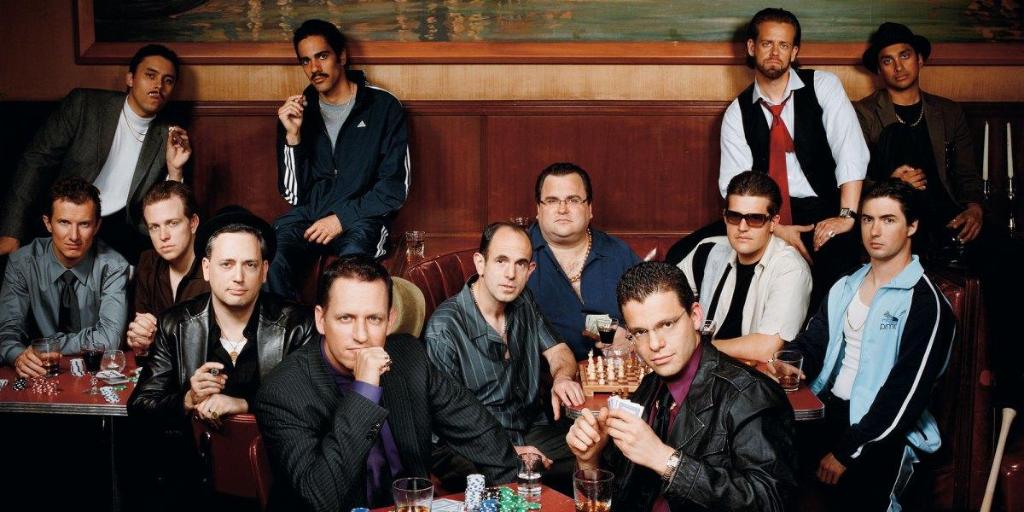
(The classic group photo of the "PayPal Mafia" refers to a very famous team photo in the history of Silicon Valley technology. It was taken during a gathering of the early core members of PayPal and has been repeatedly cited to symbolize the huge influence of these people on the subsequent Silicon Valley startup ecosystem.)
This time, sitting at the table were the new generation of the power core in Silicon Valley:
Sam Altman (Founder and CEO of OpenAI)
Palmer Luckey (Founder of Anduril Industries)
Dylan Field (Co - founder and CEO of Figma)
Moxie Marlinspike (Co - founder of Signal)
Bryan Johnson (Initiator of the "Don’t Die" project)
Trae Stephens (Partner of Founders Fund)
Ryan Petersen (Founder and CEO of Flexport)
If you simply add up the market values and influences of the companies these people represent, this table can almost be regarded as a miniature "global technology economy".
But the first thing they did was: close their eyes, "kill", and vote.
In the view of Mike Solana, the marketing director of Founders Fund, this seemingly absurd arrangement is actually a deliberate rebellion against the traditional VC content form.
Over the past decade or so, the most common narrative in the tech circle has been founders telling standardized life stories in podcasts: loving programming, failing in startups, and changing the world.
After hearing so many similar stories, everyone starts to seem the same.
But Werewolf is different.
It doesn't give you time to prepare, nor does it allow you to package your narrative.
You have to judge others' intentions in a very short time and make decisions under a serious information asymmetry. The behavior patterns shown under this pressure are often closer to the real personality than any interview.
Thus, this game essentially becomes a "personality development experiment".
Sam Altman dissected everyone's speech logic like analyzing an AI model; Palmer Luckey continued his usual joking style and became the target of criticism just a few minutes after the game started because of his over - activity; and Moxie Marlinspike, the founder of Signal, staged the most exciting scene of the whole show - with just one sentence, he successfully changed everyone's thinking framework.
02
Silicon Valley tycoons at the card table
The game got out of control quickly from the first night.
After Dylan Field, the founder of Figma, was "executed by the Mafia" in the first round, the whole situation quickly entered an information vacuum, and everyone started to rely on intuition and experience for reasoning.
Ryan Beiermeister, an AI policy expert, was the first to attack, questioning that Trae Stephens and Bryan Johnson over - reacted when they heard the news of the death. And Josie Zayner, a biohacker, defended Bryan by saying that he "watched too many Korean dramas".
While everyone was chatting away, Sam Altman spoke up. With his extremely calm defensive and analytical abilities, he started to analyze others' speeches and justifications.
When Moxie, the founder of Signal, firmly accused biohacker Josie Zayner of being a member of the Mafia, Altman noticed something strange:
"As an old player, Moxie is taking such a big risk to accuse a newbie. This is very interesting... This extremely certain way of speaking feels very 'Mafia - like'. Moxie, I think you are the most likely to be a member of the Mafia."
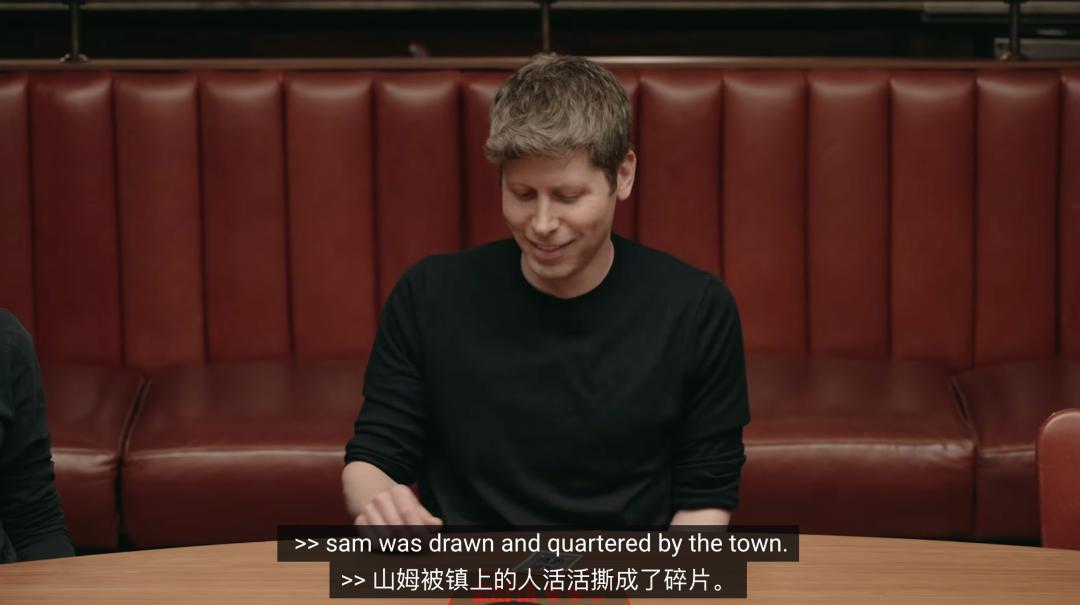
However, this straightforward way of playing made him the target of criticism immediately. In the hand - raising vote on the third night, Altman unfortunately was out of the game.
When the host announced that he was "torn apart by five horses" by the townspeople, the whole room burst into laughter. Someone even added, "At least this proves that he is not a super - intelligent AI."
03
The "new wealth code" in Silicon Valley in the era of infotainment
After the "MAFIA" reality show was launched on YouTube and X platforms, it quickly attracted attention in the tech circle, and the view count of the first episode easily exceeded 10,000 in a short time.
Against the backdrop of the gradual decline of traditional media and the suspension of some talk shows, the VC giants in Silicon Valley are taking over the baton of content creation in a high - profile manner.
From the early heavy investment in the media matrix by a16z, to the recent official acquisition of the tech talk show TBPN by OpenAI, and now Founders Fund's own production of an entertainment variety show, the business logic behind them is highly consistent.
In this modern society reshaped by social media, the path to power and influence is increasingly paved with "infotainment".
Whether it's Bryan Johnson attracting traffic by showing his strange anti - aging routine online, or Elon Musk charging his business empire with his personal influencer matrix, the new generation of elites in Silicon Valley know better than anyone else that in the Internet era, controlling traffic, creating narratives, and even performing skillfully in public are becoming the most core business capital.
Although the venture capital tycoons are playing a game at this long table, the precise defense, logical analysis, persuasive eloquence, and decisive decision - making in the face of insufficient information that they display are exactly the underlying genes that make them successful in the real business world.
This article is from the WeChat official account "Wall Street Insights", author: Ye Zhen. It is published by 36Kr with authorization.