The competition among major tech companies over AI Agents is evolving along four main trajectories.
Generalizing the Coding Agent to general scenarios is a system-level competition.
For the AI field, this week has been a week filled with heavyweight news. From Jensen Huang redefining the AI PC, to Microsoft Build 2026 advocating for "Agent first", OpenAI announcing the merger of ChatGPT and Codex, to the exposure of WeChat Agent's progress, Qianwen starting to integrate third - party Skills, Doubao responding to the paid service rumor, and Meituan emphasizing at its earnings conference that serving AI Agents is becoming increasingly important.
Previously, some people were asking why no one was talking about the once - popular OpenClaw. The news this week has answered this question with actions - people are no longer talking about OpenClaw because the Coding Agent has become a general solution for task execution and is moving towards integration with Chatbots. Meanwhile, the corresponding Skill and Agent ecosystems are also being built, and new paid service explorations are underway.
Large companies are translating the inspiration brought by OpenClaw into real business progress. In this process, OpenClaw and the products we see now may not be the final form of AI products. As Yao Shunyu, the chief AI scientist at Tencent, said at the 2026 Tencent Cloud AI Industry Application Conference, a long - term transformation has just begun, and the real product forms, business opportunities, and usage methods are far from being fully invented.
What we can be sure of is that Agents are becoming the core battlefield for large companies' AI, and the form of this competition is evolving along four main lines: Who can expand the user base in more productivity scenarios; who can integrate internal products more deeply; who can build a sufficiently rich Skill and Agent ecosystem; who can accumulate enough context.
"Colleague" Becomes the Focus of Agent Competition
"Colleague" is the most frequently mentioned term when describing Agents. Microsoft's Scout is designed to work "like a colleague"; Kouzi 3.0 emphasizes the collaboration between humans and AI teams; the Agent plug - in launched by OpenAI is described as "a new colleague who has completed onboarding and understands the entire process".
These statements mean that productivity scenarios have become the focus of competition for large companies' Agents.
Microsoft's Scout is an Agent built on the OpenClaw framework. It resides in Microsoft 365, can run in Teams, and can collaborate with office applications such as Outlook and OneDrive to browse emails, calendars, and work messages, automatically handle meeting conflicts, draft responses, and advance tasks. At the same time, Microsoft has also launched Agent 365 to uniformly manage the identity, permissions, policies, and risks of Agents for enterprises.
OpenAI directly set the theme of its press conference as "Intelligence at Work". At this press conference, OpenAI made three core upgrades to Codex: launching an Agent plug - in with customizable capabilities; expanding the local annotation and modification capabilities from code and web pages to documents, spreadsheets, and PPTs; and enabling the ability to report outputs by generating websites.
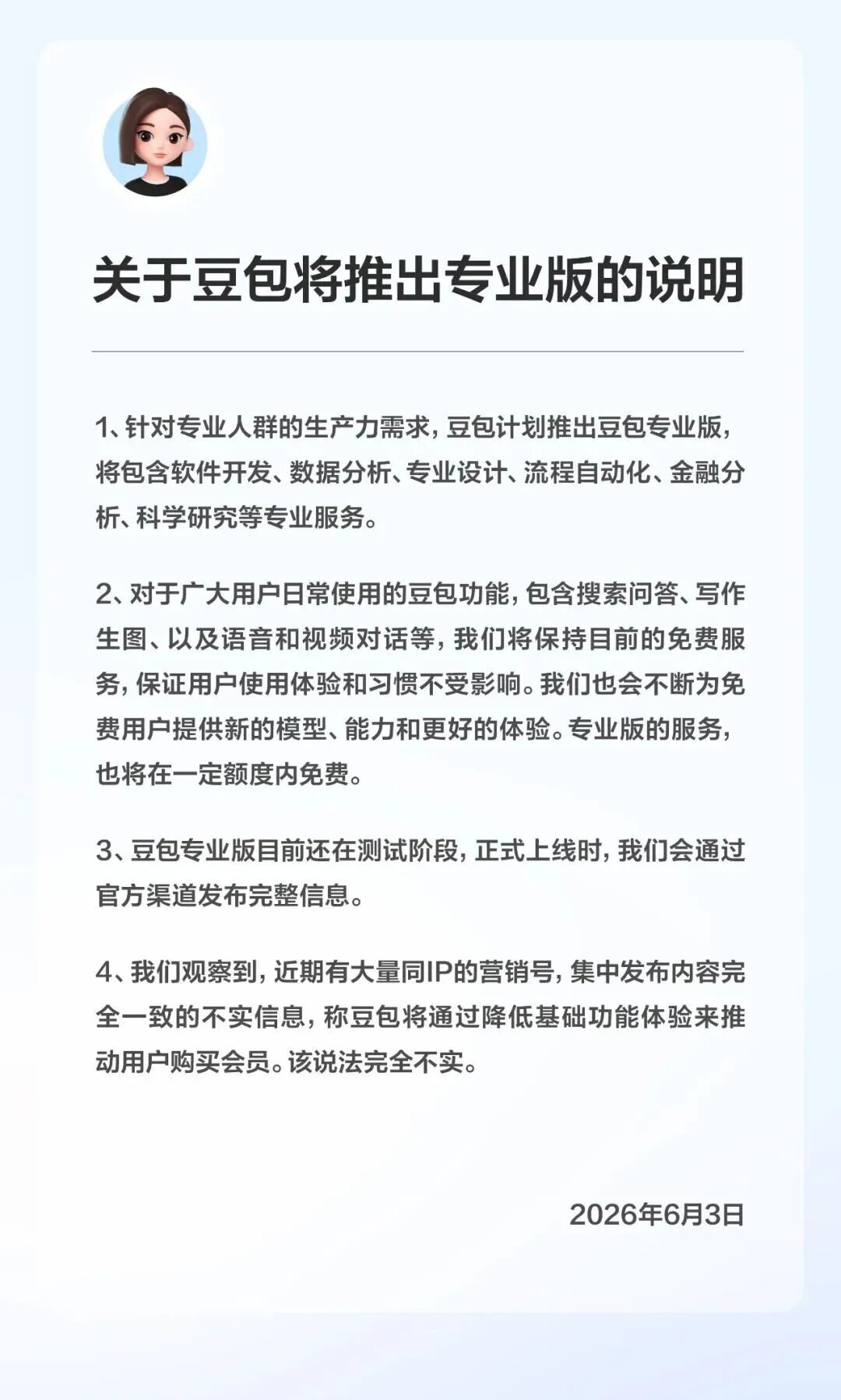
Meanwhile, in response to the paid service feature, Doubao mentioned that aiming at the productivity needs of professional groups, Doubao plans to launch a professional version, which will include professional services such as software development, data analysis, professional design, process automation, financial analysis, and scientific research.
These product actions mean that the great value of productivity scenarios - not just traditional enterprise scenarios - has been verified with real investment.
Data released by OpenAI shows that since February this year, the weekly active users of Codex have increased by 6 times, reaching 5 million, among which the growth rate of knowledge workers is 3 times that of developers. Anthropic's revenue in the second quarter is expected to more than double, reaching $1.09 billion, and it may achieve an operating profit of $559 million. Most of its revenue comes from enterprises and startups.
Integration and Connection of Internal Products are Deepening
The update and iteration of products correspond to a deeper - level restructuring of the product architecture. On the one hand, currently, large companies have basically deployed Chatbots and one or more Agent products, and the integration of these products has begun. The most radical one is OpenAI's integration of ChatGPT and Codex.
OpenAI wants to upgrade ChatGPT from a simple dialogue entry to the main interface for collaborative Agent work, while Codex will be upgraded to a general Agent platform that can meet the work needs of multiple scenarios such as office work, scientific research, enterprise processes, data analysis, and business operations. Its core is the generalization of the usage scenarios of the Coding Agent. Through this integration, OpenAI hopes to promote Codex to the large user base of ChatGPT and expand the paid user base.
There are also reports that OpenAI plans to involve the AI browser Atlas in the integration of this super AI application.
On the other hand, the original Internet product capabilities and services of large companies are being rapidly integrated into AI products in the form of Skills or Agents. Alibaba's addition of the capabilities of ordering takeaways, hailing taxis, and shopping on Taobao to Qianwen was an early exploration. Now, we can see that ByteDance, Meituan, and Tencent are all doing similar work.
After ByteDance connected Doubao to the Douyin Mall, it is adding the recommendation of local life services such as food, movie tickets, and homestays, including store and group - buying packages. Meituan said at its earnings conference that its AI assistant "Xiaotuan" has been embedded in the Meituan APP, serving over 100 million users during the May Day holiday, covering scenarios such as dining, entertainment, travel, and medical consultations. Tencent Docs has transformed its accumulated document - processing capabilities into Skills, which can be called by WorkBuddy.
Tang Daosheng, the senior executive vice - president of Tencent Group, said during the 2026 Tencent Cloud AI Industry Application Conference that in the past, the functions of many traditional applications need to be converted into capabilities that can be called by intelligent agents in order to further release the value accumulated over the years. So this year, Tencent Work Weixin is opening up some of its original data capabilities through interfaces and Skills so that other intelligent agents can call them. This trend of opening up is becoming more and more obvious.
Third - Party Ecosystem Construction is on the Agenda
A core difference between Agents and previous products is that Agents have the ability to call tools. This requires a sufficiently rich tool ecosystem behind Agents. Even large companies find it difficult to build this ecosystem on their own. This calls for the construction of a third - party Skill or Agent ecosystem.
Now, the construction of this ecosystem is on the agenda.
After completing the integration of Alibaba's internal first - party products and services, Qianwen announced that it will fully open up to third - party Agents and Skills, allowing all enterprises to operate their own brand Agents on Qianwen. This week, Luckin Coffee, KFC, MIXUE, and China Eastern Airlines have launched Skills on Qianwen. Subsequently, enterprises can also customize the Agent's persona and specific services in Qianwen.
Tencent, on the one hand, is integrating Meituan's Xiaomei into Yuanbao to provide users with services such as takeaway ordering and delivery; on the other hand, it is accelerating the construction of the WeChat Agent ecosystem.
Media reports show that WeChat's Agent has completed the prototype test, and the compliance approval process before public launch will start as soon as this month. This Agent can dispatch WeChat mini - programs to achieve composite services such as ordering food, hailing taxis, booking tickets, shopping, and local life services.
In addition, WeChat is also trying to establish Agent - to - Agent connections with mobile phone manufacturers such as Honor and Xiaomi, so that its basic capabilities can be called by the Agents of mobile phone manufacturers. That is to say, mobile phone manufacturers will also become new entrances to the WeChat Agent ecosystem, forming an architecture where multiple entrances share the same Agent ecosystem.
OpenAI's Agent plug - in can package the tools, knowledge, and skills required for a position at once. For example, the creative production plug - in can generate campaign boards, display advertising variants, product lifestyle pictures, and e - commerce picture collections according to the brief, and can call tools such as Figma, Canva, Shutterstock, Picsart, and Fal. Put simply, this is a professional inheritance system for Agents.
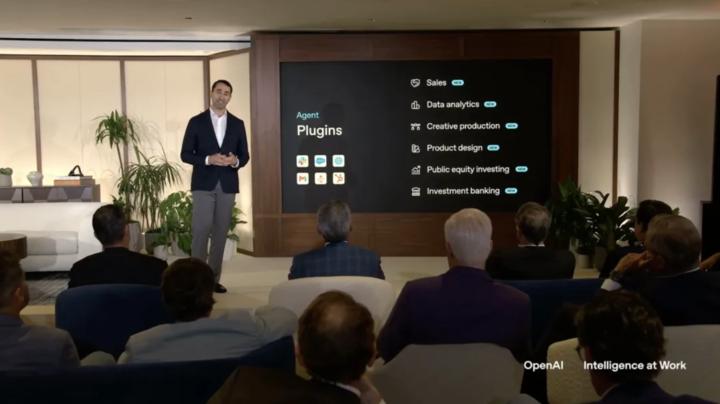
Currently, Codex's Agent plug - ins cover 62 popular applications and 110 skills. In the future, OpenAI hopes to open up the plug - in ecosystem to partners, allowing third parties to directly create and deploy their own plug - ins in Codex and ChatGPT.
Context Becomes More Important
Yao Shunyu said that models are becoming better at turning complex inputs into outputs, but only if they can get good enough inputs. This requires the user side to provide the model and the Agent with detailed and useful information so that the model and the Agent can understand questions such as "who you are", "what you are doing", and "what answers are valuable to you" that can anchor the correct path.
On the development side, sufficient context communication is also needed around AI product development. Yao Shunyu and Tang Daosheng mentioned in their conversation at the above - mentioned event that AI product development needs to determine what the model should reward or punish, what answers are good, and what behaviors are bad from product feedback. This means that the model team and the product team need to complete co - design through a context - sharing process to jointly create a better experience.
Therefore, AI products need to connect and accumulate multi - source context information on the user side, and then align the task intention with the Agent by distinguishing what information should be given and what should not; on the development side, a smooth feedback mechanism should be established to align the development goals of the model team and the product team and accelerate the optimization of the experience.
Whether it is the accumulation of context on the user side or the sharing of context on the development side, it is not only a development issue but also an organizational issue, which requires collaboration to achieve context accumulation and sharing.
This is why, in order to integrate ChatGPT and Codex, OpenAI started to restructure its team in January this year, making the product team and the researchers in charge of the relevant underlying models collaborate more closely; then it integrated the ChatGPT, Codex, and API teams into one department, led by Thibault Sottiaux.
Meanwhile, the emphasis on context may also stimulate the Agent - ization of hardware, making hardware an effective way for Agents to collect user context. Microsoft's Project Solara is conducting such an exploration. The purpose of developing Agent desktop terminals and portable devices is not only for communication at any time and place, but also to provide more context information for Agents to perform tasks in desktop and mobile scenarios.
In the past few years, the AI industry has shown a relatively clear technological path: pre - training → post - training → Agent → Coding Agent. This path may not be the only main line in the future, but it is the most effective main line that large companies can grasp at present.
The four trends we have extracted are the connected basic coordinates along the fixed path, all aiming at the generalization of the Coding Agent to general scenarios. This is again a system - level competition.
This article is from the WeChat official account "Narrowcast AI", author: Li Wei, published by 36Kr with authorization.