Yao Shunyu, presents Tencent AI's "Longzhong Strategy"
The outside world has set extremely high expectations for Tencent's AI.
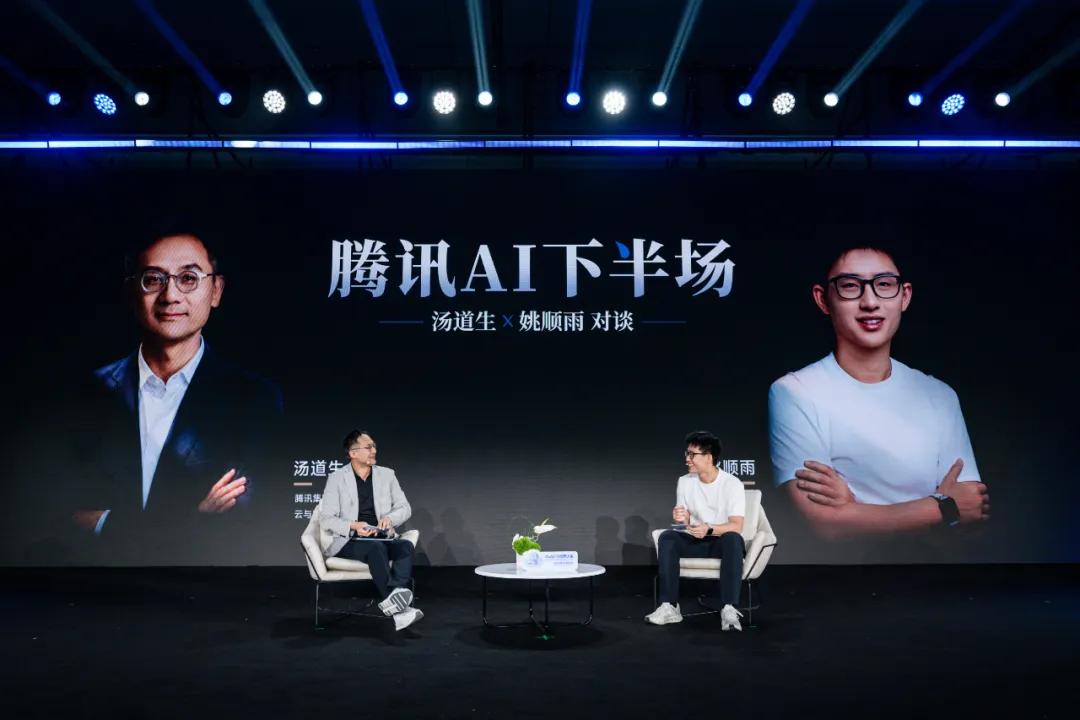
On June 5th, at the 2026 Tencent Cloud AI Industry Application Conference, Tang Daosheng, the senior executive vice president of Tencent Group, had a dialogue with Yao Shunyu, Tencent's chief AI scientist. The theme of the dialogue was "The Second Half of Tencent's AI Journey."
The focus of the entire event fell on Yao Shunyu: the venue was packed with on - site audiences, and off - site topics also gained an overwhelming amount of popularity.
Yao Shunyu Answers All for Tencent's AI
This was his first appearance at an open offline event since he joined Tencent in December last year. Previously, he only appeared via a remote connection at a round - table forum.
AI Blue Media reported that Yao Shunyu is the most prominent product of Tencent's AI. Pushing this prodigy to the forefront might be a deliberate move by Tencent. For example, in the agenda setting of the dialogue, the roles of Tang Daosheng and Yao Shunyu were unusually reversed.
As a member of Tencent's top management "Executive Committee," Tang Daosheng is directly in charge of the Cloud and Smart Industry Group, which is closely related to AI. With deep experience and high authority, he became the host and frequently asked questions. On the other hand, Yao Shunyu became the unified outlet for Tencent's AI strategic information, and he presented it from his own and technical perspectives.
At this time, Yao Shunyu, like Luo Fuli of Xiaomi, became the face of the enterprise. When Tencent's AI was in a weak position in the industry, the public's attention focused on this individual star would also be directed towards Tencent's AI products.
Naturally, Yao Shunyu became the external spokesperson for Tencent's AI. In the question - and - answer session with Tang Daosheng, he shared Tencent's AI thinking about the second half of the journey:
Competing in general large - scale models is only the first half of the AI journey. When the methodology of AI matures, the focus of competition shifts from competing in parameters and scale to the ability to implement, adapt to scenarios, and integrate with the ecosystem for industrial intelligence.
In the second half of the AI journey, one needs to find good problems and solve them.
Therefore, "good problems" have become extremely scarce. Tencent has a rich product scenario and high - quality context data, which will become a key barrier in the Agent era.
As models are becoming better at turning a very complex input into an output, in many cases, your competitive barrier lies in whether you have that original input. Do you know what this person is doing? Do you know all kinds of information about this enterprise?
The two also answered the outside world's great concern about "Tencent's AI is lagging behind" in a very dramatic way.
Tang Daosheng asked: People outside say that Tencent is slow and has not seized some opportunities in AI in a timely manner. Do you think we are really slow? What exactly is the second half?
Yao Shunyu replied with an attitude like "Gen Z straightening out the workplace": It feels like this should be a question I ask you.
This conflicting interaction was highly contagious and instantly went viral on various platforms.
Of course, Yao Shunyu still played his role well and shared his judgment on the industry: AI will be a long - term game, and the second half has just begun. It's not too late. Moreover, ChatGPT and Claude won't be the only super - applications. The future of AI will become more diverse, and Coding Agents and productivity will become more important.
Tang Daosheng added from the perspective of a product veteran: In the past (in the PC and mobile Internet eras), developing products was like making pre - made dishes. The menu was set, and users just placed orders. Now, AI products face open - ended inputs, and you never know what users will ask. This change forces organizations to be small - team - based and experiment - driven. Engineers are no longer just code - writers but "product leaders who drive multiple Coding Agents."
Following this logic, he also made up for Tencent's AI from the management perspective: In an organization with multiple business forms, it is normal to have a co - existence of fast and slow development. In a long - distance race, rich scenarios and data context are Tencent's core barriers.
However, Tencent's responses at all levels to the issues of "being slow" and "falling behind" also reflect the anxiety of Tencent's AI.
On May 13th, at the shareholders' meeting, Ma Huateng used a viral metaphor when answering the question of whether Tencent's AI "has fallen behind." He said that a year ago, we thought we had boarded the boat, "but later we found that the boat was leaking. Now we feel that we are on it, but we can't sit still. We still hope the boat can go faster."
Tencent's AI: A Low - level "Longzhong Plan"
The dialogue between the two lasted about 45 minutes and contained a lot of information. But after reading it all, my main feeling was that the setup of this dialogue, where the head of Tencent Cloud's business and the new key figure in Tencent's AI openly discussed Tencent's AI actions, judged AI trends, and even reflected on Tencent's AI strategy, was a bit awkward.
This sense of alienation is very similar to the fragmentation of Tencent's AI business. Behind closed doors, they are a family, but the information conveyed is likely to have a huge gap with the actual implementation pace of Tencent's internal AI.
However, through the dialogue, Yao Shunyu still presented a low - level "Longzhong Plan" for Tencent's AI.
Why is it called a low - level one? There is only one reason: sitting on the stage are neither Pony Ma nor Allen Zhang.
A friend of mine joked that both Tang and Yao are in the President's Office, each in charge of a different area. They have reached an agreement on the general direction of AI, but the two most important people didn't participate. So, the conversation might be in vain.
Of course, it's not completely in vain. This alignment at the implementation level will, to some extent, affect the strategic tone. Questions like the outside world's concern about "Tencent's AI is slow" and "how Tencent's AI will play in the future" are very suitable for them to answer.
The two have aligned their views at the tactical level, and there are also strategies and means. But this only conveys the information about "how Tencent's AI will play in the second half," and they can't provide the answer to "where to play."
Because the answer is in Allen Zhang's hands. This Big Boss, who didn't appear at the conference, is Tencent's trump card in the second half of the AI journey. He has China's only real "super - application" in his hands - WeChat.
For example, within the past week, two actions of WeChat have caused a stir in the industry, which is enough to prove its importance.
On June 2nd, there were reports that Tencent was testing a prototype of an AI Agent built into WeChat. Users only need to swipe right on the WeChat home page to bring up the dialogue window of this AI agent, which can automatically call millions of mini - programs in the WeChat ecosystem, covering services such as taxi - hailing, food delivery, and ticket booking.
This rumor has not been officially confirmed. However, affected by this, Tencent's stock price had its biggest increase since the end of 2022, closing up 10.5%, and the trading volume reached a new high in more than a year.
The market is expecting that WeChat AI can help Tencent's AI make a comeback.
Subsequently, on June 4th, WeChat customer service confirmed that WeChat was preparing to launch an A2A (Agent - to - Agent) assistant function. Through the AI voice assistant in the mobile phone system, users can initiate voice or video calls on WeChat or send messages to designated friends.
Different from WeChat's previous practice of blocking Doubao AI phones, this time it rarely cooperated with leading mobile phone manufacturers such as Huawei, Honor, Xiaomi, OPPO, and vivo, opening a door for third - parties.
In addition, at Meituan's earnings conference, Wang Xing announced that Meituan's AI assistant "Xiaomei" will be connected to Tencent's Yuanbao, and users can complete food ordering and delivery services for Meituan Takeaway in Yuanbao.
Tencent's AI is boldly taking an offensive stance with WeChat AI as its most powerful weapon. In a sense, Tencent's AI is also approximately equal to WeChat AI. The other part consists of AI - native products such as Yuanbao and WorkBuddy. Together, they form the landscape of Tencent's AI.
Tencent has made numerous AI products and attempts in the past year, from Yuanbao to WorkBuddy, and then to various "Lobster" matrices. Their popularity will soon be overshadowed by competitors or themselves. But in the end, only WeChat AI can make waves in the market and shock competitors.
WeChat has 1.4 billion users, as well as official accounts, mini - programs, Moments, Video Accounts, and Search. This is almost an AI - native ecosystem tailor - made for Agents. No other product has a higher frequency of use, deeper scenarios, or thicker data precipitation.
This is also what Yao Shunyu believes: "Tencent has many good problems and many products." WeChat might be the best one. The context and co - design he mentioned can all be solved in the WeChat Agent.
The most core infrastructure in the Agent era lies in WeChat. Without the in - depth integration of WeChat, Tencent's AI can only stay in B - end tools and scattered C - end applications and will never form a closed - loop. Only when AI becomes a native ability of WeChat and truly reconstructs the user's interaction logic can Tencent's AI get the ticket to the second half of the journey.
So, I say this dialogue is a low - level "Longzhong Plan."
But it's not the final plan for Tencent's AI future roadmap. It has tactical consensus, implementation means, responses to the "slow" issue, and the direction of organizational change. But it lacks the most crucial part: the final judgment of the top decision - makers on the C - end entrance.
Ma Huateng once admitted that the design of WeChat AI is very complex, and people should be a bit patient, saying "slow work yields fine products." Throughout this event, WeChat was not mentioned at all, but everyone knows that the real protagonist is WeChat.
This is the most thought - provoking strategic omission behind today's dialogue. However, it's obviously not appropriate for the two of them to publicly announce that "the second half of Tencent's AI journey depends on WeChat" at their own event.
Reference materials:
Tencent Technology, "Dialogue between Tang Daosheng and Yao Shunyu: The Second Half of Tencent's AI Journey"
AI Blue Media, "Yao Shunyu Is the Most Prominent Product of Tencent's AI"
Intelligent Emergence, "WeChat AI Opens a Narrow Door for Mobile Phone Manufacturers"
I'm Tang Chen. I focus on Internet technology and the new AI economy. The content is original. Reproduction is prohibited without permission.
「Tang Chen」
Hot lists of TMTpost, 36Kr, and Tiger Finance
The most outstanding creator of The Paper in 2024
Outstanding column of Tiger Finance in 2024
Influential author of Henan Daily · Top News in 2024
High - quality list of Jiemian News
Outstanding column of Tiger Finance in 2024
High - quality Q&A host of Tencent News in 2024
Outstanding creator of Sohu News in 2023
Outstanding author of Everyone is a Product Manager in 2023
Content partner of NetEase News in 2023
Certified column author on platforms such as Jiemian, 36Kr, TMTpost, The Paper, 21st Century Business Herald, LanJing, and Tiger Finance
This article is from the WeChat official account “Tang Chen”, written by Tang Chen and published by 36Kr with authorization.