Reading these four books will give you a better understanding of the logic behind AI.
Artificial intelligence is reshaping the world. We are both amazed by the fluent dialogue ability of large language models and the autonomous task - execution ability of agents, and puzzled by their "black - box" characteristics. When machines conduct reasoning, what kind of logic do they actually follow?
In fact, AI is not a "black - box magic" that emerges out of thin air. Its underlying structure is deeply rooted in ancient and rigorous knowledge systems such as mathematical logic, philosophy of language, and formal systems. From Turing's computing model to the modal logic behind modern reasoning engines, the development context of AI is actually a history where logic and the evolution of intelligence are intertwined.
Understanding these can not only clarify the development context of AI but also see its boundaries clearly. For this reason, Yixiu has selected four books that combine theoretical depth and readability from three perspectives: tracing the foundation of logic to help you understand the thinking foundation of AI; focusing on the cross - evolution of AI and logic to reveal how reasoning, learning, and cognitive models are unfolded in technology; providing a critical perspective to remind us that while admiring the logical ability of AI, we should also be vigilant about its limitations and biases.
Tractatus Logico - Philosophicus

Tractatus Logico - Philosophicus is the representative work of Ludwig Wittgenstein and an important early work of logical positivism. Although the whole book has only more than twenty thousand words, it is recognized as a masterpiece.
The book uses an aphoristic form and extremely concise and poetic language to discuss the relationship between language, logic, and reality. In terms of content arrangement, it adopts a unique numbering system, and each proposition has a specific corresponding number, which reflects the logical hierarchy and structural relationship between propositions. Through the numbering system, readers can sort out the author's argumentation ideas and system architecture.
Wittgenstein proposed in the book that language maps the world through propositions, and its meaning lies in describing the facts of the world. This view is called the "picture theory" - propositions are like pictures, and their structure is isomorphic to the facts, thus revealing that language is essentially a way to understand and construct the world. However, there are boundaries to language expression. For example, propositions in fields such as ethics and aesthetics cannot be accurately described by language.
He emphasized that the truth - value of a proposition depends on its corresponding relationship with the facts in reality and introduced the concept of "atomic facts", believing that the world is composed of these indivisible basic facts, and complex propositions can be expressed through their logical combination. Thus, he established a logical system that pursues accuracy and consistency.
Wittgenstein's philosophy shows a unique dual path: on the one hand, it delimits the boundaries of language through strict logical analysis; on the other hand, it points to the metaphysical experience beyond language.
Wittgenstein first regarded philosophy as a logical clarification activity rather than the construction of a theoretical system. By analyzing the meaning of propositions, he distinguished the areas that can be said and those that cannot be said: the area that can be said is the factual world that science can describe, and the area that cannot be said is the logical form and metaphysical truth. The task of philosophy is not to put forward new theories but to make thoughts clearer through logical analysis, thereby revealing the essence of speech.
Wittgenstein put forward a surprising view at the end of this book: all philosophical propositions, including his Tractatus Logico - Philosophicus, are essentially meaningless because they try to say what should be kept silent. However, these propositions are not worthless. They are like ladders, helping people gradually see the logical structure of the world: scientific propositions describe facts, and logical propositions show forms. Once people reach a higher level of understanding with the help of these propositions, they must "kick away the ladder" and go beyond language itself to enter the area that cannot be said. Here, logical analysis gives way to non - rational understanding. Only through this transcendent experience can people truly grasp the mysterious existence that cannot be said.
The difficulty in reading this book lies in the fact that it incorporates Wittgenstein's thinking on cutting - edge logical and mathematical issues and uses technical symbols and charts to express ideas. This book provides the initial philosophical soil for the birth and development of artificial intelligence. Reading this book is like entering the underlying structure of the AI logical world.
Chinese Bibliography: Ludwig Wittgenstein. (1996). Tractatus Logico - Philosophicus (Translated by He Shaojia). The Commercial Press.
Gödel, Escher, Bach: An Eternal Golden Braid

Gödel, Escher, Bach: An Eternal Golden Braid (abbreviated as GEB) is a cross - disciplinary classic work written by Douglas Hofstadter, an American scholar, and it won the Pulitzer Prize for Non - Fiction.
GEB is the prefix of the names of the mathematician Kurt Gödel, the printmaker M. C. Escher, and the musician Johann Sebastian Bach. The whole book uses them as clues to deeply explore the self - reference, recursion, and hierarchical structure that commonly exist in nature and human thinking, and then conducts thinking on artificial intelligence, the essence of life, and philosophical significance.
Hofstadter believes that although Gödel's incompleteness theorem, Escher's paradoxical paintings, and the complex counterpoint structure in Bach's music come from different fields, they all reflect the deep - seated logic of self - reference and recursion. Gödel's incompleteness theorem shows that any self - consistent mathematical system has propositions that can neither be proved nor disproved. This "self - causation" goes beyond the boundary of formal logic. Escher's paintings such as "Relativity" show the self - nesting of space and hierarchy through visual paradoxes. Bach's canons and fugues form a multi - voice recursive structure through the repetition and variation of melodies. Hofstadter uses the metaphor of the "eternal golden braid" to closely connect these three seemingly different fields.
In cross - disciplinary exploration, the book puts forward many insightful views. Regarding artificial intelligence, the book points out that the non - formalizable characteristics of human thinking (such as intuition and creativity) are similar to the unprovability of Gödel's theorem, suggesting that strong artificial intelligence may be limited by similar logical boundaries. In the field of biology, from molecular self - replication to the reflexivity of consciousness, self - reference is reflected as a characteristic of the essence of life. In addition, the book compares the "unprovability" of Gödel's theorem with the "neither true nor false" thought of Zen koans, showing the commonality of Eastern and Western thoughts in transcending binary opposition.
In the discussion of formal systems and the essence of consciousness, the book believes that if consciousness can be fully formalized, it may fall into a Gödel - style self - reference paradox, suggesting that consciousness has an "incompressibility" beyond algorithms. At the same time, the book emphasizes that the deep - seated structures of language, art, and thinking all depend on the dynamic relationship between symbol systems and meanings, which echoes Wittgenstein's philosophy of language.
As one of the most influential popular science works in the 20th century, GEB breaks the boundaries of mathematics, art, science, and philosophy with its excellent cross - disciplinary integration ability and creative expression, and expands the public's understanding of issues such as artificial intelligence, consciousness, and self - organizing systems. It still influences the research directions in fields such as cognitive science, philosophy, and complex systems to this day.
Chinese Bibliography: Douglas Hofstadter. (1996). Gödel, Escher, Bach: An Eternal Golden Braid (Translated by Yan Yong, Liu Haoming, and Mo Dawei). The Commercial Press.
Logic, Language, and Cognition

The author of this book, Johan van Benthem, is one of the most influential logicians in the contemporary era and has won the Dutch Spinoza Prize. He has made great achievements not only in fields such as modal logic, language logic, and dynamic epistemic logic but also contributed a large number of profound insights in the field of philosophy of logic.
This book focuses on the cross - field of logic, linguistics, cognitive science, and computer science. It collects 17 classic papers by van Benthem in the fields of natural language logic and logic and cognition, which are divided into three parts according to the research topics: "Quantifiers in Natural and Formal Languages", "Categorial Grammar and Proof Theory", and "Logic, Computation, and Cognition".
Van Benthem points out that logic is not an abstract system divorced from daily language but is closely related to the use of natural language. For example, the categorial grammar and quantifier semantics in natural language can be formalized through logical frameworks, and how the implicit reasoning patterns in the dialogue process (such as the maintenance of the common cognitive state) reflect the practical application of logic.
Van Benthem focuses on the application of modal logic in cognitive science and analyzes how human thinking simulates the complex interactions in the real world through modal operations. This research provides important inspiration for the design of artificial intelligence reasoning systems.
Van Benthem regards logic as the "universal language" for interdisciplinary research. In the field of philosophy, logic re - examines its position in epistemology and scientific methodology; in computer science, through logical programming and game theory analysis, it explains the interaction logic between humans and machines; in linguistics, combined with categorial grammar, it analyzes the relationship between the semantic structure and logical form in natural language.
The breakthrough of this book lies in breaking down the anti - psychological dogma. From the end of the 19th century to the beginning of the 20th century, in order to establish the objectivity of logic, mainstream analytic philosophy strictly distinguished logic from psychology. This book advocates integrating logical theory with empirical practice, such as verifying logical hypotheses through cognitive experiments and extracting logical laws from actual language use.
Chinese Bibliography: Johan van Benthem. (2009). Logic, Language, and Cognition (Translated by Liu Xinwen). Science Press.
The Universal Computer: The Road from Leibniz to Turing
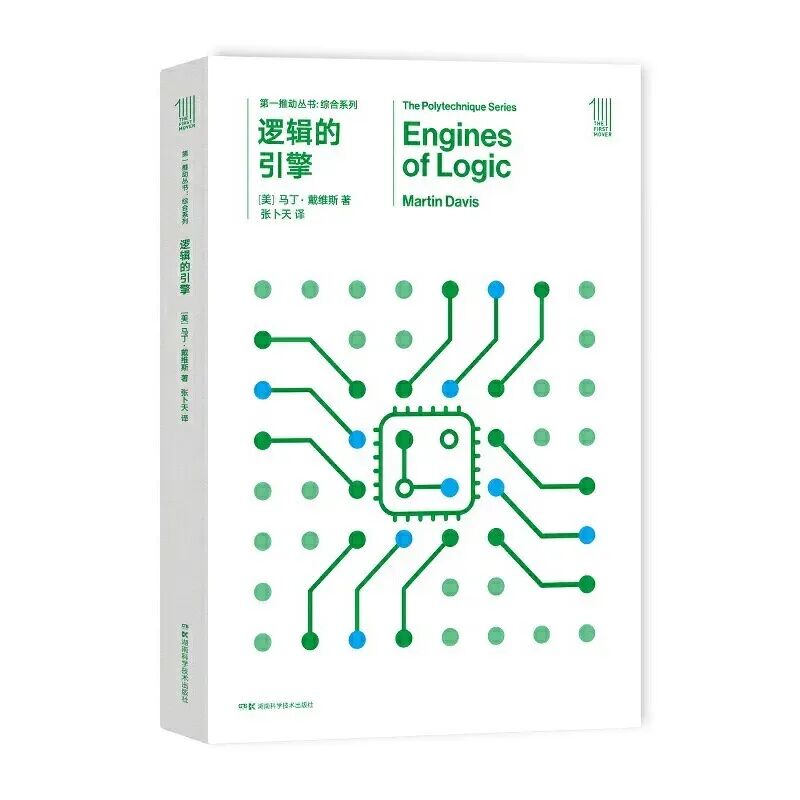
The author of this book, Martin Davis, is a pioneer in the development history of computer science and a world - famous mathematical logician. His book Computability and Unsolvability is regarded as one of the few truly classic works in the field of computer science, and The Universal Computer: The Road from Leibniz to Turing is regarded as the best popular reading material for telling the history of computer development from a logical perspective.
Davis believes that a computer is actually a logical machine, and its circuit design condenses the essence of the thoughts of many logicians over the centuries. From Leibniz to Turing, both the hardware and software of the computer contain the core concepts put forward by these logicians. This book is to trace the evolution process of the thoughts that support the development of the computer. Through vivid historical materials, the book shows the lives and contributions of geniuses such as Leibniz, Boole, Cantor, Hilbert, Gödel, and Turing, and reveals how these mathematicians conceived key ideas before putting theories into practice.
In the discussion of several key issues, this book implies a profound reflection: Is our trust in "logic" itself a misjudgment? Readers can think about this question from the following entry points:
Do logical systems have limitations?
The book discusses Gödel's incompleteness theorem, which proves that any sufficiently powerful formal system has true propositions that cannot be proved within the system. This shakes the pursuit of a complete and consistent logical system by Hilbert and others, indicating that logic itself cannot fully carry absolute truth.
The Turing machine model reveals the existence of undecidable problems (such as the halting problem), indicating that there are essential limitations to logical reasoning. This reveals that our expectation of the omnipotence of logic may be too simplistic.
Is there a disconnect between logic and reality?
The book mentions that Frege tried to fully formalize mathematics, but Russell's paradox made this attempt a failure. This failure shows that logical systems may not be able to fully handle the complexity in human intuition (such as self - reference problems). Logical rules are tools constructed by humans, not natural laws.
A often - overlooked question is: Where does the authority of logic come from? The book shows through historical cases (such as the controversy over Cantor's set theory) that the correctness of logic often depends on academic consensus rather than absolute truth. This social constructiveness is easily overlooked.
The clarity of logic may mask its limitations. For example, propositional logic cannot handle vagueness or context - dependence, but people often mistakenly think that logic can solve all rational problems.
In the era of prevailing technology, this book provides a new perspective: We need to re - examine our unconditional trust in logic. Facing the complex reality, logic is only one of the tools, not the ultimate standard of truth.
Chinese Bibliography: Martin Davis. (2005). The Universal Computer: The Road from Leibniz to Turing (Translated by Zhang Butian). Hunan Science and Technology Press.
Summary
If you want to understand the logical foundation of artificial intelligence from the root, it is recommended to start with Tractatus Logico - Philosophicus; then explore the essence of self - reference and representation of intelligence through Gödel, Escher, Bach: An Eternal Golden Braid. If you want to understand the new logical requirements in the AI era, Logic, Language, and Cognition provides a key perspective. If you have respect and a little alertness for algorithms, technology, and rationality, you might as well read The Universal Computer: The Road from Leibniz to Turing. It can remind us that no matter how sophisticated AI is, it is the product of human logic; understanding it is not just about knowing the rules, but also about seeing why we formulate these rules.
This article is from the WeChat public account "Open Mind Club" (ID: openmindclub). The author is Yixiu. It is published by 36Kr with authorization.