Investing 10 million, L'Oréal has set its sights on this 100-billion-yuan track
Recently, foreign media reported that OliX Pharmaceuticals, a South Korean RNA technology company, introduced strategic investors through a private placement and raised a total of approximately 110 billion won (equivalent to about 490 million yuan). Among them, BOLD, a venture capital fund under the L'Oréal Group, will invest approximately 1.05 billion won (equivalent to about 46.55 million yuan) and be allocated more than 70,000 new shares.
It is worth mentioning that in June 2025, L'Oréal signed a cooperation agreement with OliX Pharmaceuticals. Relying on OliX Pharmaceuticals' small interfering RNA (siRNA) technology, they will jointly conduct research in the fields of skin and hair. OliX Pharmaceuticals will lead the R & D, while L'Oréal will provide guidance on product development and commercialization.
This further in - depth cooperation between L'Oréal and OliX Pharmaceuticals has once again deepened L'Oréal's segmented layout in the effective hair - care market and promoted the development of the group's daily hair - care products towards "biological gene - level" hair care.
L'Oréal Increases Investment in "Gene - Level" Anti - Hair Loss
Public information shows that OliX Pharmaceuticals was established in 2010. It is a leading R & D company in South Korea's RNAi therapy field, committed to developing new treatment solutions for skin, eye, lung, and CNS diseases. The competitiveness of OliX Pharmaceuticals lies in its proprietary "asymmetric siRNA" platform. Based on RNA interference technology, the company has an asymmetric siRNA technology that can improve gene inhibition efficiency.
It is reported that siRNA is a technology that inhibits gene expression by targeting and degrading messenger RNA (mRNA), which can block the production of proteins that cause diseases, aging, or hair loss. Therefore, this technology is also regarded as the next - generation gene therapy platform. Especially in the field of hair loss, siRNA has the advantage of being able to regulate the core inducement of androgenetic alopecia - the signal pathways related to androgen receptors and dihydrotestosterone at the gene level.
Reference picture
In other words, most existing hair - loss treatment methods work by inhibiting hormone production or action, while siRNA can directly block the gene signals that induce hair loss.
Currently, most siRNA - based hair - loss treatments are still in the clinical trial stage, but some studies have confirmed that it can reduce the production of dihydrotestosterone and promote hair growth. Therefore, siRNA has attracted much attention as a new - generation hair - loss treatment technology.
It is worth mentioning that OLX104C, an androgenetic alopecia candidate drug of OliX Pharmaceuticals currently undergoing a phase 1b/2a clinical trial in Australia, is also developed based on the "asymmetric siRNA" platform. It blocks the hormone signals that cause hair loss by reducing the expression of androgen receptors. OliX Pharmaceuticals expects that this drug can minimize the hormone - related side effects such as decreased sexual function or depression that may be caused by existing dihydrotestosterone inhibitors.
In recent years, L'Oréal has been scouting biotech startups globally in order to commercialize new products in the hair - loss and hair - care fields. According to foreign media reports, L'Oréal finally chose OliX Pharmaceuticals precisely because of the company's unique siRNA platform technology.
As a beauty company, L'Oréal is more likely to apply OliX Pharmaceuticals' technology to the R & D of anti - hair - loss products and scalp - care products rather than new drug R & D. This also means that L'Oréal, the world's largest beauty company, is trying to regulate hair loss and study the causes of scalp aging from the biological gene level. Under this trend, the anti - hair - loss hair - care market may also welcome the next competition point.
Is Anti - Hair Loss a Promising Niche Market in Hair - Care?
In the current hair - care market, the ordinary functions such as cleaning and oil control in the past can no longer meet consumers' increasingly diversified demands. Hair - care brands no longer only focus on basic cleaning functions but pay more attention to R & D innovation. Just like the development path of skin - care brands, hair - care brands have also begun to "compete in R & D" and "compete in ingredients" to meet the expectations of "ingredient enthusiasts".
Among them, anti - hair loss has become an important segmented track in functional hair - care. According to data from Qingyan Intelligence, the retail sales of anti - hair - loss cosmetics in the Chinese cosmetics market in 2025 were 14.66 billion yuan. In addition, the average annual compound growth rate of the anti - hair - loss market from 2019 to 2023 was 7.7%. At this rate, it is expected that the global anti - hair - loss market will exceed 10 billion US dollars by 2029.
According to the consumer research data in the "Consumer Insight Report on Anti - Hair - Loss Functional Hair - Care Products" by Qingyan Intelligence, the proportion of women among anti - hair - loss consumers exceeds that of men, and the main consumer group is the middle - class aged 26 - 35 in first - tier and new first - tier cities.
This group of people has high purchasing power and high consumption willingness, which also lays a consumer base for the mid - to high - end positioning of anti - hair - loss products. Based on this characteristic, deploying in the anti - hair - loss segmented track has become the "key" for many hair - care brands to enter the mid - to high - end hair - care market, which may also be one of the reasons why BOLD chose to increase investment in anti - hair - loss technology.
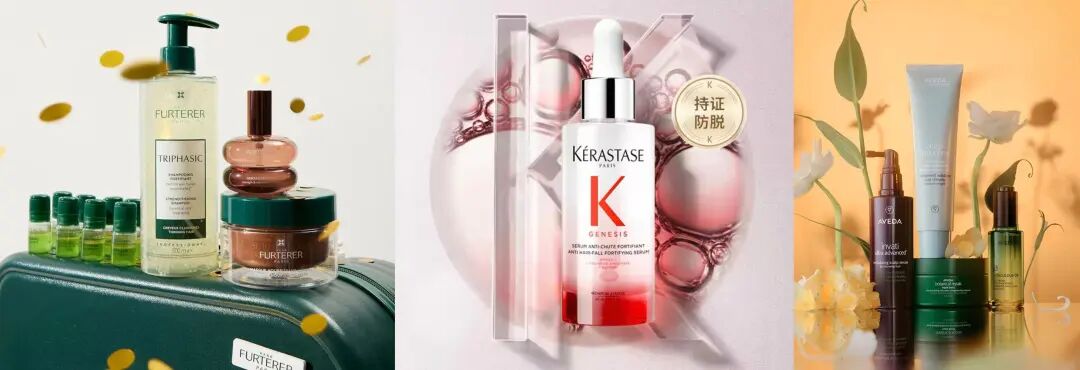
This is also reflected in the market. From the perspective of price range distribution, compared with ordinary hair - care products, most anti - hair - loss products are priced higher. For example, the 33ml of Phyto-C Phytopolleine Triple Action Scalp Serum costs 248 yuan; the 90ml of Kérastase Initialiste Advanced Scalp and Hair Serum costs 368 yuan; the 200ml of Aveda Shampure Volume Shampoo costs 310 yuan, and the 150ml of Aveda Shampure Thickening Scalp Serum costs 600 yuan.
Reference picture
In terms of products, in addition to shampoos and conditioners, anti - hair - loss hair - care products on the market have also extended to various forms such as scalp serums and scalp ampoules. The anti - hair - loss functions are mainly divided into strengthening hair strands and reducing hair breakage.
From the perspective of the underlying R & D of anti - hair - loss products, international beauty giants such as L'Oréal, Shiseido, Estée Lauder, and Unilever have also increased their investment in cutting - edge anti - hair - loss scientific research. Domestic brands have quickly broken through by relying on Chinese - characteristic plant ingredients and micro - ecological technologies. The billion - dollar market has reached a technological watershed.
For example, brands under the L'Oréal Group, such as Kérastase, L'Oréal Professionnel, and L'Oréal Paris, have already covered the high - end, professional, and affordable markets. Its choice of OliX Pharmaceuticals may also be to break through the bottleneck of traditional ingredients by applying siRNA biological gene technology to hair - care products and provide a new technological innovation path for the brand.
Unilever has a coordinated layout of functional internal - taking and external - using hair - care products. On the external - using side, its brand Clear relies on the "FOLLILOCK" technology to increase hair density and relieve hair - loss problems by inhibiting the activity of proteolytic enzymes in the shedding phase and has launched a certificated anti - hair - loss serum. On the internal - taking side, Nutrafol hair - growth capsules rely on the Synergen Complex® plant - extract patented formula to nourish hair from the inside. Thus, Unilever's brands achieve complementary internal - taking and external - using products to meet all - scenario anti - hair - loss needs.
Domestic brands have formed three major camps: traditional herbal brands, pharmaceutical cross - border brands, and new scientific research brands, and compete differentially by relying on local advantages.
Traditional herbal brands mainly rely on their traditional hair - care heritage to strengthen offline channels. For example, Zhangguang 101 has been deeply involved in offline hair - care chains and occupies offline channels with traditional Chinese herbal formulas such as Polygonum multiflorum and Platycladus orientalis. Pharmaceutical cross - border brands such as Mandi under Sansheng Pharmaceutical and Dafixin under China Resources Sanjiu rely on the advantages of minoxidil OTC drugs, extend from medicinal tinctures to foam - type and hair - care supporting products, and quickly open up pharmacy and e - commerce channels with the endorsement of dermatological clinics. Their pharmaceutical background also builds a natural sense of trust among consumers to a certain extent.
In addition to the "old players" in the hair - care market, in recent years, many beauty groups that started with skin - care and makeup have also begun to deploy in anti - hair - loss hair - care. For example, Proya Group acquired the scalp - care brand Off & Relax in 2021 and later launched the self - incubated scalp micro - ecological brand Jing Shi; Freda launched the micro - ecological hair - care brand Jimi; Shangmei launched the anti - hair - loss brand Jifang.
It is worth mentioning that the anti - hair - loss ingredients and technologies of each brand are different, but there is no representative ingredient like "retinol" or "niacinamide" in the skin - care category. Some industry insiders have also told Qingyan that compared with the "lively" registration of new whitening ingredients, few companies are involved in new anti - hair - loss ingredients.
This also means that the leading effect in this track has not fully emerged. Whoever can create a representative ingredient in the anti - hair - loss field from multiple dimensions such as technology and communication may stand out and become a "dark horse" in the segmented track.
Tightening Policies Accelerate Market Shuffle
Against the background of upgraded demand and accelerated market competition, in the Chinese market, policies are becoming increasingly strict, and the corresponding laws and regulations are also becoming more and more perfect. This not only raises the technological access threshold for the anti - hair - loss market but also leads the billion - dollar anti - hair - loss market onto a new technology - oriented path.
In 2021, the "Regulations on the Supervision and Administration of Cosmetics" came into effect, and anti - hair - loss products were clearly classified as "special cosmetics" that require mandatory registration for the first time. In May of the same year, in the "Regulations on the Administration of Cosmetics Registration and Filing Materials", anti - hair - loss products were required to submit human efficacy test reports for the first time, and no special certificates will be issued without clinical data.
In the following years, a number of brands were punished for claiming anti - hair - loss efficacy without registering as "special cosmetics". The most typical case is that in 2024, Beijing Funakang Biotechnology Co., Ltd. was ordered by the Beijing Market Supervision and Administration Bureau to stop illegal activities and fined 80,000 yuan for prominently promoting the fullerene ingredient in its products and other anti - hair - loss and hair - growing effects of the "Rensheng Zefa" brand products without filing for anti - hair - loss efficacy.
In recent years, many brands and enterprises have been punished for false promotion of anti - hair - loss efficacy or for claiming ordinary cosmetics as special anti - hair - loss cosmetics. For example, just this month, Nanjing Tongrentang Pharmacy Co., Ltd. was punished by the Qinhuai District Market Supervision and Administration Bureau of Nanjing, Jiangsu Province for selling the "Mingou Plant Anti - Hair - Loss and Hair - Growing Liquid" whose special cosmetics registration information had expired. It was confiscated of illegal income of 415.76 yuan and fined 10,000 yuan.
It is worth mentioning that in January this year, with the end of the five - year transition period, the anti - hair - loss market officially entered the "era of real efficacy".
According to the "Regulations on the Supervision and Administration of Cosmetics", five categories of original special - use cosmetics, namely "hair - growing, hair - removing, breast - enhancing, body - building, and deodorizing", have been officially prohibited from production and sales since January 1, 2026. Moreover, product packaging and claims cannot imply or explicitly state that they can grow new hair or increase hair volume, and words such as "hair - growing", "hair - thickening", and "hair - nourishing" cannot be used.
The regulations mainly focus on two aspects: all products claiming "anti - hair - loss" must conduct rigorous human trials by compliant institutions in accordance with the "Technical Specifications for Cosmetics Safety"; a raw material grading management system should be established, and all relevant raw materials are clearly divided into "anti - hair - loss agents" and "anti - hair - loss auxiliary agents".
The former starts from the empirical end to strengthen the actual efficacy of anti - hair - loss products. Under this regulation, the third - party testing cost and time cost have increased significantly. In recent years, many leading brands have also begun to build their own testing laboratories to conduct human trials in compliance, enhance product efficacy through actual R & D investment, and promote the healthy development of the industry. Small and medium - sized white - label brands and three - no products from WeChat business have gradually withdrawn from the market due to high testing and registration costs.
The latter starts from the raw material end to address industry chaos at the root: in the past, merchants hyped up anti - hair - loss and hair - growing concepts by relying on hair - care auxiliary materials and ordinary moisturizing ingredients. The new regulations lock in the publicity boundaries through raw material classification and compress and cut off the space for false efficacy from the source of the formula.
In addition, in December last year, the National Institutes for Food and Drug Control also issued the "Technical Guidelines for the Research of Anti - Hair - Loss Cosmetics (Trial)" and the "Technical Guidelines for the Research of Raw Materials Related to the Efficacy of Anti - Hair - Loss Cosmetics (Trial)", emphasizing that registrants should conduct in - depth research on anti - hair - loss cosmetics in accordance with relevant regulations, focusing on the technical aspects of product quality, safety, efficacy, and label claims, to ensure that consumers can use the products correctly and achieve the expected results.
Against the background of strong supervision, consumers' rights and interests are better protected. Correspondingly, the pattern of the anti - hair - loss market has also been reshaped. After the test of time, brands with exaggerated publicity and no actual effect will only be short - lived. Only brands that specialize in high - efficiency ingredients and intensively cultivate patented technologies to build differential advantages can survive longer economic cycles.
This article is from the WeChat official account "Qingyan", author: Guaji. Republished by 36Kr with permission.