AI reshapes globalization, bringing new opportunities for Chinese enterprises to expand overseas
Global AI Market: From Explosive Growth to Structural Differentiation
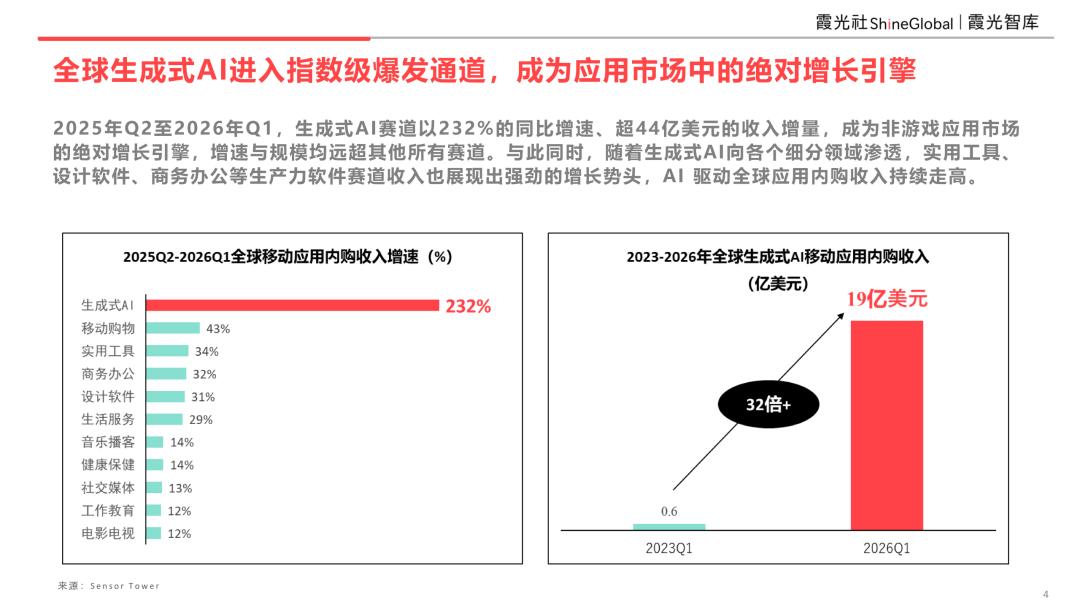
The global generative AI is undergoing a crucial leap from technological breakthrough to commercial monetization.
According to SensorTower data, from the second quarter of 2025 to the first quarter of 2026, the generative AI track became an undisputed growth engine in the non - gaming app market with a year - on - year growth rate of 232% and an income increment of over $4.4 billion. This not only reflects the rapid increase in users' acceptance of AI applications but also marks that AI has entered the large - scale paid stage of the mainstream consumer market from the early concept verification stage.
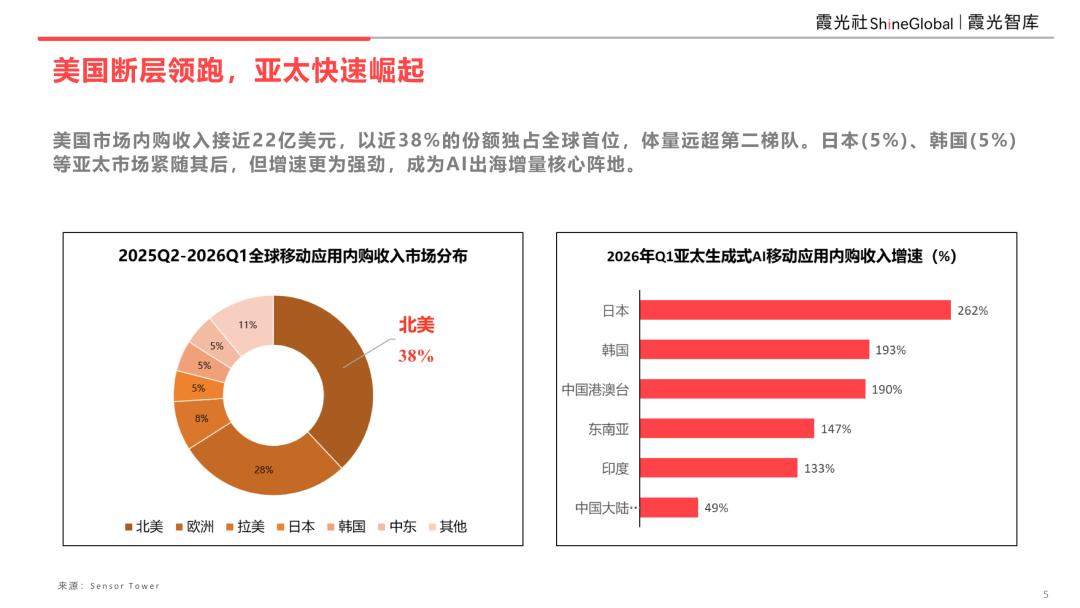
In this global growth wave, regional markets show significant differentiation characteristics. The US market leads the world with a nearly 38% share and in - app purchase revenue of nearly $2.2 billion. Its mature application ecosystem and high - paying users constitute a first - mover advantage that is difficult to replicate in the short term. Although the Asia - Pacific markets such as Japan and South Korea are smaller in scale, they have strong growth and are becoming incremental positions that Chinese AI companies need to break through when going global.
This "dual - pole pattern of the US and Asia" means that Chinese enterprises need to verify their technological strength in mature markets and also give full play to the advantages of cultural proximity and scenario innovation in the Asia - Pacific market.
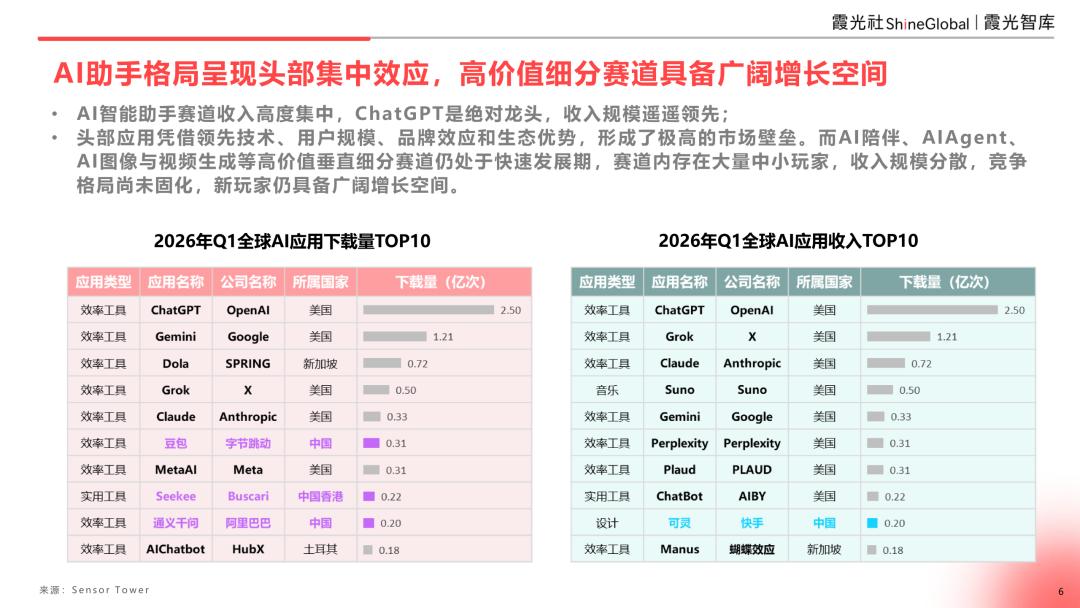
Further observation of the competitive landscape of the AI application market reveals that general tools and vertical applications are accelerating differentiation along different paths. In the field of AI intelligent assistants, ChatGPT has formed a significant leading effect with its technological leadership, user scale, and ecological barriers. New entrants will face extremely high market thresholds. High - value tracks such as AI companionship, AI agents, and AI image and video generation are still in the rapid development stage. The competitive landscape is not yet solidified, with a large number of small and medium - sized players coexisting, leaving broad growth space for new entrants.
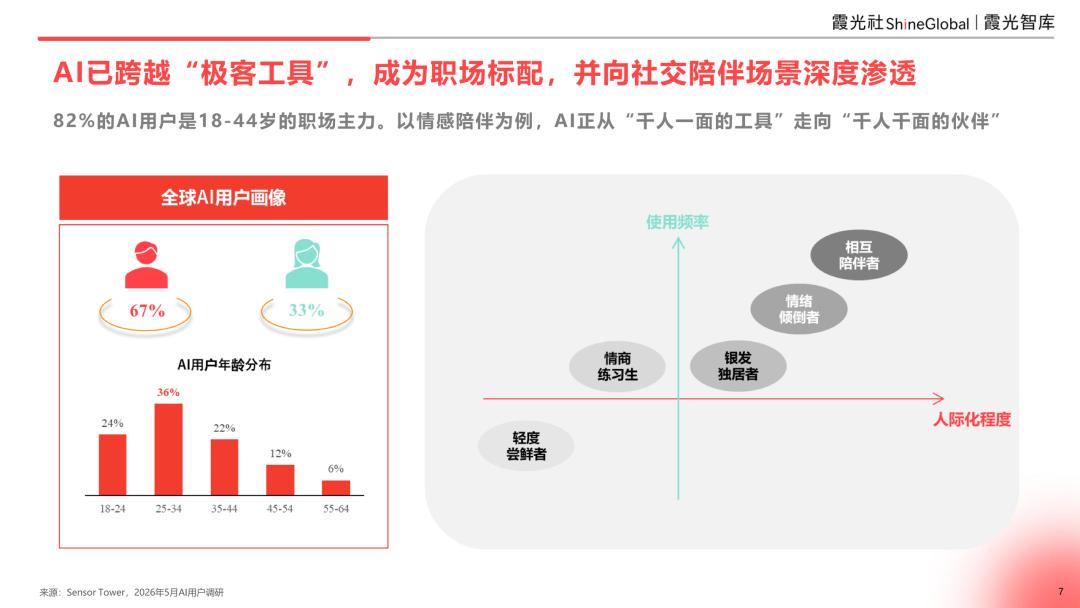
Meanwhile, the portrait of AI users is changing from "geek tools" to "workplace essentials". Surveys show that 82% of AI users are concentrated in the main workplace population aged 18 - 44. AI has covered multiple scenario applications such as content creation, office efficiency, and social companionship, and has become an indispensable infrastructure in daily work. This change in the user structure directly promotes the extension of AI applications from functional attributes to emotional value.
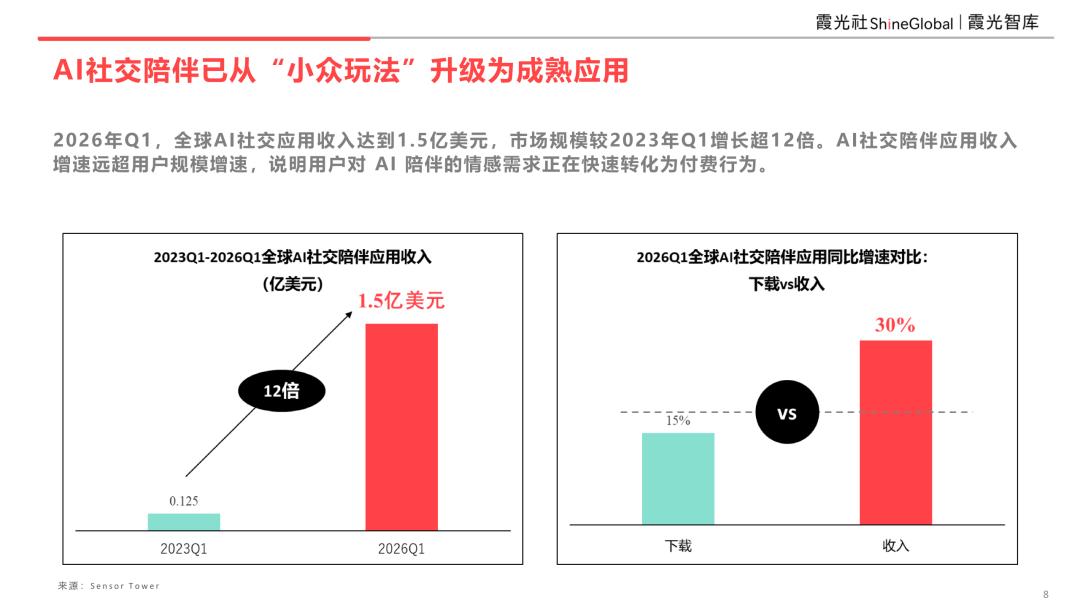
Taking the AI social companionship track as an example, the global revenue in the first quarter of 2026 reached $150 million, more than 12 times the revenue in the same period in 2023. The growth of user payments far exceeds the growth of user scale, indicating that emotional needs are being transformed into paid behaviors, and AI companionship products have formed a sustainable business closed - loop.
Chinese AI Going Global: Capability Leap and Value Reconstruction
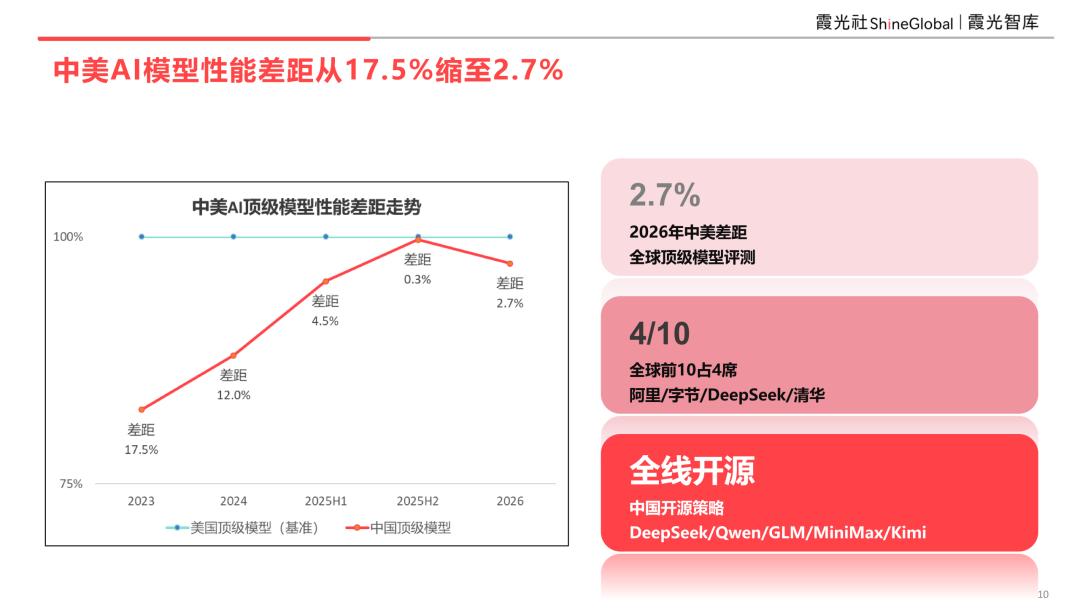
In terms of technological capabilities, Chinese AI companies are accelerating to narrow the gap with the global leading level. Research shows that the performance gap between top - level AI models in China and the US has significantly narrowed from 17.5% to 2.7%. Among the top ten in the global top - level model evaluation in 2026, four are from Chinese companies, namely Alibaba, ByteDance, DeepSeek, and Tsinghua University. Meanwhile, Chinese open - source models represented by DeepSeek, GLM, MiniMax, Kimi, and Qwen are establishing technological influence globally. The full - line open - source strategy effectively lowers the access threshold for overseas developers and accelerates the global penetration of Chinese AI technology.
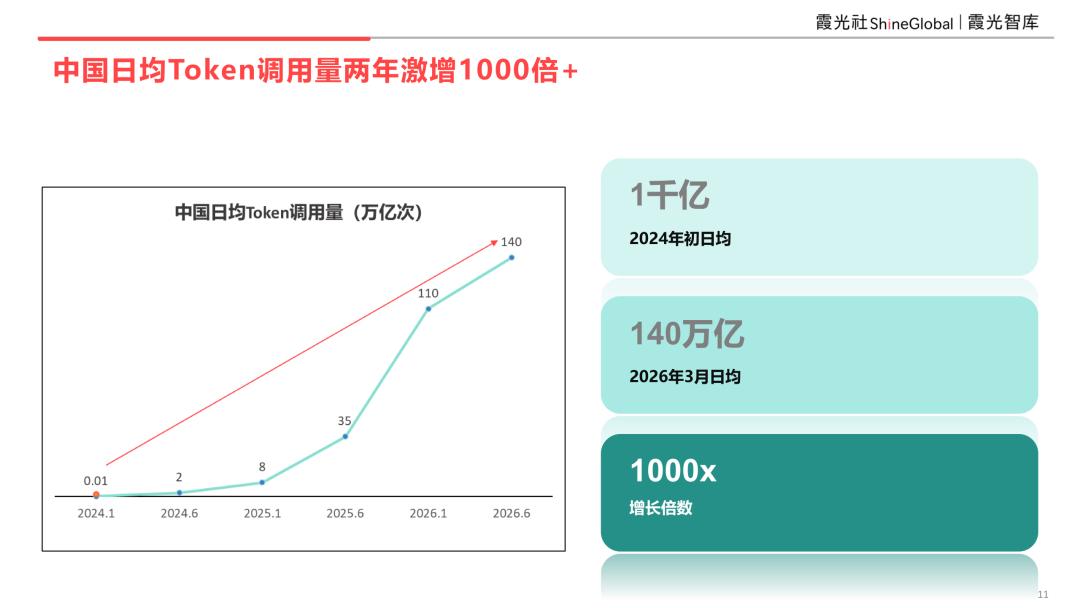
The rapid catch - up in technological capabilities has also been fully verified at the application level. Data shows that the daily average Token calls in China have jumped from the tens of billions level at the beginning of 2024 to 140 trillion in March 2026, more than a 1000 - fold increase in two years. This exponential growth not only reflects the rapid penetration of domestic AI applications but also means that the training and iteration capabilities of Chinese AI models in real - world scenarios have entered the global first echelon.
The accumulation of the above technological and scale advantages has also translated into real demand for Chinese AI in overseas markets - technological cost - effectiveness, accessibility of the open - source ecosystem, scenario implementation capabilities, and global deployment experience. These four reasons together constitute the core driving force for overseas users to adopt Chinese AI solutions.
Representative Players: From Platform Giants to Vertical Deep Dive
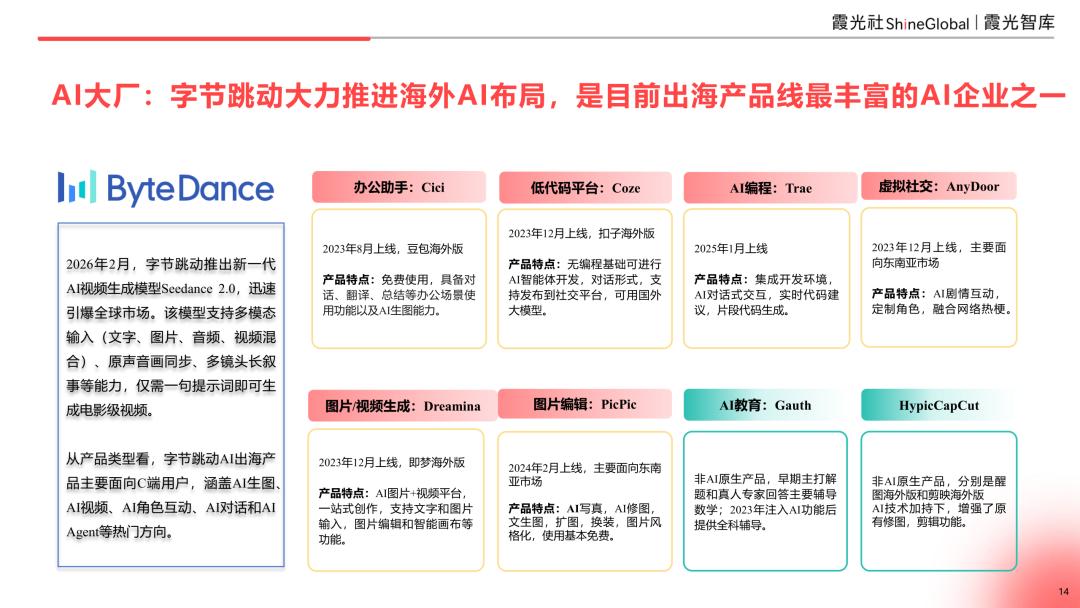
Among platform - type players, ByteDance is one of the Chinese AI companies with the most diverse product lines going global. In February 2026, ByteDance launched the new - generation AI video generation model Secdance2.0, which supports multi - modal input, original sound - picture synchronization, multi - shot long - narrative capabilities, and can generate movie - level videos with just one prompt, quickly attracting global market attention. ByteDance's layout path shows that Chinese AI giants are not just exporting single products but are exporting a platform - based, matrix - type ecosystem.
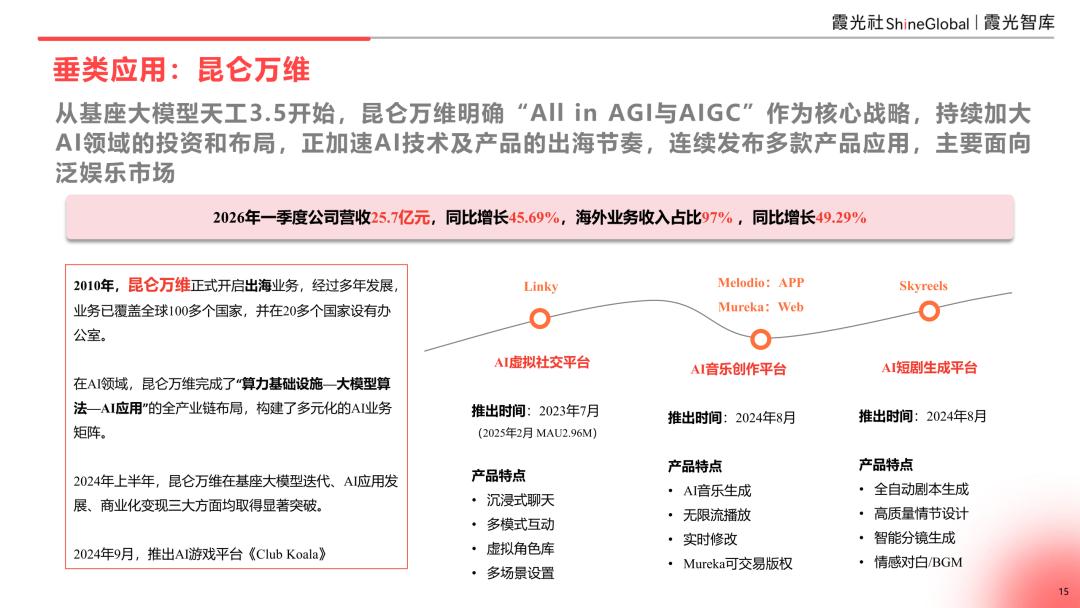
Different from the matrix - type layout of platform - type enterprises, Kunlun Tech has chosen to deeply cultivate the entire industrial chain from the base model to vertical applications. Since it launched its overseas business in 2010, Kunlun Tech has covered more than 100 countries globally and has clearly defined its core strategy of "All in AGI and AIGC". In the first quarter of 2026, the company's revenue reached 2.57 billion yuan, a year - on - year increase of 45.69%. Among them, the overseas business revenue accounted for as high as 97%, a year - on - year increase of 49.29%. From computing power infrastructure to large - model algorithms and then to various pan - entertainment application products, Kunlun Tech has completed the layout of the entire industrial chain. Its high proportion of overseas revenue also verifies the feasibility of upgrading AI going global from a "supplementary business" to a "core growth engine".
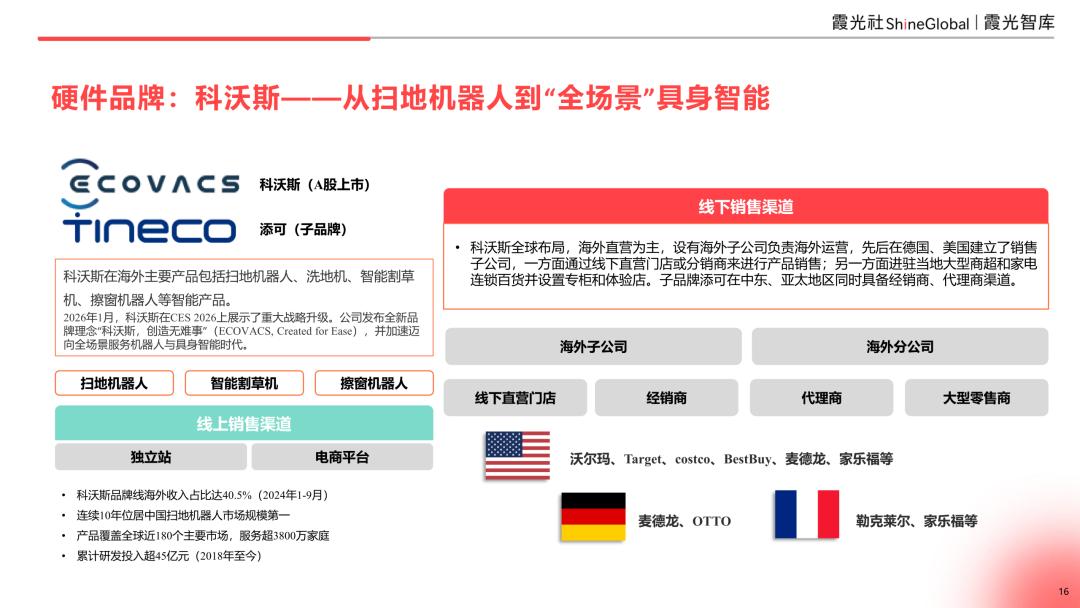
In the field of hardware and embodied intelligence, Ecovacs represents another path for going global. Starting from floor - cleaning robots, Ecovacs is accelerating its entry into the full - scenario service robot track. In terms of channels, Ecovacs mainly focuses on overseas direct sales. It has established sales subsidiaries in Germany and the US successively and has deployed through multiple channels such as offline direct - sales stores, distributors, and counters in large supermarkets. Its sub - brand Tineco is expanding its dealer and agent network in the Middle East and the Asia - Pacific region simultaneously. This case shows that the going - global of Chinese AI hardware has been upgraded from single - product export to the output of a systematic ability integrating brand, channel, and service.
Overall, Chinese AI going global is evolving from "model output" to "technological standard and ecological penetration". Whether it is ByteDance's platform - based matrix, Kunlun Tech's entire - industrial - chain layout, or Ecovacs' hardware brand upgrade, their common feature is that they no longer rely on a single price or channel advantage but build a systematic competitive barrier globally with technological capabilities as the core, local operation as the support, and vertical scenarios as the breakthrough point.
This article is from the WeChat official account "Xiaguang Think Tank". Author: Xiaguang Think Tank. Republished by 36Kr with permission.