Even GitLab has started laying off programmers.
Started with programmers, but now laying off programmers because of AI.
GitLab, which is on par with GitHub as the two cornerstones in the developer world, has just laid off 14% of its employees for a full - scale transformation into AI.
To be honest, although GitLab's actions go against the fine tradition of "never forgetting those who dug the well when drinking the water", it's not too surprising in today's Silicon Valley.
After all, in the wave of AI, from large corporations to startups, layoffs and organizational restructuring are almost standard operations.
What's really surprising is that GitLab's layoffs this time are neither due to a decline in performance nor a shortage of funds.
On the contrary.
The latest Q1 financial report shows that the company's revenue increased by 23% year - on - year, exceeding market expectations. After the release of the financial report, the stock price rose by 7% in after - hours trading.
On one hand, there is revenue growth and a rising stock price, while on the other hand, 14% of the employees are being laid off.
If I were a GitLab employee, I'd probably feel extremely disappointed at this moment -
What a preventive layoff, what a situation of sharing hardships but not joys.
So, the question is:
Why does a profitable company lay off the people who make money for it?
"Proactive transformation towards the agentic era"
GitLab may not be as well - known as GitHub, but in the field of developer infrastructure, it's a name that can't be ignored.
This company originated from a typical programmer story.
In 2011, Eastern European developer Dmytro Zaporozhets wrote an open - source project, and later he and Dutchman Sid Sijbrandij turned it into a company.
GitLab provides a DevSecOps platform that covers the entire software development lifecycle - from code management, security scanning to deployment and launch. It almost integrates all the toolchains required for software development into the same platform.
About 10 years later, the company successfully listed on the NASDAQ, and its market value once exceeded $15 billion at its peak.
As of the end of 2025, GitLab has more than 50 million registered users globally, and half of the Fortune 100 companies are its customers.
What's more special is that since its founding day, GitLab has been a completely remote - working company - there is no headquarters office, and about 2,500 employees are distributed in more than 60 countries and regions around the world.
Logically, a company that grew up with developers should understand the value of programmers the most.
But now, GitLab has swung the ax of layoffs at nearly 14% of its employees - about 350 people.
People can't help but ask: What on earth happened? Why does GitLab do this?
From the financial report and the layoff letter issued by the company's CEO, we may find the answer:
GitLab is undergoing the most significant self - reshaping since its establishment:
Layoffs, restructuring, and the AI strategy are carried out simultaneously.

Not long ago, GitLab released its Q1 financial report (as of April 30, 2026) and disclosed the details of the layoffs at the same time.
Let's talk about the performance first. Several key indicators look quite healthy:
The company's Q1 revenue reached $264.2 million, a 23% year - on - year increase, exceeding analysts' expectations of $254 million;
Subscription revenue jumped from $194.5 million in the same period last year to $239.3 million;
The number of large customers with annual recurring revenue of more than $100,000 increased by 18%;
The GAAP net loss narrowed significantly from $35.9 million to $5 million;
The adjusted earnings per share were 23 cents, 2 cents higher than Wall Street's expectations, and the full - year profit guidance was also raised.
Doesn't it seem to be all good? But who could have expected that layoffs would follow.
GitLab announced the news of layoffs as early as May this year, but the final layoff plan was not determined at that time. Now, everything is settled -
About 350 full - time employees need to leave. The estimated layoff cost is between $30 million and $35 million, including severance pay, separation compensation, and retention costs. About $19 million of it will be paid before the end of July.
Meanwhile, GitLab will also withdraw from 22 countries and regions, which will reduce the geographical scope of its business by 37%. The R & D team will also be reorganized into about 60 smaller autonomous teams.
The core reason why GitLab is "growing while making cuts" points directly to AI.
In the words of CEO Bill Staples, this is a proactive transformation towards the "agentic era".
Bill issued an open letter titled "GitLab Act 2" as early as May, and then posted 14 consecutive tweets on X, explaining the logic behind the layoffs one by one.
This move was also rated by netizens as:
To date, the most honest statement on layoffs and AI transformation ever made by any listed CEO.
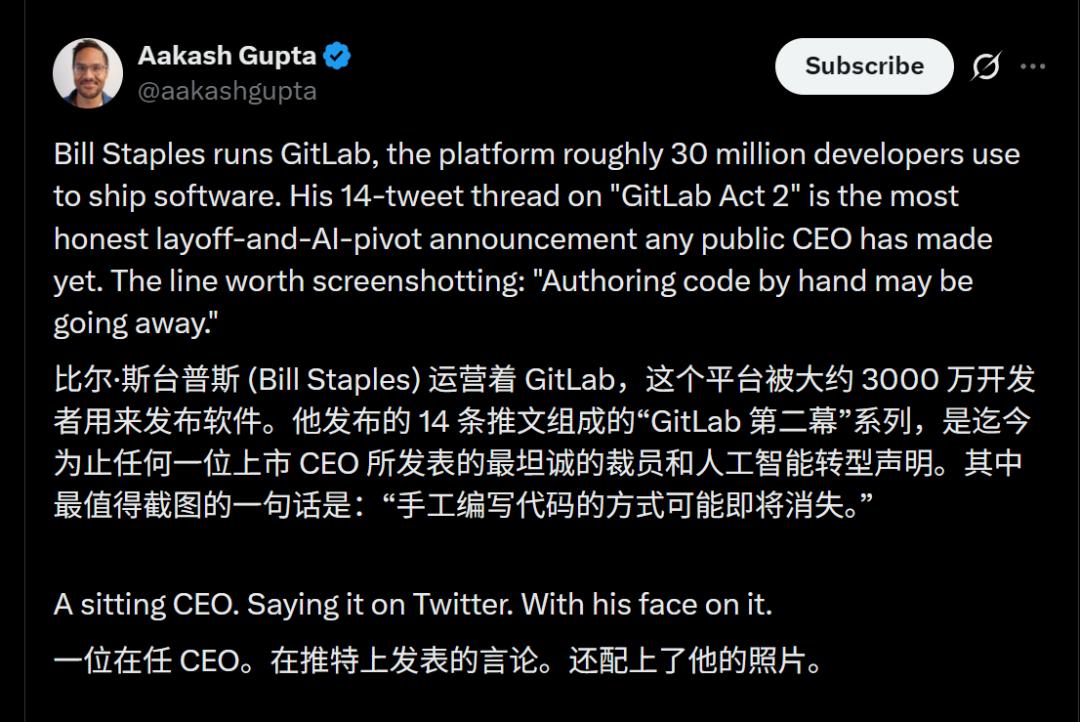
In Bill's view, AI agents are impacting developer infrastructure at "machine - level speed", and GitLab must rebuild its architecture to handle this traffic.
The saved funds will "mostly" not turn into profits but will be reinvested in R & D and AI products.
He also revealed that the company is deepening its integration with the Anthropic Claude model and is collaborating with AWS and Google Cloud to run agent functions on Bedrock and Vertex AI.
Obviously, agents are becoming the core narrative for GitLab's restart.
However, although Bill specifically emphasized that "this is not AI optimization, nor is it cost - cutting", the market's reaction is quite honest:
After the performance was announced, the after - hours stock price rose by 7%, but after the market digested the layoff news the next day when it officially opened, all the gains were given back.
Overall, since its listing day in 2021 at about $104, GitLab's stock price has been falling all the way, and its current market value has shrunk by about 80%.
This shows that, at least for now, Wall Street still has doubts about this restructuring logic -
Investors recognize the performance brought by growth, but they still have questions about whether the layoffs and the agent strategy can truly drive long - term value.
Silicon Valley tech companies' Q1 layoffs increased by 40% year - on - year
Actually, GitLab is not an isolated case.
Just look through the layoff cases of Silicon Valley tech companies this year, and you'll find -
Preventive layoffs like GitLab's, "making money while laying off employees", have become their standard operations.
And AI is almost the universal answer for all companies to explain this contradiction.
The latest report released in April by the American authoritative layoff tracking agency Challenger, Gray & Christmas pointed out:
In March 2026, AI became the top reason for layoffs in US companies for the first time. The number of layoffs caused by AI in a single month reached 15,341, accounting for 25% of all layoffs in that month.
The tech industry was the hardest hit. In Q1 2026, tech companies laid off 52,050 employees, a 40% year - on - year increase. Dell, Oracle, and Meta were the main players in the layoffs.
The judgment of Andy Challenger, the head of the agency, is straightforward:
Companies are shifting their budgets from human resources to AI investment (mainly flowing to computing power). In tech companies, AI can already replace coding - related positions.
However, the narrative of "AI laying off employees" itself is also being questioned.
And the one who jumps out to question is the familiar "veteran actor" - OpenAI CEO Altman.
He said something that doesn't quite fit his CEO identity in an interview in February this year:
I don't know the exact proportion, but there is indeed a certain "AI washing" - some companies blame the layoffs that would have happened anyway on AI.
If the performance is bad, blame it on not keeping up with the AI trend. If the performance is good, it's because AI is used well.
Who wouldn't say that AI has become the biggest "brick" on Wall Street today (doge).
Of course, saying that AI will lead to unemployment is only one side of the story. There are also opposite voices.
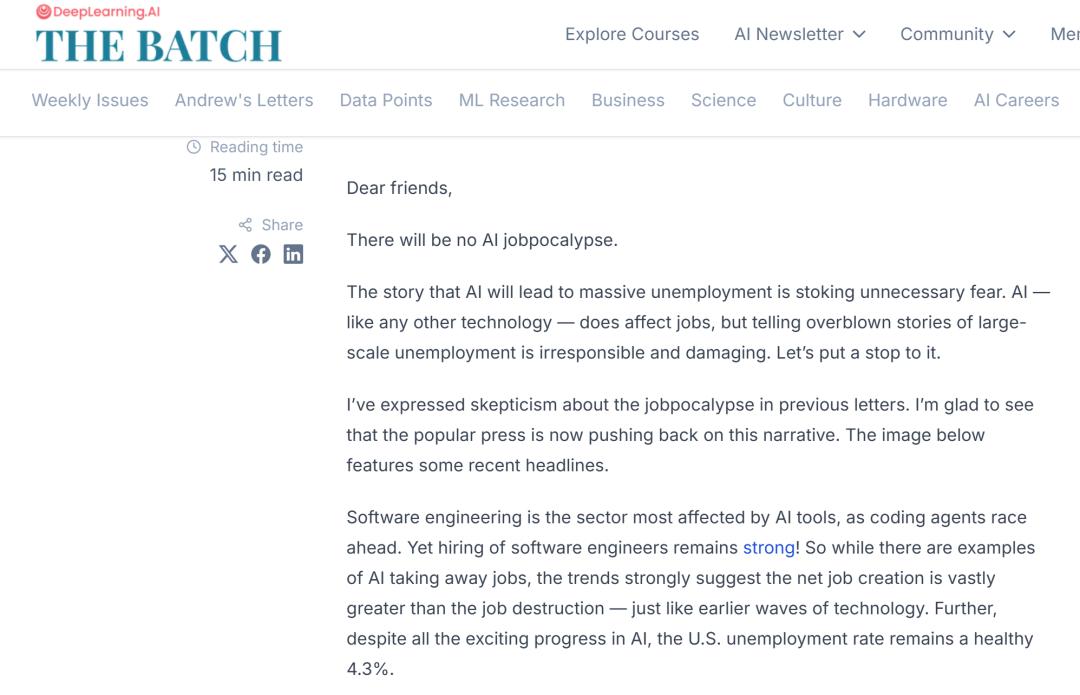
Teacher Andrew Ng, whom we are familiar with, also published a widely - circulated long article "There will be no AI jobpocalypse" in May this year.
His attitude is quite direct: AI will not cause an employment apocalypse.
He pointed out that software engineering is the field most affected by AI, but recruitment is still strong.
In his view, there are two motives driving the narrative -
Cutting - edge AI labs have the motivation to make AI seem more powerful so that their products can sell better; companies have the motivation to attribute layoffs to AI to appear more forward - looking.
In other words, the impact of AI on employment is real, but in many cases, the narrative about AI may run faster than AI itself.
Therefore, Andrew Ng's prediction is not the so - called "employment apocalypse", but the opposite, a "Jobapalooza".
The reason is that when the cost of software development is significantly reduced by AI, people will not reduce software development but will develop more software, create more new demands, and ultimately bring more rather than fewer job opportunities.
That being said, the 350 people at GitLab have indeed left.
A company that started with programmers has laid off programmers. It can only be said that whether it's called "proactive transformation" or "AI washing", it makes no difference to the laid - off employees.
Moreover, GitLab's story is probably not just GitLab's story.
When a company that depends on developers starts replacing developers with AI agents, it undoubtedly reflects the transformation that the entire industry is going through.
Bill said a sentence that was screenshot by many people:
Software will be built by machines and directed by humans.
It's just not known how many people will stay...
Reference links:
[1]https://www.wsj.com/business/earnings/gitlab-to-cut-14-of-workforce-as-part-of-ai-pivot-493b9813?st=EjHR3H&reflink=desktopwebshare_permalink
[2]https://about.gitlab.com/blog/gitlab-act-2/
[3]https://www.deeplearning.ai/the-batch/issue-352
This article is from the WeChat official account "QbitAI". Author: Focus on cutting - edge technology. Republished by 36Kr with authorization.