Doubao's rumor-refuting is more thought-provoking than charging fees.
Doubao has finally stepped in personally.
On the evening of June 3rd, Doubao issued an announcement of less than 300 words.
The tone was unusually stern. It didn't even use the polite opening of "Dear users" and directly listed four pieces of information.
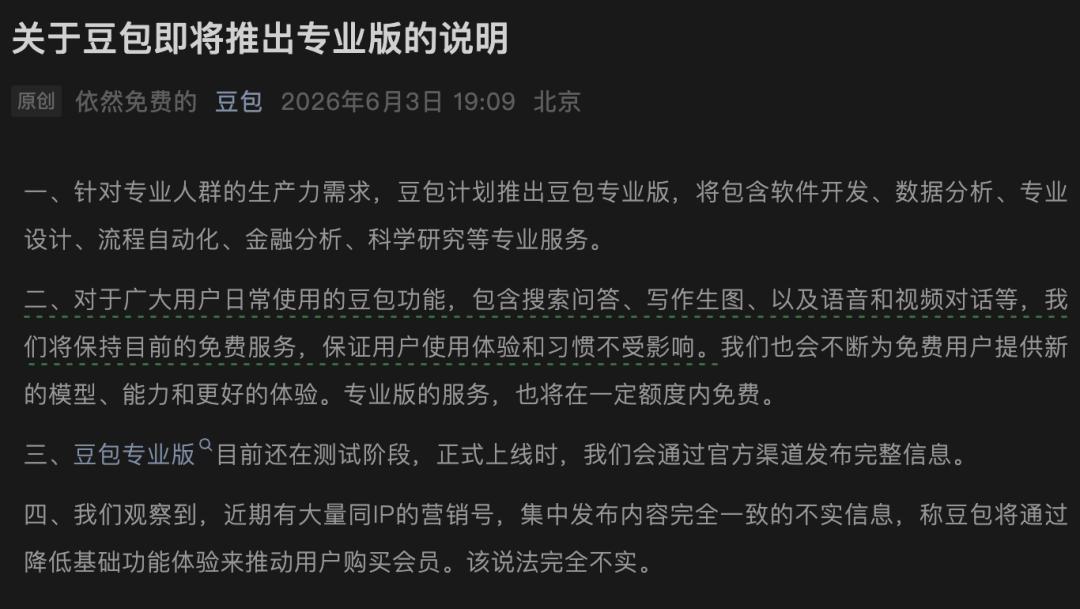
The first piece announced that Doubao Pro Edition was about to be launched; the second guaranteed that the daily functions would remain free; the third said it was still in testing; the fourth suddenly changed the topic, named a large number of marketing accounts with the same IP for spreading false information, and emphasized that the statement was completely untrue.
Putting a section of rumor - refuting in a product announcement is almost unprecedented in ByteDance's product history.
But if you look closely at the content of the fourth piece of rumor - refuting, you'll find that Doubao is not refuting the issue of charging, but the claim that the free version will be dumbed down.
The original announcement stated that the claim that Doubao would reduce the experience of basic functions to encourage users to buy memberships was completely untrue.
ByteDance is not afraid that users will complain about the high fees. What ByteDance really fears is that once hundreds of millions of users believe that Doubao will deliberately become dumber in the future, the brand equity of the entire product will be trampled on instantly.
These two things are not on the same level at all.
1. Charging is not scary, dumbing down is
Globally, users can accept the fact that AI products charge fees.
People accept that ChatGPT charges fees. They also accept that Claude charges fees. Developers even think that Cursor's fees are too cheap and want to pay more. Globally, users have formed a clear understanding that good AI tools are worth paying for.
However, reducing the experience of basic functions to promote purchases is another matter. It can even be regarded as a back - stab that damages users' assets.
In the history of the Internet, this kind of bad - money - drives - out - good - money harvesting routine has happened repeatedly.
Baidu Netdisk uses technical speed limits to force users to buy SVIPs. Various apps maliciously limit the number of uses and core functions of the free version. Video platforms keep adding more advanced on - demand features.
Chinese users have developed a conditioned reflex. Whenever a free product announces that it will start charging, everyone's first reaction is: Are you going to make what I'm using now worse?
This is not a baseless conspiracy theory. It's the experience taught to Chinese users by the history of Internet traffic monetization in the past 20 years.
So what ByteDance fears most is not that users will scold the high fees. Once users get emotional, they'll vent for a few days and it'll pass. What ByteDance really fears is that once hundreds of millions of users believe that Doubao will deliberately become dumber in the future, the brand equity of the entire product will be trampled on instantly.
In the highly homogeneous large - model track, the migration cost of mass users is almost zero. Once there is a run on user trust in B2C products, no amount of rumor - refuting can repair it.
This is why a section of highly - charged rumor - refuting is included in a product announcement, and marketing accounts with the same IP are singled out. Doubao is almost clearly indicating that someone is launching an opinion war against it.
Qualifying these voices as false information from marketing accounts is essentially a fight for the right to speak. It's trying to distinguish two things: Organized malicious attacks vs. users' reasonable doubts.
So it simply singles out the former and tries to make the latter lose its legitimacy as well.
Doubao is protecting the most core part of the brand, the underlying trust in users' minds.
2. Why the Pro Edition?
After understanding that refuting the claim of dumbing down is the core, look back at the first piece of the announcement. The naming of "Pro Edition" makes the logic clear. It's not a membership edition, not a VIP, not a Plus.
This naming itself is a statement of attitude.
Doubao is conveying that the charging is not to make money from ordinary users. These functions are originally productivity tools for professional groups. Software development, data analysis, professional design, long - text reasoning, cross - modal generation, and complex fully - automatic Agent calls. These scenarios naturally require more computing power and deeper reasoning chains.
It doesn't follow the logic of ChatGPT Plus, which unlocks a stronger model. It's more like Adobe Creative Cloud or GitHub Copilot Pro. Users are paying for a deterministic efficiency tool, not just an emotionally - accompanied chat.
In other words, Doubao is not charging 300 million users. It's providing value - added services for a small number of professional users.
Doubao is drawing a line. Above this line, it charges. Below this line, it's not only free but will also continue to improve. The free version won't get worse. This is what the whole announcement really wants users to remember.
The existence of the term "Pro Edition" is to make this statement logically tenable and avoid falling into the public - opinion quagmire of "fleecing customers".
But the market doesn't see it this way.
Previously, there were multiple price tiers such as 68 yuan, 200 yuan, and 500 yuan on the App Store test page, with the highest annual fee reaching 5088 yuan. As soon as the news came out, the topic of Doubao's charging topped the Weibo hot - search list. A large number of users said they would uninstall it if it charged, saying it was more expensive than ChatGPT.
In terms of pricing, Doubao Pro Edition at 500 yuan per month is indeed higher than ChatGPT Plus at $20 per month (about 145 yuan), and far higher than domestic competitors. Kimi's paid version costs 49 to 99 yuan per month, and the basic memberships of Zhipu and MiniMax are between 30 and 60 yuan. ByteDance obviously isn't taking the low - cost and inclusive route. It seems to be testing the high - end premium space.
However, the problem is that third - party evaluations generally believe that Doubao still lags behind in deep logic and code capabilities. This gap between the ability narrative and the technical reality may be the biggest hidden danger of the Pro Edition.
3. The Unique Dilemma of Chinese AI
Taking a broader view. The problem Doubao faces is not just ByteDance's problem. It's a common dilemma for the entire Chinese AI industry.
An interesting comparison.
Globally, users default that AI should be charged. ChatGPT Plus costs $20 per month, Claude Pro costs $20 per month, and Cursor Pro costs $20 per month. No one finds it strange.
But Chinese users have been taught in the past 20 years that Internet services should be free. Ads support me, capital supports me, and platforms subsidize me. The paid conversion rate of all tool - type products in the Chinese market is far lower than that overseas.
This has created a contradiction unique to the Chinese market: Users recognize the value of AI but don't recognize its price.
Everyone knows that Doubao is good. The monthly active users exceeding 300 million are not fake. But getting these people to pay? It's an order of magnitude more difficult than getting American users to pay for ChatGPT.
Even for a powerful product like ChatGPT, the global paid conversion rate is only about 5%. In the Chinese market, which lacks the gene for paying for tool software, this figure will probably be even lower.
What does this mean?
It means that Chinese large - model companies must find a completely different commercialization path from OpenAI/Anthropic. They can't simply and crudely charge for chatting. They must make users feel that they are not paying for better chatting but for a productivity solution that fits into specific workflows.
This is the deeper reason why Doubao chose the Pro Edition instead of a VIP. It's trying to avoid Chinese users' conditioned reflex to Internet charging.
Whether it can succeed depends on what kind of differentiated capabilities the final Pro Edition can demonstrate.
4. The "80/20 Rule" of Large Models
There is a larger industry background supporting this logic.
In the past six months, a structural split has occurred in the large - model market. The price of underlying general capabilities has dropped sharply, while the price of upper - layer professional scenarios has continued to rise.
Top - tier models such as DeepSeek have been continuously reducing prices in the past six months. After multiple rounds of price wars, the prices of some general reasoning capabilities have approached zero, prompting leading cloud providers such as Alibaba Cloud and Tencent Cloud to follow suit.
The price of general models is approaching zero. This is an irreversible trend.
On the other hand, leading players such as Zhipu, which focus on hardcore B - end full - stack scenarios, have seen a steady increase in the actual unit price of API in complex long - chain logical reasoning and multi - Agent scheduling scenarios. A clear price premium is emerging in high - end and complex task scenarios.
The "80/20 rule" of the large - model industry is taking shape. 80% of daily tasks will be free or nearly free, and 20% of professional tasks will generate 80% of the revenue.
Doubao's Pro Edition falls on this dividing line. It's trying to prove that it has the ability to capture the productivity premium of that 20% of high - net - worth customer groups.
But the risk lies here. If users can't perceive a clear gradient difference in the capabilities of the Pro Edition and it's not much different from the free version, this narrative will collapse instantly.
Of course, another reason why Doubao has to come out officially is that charging is imminent.
In the past two years, the Chinese large - model industry has burned money for growth and offered free services for users. This approach is essentially no different from that of the ride - hailing, shared - bike, and community - group - buying industries back then.
But AI has a problem that these industries don't have. Its marginal cost doesn't approach zero. For each new user, there is an additional computing - power bill. The scale advantage doesn't work here.
This step that Doubao takes today, whether it succeeds or not, marks one thing:
The Chinese large - model industry is learning to set prices for the first time.
It's not setting prices for the models but for its own value.
Words Beyond the Page:
Looking back many years later, we may find that the 2026 opinion war between charging and dumbing down is actually an extremely absurd metaphor.
Large companies are anxious about how to price their value, while users are anxious about being exploited by large companies.
But we seem to have forgotten that the biggest feature of large models is learning from human feedback. The data fed and conversations input by hundreds of millions of users in the free version every day are becoming the nourishment for shaping the character of this underlying model.
Is it possible that the reason the free version seems less sharp than before is that it has been domesticated into an ordinary person on an assembly line by our own massive, mediocre, repetitive, and emotional daily use?
We are always on guard against being back - stabbed by technology. But in many cases, it's our dependence on free services and our acceptance of mediocrity that determine the output content and the future.
This article is from the WeChat official account “Beyond the Page”, author: Ban Jun. Republished by 36Kr with permission.