Japan "fattened up" Plaud
Some time ago, Sensor Tower released the "Global AI Application Trend Insights in 2026". Plaud, as the only hardware brand, was particularly eye - catching.
The report shows that as of March 2026, the in - app purchase revenue of Plaud's supporting App has ranked among the top 10 global AI intelligent assistant mobile applications, reaching a cumulative total of $65 million. In Q1 2026, it was an explosive period for the App's revenue, approaching $18 million, a surge of 475% quarter - on - quarter.
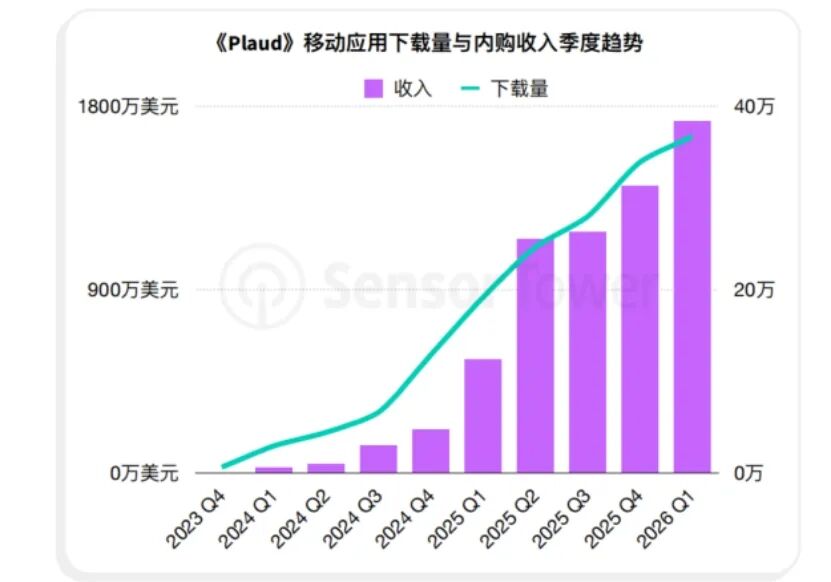
It was thought that Plaud, which would be squeezed out of the market by many similar competitors, seems to have been doing well. More notably, initially Plaud rose rapidly in the United States with its hardware. Now, from the perspective of the software side, Japan has become the largest revenue market, far outpacing the United States.
Plaud Bets Big on Japan
In March this year, Plaud held an official press conference in Japan and launched a new hardware product, NotePin S, which added physical buttons and a highlight marking function, directly addressing the pain point of the previous product - "inconspicuous operation feedback".
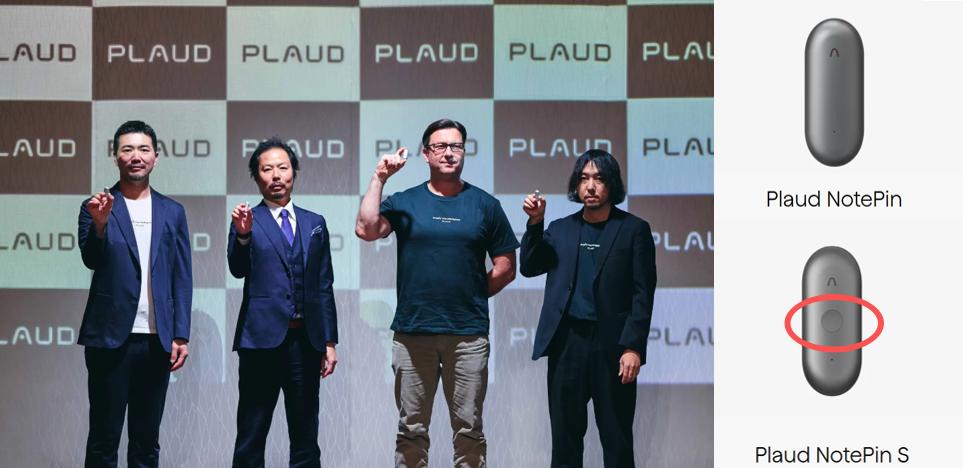
NotePin S Japan Press Conference | Image Source: Plaud, digigadget.jp
At the press conference, Plaud also officially announced Yuuto Nagatomo, a national - level football star in Japan, as its brand ambassador.

Image Source: soccer - king.jp, Plaud
In Japan, which has a natural cautious attitude towards foreign brands, Plaud is declaring its determination to operate in the Japanese market for the long term in a very formal way. This stems from the very impressive sales figures in the Japanese market.
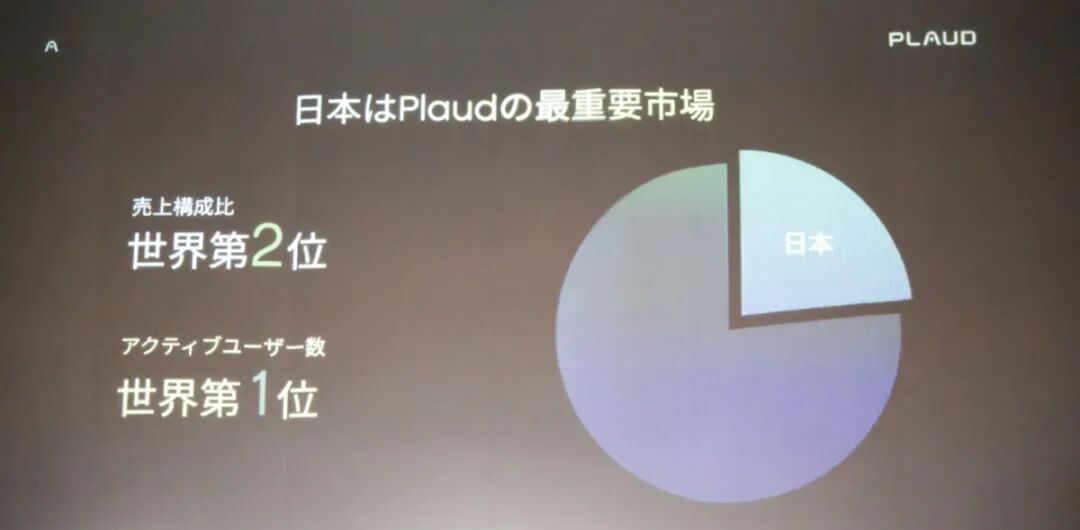
According to the data at the press conference, Japan's sales in 2025 were four times that of 2024, making it the second - largest market for Plaud's hardware sales. According to the Japanese media present at the press conference, the number of active users in Japan even exceeded that in the United States, ranking first, which also explains why the revenue of the App in Japan has far exceeded that of the US market.
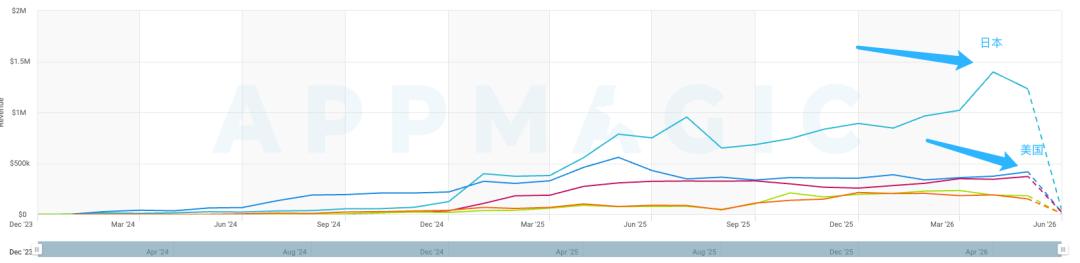
Monthly Revenue Changes in Plaud's US and Japanese Markets | Image Source: AppMagic
Therefore, Plaud plans to continue to distribute its products to more offline stores, expanding from 280 in 2024 to more than 400 in 2026.
Japan has opened its doors to AI efficiency tools and hardware brands because of its unique workplace culture.
Started in the US, but Found a Suitable Soil in Japan
Looking back at Plaud's development history, Japan only surpassed the United States to become its top - ranked market for App revenue after 2025. In fact, as early as 2023, the potential of the Japanese market had already emerged.
In June 2023, Plaud's first product, Plaud Note (hereinafter referred to as "Note" for short), entered the US market with its features of being lightweight and fitting well with iPhones, and complementing call recording and AI summarization functions. It exceeded one million dollars in crowdfunding within two months. Interestingly, Plaud did not achieve a key leap in the US market, but instead found a more suitable soil in Japan.
In October 2023, "Note" was officially launched in the Japanese market, with a crowdfunding result of 270 million yen (equivalent to about $1.8 million), even exceeding the $1.1 million crowdfunding result in the United States.
This abnormal phenomenon occurred because Plaud was not in a new field in Japan. When it first entered the Japanese market, Plaud did a very smart thing. It directly entered the most real and stubborn part of Japanese workplace work - the generation of "meeting minutes".
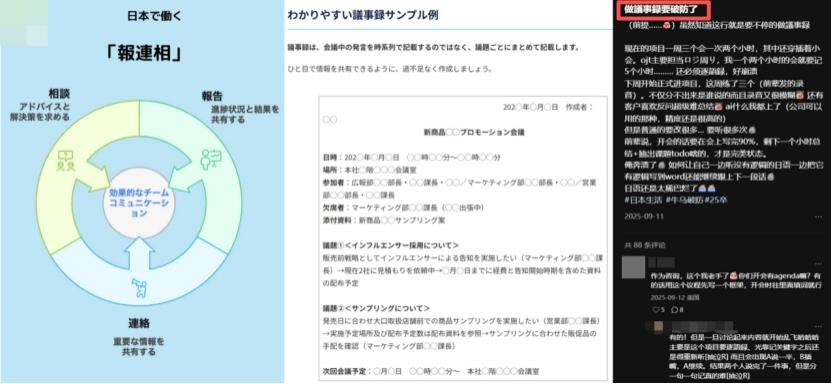
Templates of "Report - Communication - Consultation" and Meeting Minutes, and Posts of Japanese Corporate Employees Breaking Down | Image Source: nomura - system.co.jp, Xiaohongshu
Capabilities such as meeting transcription, voice recognition, and meeting minutes organization have been repeatedly verified in the past decade. From Japan's local AmiVoice, to Notta later, and then to the meeting tools provided by large companies such as Microsoft and Google, the Japanese market has never lacked transcription products.
However, even so, users are still willing to pay for new transcription tools. This is because Japanese companies have a "report - communication - consultation" culture that has been in place for decades. Any communication from subordinates to superiors or any cross - departmental collaboration requires an "evidentiary" intermediate link, and meeting minutes are the most direct carrier of this culture. (We made the same observation in our previous article "Top 10 Most Profitable AI Products in Japan in the First Half of the Year: Nearly Half from China?")
Compared with European and American companies that emphasize quick decision - making, the Japanese workplace attaches more importance to the complete transmission of information and the recording of processes. A blogger who has lived in Japan for a long time on Xiaohongshu once shared that her company requires a formal meeting minutes to be formed and distributed to all participants within 24 hours even for a small meeting of 5 people. Meeting minutes are not just a formality. To a certain extent, they are legal - level vouchers for responsibility division and process closure. They are not "things to do if possible", but "things that must be done".
Therefore, the strategy of "Note" in the Japanese market is to give itself a localized positioning - "AI secretary", directly linking the product with the old task of "meeting minutes", and adapting the publicity to the local style, making "efficiency improvement, accurate transcription, and immediacy" prominent words, which set a good start for Plaud to enter the Japanese market.
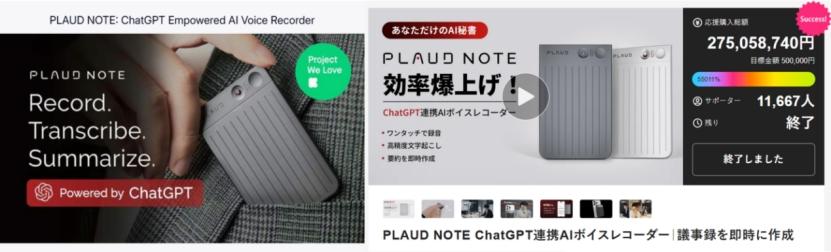
The crowdfunding interface styles of Plaud in the US and Japan are significantly different, raising $1.1 million and $1.8 million respectively | Image Source: Kickstarter, Makuake
The Unexpected Success of NotePin
In 2024, Plaud launched its second - generation product, "NotePin". The different responses of the US and Japanese markets to this product were also directly reflected in the App side.
In August 2024, "NotePin" was first launched in the United States. From the product form, it was quite controversial. The second - generation "NotePin" was designed in a lighter and smaller pendant form. Plaud's assumption was to make "recording" move out of the conference room and cover more on - the - go scenarios.
However, American users were not very receptive to this new "pendant" product at that time. There were three typical complaints in the discussions on communities such as Reddit - insensitive startup and possible missed recording; recording interruptions and audio garbled codes in noisy outdoor environments; after recording, it could only do transcription and summarization, and there was still a certain distance from the real "process closure" (see our previous article "Why Didn't the New PLAUD Product, Which is Similar in Function and More Portable, Become a Blockbuster Again?").
With mixed reviews, American users would wonder "Why do we need this hardware?"; In Japan, where it went on sale four months later, at the end of 2024, users' concerns were quite different.
In the reviews of Japanese users about "NotePin", besides positive feedback such as efficiency improvement and convenient fieldwork recording, expressions such as "inconspicuous during meetings" and "forget that you are wearing it" often appeared. This "temperature difference" reflects a typical Japanese preference.

There are also common complaints such as "insensitive buttons" in the reviews of Japanese consumers about NotePin, but the core demand is still basic transcription. Therefore, most of them still gave 4 - 5 star positive reviews | Image Source: Amazon.jp
In Japanese social norms and workplace culture, there is a general emphasis on "not causing trouble to others" and "reading the atmosphere", especially in business scenarios, where the naturalness of the communication process is emphasized. The more "concealed" wearable design of "NotePin" happens to meet this need, making the recording process more natural.
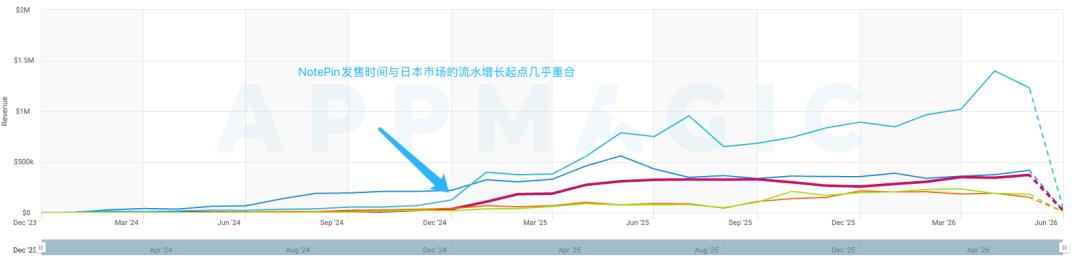
The release time of "NotePin" almost coincides with the starting point of the revenue growth in the Japanese market | Image Source: AppMagic
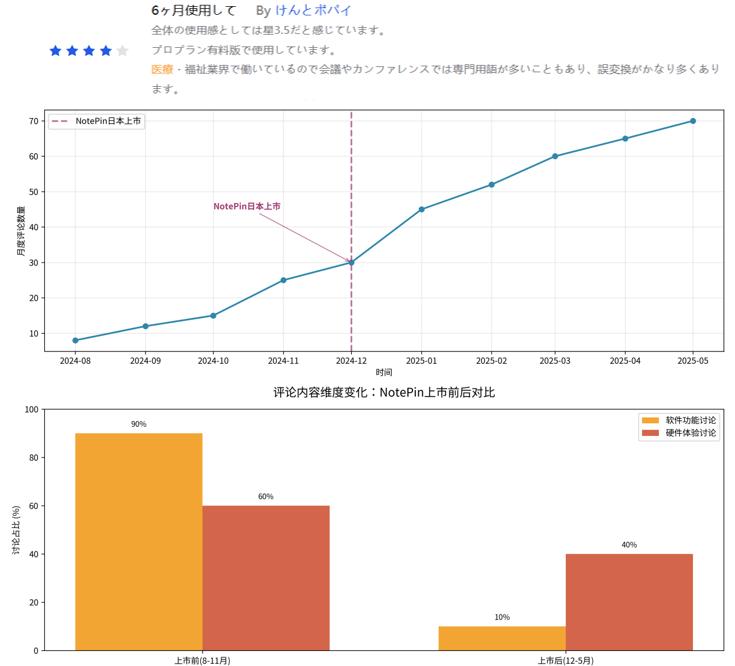
After "NotePin" was officially launched in Japan, because of its unique form and the feature of invisible recording, users' reviews began to cover aspects such as hardware design, wearing experience, and software - hardware collaboration. Among them, "doctors" are the only profession clearly mentioned, and they happen to face high - frequency and low - interference recording needs.
Although the issue of transcription accuracy was still mentioned at that time, the experience values such as convenience, concealment, and non - interference with meetings, which are highly in line with Japanese workplace culture, began to become important reasons for Japanese users to recognize and recommend the product.
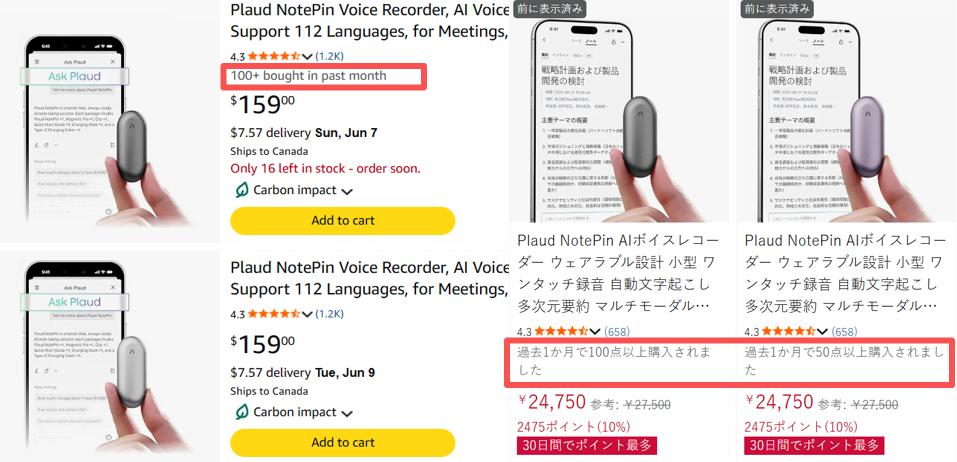
The sales performance of "Note Pin" in the US and Japanese markets has not been very different in the past month | Image Source: Amazon.us, Amazon.jp
In fact, what Plaud envisioned as on - the - go scenarios are seen as concealment and compactness by Japanese users.
However, after this unexpected success, Plaud's subsequent explosion in Japan comes from its continuous iteration of products to meet users' ever - changing needs.
It launched a new hardware product, NotePin S, which added physical buttons and a highlight marking function, directly addressing the pain point of the previous product - "inconspicuous operation feedback".
On the App side, from the dialogue interaction of "Ask", to the attempt of "Flow" to connect information in different tasks, and then to "Skill" providing automated solutions for repetitive labor. These updates all point to one goal, to provide users with either an intermediate or final result for their high - frequency recording, and deeply integrate into the workflow. In February this year, Plaud also updated a dedicated "Workspace" section to facilitate users to call historical data and customize work tasks.
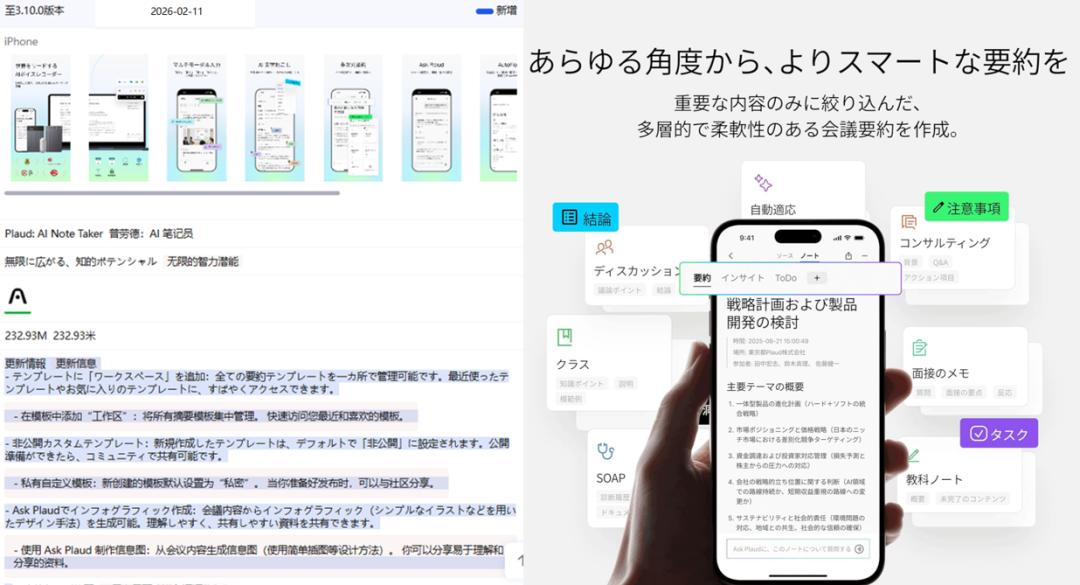
In previous feature updates, the Ask feature directly extracts information on the basis of transcription; the Flow feature automatically transcribes and extracts summaries after detecting recordings, and can be associated with meetings, to - dos, and knowledge management; following the recent Agent boom, Plaud launched the Skill feature, which can take over and complete some work tasks | Image Source: Plaud
Conclusion
Looking back at Plaud's trajectory in the Japanese market, it is closer to the real situation. The explosion may not stem from the company's foresight, but from continuous attempts. It is about quickly iterating and responding to users' needs after receiving the "accidental product definition" from the Japanese market, and then precipitating it into a market strategy.
It is difficult to truly understand a market, especially a market like Japan, from the outside.