Don't just focus on narrowing losses, let's talk about Meituan's "Physical AI"
Short-term loss reduction repairs the basic business. Long-term technological layout determines the future of the enterprise.
On the evening of June 1st, Meituan released a performance report that relieved the market.
In the first quarter of this year, Meituan's revenue reached 91.039 billion yuan; its operating loss narrowed from 10 billion yuan in the previous quarter to 2 billion yuan, which was half less than the investment banks' expectations. The losses of new businesses such as Freshippo Supermarket and overseas Keeta also narrowed simultaneously, from 4.6 billion yuan to 2.1 billion yuan.
But to be honest, loss reduction is actually just the most superficial performance signal.
There are no real winners in the food delivery war. After the brutal close combat last year, the three major platforms all stopped the subsidy war this year, and the pressure of the subsidy war eased. Therefore, loss reduction was expected.
The reason why Meituan can lose less than its competitors is essentially because of its solid foundation. Meituan focuses on high - end dinner business with high customer unit price and stable demand. In terms of transaction volume, Meituan's GTV share in food delivery has always been stable at over 60%, and its order structure is healthier.
After the food delivery war, it has become an industry consensus that the marginal benefit of subsidies is decreasing. Wang Xing frankly said at the performance meeting, "Order growth driven only by subsidies is unsustainable."
What the market and the outside world really care about is: What will drive Meituan's next - stage growth?
Meituan's answer is to increase investment in technology and physical AI. "We will continue to increase investment in AI and continuously iterate the capabilities of AI Agents and large models," Wang Xing said. In the first quarter, Meituan spent 7 billion yuan on R & D, a year - on - year increase of 22%, accounting for 7.7% of the total revenue.
Another piece of news is also worth noting. Meituan's AI assistant "Xiaomei" will be connected with Tencent's Yuanbao. Users can directly order food delivery in Yuanbao. This kind of multi - AI Agent collaboration will obviously help Meituan expand the entry points for real - world transactions and life services and tell a new AI story.
It is not surprising that Meituan is moving towards a new AI narrative. And its investment in hard technology may far exceed many people's expectations. From underlying computing power, semiconductors, to large models and embodied intelligence, Meituan has almost invested in unicorns in various fields, quietly weaving a huge map covering most of China's AI circle.
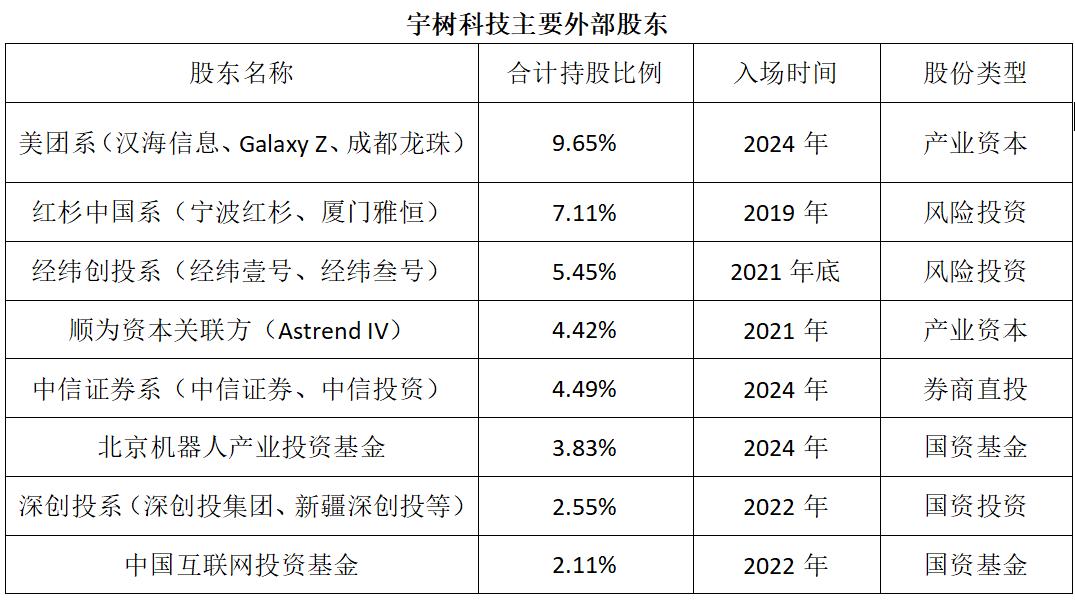
Yushu Technology, which has just passed the IPO review and is about to become the "first stock of embodied intelligence" in the A - share market, is just the tip of the iceberg of this map. The Meituan - affiliated entities hold a total of 9.65% of the shares, making it the largest external shareholder of Yushu Technology.
Investing in Most of China's AI Circle
In 2021, Meituan upgraded its strategy from "Food + Platform" to "Retail + Technology", and its attention to cutting - edge technological trends such as drones, embodied intelligence, semiconductors, AI, and autonomous driving has moved from the shadows to the forefront.
Since then, Meituan has accelerated its investment shift from consumption to hard technology. In 2022, the number of investments made by large - scale companies in the entire industry dropped by 70%, but Meituan increased its investment against the trend, with the proportion of hard - technology investment reaching about 65%. In 2025, when the food delivery war was at its fiercest, Meituan's core business turned from profit to loss, but its technology investment increased instead of decreasing.
Now, Meituan can be regarded as the most active hard - technology industry investor in China. Its investment map is so vast that it spans five core sectors: embodied intelligence, large models, semiconductors, intelligent hardware, and autonomous driving, covering more than 50 unicorns.
However, Meituan's investment approach is different from that of other large companies.
The R & D cycle of hard technology is long, and the return is slow. Many investors can't wait, but Meituan can. When Yushu was in the B2 round with a valuation of only 1 billion yuan, Meituan led the investment and also participated in the B3 round. By June 2025, when Yushu appeared on the Spring Festival Gala and its valuation reached 12 billion yuan, Tencent, Alibaba and others followed in. From a strategic perspective, the difference between betting on the future and buying a defensive ticket is obvious.
A similar scenario has been repeated. In the field of embodied intelligence alone, Meituan has invested in at least 16 companies, entering at an early stage. Ten of them have become unicorns, such as Galaxy General, Xinghai Map, Sharpa, etc., with valuations exceeding tens of billions.
In the autonomous driving sector, Meituan has been the largest external shareholder of Li Auto since its Series B investment in 2018 until it reached a market value of hundreds of billions. In the semiconductor sector, on the first day of listing, Moore Threads had a market value of over 300 billion yuan, and Muxi Co., Ltd. had a market value of over 280 billion yuan. Meituan was an early - stage shareholder of star companies such as Zhipu AI and Moon's Dark Side, whose market values once exceeded that of JD.com. Meituan also invested in Ziguang Zhanrui, a "national team" chip enterprise.
Meituan has also made significant investments in unicorns with valuations in the tens of billions, such as Hesai Technology, Jiushi Intelligence, Qingzhou Zhihang, Del Technology, and Guangzhou Zhongshan, through capital injection.
Meituan has invested in half of China's AI circle and has also shown patience. Moreover, Meituan's investment is by no means the common financial investment of large companies. It not only provides funds but also offers application scenarios.
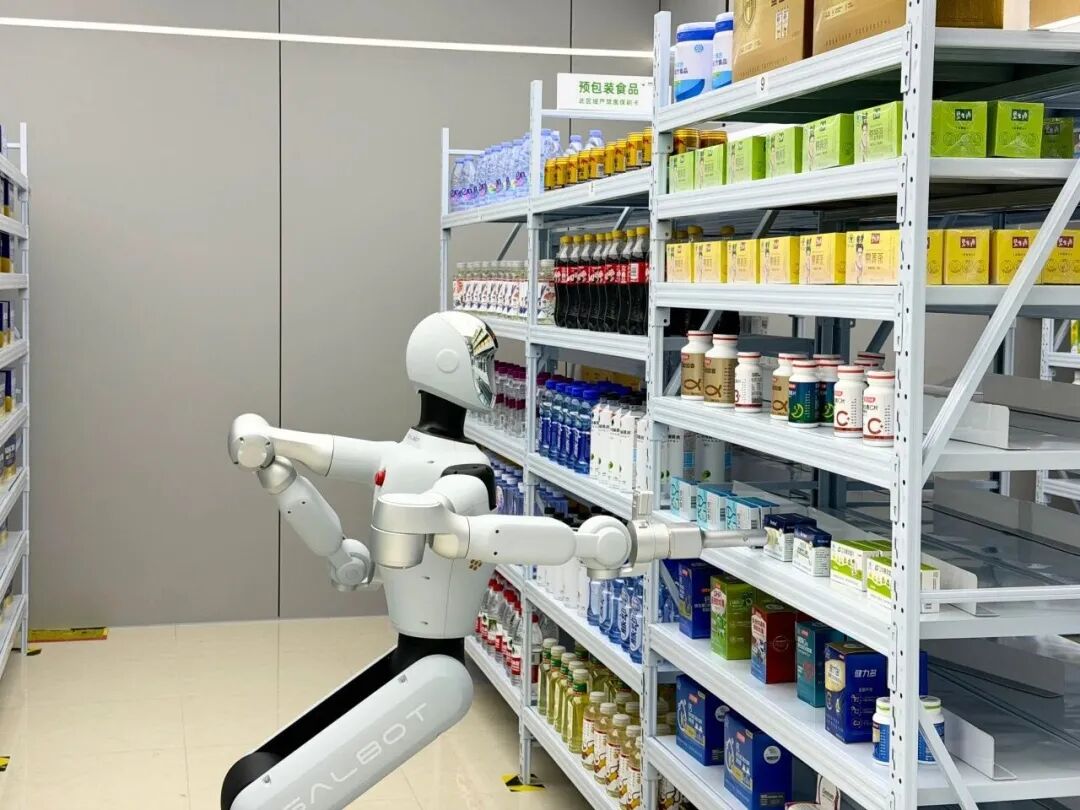
Galaxy General Robot
Hesai's lidar has been selected for mass - production in Meituan's drones. 100 sorting robots from Libiao are operating in Meituan's pharmacies in Guangzhou and Wuhan warehouses respectively. Galaxy General's robots have been on duty in pharmacies 24/7.
This platform, which started from life services, has penetrated deep into the underlying layer of hard technology and become the most determined long - term supporter.
While Others Do AI, Meituan Does "Physical AI"
The AI era has arrived.
As the industry enters the second half, the dividends of selling shovels (selling GPUs and building data centers) have peaked. The next opportunities lie in two major directions: One is technology companies that can make Tokens cheaper, and the other is entry platforms that can truly implement AI in specific scenarios.
Anthropic is an example. It is not as well - known as OpenAI and did not start as early, but by focusing on the B - end scenario, its annualized revenue reached as high as 30 billion US dollars, surpassing OpenAI. This confirms the truth that virtual AI without a physical scenario has limited long - term value.
This is also Meituan's approach.
On various occasions, Wang Xing has repeatedly emphasized, "The digitalization of the physical world is the most important foundation for AI." What Meituan wants to do is to act as a connector between the digital world and the physical world, and ultimately implement AI in the real world, so that AI is not just a chatbot but truly serves the daily needs of consumers.
Investing in hard technology externally and upgrading the Meituan App to an AI - powered App internally actually lead to the same goal, which is to establish connections. Meituan's strategy towards AI has always been offensive rather than defensive.
Breaking it down, Meituan's "Physical AI" strategy has three layers:
The bottom layer is real data. In the AI era, real data is the most valuable. Meituan has the most real and complex offline interaction scenarios in China, including hundreds of millions of users, residential buildings, streets and alleys, and a diverse population. The operation that cannot be standardized and the fulfillment data generated by tens of millions of orders every day are unique in the world and cannot be simulated. Even OpenAI and Doubao cannot obtain such data.
The middle layer is the combination of hardware and software. Meituan's self - developed LongCat large model was upgraded to 2.0 - Preview in April this year, with a total parameter exceeding one trillion, and it runs entirely on domestic computing power. In May this year, Meituan's drones entered regular operation, with a cumulative number of commercial orders exceeding 900,000, ranking second in the world. Unmanned vehicles and low - altitude logistics are also being planned to supplement scenarios that are difficult to cover by human resources.
The upper layer is the experience of users and merchants. Meituan's C - end AI assistant "Xiaotuan" has been embedded in the Meituan APP. During the May Day holiday, it served over 100 million users, covering scenarios such as dining, entertainment, travel, and medical consultations.
The cooperation between Meituan's "Xiaomei" and "Yuanbao" means that Meituan will open up its local life services to other AI Agents, taking another step towards becoming the "water, electricity, and gas" infrastructure in the local life field.
On the B - end, the "Intelligent Shopkeeper" service has served over 700,000 merchants, and the "Digital Employee" has covered over 300,000 merchants. "Help every merchant use their own AI assistant."
For AI assistants, the dialogue and tool functions can hardly cover the high computing costs. Even ByteDance has to consider launching a paid service for Doubao, which is obviously not a suitable path for the general public. They must be involved in real - world transaction scenarios to form a sustainable business closed - loop. Therefore, ChatGPT and many domestic AI assistants are cultivating the consumption habit of "dialogue as service" and trying to connect with the real offline world through "purchases".
However, most of them have encountered difficulties, and their user experience has been criticized. The reason is simple: the traffic entry point does not equal the implementation service and fulfillment ability. The essential difference between them and Meituan lies in the infrastructure gap - they always struggle to make up for the lack of the local life ecosystem and fulfillment network.
As Wang Xing said before, this is not an intelligence problem but an information problem. "Even if Einstein were a secretary, when asked to book a restaurant, he still wouldn't know if there were any available seats." This is exactly Meituan's most scarce core resource, which is also the reason why WeChat's AI Agent is about to be launched and Yuanbao is going to cooperate with "Xiaomei".
Has the Market Underestimated Meituan?
Many people think that Meituan's investment in hard technology is more of an ecological positioning for the future and has little to do with its main business. However, some investment professionals said that this is actually a misinterpretation: "Meituan's investment logic is industrial synergy, not financial return. What they invest in is not the current trend but the infrastructure for the next decade."
An often - overlooked detail is that Meituan uses FVOCI accounting for its strategic investments in Zhipu, Yushu, etc. Simply put, the rise and fall of the stocks of Zhipu and others will not be included in Meituan's income statement but will be regarded as assets, which can be seen as a form of cash. This will not exaggerate the actual operating results of the main business.
Analytical data shows that at the initial stage of Yushu's listing, its market value will be at least 42 billion yuan, and Meituan's corresponding value will exceed 4 billion yuan. The floating profit from Zhipu exceeds 20 billion Hong Kong dollars.
This is different from Alibaba. Alibaba's external equity investments are directly included in the profit. In the first quarter, its operating profit was in the red, but relying on its investments in Zhipu, MiniMax, etc. - through the "interest income and net investment income", it added 41.3 billion yuan in profit, turning the net profit into positive growth.
In addition, the synergy value of the invested companies has not been realized yet.
Yushu plans to raise 4.2 billion yuan in this IPO, and nearly half of it will be invested in the R & D of the "robot brain". Wang Xing once said that the biggest bottleneck for robots is the lack of generalization ability, which requires a large amount of real - world physical scenario data.
The logic behind investing in large models, chip semiconductors, autonomous driving, etc. is the same. Compared with investing for profit, the more important thing is ecological synergy and positioning in key sectors.
At the same time, the market may not yet understand the valuation logic of the physical AI sector.
It will take time for the large - scale implementation of physical AI. The regulatory policies for drones, the generalization ability of embodied intelligence, and the commercialization rhythm of the invested companies - these are all variables. However, the direction is certain.
History has repeatedly verified a rule: in each technological wave, those who make money first are the ones selling shovels, but the ones who go the farthest are the entry platforms that implement technology in real - world needs. This was the case for Reuters in the telegraph era, the Yellow Pages in the telephone era, and Tencent and Alibaba in the traffic era.
The same is true in the AI era. The stock prices of GPU manufacturers have peaked, and companies like DeepSeek, Moon's Dark Side, and Zhipu are booming. The larger application explosion - implementing AI in local real - world needs - has just begun.
As the largest local life service entry platform, Meituan has data, scenarios, a combination of hardware and software, an ecological and technological synergy covering most of China's hard - technology field. The physical AI foundation it has built is not for helping users draw pictures or write poems, but for delivering food to users' homes, delivering medicine to their hands, and helping merchants save money.
Short - term loss reduction repairs the basic business. Long - term technological layout determines the future of the enterprise. For Meituan, whether the layout can be fully implemented depends on the technology implementation rhythm and execution ability. Once the physical AI closed - loop is completed, how should its value be re - evaluated?
This article is from the WeChat official account "Pole Business" (ID: jdsy2020), written by Liu Shanshan and edited by Cindy. It is published by 36Kr with authorization.