TSMC: "Be sure to remember COUPE"
In 2021, TSMC released its latest 3D packaging technology roadmap at Hot Chips, which involved a silicon photonics packaging technology called COUPE.
That year, the hottest topics in the industry were 3nm and 2nm technologies, and silicon photonics packaging was just a minor aspect. However, TSMC saw another problem: when the number of GPUs in an AI training cluster increased from dozens to tens of thousands, the cost of data transfer between chips became too significant to ignore.
Five years later, the situation reversed. TSMC announced that the silicon photonics integration platform COUPE would enter mass production in 2026. Orders from NVIDIA and Broadcom have already been placed, and Samsung is catching up. This year, Zhang Xiaoqiang, the deputy co - CEO of TSMC, said at a technology forum: "You must remember COUPE."
An Overlooked Bottleneck
Over the past few decades, communication between GPUs and switches in data centers has relied on pluggable optical modules. You can think of it as a pluggable box that converts electrical signals into optical signals for transmission, and the receiving end converts the optical signals back into electrical signals. The advantage of this architecture is that it is simple, easy to use, and when there is a problem, you can just replace it.
However, the rapid development of AI has refreshed the demand again. When the number of GPUs in a single training task increased from dozens to tens of thousands, and the transmission rate increased from 400G to 800G and 1.6T, the cost of signal conversion between electrical and optical signals started to get out of control. The traditional DSP pluggable solution consumes about 30 watts of power when processing 1.6T signals. In the competition of advanced manufacturing processes, this power consumption figure may not seem significant, but in large - scale model training with tens of thousands of GPUs running simultaneously, the energy consumption of optical modules alone can consume the entire power quota of a server. More importantly, FEC error correction requires additional processing time. In the scenario of large - scale model distributed training, these small delays add up, causing a significant number of GPUs to wait for data.
Can copper save the day? It can for short distances, but once the signal crosses racks or nodes, signal attenuation and delay become unbearable. The industry needs a new solution.
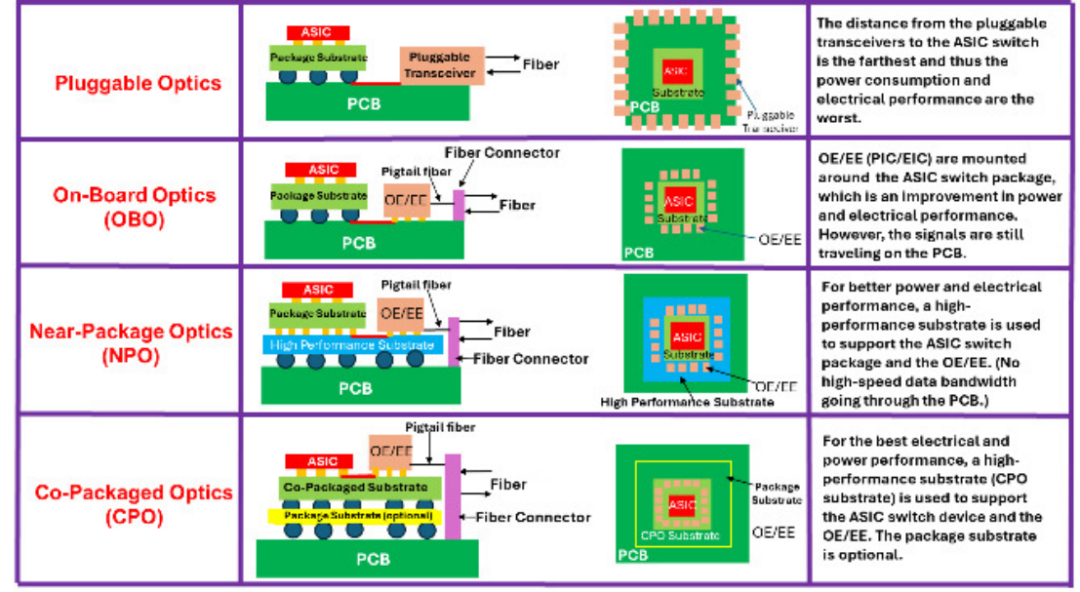
Pluggable optical devices, OBO, NPO, and CPO
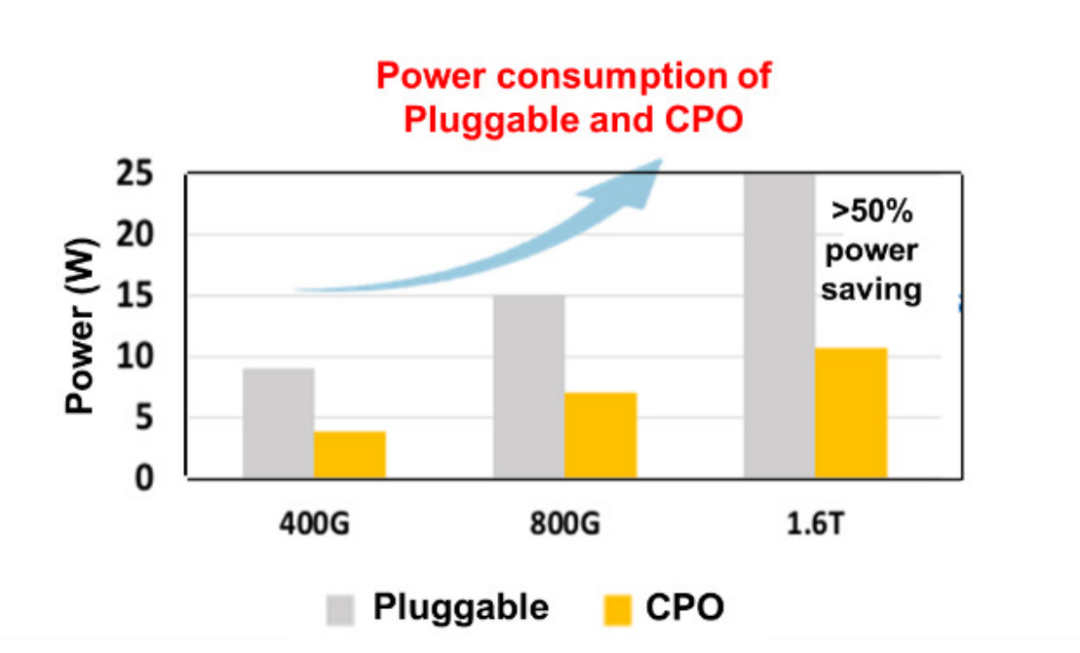
Power consumption of pluggable and CPO
The industry has chosen optical interconnection, using light instead of electricity to transmit data, which has lower power consumption, shorter latency, and higher bandwidth density. However, the problem is how to efficiently integrate optical devices and electrical chips. The traditional approach is to design them separately and package the optical modules independently, but this method seems too loose in the AI scenario, with long signal paths and large losses.
CPO, Co - packaged Optics, is designed to solve this problem: it directly integrates the optical engine into the chip package, allowing optical signals to be generated as close to the processor as possible.
The idea is not complicated. However, implementing it is another matter.
What is COUPE?
Silicon photonics is not a new concept. People started researching it in the early 2000s. It has clear advantages: it is compatible with CMOS processes, has controllable costs, and can be integrated on a large scale. However, the challenges are also clear: how to integrate optical devices and electrical chips at high density? How to perform optical coupling? How to ensure packaging accuracy? How to conduct testing? Without solving these problems, silicon photonics cannot be mass - produced on a large scale.
TSMC's approach is: since silicon photonics alone cannot solve these problems, let it be combined with TSMC's strongest packaging capabilities. CoWoS and SoIC are well - known in the AI industry.
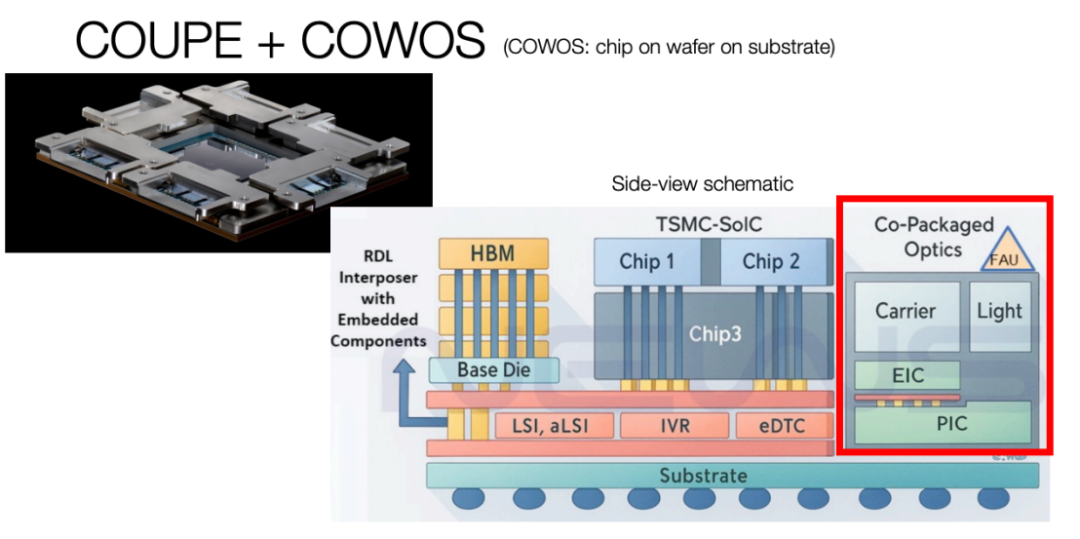
In 2023, TSMC launched COUPE 2.0 at the IEEE ECTC. The core upgrade is the introduction of Hybrid Bonding technology. Instead of using microbumps to connect chips, the oxide molecules are directly "attracted" together at room temperature, and then the copper is bonded by heating and annealing. This process significantly shortens the distance between electronic and photonic chips, minimizing signal transmission losses.
In 2024, COUPE entered the intensive verification stage. At the IEDM conference, TSMC announced more details: the loss of single - mode silicon waveguides is 0.67dB/cm, the loss of silicon nitride waveguides is as low as 0.21dB/cm, the responsivity of Ge detectors is close to 1A/W, and the bit error rate of the 200Gbps micro - ring modulator is less than one in a hundred million. This means that COUPE not only works but also works well.
However, only those who can simplify complex things are qualified to charge a premium. What really turns COUPE from a technology into a business is TSMC's change.
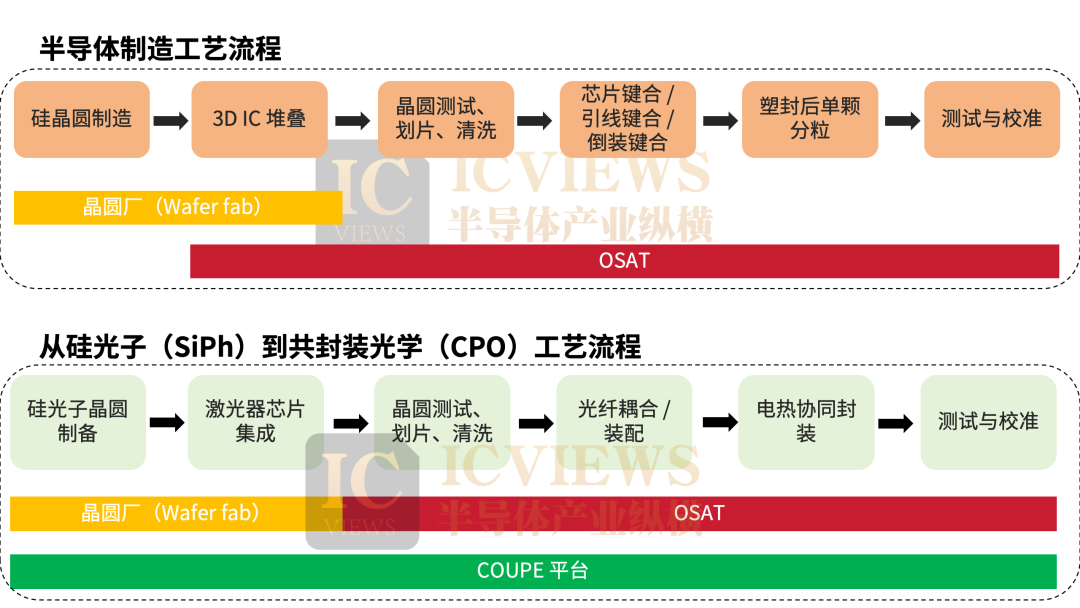
Here is some industry background: GlobalFoundries was actually an earlier player in silicon photonics. It started manufacturing silicon photonics chips for customers in 2017 and has accumulated a lot of experience. Logically, it should have an advantage. However, GlobalFoundries' model is a typical foundry mindset: it only manufactures chips, and the subsequent packaging and integration are up to the customers. This logic works for top customers with complete optoelectronic design capabilities, but there are less than ten such companies globally.
TSMC's approach is different. It not only manufactures chips but also takes care of the entire packaging process. From the manufacturing of silicon photonics wafers, the bonding of electronic and photonic chips, to optical packaging, everything is done on TSMC's production lines. Customers only need to submit their requirements, and the rest will be taken care of in one stop.
This difference ultimately determines the flow of customers. In 2025, NVIDIA and Broadcom started to transfer some of their products from GlobalFoundries to TSMC's COUPE platform. More importantly, when NVIDIA decided to use the 6nm advanced logic node to manufacture electronic control chips, only TSMC could handle both the advanced manufacturing process and hybrid bonding packaging. Other companies either have advanced processes but lag in packaging or have good packaging capabilities but lack advanced nodes.
After a long circle, CoWoS has become the entry ticket, and only TSMC has it.
COUPE Mass Production and the Changes in the Industrial Chain
The impact of COUPE mass production extends far beyond TSMC itself. Currently, the value of the supply chain is shifting from traditional optical module manufacturers to the semiconductor and advanced packaging sectors.
Lasers will change from supporting components to core assets. Traditional pluggable optical modules use EML lasers with integrated modulators. However, CPO requires external continuous - wave lasers, a laser light source that emits continuously with a power of up to hundreds of milliwatts, which supplies light to multiple photonic channels simultaneously through a beam splitter. The technical threshold is completely different. At the same time, the core material of these lasers is indium phosphide (InP), and the global supply is tight. The demand is increasing (due to the expansion of the optical communication market, new demand from CPO, and export restrictions), but the production capacity cannot keep up.
As a result, laser manufacturers have stepped into the spotlight. Coherent believes that the supply - demand imbalance of InP will last at least throughout 2026 and 2027. Coherent is fully promoting the mass production of 6 - inch InP wafers. Lumentum expects that by the end of fiscal year 2026, its EML production capacity will increase by more than 50% compared to 2025, so the company has advanced about 40% of its indium phosphide (InP) production expansion plan. In March 2026, NVIDIA directly invested $4 billion ($2 billion each) in Lumentum and Coherent, locking in multi - year procurement commitments.
Testing equipment manufacturers are also winners. The manufacturing complexity of CPO far exceeds that of traditional optical modules. From photonic wafer testing, chip bonding, optical engine assembly to whole - machine testing, each step requires specialized equipment with micron - level precision. Lianxun Instruments, Chroma, and ficonTEC are indispensable in the CPO mass production chain. Yole predicts that the CPO market will soar from $46 million in 2024 to $8.1 billion in 2030, which means that the peak of testing equipment orders is yet to come.
FAU manufacturers will also benefit. The Fiber Array Unit (FAU) is a key component for coupling the optical signals generated by chips into optical fibers. In the CPO architecture, FAU requires higher coupling accuracy and more complex packaging integration. In the CPO scenario, the value of a single FAU will significantly increase. Domestic FAU manufacturers such as Tianfu Communication, with their precision processing capabilities, are becoming an indispensable part of the CPO industrial chain.
Traditional optical module manufacturers will be affected to some extent. Zhongji Innolight and Xinyisheng are the most typical examples in this change. These two global leaders in optical modules had high - speed growth in their performance in 2025 (Zhongji Innolight's net profit increased by 109% year - on - year, and Xinyisheng's increased by 235% year - on - year). In the pluggable era, optical module manufacturers were the integrators of solutions, controlling the core link of photoelectric conversion. However, in the CPO era, the optical engine and XPU/switch chips are co - packaged together, and the position of solution integrators has been taken over by semiconductor manufacturers (NVIDIA, Broadcom) and OSATs. All that traditional optical module manufacturers can do is manufacture optical engines and external light source components.
However, Zhongji Innolight has already announced that it can self - develop and produce optical engines, and Xinyisheng also stated in March 2026 that it has optical engine technology. Their strategy is: since you don't need "plug - in" modules, I'll make the core "optical engine" and sell it to you. This is the proactive transformation of leading manufacturers from "selling modules" to "selling optical engines."
The Competition Has Just Begun
In 2026, Scale - out CPO (inter - rack interconnection) switches started mass production and shipment, which is the current main battlefield. However, the real challenge will be the Scale - up CPO (intra - rack GPU interconnection) solution from 2027 to 2028. Scale - up CPO means that optical interconnection will enter the inside of the rack and be directly packaged with GPUs. This scenario has higher technical requirements and stricter supply chain control.
TSMC is not the only player in this field.
Whenever TSMC announces a major move, another South Korean competitor will quickly follow. Yes, I'm talking about Samsung. In March this year, Samsung Electronics officially announced its entry into the optical communication market. Samsung Electronics' roadmap shows that it will achieve an optical engine based on TC (thermal compression) bonding in 2027, transition to hybrid bonding in 2028, and start providing "turnkey" CPO services, that is, one - stop, full - process CPO foundry services, in 2029.
Currently, Tower Semiconductor's silicon photonics revenue is still growing. It increased from about $106 million in 2024 to about $228 million in 2025, and the company plans to expand its production capacity by more than five times. This year, it signed a $1.3 billion supply contract for 2027 with its largest silicon photonics customer and has received a $290 million advance payment for capacity reservation. The company also disclosed that the customer has committed to a larger - scale wafer order for 2028, and the relevant additional advance payment will be in place before January 2027.
At the same time, there are many emerging players in the industry, such as Ayar Labs, Lightmatter, Celestial AI. These companies are more radical, directly integrating photonics into XPU packages, targeting the next - generation market after 2028. Marvell announced the acquisition of Celestial AI for $3.25 billion, hoping to occupy a position early.
Conclusion
TSMC is building a complete "three - layer cake" AI platform architecture, including SoIC, CoWoS, and COUPE optical interconnection technology.
TSMC said that the world's first 200Gbps Micro Ring Modulator using COUPE technology started production this year and has achieved a bit error rate of less than one in a hundred million.
By 2030, TSMC will increase the bandwidth density by eight times to 4TBps through 400Gbps optical modulators, multi - wavelength, and multi - fiber array technologies. Compared with traditional copper wires, COUPE can improve system energy efficiency by four times and reduce latency by ten times; if further integrated with the packaging platform, the energy efficiency can even be increased to ten times, and the latency can be reduced by twenty times, making it an important basic technology for future AI data centers.
The demand for COUPE will become more and more strong.
This article is from the WeChat official account "Semiconductor Industry Insights" (ID: ICViews), author: Jiulin. It is published by 36Kr with authorization.