Mobile phone manufacturers engage in a fierce battle during the 618 shopping festival: some offer real discounts, while others just put on a show.
As June arrives, the 618 Shopping Festival reaches its peak.
As a crucial sales period for 3C digital products throughout the year, the 618 Shopping Festival has always been a golden time for smartphone manufacturers to boost sales and seize market share. However, the situation this year is somewhat special.
In the past year, the prices of upstream memory have been continuously rising, driving up the overall cost of mobile phones. Against this backdrop, the room for smartphone manufacturers to offer promotions and discounts is quite limited.
Surprisingly, during the 618 period, the smartphone industry still witnessed a wave of price cuts. Manufacturers such as Apple, Huawei, and Xiaomi have lowered the prices of their models, with the maximum reduction reaching 3,500 yuan.
The reason lies in the fact that under the wave of rising memory prices, smartphone manufacturers have fallen into a "prisoner's dilemma." Leading manufacturers, leveraging their scale advantages, took the lead in cutting prices to seize market share. Other manufacturers, in order to avoid losing customers, had to follow suit passively, eventually leading to a price war.
As Lei Jun, the founder, chairman, and CEO of Xiaomi, said, "If you plan to change your phone in the next year, I strongly recommend that you do it now." Considering that memory prices will continue to rise, this year's 618 is undoubtedly an important window period for consumers to purchase new phones at a relatively low price.
However, it should be noted that due to factors such as shipment volume, supply - chain bargaining power, and product structure, the cost pressure borne by smartphone manufacturers varies significantly. Although the smartphone industry has launched a series of promotional activities during the 618 period, not all mobile phone products have seen real - price cuts.
Behind the 618 price war, only old flagship models have seen substantial price cuts
With a wider profit margin, flagship phones have become the main products for promotion during this year's 618, with an average price cut of about 1,000 yuan.
For example, on the Tmall platform, after stacking various discounts, the Huawei Mate X6, Xiaomi 15 Ultra, and OPPO Find X9 Pro have seen price cuts of 3,500 yuan, 2,700 yuan, and 1,289 yuan respectively, with the final prices being 9,499 yuan, 3,799 yuan, and 4,310 yuan respectively.
In contrast, mid - to - low - end products in the 2,000 - yuan range, such as the REDMI K90, iQOO Z10 Turbo+, and Realme GT8, have only seen a price cut of about 500 yuan. After excluding national subsidies, the official subsidies are very limited.
However, it is worth noting that although the price cuts of flagship phones are significantly higher than those of mid - to - low - end models, it does not mean that the former is more sincere.
Currently, most of the mobile phone products with a price cut of over 2,000 yuan are old flagship models that have been on the market for a long time. Most new flagship models have only seen a price cut of about 1,000 yuan.
In the long run, the discount rate of new flagship models is actually not very large. Since the second half of 2025, with the soaring memory prices, the prices of many new flagship models have been on the rise.
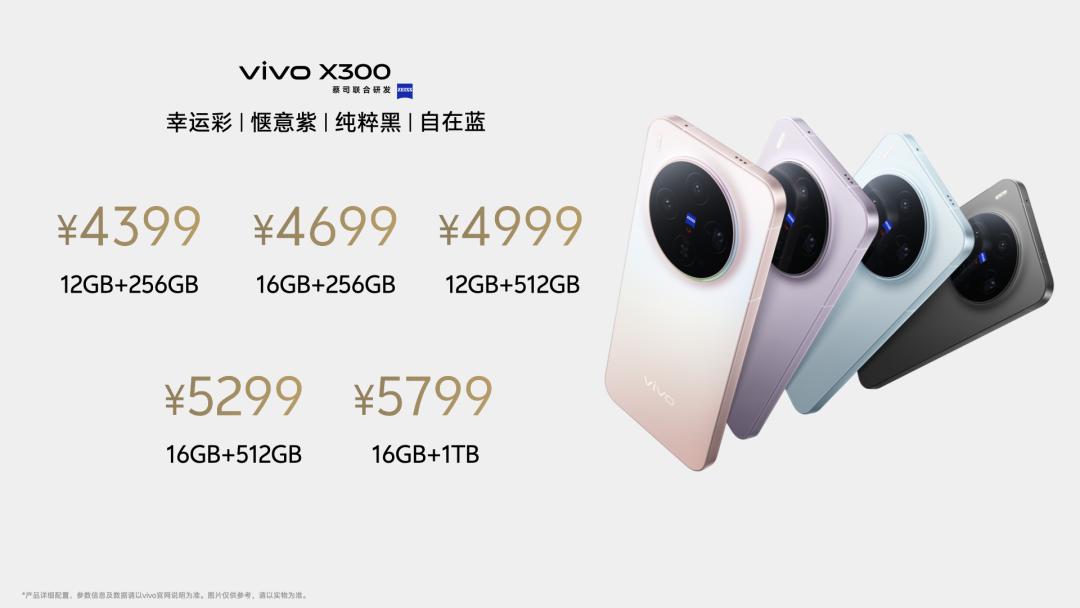
Image source: vivo
For example, when the vivo X300 standard version was launched in October 2025, its starting price was 4,399 yuan, a 100 - yuan increase compared to the previous generation. In March 2026, its starting price increased by 200 yuan to 4,599 yuan. During the 618 period, the vivo X300 standard version can enjoy an immediate discount of 300 yuan and a national subsidy of 500 yuan, with the starting price dropping to 3,799 yuan.
A vertical comparison shows that without the national subsidy during this shopping festival, the price of the vivo X300 standard version is almost the same as when it was first launched. As a flagship phone that has been on the market for more than half a year, the limited discount offered by the X300 standard version during the 618 period is hard to satisfy consumers.
Overall, during this year's 618, although the Chinese smartphone market still launched promotional campaigns as scheduled, the discount intensity is significantly lower than in previous years.
On the one hand, only flagship models have seen significant price cuts, while the discount range for mid - to - low - end products is relatively limited. On the other hand, in the flagship market, most of the products with significant price cuts are old models that have been on the market for a long time. Many new flagship models have "raised prices first and then cut them," and the actual discount is not as substantial as it seems.
Apple leads the price cuts during 618, and the iPhone 17 wins the market with "sincerity"
During the 618 period, the phenomenon of "partial price cuts" for old flagship models in the Chinese smartphone market is primarily due to the sudden increase in the cost of upstream components.
As memory prices continue to rise, the profit margins of smartphone manufacturers are being continuously squeezed. Compared with mid - to - low - end models with thin profits, flagship products have a higher gross profit margin and more room for price cuts.
However, it should be noted that, different from previous 618s when smartphone manufacturers launched promotions simultaneously, this year's price war in the Chinese mobile phone industry was initiated by Apple. The targeted "sniping" of Apple by domestic smartphone manufacturers is also an important reason for the "partial price cuts" during this 618.
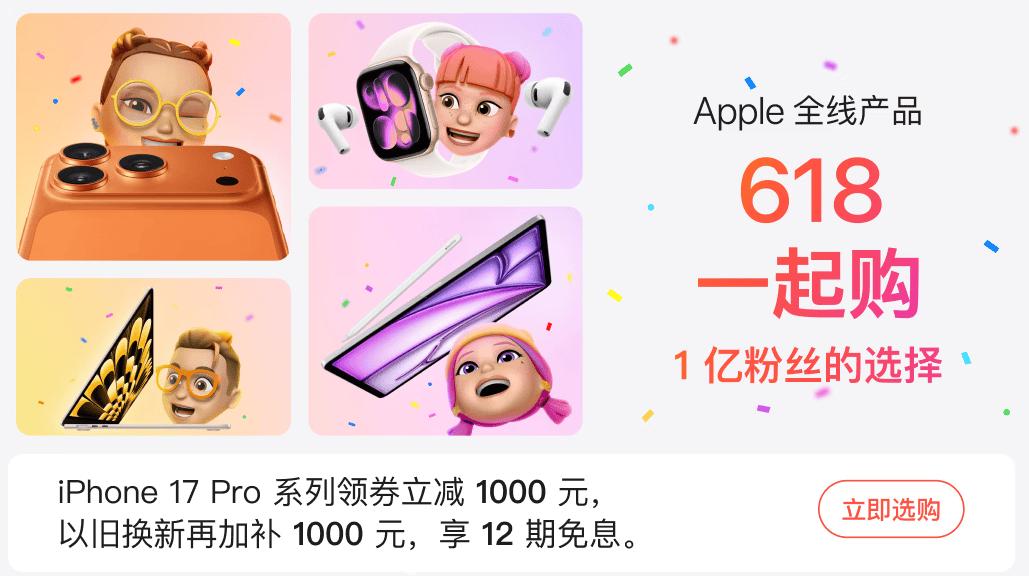
Image source: JD.com
On May 15, 2026, the entire iPhone 17 series saw price cuts. The iPhone 17 standard version had a direct price cut of 200 yuan. With national subsidies and trade - in subsidies, it starts at 4,499 yuan. The iPhone 17 Pro had a direct price cut of 1,000 yuan, and with an additional 1,000 - yuan trade - in subsidy, it starts at 6,999 yuan. This event lasted until June 21, fully covering the 618 period.
After the price cut of the iPhone 17, to avoid losing customers, a number of domestic smartphone manufacturers lowered the prices of their flagship products. Before the start of the 618, the Huawei Mate X6, Mate X7, and Xiaomi 15 Ultra saw price cuts of 3,000 yuan, 1,000 yuan, and 1,500 yuan respectively.
Since the iPhone is positioned as a high - end flagship, Apple's influence in the mid - to - low - end market is relatively limited. Against the backdrop of continuously rising cost pressure, domestic smartphone manufacturers naturally lack the motivation to actively lower the prices of mid - to - low - end products.
However, from a market perspective, although domestic smartphone manufacturers followed Apple's lead and lowered the prices of their flagship products, the iPhone 17 series is still one of the most popular products during this 618.
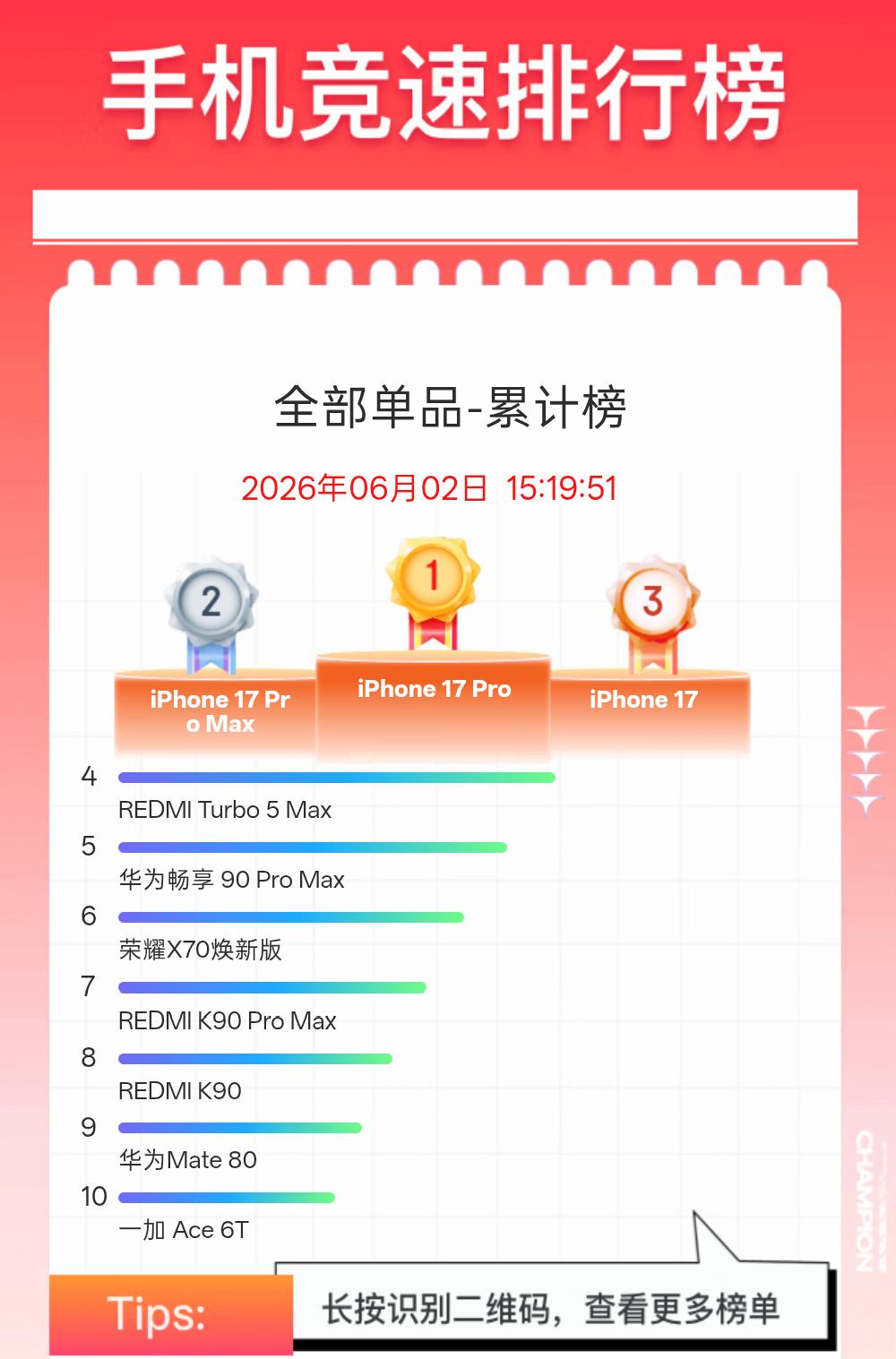
Image source: JD.com
The JD.com 618 sales ranking shows that from May 13 to June 2, among the cumulative list of single - product mobile phones, the top three products are the iPhone 17 Pro, iPhone 17 Pro Max, and iPhone 17 respectively.
In the long run, the price cut has had an immediate effect on boosting the sales of the iPhone 17 series. Farsight analyzed the cumulative sales data of the iPhone 17 series from weeks 1 - 21 in 2026 disclosed by the digital blogger "RD Observation" and found that after week 8, the month - on - month growth rate of the product's sales has been declining, and the month - on - month increase in week 19 was only 1.51%.
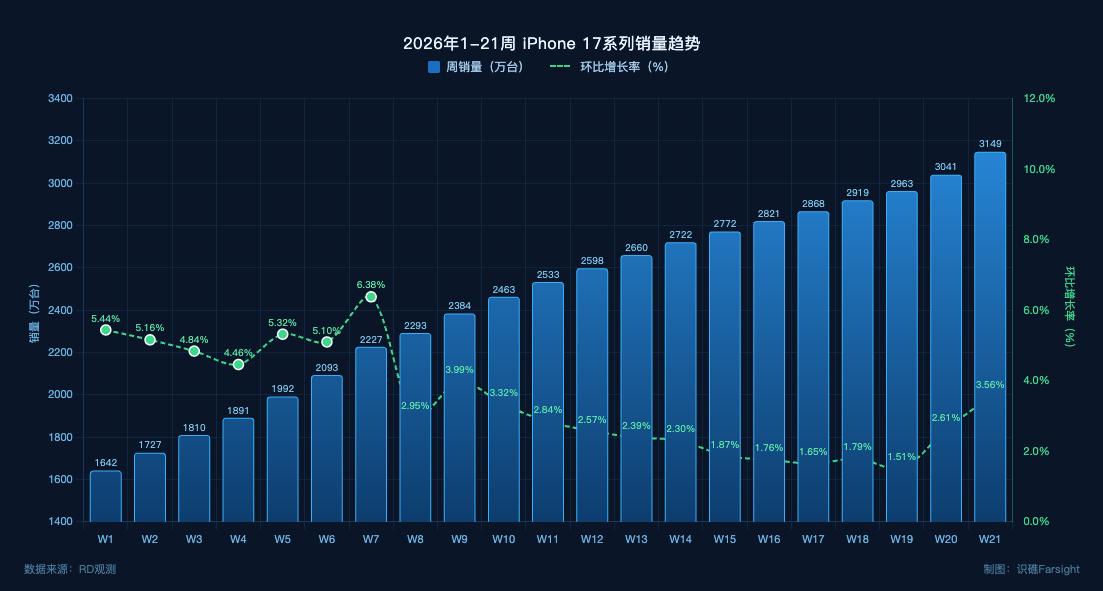
However, thanks to the significant price cut, the month - on - month growth rate of the iPhone 17 series' sales has shown a "smile curve," reaching 2.61% and 3.56% in weeks 20 - 21 respectively.
As Guo Mingji, an analyst at Tianfeng International Securities, said, in Q2 2026, the increase in the memory cost of the iPhone will be close to that of the previous quarter. However, Apple's strategy is clear: "Use its strong bargaining power to ensure chip supply, bear the cost pressure to seize market share, and then make up for the losses through service business later."
The reason why the iPhone 17 series is so popular among consumers is mainly that Apple has a strong say in the supply chain and has a closed - loop ecosystem integrating software and hardware, which can absorb the increase in upstream costs internally and truly offer benefits to the market.
The iPhone 17 series, launched in September 2025, not only did not raise prices in response to the rising memory prices but also "upgraded its configuration." The starting storage capacity of the standard version has increased from 128GB to 256GB, and it is equipped with an LTPO screen, supporting a variable refresh rate of 1 - 120Hz ProMotion.
During the 618 period, the iPhone 17 series directly cut prices. Compared with a number of domestic new flagship models that "raised prices first and then cut them," it shows stronger price competitiveness.
However, this does not mean that Apple will become the "winner" in the mobile phone industry. Although the iPhone's active price cut has attracted a large number of consumers, it also shows to some extent that Apple's pricing power is gradually weakening. If Apple continues to rely on price cuts to gain market share, its high - end brand positioning may be shaken.
Memory prices will continue to rise, and smartphone manufacturers need to prepare for the winter
Although memory companies are actively expanding production, against the backdrop of the continuous release of AI demand, the market supply - demand relationship is difficult to improve significantly in the short term. In the next period, memory prices will remain at a high level.
Recently, Goldman Sachs pointed out in a research report that it is expected that in 2027, the supply - demand situation of traditional DRAM, NAND, and HBM will be more tense than in 2026, and the tense situation will continue until 2028.
In response, Lu Weibing, the president of Xiaomi, said that the pricing of any mobile phone today is affected by the significant increase in memory costs. "In the second half of this year, especially at the end of the year, the prices of some domestic flagship straight - screen mobile phones may exceed 10,000 yuan."
Since the smartphone market has entered an era of over - performance, consumers' demand for changing phones is already weak. Against this backdrop, the continuous rise in memory prices, which drives up the terminal price, will undoubtedly further suppress market demand.
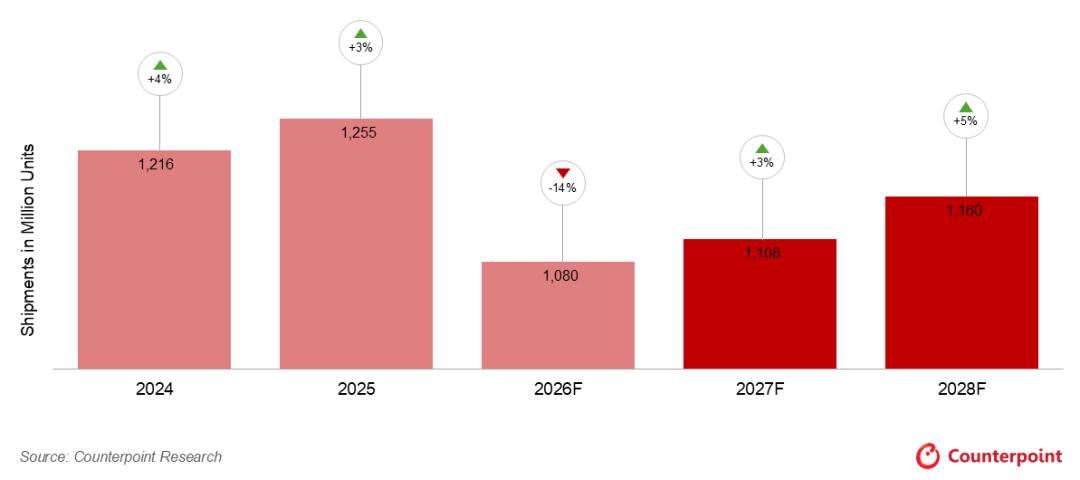
Image source: Counterpoint Research
A research report disclosed by Counterpoint Research shows that it is expected that in 2026, the global smartphone shipments will be about 1.08 billion units, a year - on - year decrease of 13.9%, hitting a new low since 2013.
It can be seen that this year's 618 Shopping Festival is not only an important window period for consumers to buy mobile phones but also a rare opportunity for smartphone manufacturers to increase shipments before the cost winter arrives. As the smartphone industry enters the era of stock competition, if smartphone manufacturers continue to maintain the original iteration model, they will face huge downward pressure.
Farsight believes that after the smartphone industry enters the era of stock competition, rather than launching new models step by step and inefficiently seizing market share, smartphone manufacturers should actually invest limited resources in the operation of existing users.
Apple's successful experience shows that the improvement of user stickiness of mobile phone products not only depends on hardware parameters but also on continuously iterated software experience and a perfect ecosystem.
In the future, domestic smartphone manufacturers can build a deeper user moat by extending the system maintenance period and strengthening cross - terminal collaboration capabilities.
In addition, as AI technology matures, smartphones are evolving from simple information terminals to personal intelligent entrances. Against this backdrop, smartphone manufacturers can also reconstruct products and business models around the characteristics of AI technology, creating new service scenarios and value systems to forge differentiated competitiveness.
In general, although limited by the pressure from the upstream supply chain, the promotional intensity of most mobile phones during this year's 618 is quite limited. However, in the long run, for smartphone manufacturers, the rising memory prices are not only a cost crisis but also may lead to an industry reshuffle.
It is forcing smartphone manufacturers to bid farewell to the old growth model that relies on supply - chain dividends and price wars and instead look for new value fulcrums.
Especially in the context of the accelerated maturity of AI technology, what determines the future fate of smartphone manufacturers is no longer just hardware parameters and channel resources but ecological construction, software services, and AI implementation capabilities.
For smartphone manufacturers, whether they can complete their self - evolution during this downward cycle will determine whether they can regain growth in the next industry recovery or be left behind by the times.
This article is from the WeChat official account "Farsight," written by the Farsight team and published by 36Kr with authorization.