36Kr Exclusive | A Team Led by Professors from Zhejiang University Receives Investments from Caitong and SenseTime to Develop Embodied Robot Brains for High-Risk Scenarios
Author: Ou Xue
Editor: Yuan Silai
Hard Kr has learned that Hangzhou Kuangxing Technology Co., Ltd. (hereinafter referred to as "Kuangxing Technology"), an embodied intelligence company in the high - risk operation field, has recently completed the first round of market - oriented financing (Pre - A round) worth tens of millions of yuan. The investment comes from Caitong Capital and SenseTime Guoxiang. The funds from this round will be mainly used for algorithm research and development, product matrix improvement, and market expansion.
Established in Hangzhou in 2025, Kuangxing Technology is an embodied intelligence company that focuses on providing "robot + AI brain" operation and maintenance solutions for high - risk industrial engineering fields (resource mines, energy and power, oil and gas chemical industry, transportation and urban construction). The company's founder, Shu Jiangpeng, is a national high - level young talent, a researcher and doctoral supervisor under Zhejiang University's "Hundred Talents Program". The team has been engaged in the research and development of smart city AI and engineering robot technology since 2011, with more than 15 years of accumulation and technical precipitation of negative sample annotation data in the industry.
Different from the common inspection robots in the market, Kuangxing Technology's core ability lies not only in the mobile control of robots in complex engineering scenarios, but more in endowing robots with an "engineer's brain" that has the ability of "identification + diagnosis + disposal" in high - risk operations, especially for infrastructure parts.
"Most of today's robots are still at the 'inspection' stage. They can see problems, but they can't understand them, let alone handle them," Shu Jiangpeng told Hard Kr. Through its self - developed engineering multi - modal large model, Kuangxing Technology integrates multi - sensor data such as images, point clouds, ultrasound, electromagnetic waves, and infrared rays. It can achieve sub - millimeter - level quantitative identification and state diagnosis of apparent and hidden diseases such as concrete cracking, steel structure corrosion, and rock and soil instability, rather than simple qualitative judgment.
Currently, Kuangxing Technology mainly adopts the asset - light model of "complete machine solution provider". The company purchases or cooperates with leading manufacturers to produce robot bodies, installs self - developed standardized "brain boxes" and upper - mounted equipment, and delivers complete solutions to end - customers. At the same time, some body manufacturers lacking vertical scenario - solving capabilities will also actively push orders to Kuangxing, forming a synergistic effect.
Another key advantage of the team lies in the accumulation of data and vertical algorithms. Relying on the background of the Department of Civil Engineering of Zhejiang University, Kuangxing Technology has the world's largest structured multi - modal database in the infrastructure field (according to publicly available industry data), which has been cleaned and annotated. It covers millions of professionally annotated negative samples of apparent and hidden diseases of concrete/steel structures/rock and soil, equipment failures, and personnel safety. The data volume is more than two orders of magnitude ahead of its peers. This gives its algorithms significant barriers in terms of diagnostic accuracy and generalization ability.
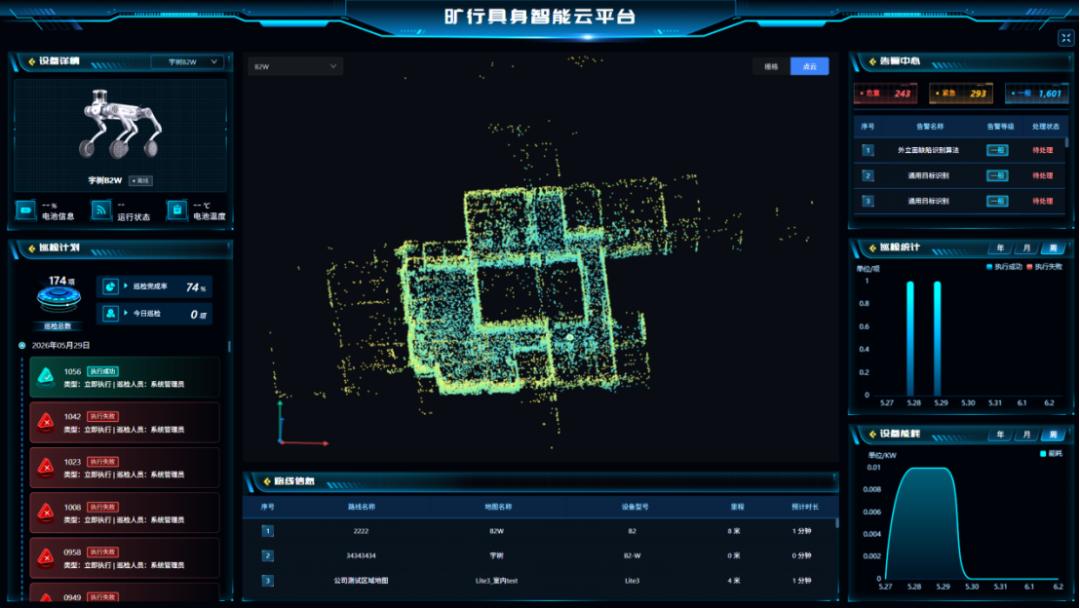
Engineering operation and maintenance digital twin platform with multi - robot control and intelligent agent analysis capabilities (Source: Company)
In terms of commercialization, the company has initially opened up the situation. In the year of its establishment, Kuangxing Technology signed contracts worth tens of millions of yuan with leading enterprises such as Jiangxi Copper, State Grid, and PowerChina. The products have been piloted in scenarios such as mines, tunnels, and power, replacing workers to complete high - risk operation and maintenance work.
Shu Jiangpeng calculated an account for Hard Kr: "Taking mines as an example, a high - risk operation roadway requires 4 workers to work in two shifts. With the equipment they carry, the annual comprehensive cost exceeds 1 million yuan. The cost of a quadruped robot product with upper - mounted equipment after mass production is in the hundreds of thousands, and the service life of the whole machine can reach 3 years. It not only has obvious cost advantages but also can avoid the risk of production suspension caused by safety accidents."
According to Shu Jiangpeng, currently Kuangxing Technology cannot cover all operations 100%. Half of the work still needs to be done manually. Their goal is to increase the coverage rate from 50% to over 90% through continuous data accumulation and algorithm iteration.
Kuangxing Technology has a clear plan for its future. "We aim to be the most knowledgeable 'brain' for engineering robots and use data and algorithms to solve the core problems of diagnosis and maintenance," Shu Jiangpeng told Hard Kr.
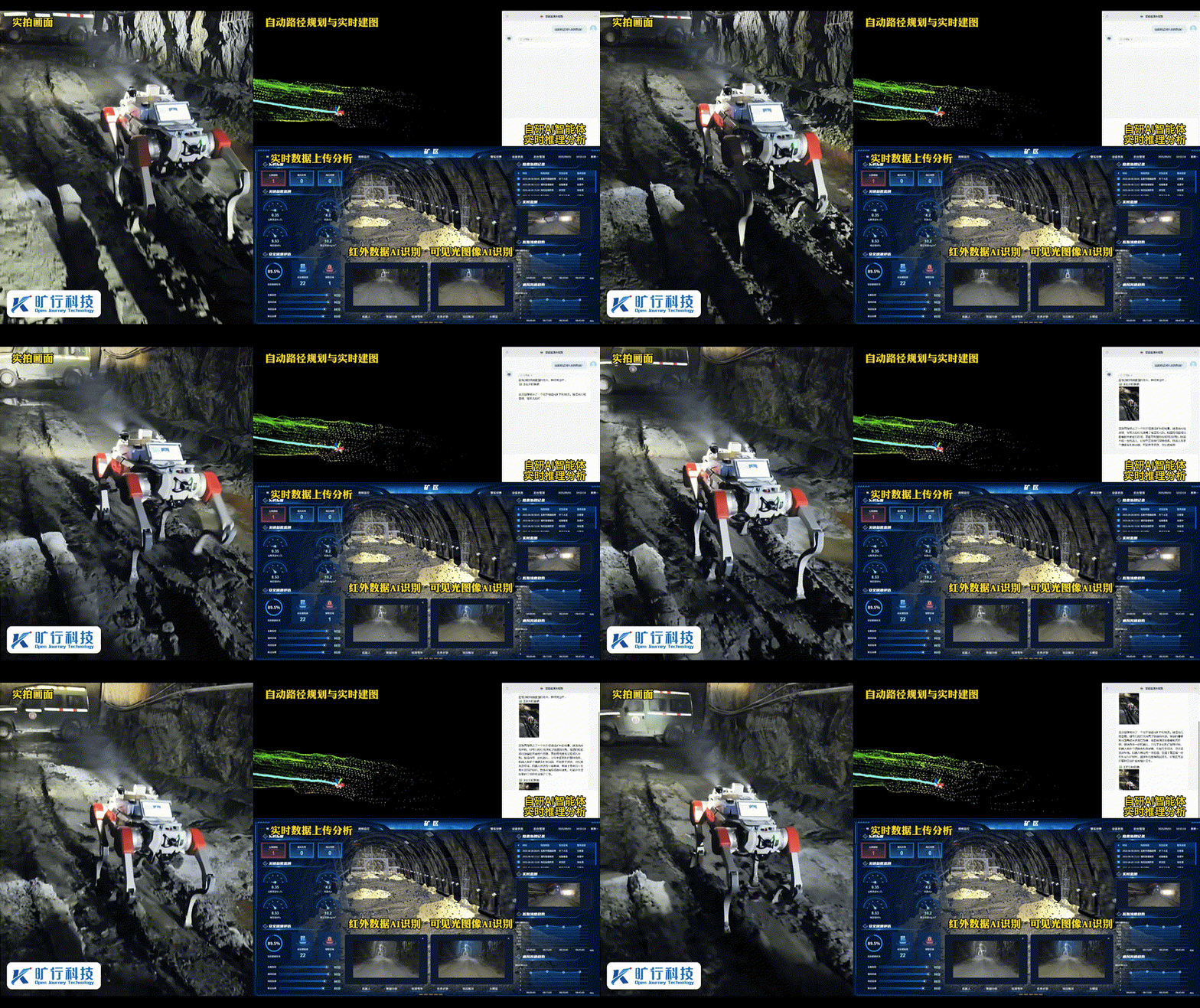
Under - mine operation and maintenance of quadruped robots: millimeter - level quantitative identification and diagnosis of the state of mine rock mass (Source: Company)
The following are the selected dialogues between Hard Kr and Shu Jiangpeng:
Hard Kr: Compared with other inspection robots in the market, where are Kuangxing's specific technological advantages?
Shu Jiangpeng: The core of our technology is high - precision quantitative and multi - modal identification. Most AI only does qualitative identification, such as "there is a crack here". We can identify how wide the crack is and its direction, accurate to the millimeter or even sub - millimeter level, which is crucial for engineering maintenance decision - making.
In addition, many defects are hidden inside the structure and cannot be detected visually. We have integrated technologies such as ultrasound, electromagnetic waves, and infrared rays, which can "see through" the voids inside the structure. Behind this is our team's more than 15 - year accumulation in the cross - field of infrastructure and AI. The number of our professionally annotated negative sample data is in the millions, while the industry generally only has a few thousand.
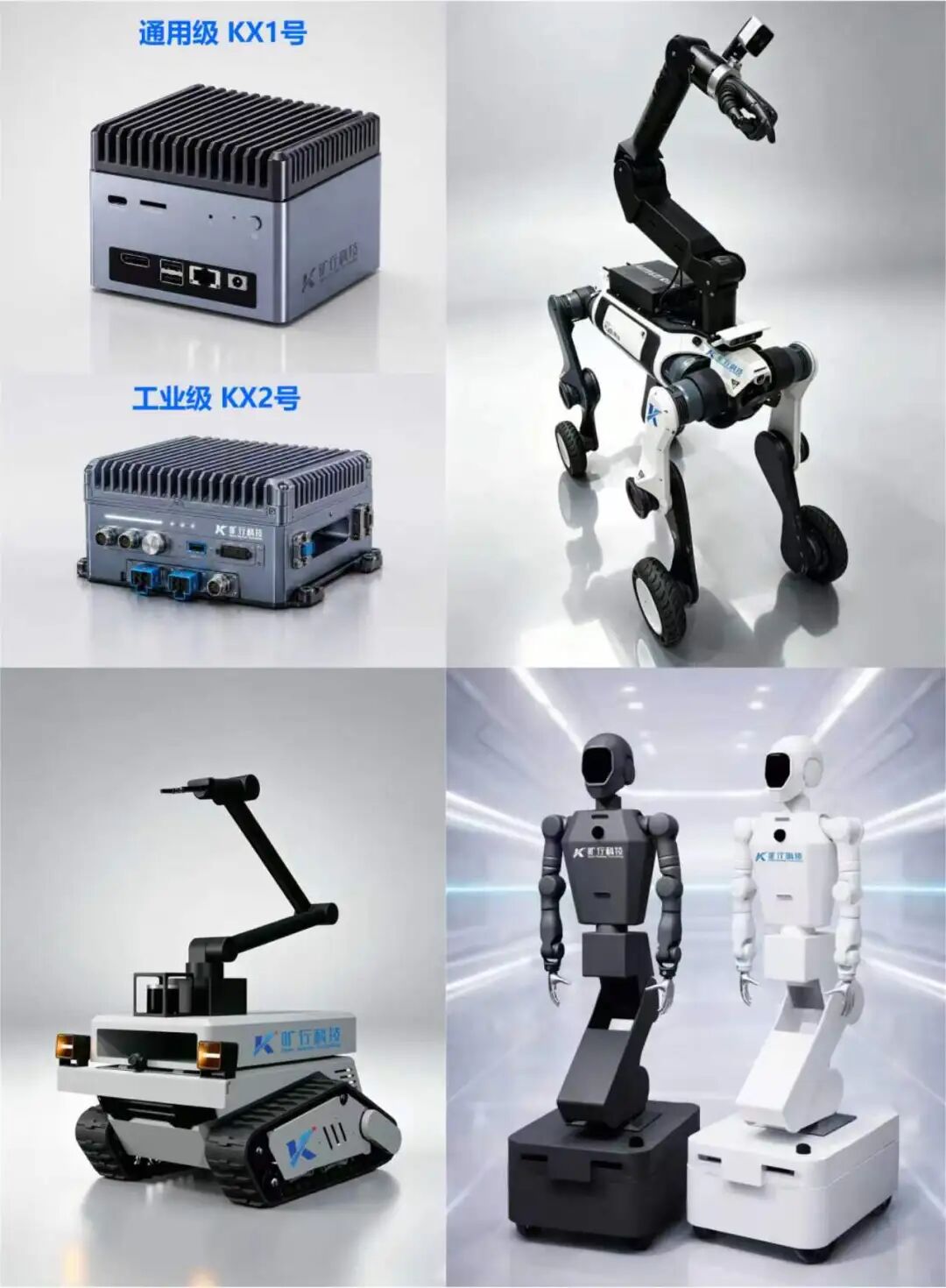
Kuangxing products: Engineering brain KX and a full set of embodied intelligence solutions (Source: Company)
Hard Kr: What is the biggest challenge the company currently faces in commercialization?
Shu Jiangpeng: The main challenges are the stability and comprehensiveness of the robots. It's not difficult to run the system in the laboratory, but in the underground mine, changes in network signals and slight adjustments to the roadway structure may make the machine "act stupid". Currently, we cannot cover all operation points 100%. For example, we can only handle half of the points, and the other half still needs manual work.
Our goal is to increase the coverage rate from 50% to over 90% through continuous data accumulation and algorithm iteration, so that customers can transition from "needing to take care of the machine" to "being able to sleep soundly at home". However, the trend is irreversible because young people are no longer willing to work in mines. If you don't use robots, there will be no one to do the work.
Hard Kr: In terms of future product planning, will the company develop humanoid robots? How do you view the debate between the quadruped and humanoid robot routes?
Shu Jiangpeng: In the short term, we will still focus on quadruped or related products. The reason is simple: reliability. The high - risk industrial engineering field does not allow for mistakes. If a robot falls, the loss will be significant. In complex terrains, the stability of quadruped robots far exceeds that of biped robots at present.
It may take three to five years for humanoid robots to achieve the reliability required for high - risk engineering scenarios. We will continue to pay attention, but the hardware of the robot body is not our focus. That is the battlefield of body manufacturers. Our positioning is clear - to be the most knowledgeable "brain" for engineering robots and use data and algorithms to solve the core problems of diagnosis and disposal.
Views from the investors:
Investor from SenseTime Guoxiang: In special industries, the problem of high - risk safety hazards is serious, and the logic of robots replacing humans is clear. Therefore, there is a large demand for operation and maintenance in the field of special robots, and the demand for human replacement continues to rise. We are optimistic about Kuangxing's robot system solutions that can perform inspection, detection, and even repair in multiple scenarios such as infrastructure, mines, transportation, water conservancy, energy, power, and chemical industries. Based on the multi - modal model and intelligent agents, it forms a hardware - software integrated operation and maintenance, inspection, and repair solution. The team has the technical background of Zhejiang University, Stanford, and Berkeley, and at the same time, it has well integrated a market - oriented team. It has effectively achieved the implementation of the solution. We look forward to the company becoming a leading enterprise in the special robot industry and reshaping the safety production model of traditional industries.
Investor from Caitong Capital: Caitong Capital has long been concerned about the next - generation robot track with the "hand - brain - eye" coordination ability. The most core difference of Kuangxing Technology is that it not only manufactures robot bodies but also uses the engineering multi - modal large model and decades of industry - annotated database as a moat, enabling inspection robots and drones to truly have the ability to "understand engineering defects and diagnose independently", which solves the industry pain point of traditional operation and maintenance robots of "strong inspection and weak detection".
The team has an academic gene from Zhejiang University - Stanford, has undertaken multiple national key research and development projects, and has completed the closed - loop from algorithm to order in real industrial scenarios. It has reached cooperation with leading customers such as Jiangxi Copper Group, and the commercialization verification has met expectations. As a provincial - level securities - affiliated investment institution based in Zhejiang, Caitong Capital will also provide comprehensive support through "capital + investment banking + industrial resources" to help Kuangxing Technology accelerate product iteration and market expansion, and jointly serve industrial safety and digitalization.