Shenzhen-based embodied AI company Stardust Intelligence completed a Series B financing round of over 1 billion yuan, with a valuation exceeding 10 billion yuan | First report by Yingke
Author | Huang Nan
Editor | Yuan Silai
Yingke learned that Astribot, a rope-driven AI robot company, recently completed a Series B financing round. The cumulative financing amount in three rounds within three months exceeded 1 billion yuan. The investors include Liangxi Science and Technology Innovation Industry Phase II Mother Fund (managed by Bohua Capital), Yangzhou Longtou Core Chip, Zhongbo Juli, Thundersoft, Kede Education, a leading listed company, and old shareholders such as Guoke Investment, who continued to increase their investments.
Currently, the valuation of Astribot has exceeded 10 billion yuan. It is also another embodied intelligence unicorn worth over 10 billion yuan born in Shenzhen. Previously, Tencent, Alibaba, and ByteDance-related institutions had already appeared among the company's investors.
In terms of commercialization, Astribot has also won several cooperation orders in industrial scenarios. These include a thousand-unit industrial and commercial service order with Thundersoft and the promotion of overseas expansion, as well as the co - construction of a 100 - million - yuan - level application innovation center with Jiangdu Economic Development Zone for implementation in the cultural tourism and hotel scenarios.
The competition logic in the embodied intelligence track is undergoing a fundamental change. The industry is moving away from the extensive competition that focuses on pre - set stage demonstrations and instead facing the complex implementation challenges in real physical environments. The technical routes have not yet converged. Based on different understandings of the implementation paths, various manufacturers have made differentiated explorations and trade - offs in dimensions such as transmission solutions, model architectures, and data strategies.
Astribot was founded in 2022. Its founder and CEO, Lai Jie, has more than 17 years of R & D and design experience in the fields of AI and robotics. He has led the R & D of several new types of robots and has served as the first employee and architect of Tencent's Robotics Laboratory and the team leader of Baidu's Xiaodu Robot.
At the early stage of entrepreneurship, Lai Jie clearly proposed "Design for AI" path, that is, first define the robot body that is suitable for the learning and evolution laws of large AI models, and then match the corresponding AI algorithms and operating systems around this body, enabling the robot to "think like a human and work like a human." Based on this concept, Astribot has built a full - stack self - developed system of "AI model - Embodied OS - Rope - driven body."
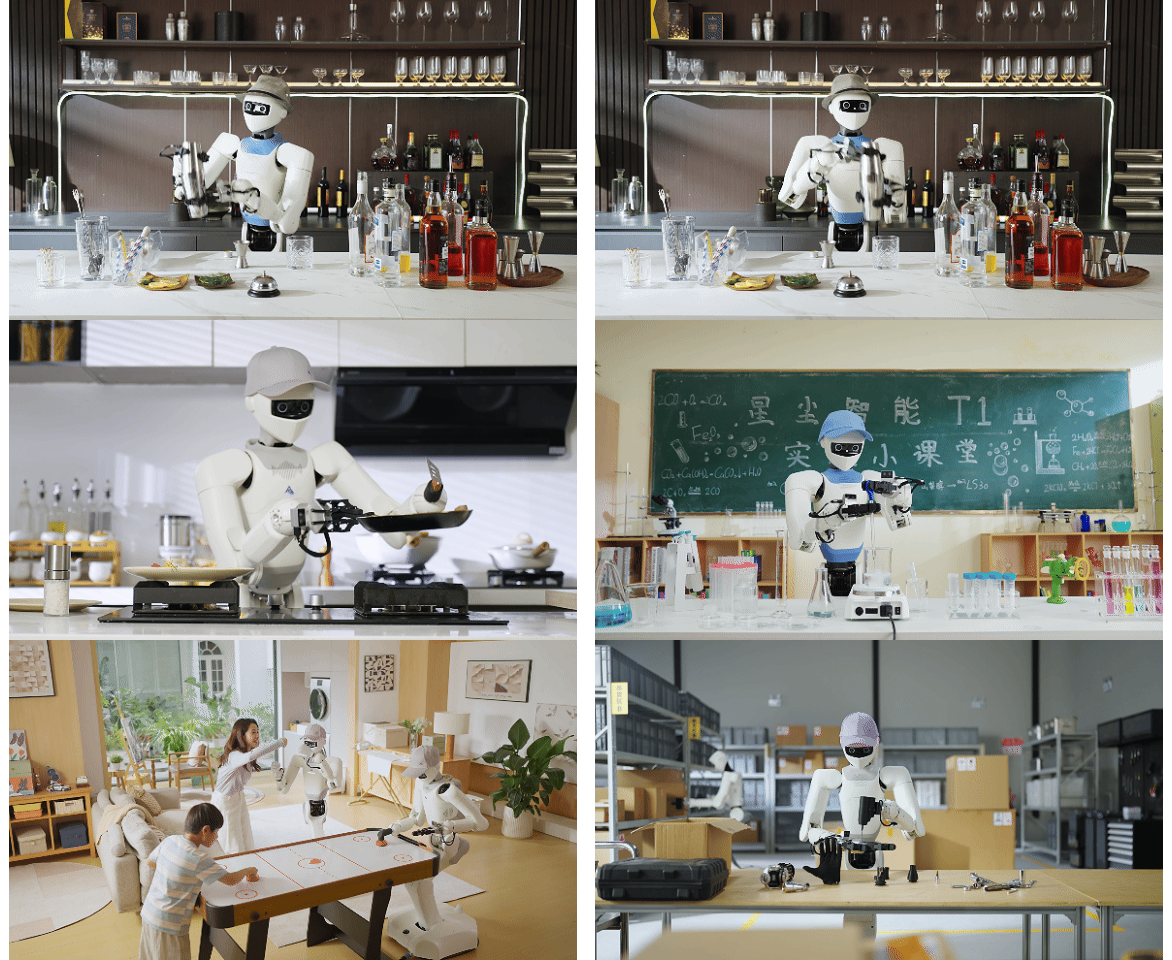
Astribot's new product T1 (Source/Enterprise)
How to make this robot think and act like a human? In this regard, Astribot has adopted a self - developed base model, relying on data efficiency rather than data scale to drive the improvement of capabilities.
Real physical tasks have a characteristic that is often overlooked for a long time: not all actions require in - depth reasoning. For example, in a home scenario, operations such as opening a microwave oven, picking up a toy, and handing over a tool rely more on rapid instinct - level responses. Long - range tasks such as "organizing the kitchen and cooking a meal" require the model to have the ability to break down steps, understand the environment, and handle exceptions. Different requirements correspond to different time scales and computing power consumption. Large models have strong reasoning ability but slow response, while end - to - end action models have fast response but lack planning ability.
Astribot's thinking is that instead of forcing a single model to cover all aspects, it is better to let different models perform their respective duties. At the underlying model end, Astribot has proposed an end - to - end whole - body VLA base model Lumo to undertake higher - dimensional general reasoning requirements.
As a global base large model, Lumo mainly solves tasks such as complex semantic understanding, abstract instruction decomposition, and generalization in unknown scenarios. The model training uses "pre - training + real - machine alignment." First, it learns the general task logic and step - decomposition ability through massive data to establish a basic cognitive system. Then, it uses high - quality multimodal data collected by the rope - driven real machine to complete real - machine fine - tuning alignment, connecting the action flow from the model's "thinking" to the robot's "actual operation."

Lumo - 1 performing long - sequence complex tasks (Source/Enterprise)
Relying on this training logic, Lumo can show stronger generalization ability in out - of - distribution scenarios such as unknown objects, unfamiliar environments, and vague and abstract instructions. Yingke learned that future iterative versions of Lumo will also incorporate the prediction ability of the world model to further enhance the robot's prediction and reasoning efficiency in dynamic environments.
At the commercial framework end, based on the human dual - system cognitive theory, Astribot has developed the first DuoCore fast - slow collaborative framework that can realize whole - body mobile operation, which is almost the same as the Helix architecture later released by the US company Figure.
This architecture splits the robot's intelligence into two independent and collaborative ability systems. The fast system focuses on instinct - level real - time response, responsible for millisecond - level posture fine - tuning, on - site obstacle avoidance, joint flexible buffering and other dynamic basic actions, adapting to environmental disturbances that appear at any time in real scenarios. The slow system focuses on cognitive - level in - depth planning, concentrating on long - time - sequence task decomposition, cross - space path planning, and global strategy generation, supporting whole - body collaborative operations such as bending, squatting, moving, and fine operations of both arms.
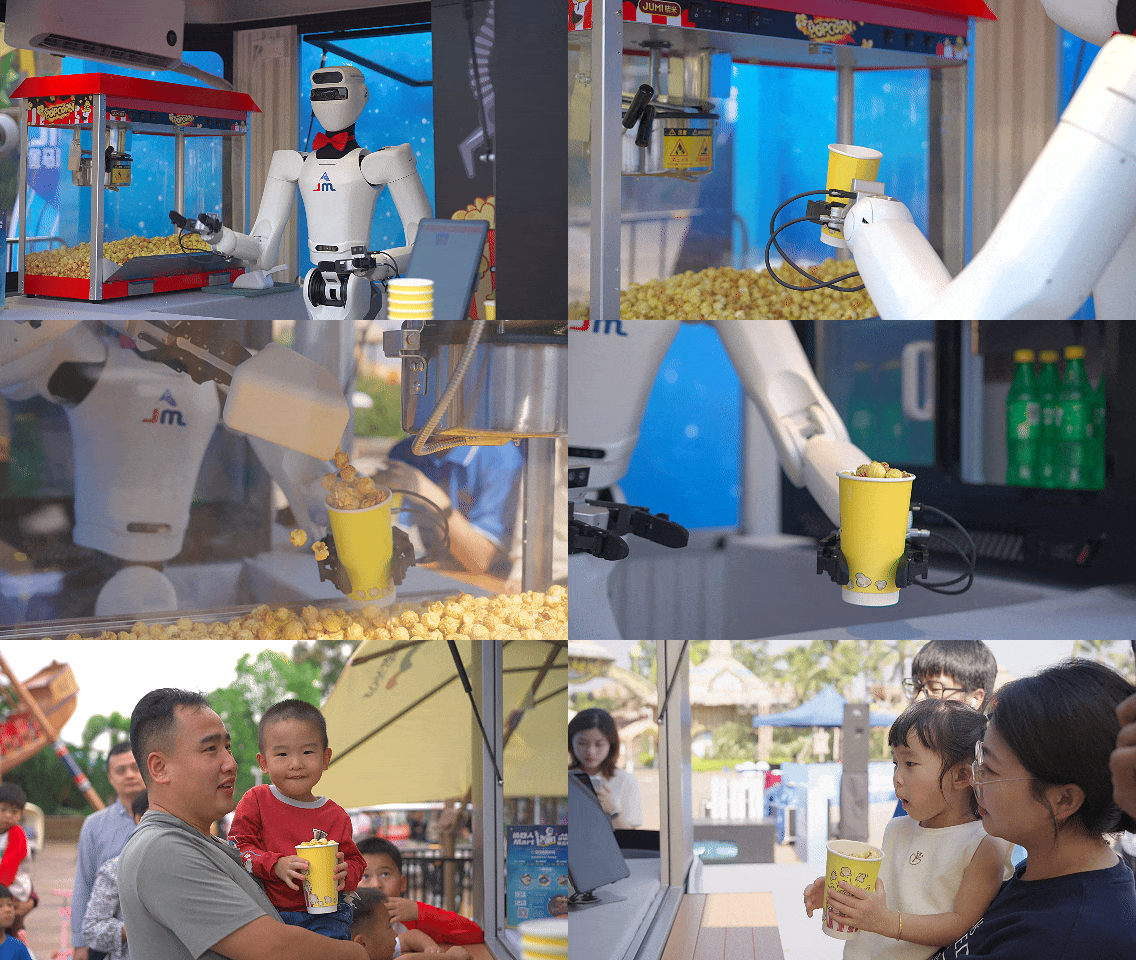
The retail application of Astribot's self - developed commercial model architecture DuoCore has been scaled up and implemented in six cities across the country (Source/Enterprise)
The two systems are uniformly scheduled and operate in linkage through the Embodied OS. As the slow system outputs the overall task plan and travel path, the fast system can correct the body posture in real - time to adapt to non - standard environmental changes. If a sudden risk is encountered, the fast system can independently trigger emergency avoidance and link with the slow system to update the task plan, realizing dynamic error correction.
Different from the traditional AI model of "feeding massive data and learning from scratch," the DuoCore framework relies on the bionic human skill transfer logic and can reuse existing experience in cross - scenario tasks, solving the implementation challenges of real - time operation, dynamic adaptation, and efficient learning of robots in real scenarios.
In terms of the transmission solution, Astribot is the world's first enterprise to achieve mass production of rope - driven AI robots. The rope - driven mechanism imitates the movement logic of human tendons. By placing the motor at the rear and using tendon ropes to control the joint flexion and extension, it forms a "rigid - flexible coupling" characteristic, which not only retains sufficient operational stiffness but also has the ability of flexible buffering and shock absorption.
Compared with the traditional rigid link structure, the rope - driven mechanism has higher effective load capacity, lower recoil and inertia, and a more compact body. This enables the robot to maintain high - dynamic operation and high anthropomorphic performance while ensuring the safety of close - range interaction, expanding the application imagination from commercial to household use.
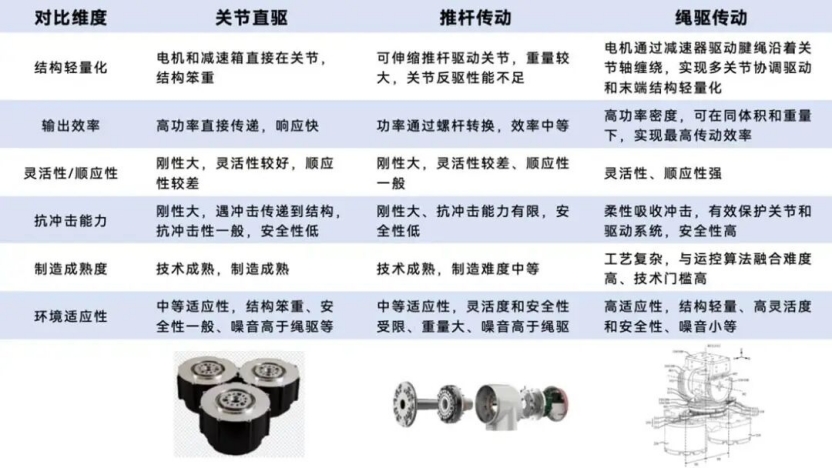
Comparison of different drive solutions (Source/Enterprise)
When the robot performs tasks, the rope - driven transmission has lower friction and more continuous movement. Compared with the traditional rigid mechanism, it reduces the backlash friction and mechanical noise, has less information loss, and can transmit high - quality real - time force - control data to AI more completely and intactly. This is the key data that large AI models rely on to learn the laws of real physical interaction.
Entering the productization stage, based on Astribot's unique modular design of the rope - driven structure, the embodied robot is split into independent modules such as arms, torso, and legs. If any part is damaged, the corresponding module can be replaced to quickly resume operation without returning the whole machine to the factory, reducing the customer's downtime cost and usage threshold. Its rope - driven body started the delivery of thousands of units at the end of 2025.
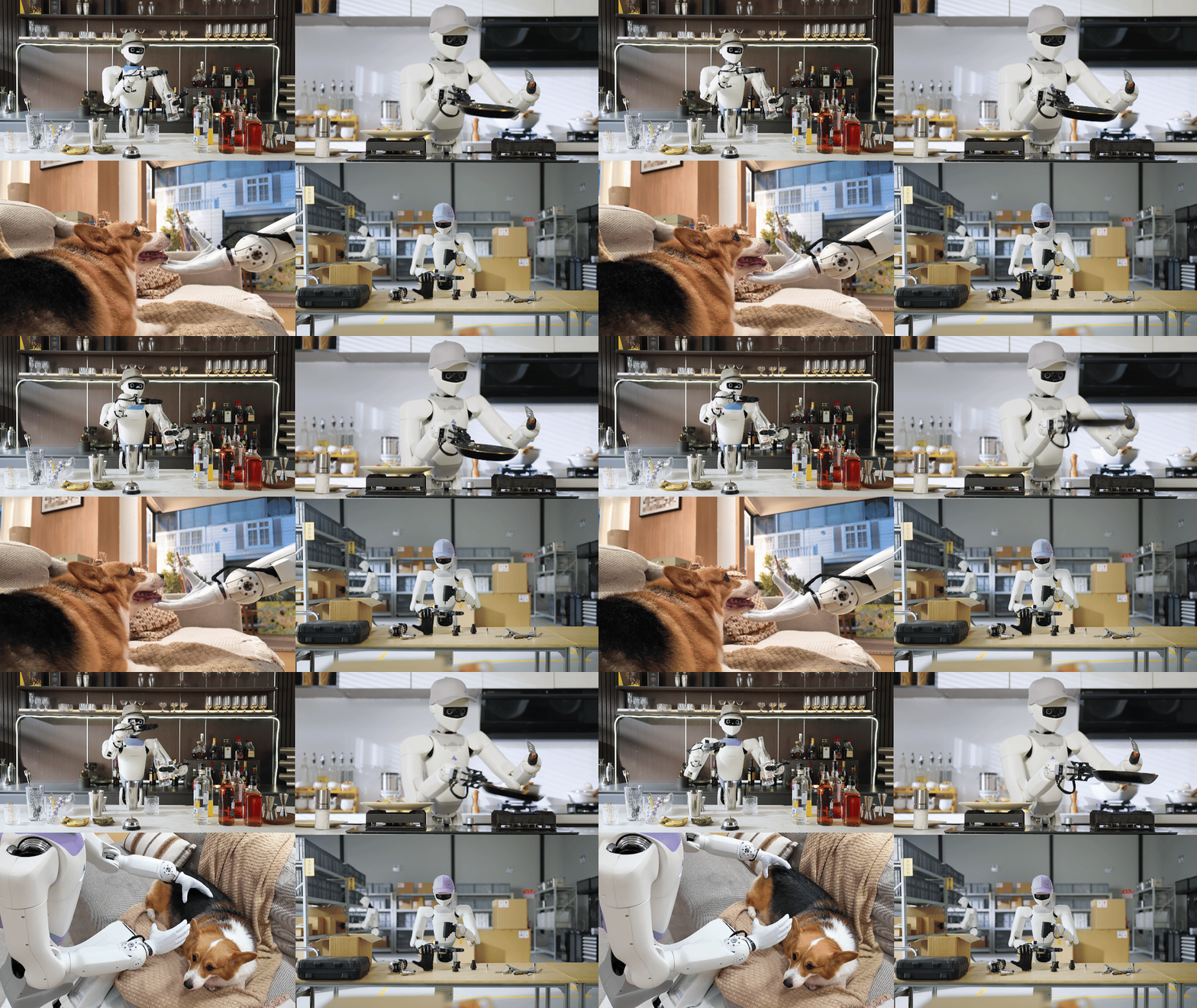
Astribot's new product T1, with a starting price of 89,900 yuan, promotes large - scale deployment with strong operation ability (Source/Enterprise)
Astribot is simultaneously promoting the implementation of multi - matrix products. The company recently released the T - series model T1, with a starting price of 89,900 yuan, which can complete continuous and fine operations such as frying steaks, doing laundry and storage, business bartending, chemical experiments, auto - parts sorting, and car charging.
Currently, Astribot has the ability to make batch deliveries in fields such as scientific research, commercial services, cultural and entertainment performances, and industry.