NVIDIA's salary details for various positions are exposed: The most expensive ones are not AI researchers, and many have a basic annual salary of 2 million yuan.
How much do NVIDIA employees really earn?
Salary sheets are sometimes more honest than job descriptions. Business Insider compiled a set of data based on NVIDIA's publicly available salary documents.
The annual salaries of NVIDIA software engineers, product managers, architecture directors, algorithm engineers and other positions, when converted into RMB, are in the millions.
Note that this is only the base salary, excluding stocks and bonuses.
Over the years, Jensen Huang has often mentioned the stability of NVIDIA employees.
He once said that NVIDIA's employee retention rate is outstanding globally, and some employees have been with him for over 30 years.
Fortune cited NVIDIA's latest sustainability report, stating that NVIDIA's overall turnover rate in fiscal year 2025 was only 2.5%. About one-fifth of employees have been with the company for at least 10 years, and about two-fifths have been there for over 5 years.
In an AI chip company with a fast pace, high pressure, and with Jensen Huang being well - known for his strict management, why do employees still want to stay?
Looking at this salary sheet, you can probably understand some of the reasons.

It's true that in the past, the most intense AI talent wars were at companies like OpenAI, Meta, Anthropic, and Google. People paid attention to who poached whose researchers, who offered sky - high salaries, and who took away an entire small team.
But talking about NVIDIA's salary sheet today isn't about boasting that Silicon Valley workers are making a fortune.
It's mainly to see, in today's increasingly fierce talent competition, what kind of people is Jensen Huang willing to pay high prices for.
The most expensive positions at NVIDIA aren't just in chip design
Let's first look at the most straightforward numbers.
According to the data compiled by Business Insider:
The maximum base salary for NVIDIA software engineers can reach $391,000.
For research scientists, it's up to $356,500.
Product managers can earn up to $379,500.
Hardware engineering managers can get up to $368,000.
Architecture directors can earn up to $488,750.
If converted into RMB, it's in the range of hundreds of thousands to millions.
But as I said before, this is just the obvious base salary.
NVIDIA is now one of the world's most valuable listed companies, with a market value of about $5.47 trillion.
For an AI company with a globally top - tier market value, stock and equity incentives are the really eye - catching parts.
Especially for a company like NVIDIA, whose stock price has been performing strongly for a long time. Once the stock incentives in employees' hands keep up with the company's market value growth, the profit curve may be much steeper than the base salary.
Exaggerating a bit, it's not an overstatement to say that NVIDIA employees' base salaries are just pocket money.
So the really interesting part of this salary sheet isn't just that "NVIDIA pays well".
It more tells the outside world what kind of people NVIDIA is most willing to pay high prices for today.
Breaking down the positions exposed in the salary sheet, we can roughly divide them into four categories -
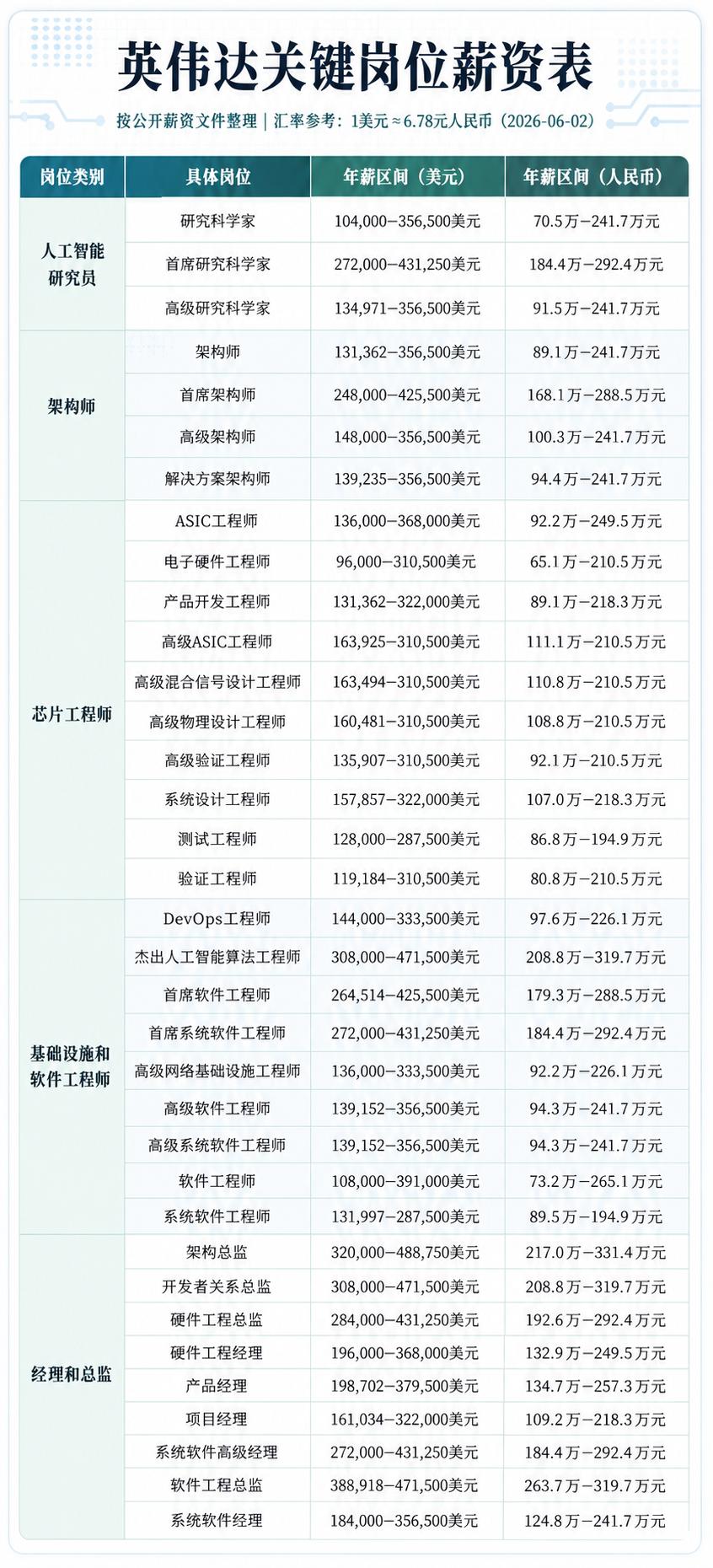
The first category is chip design positions.
NVIDIA is still a chip company, so positions such as ASIC engineers, physical design engineers, verification engineers, mixed - signal design engineers, and system design engineers, which are responsible for the semiconductor company's core business, are still in the high - salary range.
For example, ASIC engineers can earn up to $368,000 per year, which is about 2.5 million RMB per year.
In a chip company, it's normal for these positions to be highly paid.
But what's interesting about this salary sheet is that the high - salary list doesn't stop at chip design.
The second category is system software positions.
Software engineers, system software engineers, chief software engineers, and chief system software engineers are all in the high - salary echelon.
Among them, the annual salary ceiling for ordinary software engineers is $391,000, chief software engineers can earn up to $425,500 per year, and chief system software engineers can even reach $431,250 per year.
After all, it's NVIDIA's own system software system that has pushed the company from a simple hardware manufacturer to today's industry platform giant step by step.

The third category is AI algorithm and R & D positions.
The salaries are also quite high.
Research scientists can earn up to $356,500 per year, chief research scientists can reach $431,250 per year, and top - notch senior AI algorithm engineers can even reach $471,500 per year.
I believe everyone can feel that today's AI chips are no longer just hardware competing in computing power.
Current model architecture iterations, training method innovations, and various requirements of inference scenarios all force the design of the next - generation chips and the entire system.
Therefore, algorithm and R & D positions are naturally highly valued.
The fourth category is customer ecosystem and deployment positions.
This includes positions such as product managers, solution architects, developer relations directors, and project managers.
Among them, product managers can earn up to $379,500 per year, solution architects can earn up to $356,500 per year, and developer relations directors can earn up to $471,500 per year.
Now NVIDIA is facing cloud providers, AI labs, sovereign AI projects, enterprise customers, and various vertical industries.
Customers need not only computing power but also deployable, maintainable, and scalable AI infrastructure solutions.
Product managers need to define the system form, solution architects need to integrate the NVIDIA system into customers' businesses, and the developer relations team needs to enable developers to continuously build applications and tools around the NVIDIA ecosystem.
These are all quite important.
Stop thinking of NVIDIA as just a "GPU seller"
Then the question arises.
Why does NVIDIA need so many different types of high - salary positions?
In the past, when people talked about NVIDIA, the first thing that came to mind was GPUs - that's their core business.
And nowadays, AI large - model training requires GPUs. Cloud providers are buying GPUs like crazy, and the first thing startups do after getting financing is to grab GPUs.
But today's NVIDIA can no longer be simply summarized as "the company that sells GPUs".

GPUs are like the key to open the market, and there is a whole set of AI computing ecosystem behind them.
To build a functioning AI data center, there are many things to consider.
Not only do you need hardware such as GPUs and CPUs, but also high - speed networks, servers, and storage devices are essential. The underlying drivers, CUDA system, various communication libraries, compilation tools, inference frameworks, cluster scheduling systems, plus daily monitoring and maintenance, project deployment, and after - sales support services...
All need to be in place.
NVIDIA has turned AI computing into a deliverable infrastructure, which is what makes it more valuable today.
In this AI factory, chips provide computing power, the network determines the cluster scale, system software determines resource utilization efficiency, the algorithm team understands future loads, and the product and solution teams are responsible for delivering the whole package to real customers.
The competition in AI infrastructure is no longer a single - point hardware performance competition, so every link mentioned above is crucial and cannot be neglected.
NVIDIA has long stepped out of the role of a simple hardware seller and has become a real general contractor in the AI industry ecosystem.
Which positions a company is willing to invest heavily in directly reveals its current core development track.
It's not hard to understand why system software engineers, architects, and product - related positions can get top - level base salaries at NVIDIA.
We can also clearly see from the layout of high - salary positions that today's NVIDIA is more like an AI infrastructure service provider than a traditional semiconductor company.
One More Thing
An interesting detail is that NVIDIA's proxy statement for fiscal year 2026 shows that Jensen Huang's base salary is $1.5 million.
Compared with the previous year, this figure has been slightly increased by about $11,000.
Looking back one more year, the proxy statement for fiscal year 2025 shows that Jensen Huang received a base salary increase for the first time in 10 years, an increase of $500,000 compared with fiscal year 2024.
NVIDIA explained in the document that this adjustment was made to align with the salary levels of peer CEOs and to consider internal salary fairness.
As for the equity that Jensen Huang holds, that's another story (you know what I mean.jpg)
Reference links:
[1]https://www.businessinsider.com/nvidia-salaries-revealed-how-much-engineers-researchers-make-in-2026-2026-6
[2]https://www.sec.gov/Archives/edgar/data/1045810/000104581025000095/nvda-20250512.htm
This article is from the WeChat official account "Quantum Bit". The author focuses on cutting - edge technology. 36Kr is authorized to publish it.