Among Beijing, Shanghai, Guangzhou, and Shenzhen, which is the top city for inbound tourism in China?
As China vigorously develops inbound tourism, which city among Beijing, Shanghai, Guangzhou, and Shenzhen is the top gateway for inbound tourism? In this issue, Zhiku Cultural and Tourism uses data to conduct a detailed analysis.
The four major first-tier cities of Beijing, Shanghai, Guangzhou, and Shenzhen each have their own advantages in inbound tourism. Beijing's advantage lies in being the political, diplomatic, and cultural center. The Forbidden City, the Temple of Heaven, and the Great Wall are all cultural and tourism symbols representing China. For many foreigners, visiting Beijing means having been to China.
Shanghai is China's international trade center, as well as its financial and shipping center. Foreign companies coming to China tend to set up their Chinese headquarters in Shanghai. With numerous bonded areas and free trade zones, Shanghai has become the core hub for China's opening up to the outside world.
Relying on the developed manufacturing industry in the Pearl River Delta, Guangzhou attracts a large number of overseas merchants to purchase goods. The famous Canton Fair is hailed as the barometer of China's foreign trade, attracting hundreds of thousands of overseas buyers to Guangzhou every year.
Shenzhen is a special economic zone and also China's largest city for import and export trade. In 2025, its import and export volume exceeded that of Shanghai and Guangzhou. The passenger flow at Shenzhen's border inspection is legendary. The inbound and outbound passenger flow (including that from Hong Kong, Macao, and Taiwan) of this single city accounts for 39% of the total inbound and outbound passenger flow in China in 2025.
Which of these four cities is the top city for inbound tourism in China? Zhiku Cultural and Tourism consulted the statistical data from the statistics bureaus, cultural and tourism bureaus, and border inspection ports of the four cities. Excluding compatriots from Hong Kong, Macao, and Taiwan and basing on the data of pure foreign tourists, the following conclusions were drawn.
Shanghai Leads by a Wide Margin
From January to April 2026, Shanghai received 2.61 million foreign tourists, leading by a wide margin among the four cities, with a year-on-year growth of 30.5%, which is also a high growth rate. Undoubtedly, Shanghai is the top gateway for inbound tourism in China.
It should be noted that the Shanghai Statistics Bureau clearly explains that the "foreign tourists" here refer to foreigners who come to Shanghai for sightseeing, visits, travel, family reunions, visiting friends, recuperation, inspections, attending meetings, or engaging in economic, scientific, technological, cultural, educational, sports, religious, and other activities, excluding foreign experts, students, etc. who have lived in Shanghai for more than one year.
This is not purely tourist data. However, it is difficult to separately count strict tourism data, and similar "big tourism" statistical calibers are also adopted internationally. The same is true for domestic tourism statistics.
The high data in Shanghai is mainly because major foreign companies like to cluster in Shanghai, which drives various foreigners to come to Shanghai for business, conferences, and daily life. For example, in the hotel industry, the Chinese headquarters of international hotel chains such as Marriott, Hilton, InterContinental, and Hyatt are all located in Shanghai without exception, which inevitably brings frequent cross - border personnel exchanges.
According to the data released by the Guangzhou Statistics Bureau, from January to April, Guangzhou received 1.98 million foreign tourists, ranking second among Beijing, Shanghai, Guangzhou, and Shenzhen, with a year-on-year growth of 13.3%. The high foreign passenger flow in Guangzhou is largely due to the large number of overseas buyers gathered here. China is the world's factory, and the Pearl River Delta is the core base of the world's factory. Many distribution centers for furniture, household appliances, daily necessities, clothing, shoes and hats, and electronic products are concentrated here, giving rise to a huge international procurement chain and increasing the foreign passenger flow.
Beijing and Shenzhen Soar by 40%
According to the data released by the Beijing Municipal Bureau of Culture and Tourism, from January to April, Beijing received 1.68 million foreign tourists, ranking third. Its statistical caliber is basically the same as that of Shanghai and Guangzhou, excluding diplomats, students, international journalists, and their accompanying family members. Although the foreign passenger flow in Beijing is less than that in Shanghai and Guangzhou, its growth rate is faster, with a year-on-year growth of 40.3% from January to April.
Although the foreign passenger flow in Beijing is only 64% of that in Shanghai, if we compare the pure tourist flow, Beijing is likely to have the highest. This is mainly because Beijing is a symbol of Chinese culture, with a profound historical heritage, and is a genuine cultural and tourism brand internationally.
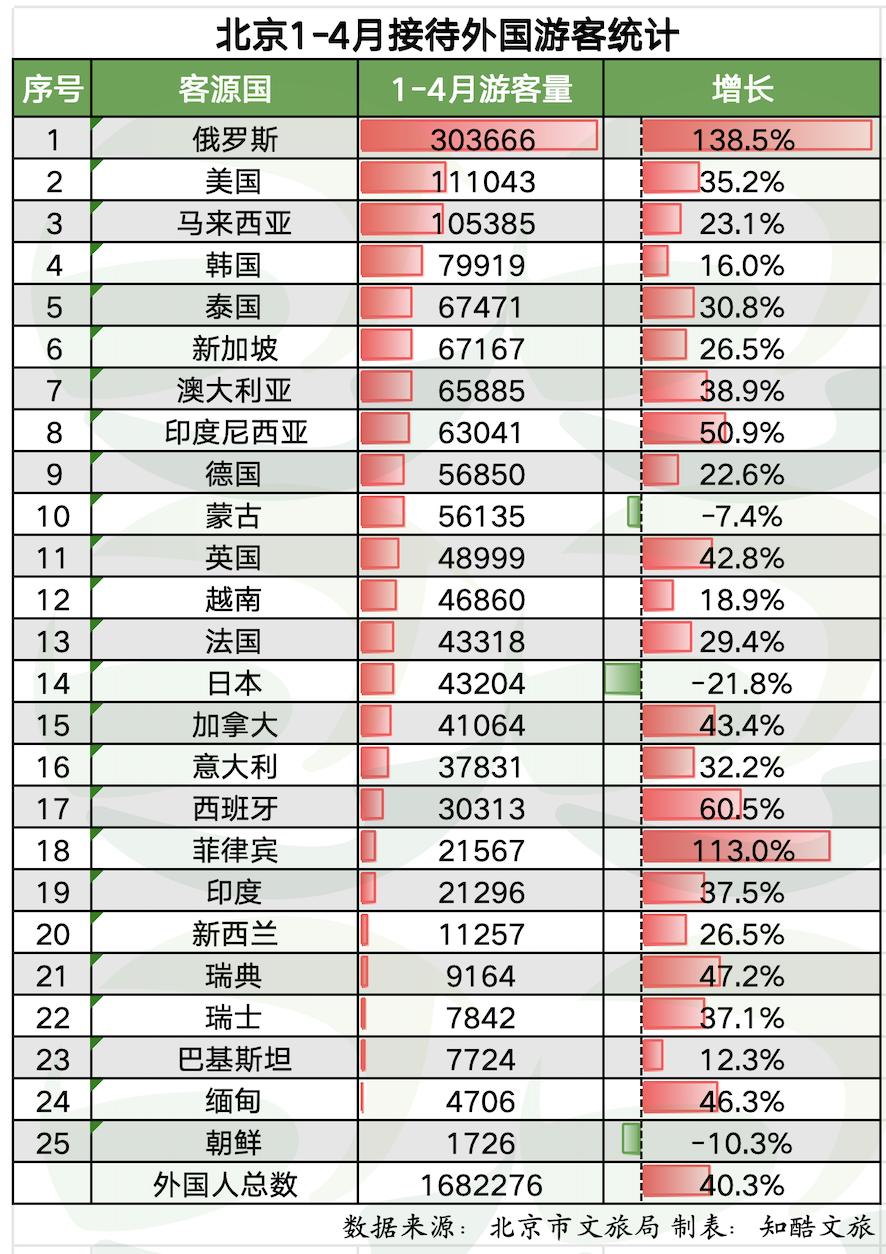
Among the foreign tourists in Beijing from January to April, Russians are the most numerous, reaching 304,000, with a year-on-year increase of 138.5%; Americans are 111,000, with a year-on-year increase of 35.2%; Malaysians are 105,000, with a year-on-year increase of 23.1%. It is worth noting that the number of Japanese tourists to Beijing has decreased by 21.8%, dropping out of the top ten on the list, even less than that of countries like Germany and France, which are far from China. This shows that the political relations between China and Japan have greatly affected the cultural and tourism exchanges between the two countries.
Except for a few countries such as Japan and Mongolia, the number of tourists from other major countries to Beijing has generally increased by double - digits, which reflects that China's tourism attractiveness is indeed increasing.
Shenzhen has not released the data for January to April, only the data for the first quarter. There are two data calibers. One is the data from the border inspection ports. In the first quarter of 2026, the ports in Shenzhen inspected 2.02 million inbound and outbound foreigners, with a year-on-year increase of 31.3%. Calculated by one entry and one exit, about 1.01 million foreigners entered China via Shenzhen in the first quarter. This data does not include the data of foreigners who entered China through other cities and then came to Shenzhen.
Another data in Shenzhen is the number of foreign overnight visitors. Since foreigners need to register online when staying in China, each major city has data on the accommodation of foreign tourists in the local area, which is also one of the statistical bases for the data of Shanghai, Guangzhou, and Beijing mentioned above. In the first quarter of 2026, the number of foreign overnight visitors in Shenzhen was 476,000, with a year-on-year increase of 41.5%.
The port data is 1.01 million, while the overnight data is only 476,000, which shows that many foreigners did not stay in Shenzhen but only used it as a transportation transfer point.
Why is Shenzhen the city with the largest import and export trade in China, but the number of foreign tourists is less than a fraction of that in Shanghai and Guangzhou? Does this go against the law of "business driving tourism"?
Actually, it does not. The main reason is that Shenzhen's trade structure is very different from that of Shanghai and Guangzhou. Although Shenzhen has a large volume of imports and exports, it is mainly the exchange of goods and customs declarations, focusing on logistics. Shanghai and Guangzhou are the business centers of many foreign companies in China, with frequent personnel exchanges. For example, Shanghai has 1,084 regional headquarters of multinational companies and 647 foreign - funded R & D centers, while Shenzhen has only 207 recognized regional headquarters of multinational companies, only one - fifth of that in Shanghai.
In addition, Shenzhen is not regarded as a tourist city in the eyes of foreigners. If you want to see Chinese history and culture, go to Beijing. If you want to see an internationalized China and Shanghai - style culture, go to Shanghai. There is also Hong Kong near Shenzhen. If foreigners want to experience a fashionable city and do tourism shopping, they will go to Hong Kong. Some iconic scenic spots in Shenzhen, such as seaside beaches, Window of the World, and Happy Valley, mainly serve domestic tourists and do not match the tourism preferences of international tourists.
However, Shenzhen's advantage is that it is a city of innovation. Many public buildings are full of a sense of the future. For example, the new Shenzhen Science and Technology Museum, the Shenzhen International Art Museum, the Bay - Area Eye Book City, and the new Shenzhen Cultural Center are all impressive cultural and architectural landmarks. There is also the world's largest indoor ski resort, Qianhai Ice and Snow World, and China's largest outdoor water theater, Happy Theater, which are all high - cost and scarce cultural and tourism experience projects. These scenes full of a sense of technology and the future will make Shenzhen China's Dubai and Abu Dhabi, attracting international tourists with fashion and innovation.
Overall, from January to April, Shanghai received 2.61 million foreign tourists, with a year - on - year growth of 30.5%; Guangzhou received 1.98 million, with a year - on - year growth of 13.3%; Beijing received 1.68 million, with a year - on - year growth of 40.3%; and in the first quarter, Shenzhen had 476,000 foreign overnight visitors, with a year - on - year growth of 41.5%.
This article is from the WeChat official account "Zhiku Cultural and Tourism", written by Zhiku Jun, and is published by 36Kr with authorization.