Selling Bougainvillea to Tibet: Small merchants in Kuaishou e-commerce and their slow-paced business
Among the Kuaishou followers of Yang Zhihua, there is a loyal customer who has placed more than 7,000 orders in total.
Calculated at two plants per order, he has bought more than ten thousand bougainvillea plants from Yang Zhihua. The average order value is more than ten yuan, and there may be four or five hundred varieties. He buys one plant at a time and makes repeat purchases year after year.
Yang Zhihua is a native of Yunnan and the owner of the Kuaishou merchant "Lili Bougainvillea Plantation". Seven or eight years ago, this enterprise was still a traditional nursery that provided greening project seedlings for real estate companies. Now, its annual sales on Kuaishou exceed tens of millions, making it the highest on the entire platform. Among them, users from the north account for 70% - 80%. In those cities that are covered in white in winter, a pot of bougainvillea costing more than ten yuan is an excellent ornament for home decoration.
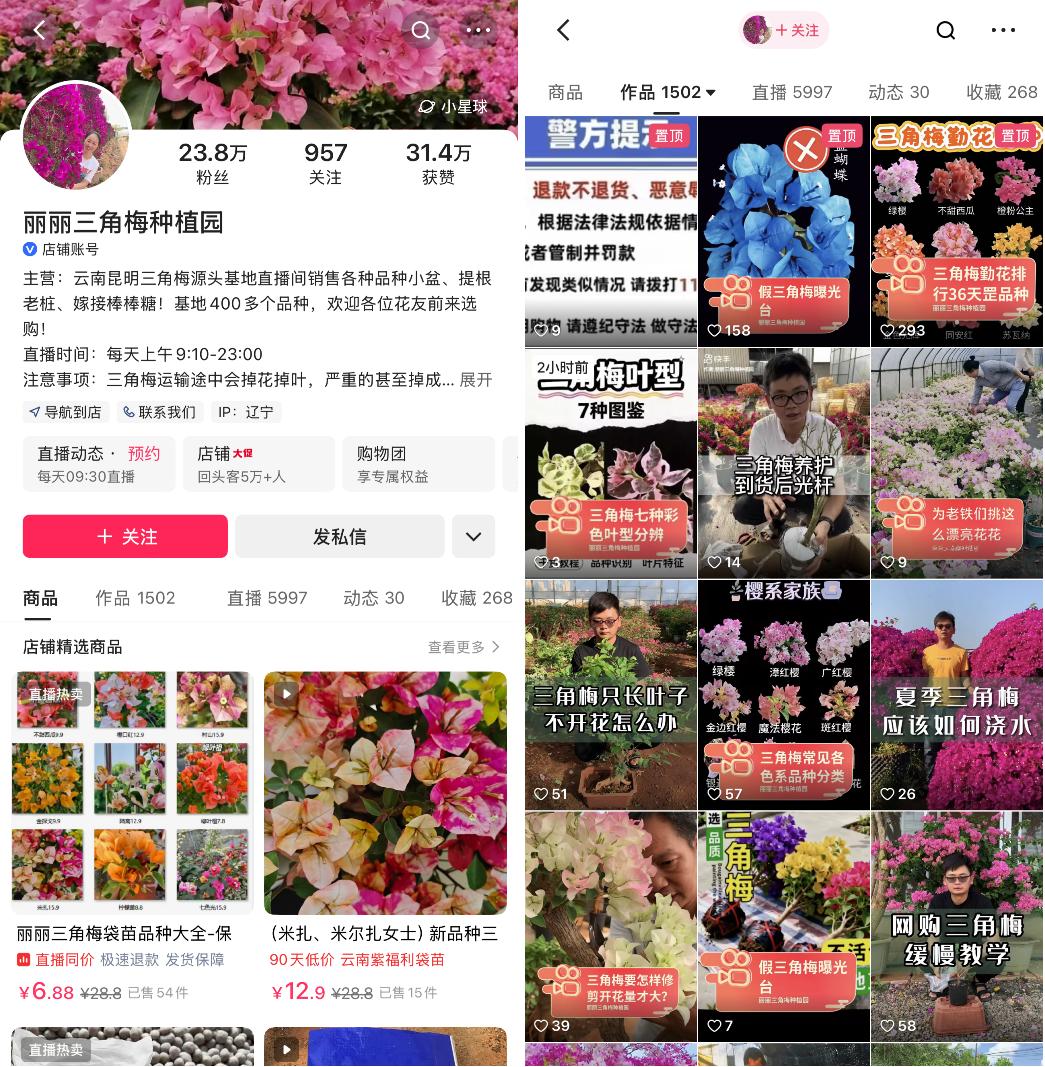
This is not a story of a "traffic miracle". Among the small and medium - sized merchants on Kuaishou e - commerce, similar growth is quietly happening in different fields, just at different speeds.
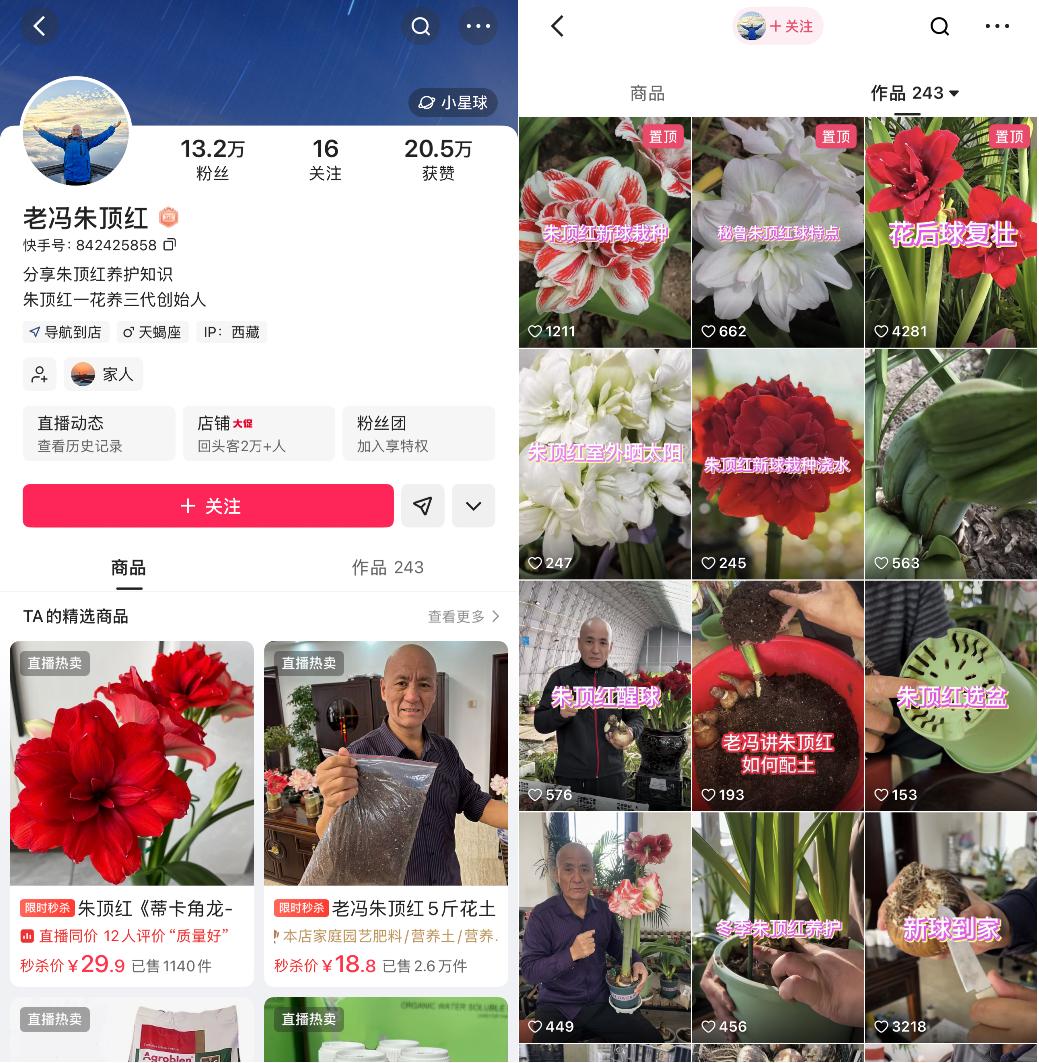
A retired man from Northeast China shares his daily flower - growing experiences in a greenhouse and sells imported amaryllis bulbs, achieving monthly sales of more than 500,000 yuan during the peak season. A couple from Hubei who came to Yunnan has achieved monthly sales of 300,000 yuan on Kuaishou by selling succulents. A young man who has been in the business of Xiangyunsha for many years has accumulated a group of loyal customers on Kuaishou who "only wear Xiangyunsha", and thus started a business layout across the whole network.
Their common features are: they are small in scale, have small teams, and even they themselves are not native Internet users, but they have all found a sustainable growth method based on trust relationships on Kuaishou e - commerce.
In the current situation where e - commerce, especially live - streaming e - commerce, has entered the stage of stock competition, these "small but resilient" merchant samples may answer a question that the industry is concerned about: Do small and medium - sized merchants still have real growth space on leading platforms?
Good businesses with different backgrounds have the same starting point
When Yang Zhihua recalled the time around 2017 when he decided to do e - commerce, the voices around him were very consistent. His family members clearly opposed it and finally reluctantly agreed to "invest a little less and give it a try". His regular business friends were more straightforward, saying, "You must be crazy. You have too much money."
What made him determined were two real - world problems. Previously, the company's main business was greening project seedlings, but the payment collection was extremely slow. "Every day, we sold a lot of seedlings and trees, but every Spring Festival was like a nightmare. We were always on the way to collect debts." At the same time, his other business of running a physical clothing store was also being eroded by e - commerce. Customers would come to the store to try on styles and choose colors, and then place orders online. "We became a large - scale fitting room."
The start of the transformation was extremely difficult. They first opened a Taobao store, but couldn't increase the sales volume. Later, when Kuaishou live - streaming became popular, the team decided to give it a try, but the first hurdle was that no one was willing to appear on camera. Yang Zhihua had to set a rule that those who didn't appear on camera would be fined. His wife, Lili, was pushed to the front of the camera as the anchor, and he himself served as the photographer.
One can imagine the state of the early live - streaming. They would speak standard scripts, but suddenly switch to the local dialect in the middle. Sometimes, the anchor would say "I'm not going to broadcast anymore" and end the live - stream. "Indeed, this process was quite difficult as everyone had no experience with this new thing."
The turning point lies in the product category. Bougainvillea is everywhere in Yunnan, but for users in the north, it is a novel species that "can still bloom in the cold winter". The team focuses on releasing planting videos from October to April every year. This sense of contrast has become the best content hook. Users have flocked in from Shandong, Hebei, Liaoning and other places, and even as far as Gansu and Ningxia.
Yang Zhihua told a story that impressed him the most. A cadre who was sent to support Tibet from Chengdu built a three - layer plastic greenhouse and installed heating in Ali, Tibet, at an altitude of more than 4,000 meters just to grow bougainvillea. The flowers were sent from Yunnan and took more than a month to arrive. On the day the flowers bloomed, all the herdsmen in the village came to see. "Because they had never seen such a thing before."
"In the past, when we did offline business, our business circle was only around Yunnan, Guizhou and Sichuan, within a range of five or six hundred kilometers. Now, with a Kuaishou store, even people in Tibet are buying my bougainvillea." Now, among his peers, some of those who laughed at him for being "crazy" before have cut down the trees in their nurseries for firewood, and some have had to change careers. While he has accumulated hundreds of thousands of followers on Kuaishou, a team of more than 40 people, and a group of loyal users who have made flower - growing a lifestyle.
This is not an isolated case. Xiao Feng from Liaoning used to do food e - commerce but didn't succeed and stopped. In 2024, his father retired and started posting flower - growing videos and doing live - streaming on Kuaishou in his spare time. "He was bored every afternoon, so he would start a live - stream to see if anyone would chat with him."
At first, there were only five or six people in the live - stream room. But Old Feng's amiable Northeast character and practical knowledge of flower maintenance attracted more and more viewers, and at the peak, there were thousands of people online. When the number of followers reached 30,000 - 40,000, Xiao Feng realized the opportunity. He helped his father plan short videos, "which were all segments with millions of views", and at the same time, he attended exhibitions to contact importers from the Netherlands and South Africa to solve the problem of the supply of goods. They officially started selling in April 2024, and now the monthly sales during the peak season exceed 500,000 yuan.
Li Jun of Tangdou Succulents took a different path. In 2020, she came to Yunnan from Hubei and learned to do the online business of succulents from her sister. At that time, succulents were still a niche category, but when consumers saw the colorful succulents in the videos, "they were very beautiful and very healing", and the conversion rate of those who were attracted and placed orders was quite good.
In 2024, Li Jun and her husband opened their own Kuaishou account, and the platform provided traffic support at the initial stage. Now, the monthly sales during the peak season exceed 300,000 yuan. They do live - streaming for 6 - 8 hours a day, almost without a break throughout the year. Their followers are mainly from the three northeastern provinces, with an age range from 30 to 60 years old, and the repeat purchase rate of old customers is very high. "If they are satisfied with one order, they will make repeat purchases of other varieties."
Her husband is in charge of product selection and shipping, and she appears on camera for live - streaming. A couple from other provinces who have settled in Yunnan have built their own small business on Kuaishou through a niche category.
The essence of Kuaishou e - commerce: The trust - based business model of small and medium - sized merchants
The repeat - purchase data of Lili Bougainvillea is amazing: apart from the extreme case of the customer with 7,000 orders, the cumulative order volume of a large number of old customers is also in the hundreds or thousands. With an average order value of more than ten yuan and hundreds of varieties, users try a new variety each time, and over time, it becomes a considerable figure. "A long - term business cannot be based on deception."
The biggest trust problem in the flower e - commerce industry is the loss during transportation. Sending flowers from Yunnan to the Northeast, across most of China, the packages take three or four days on the way, and it is almost inevitable that the leaves and flowers will fall off when they are received. Lili Bougainvillea's response is a "guarantee of survival" commitment. If the plant dies within 30 days, they will directly re - send the plant or refund the money. "This is not just an empty promise. We actually do it, so we have accumulated some old customers. After the word - of - mouth is good, they will also promote us."
The confidence to fulfill this promise lies in the quality control of their own base. They control the entire process from planting, pruning, fertilizing to packing and shipping.
Even the customer service staff grew from the followers. A flower enthusiast named Xiao Li from Yichang, Hubei, was initially just a flower - buying customer. Because of his professional knowledge of flower - growing, he was invited by Yang Zhihua to be a customer service staff. Xiao Li serves other flower enthusiasts from the perspective of a flower enthusiast, "which makes him more empathetic and persuasive". He has been in this position for seven or eight years and has become a core member of the team.
Old Feng's way of building trust in the amaryllis business is different. Xiao Feng insists on only selling imported flower bulbs and never touches domestic bulbs. "I have bought and sold domestic bulbs before, but later I didn't want to do it anymore." Imported bulbs have a mature grading standard and high - quality certainty. As a result, there are very few after - sales issues in their store. Xiao Feng summarizes the core method of his business in two words: sincerity.
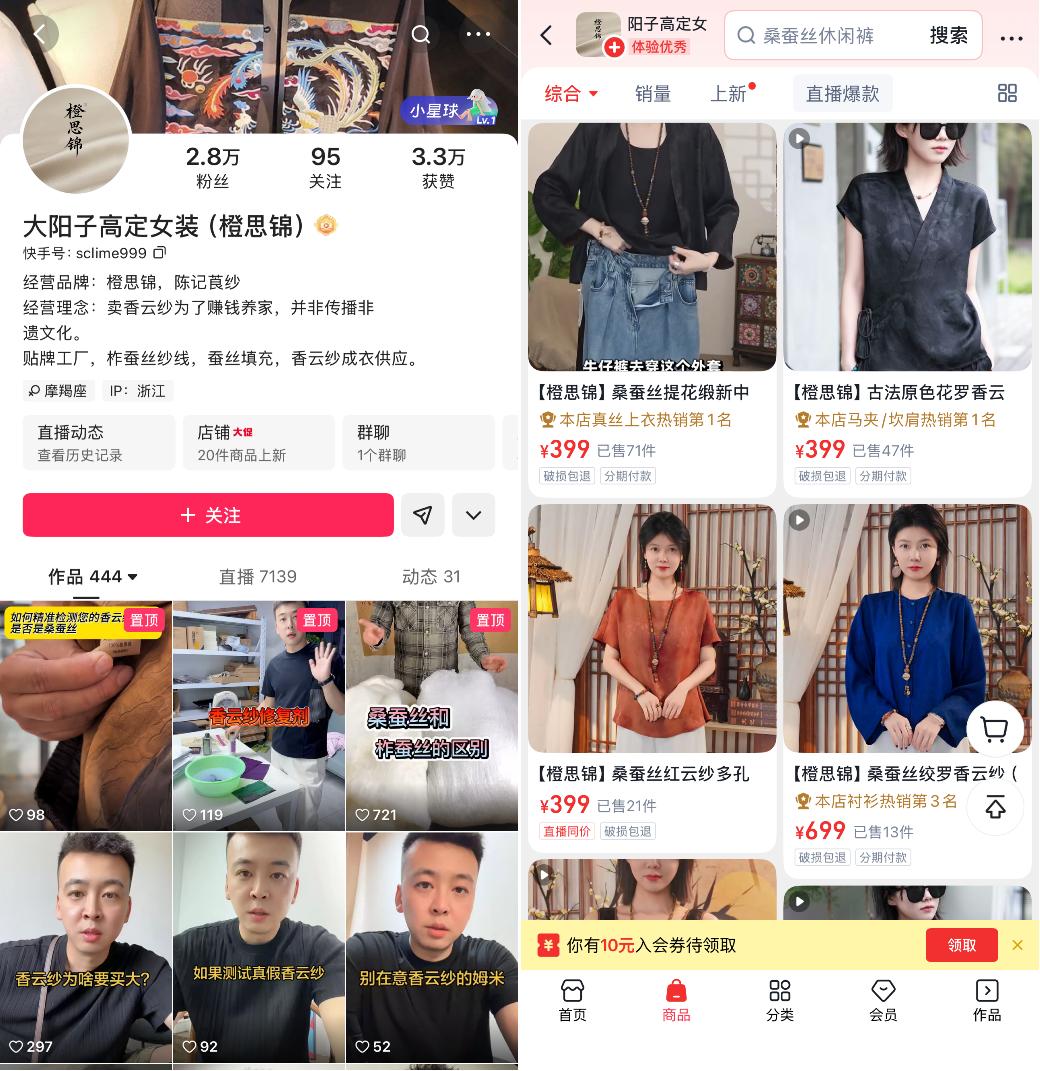
Different from the flower merchants who "cross the river by feeling the stones", Dayangzi, the founder of Cheng Sijin, entered the market with complete experience. He entered the industry at the age of 19 and did live - streaming e - commerce in a traditional Chinese - style clothing factory. He started his independent business at the end of 2022.
His confidence comes from the old fans he has accumulated over seven or eight years. Now, almost whatever styles he launches, these old fans will buy. This kind of trust relationship similar to that of a "community store" has become his most important asset during the cold - start period.
Of course, there were also setbacks. In the winter at the beginning, it was the off - season. Dayangzi tried to break the situation by using the inventory clearance goods first, but almost lost many old customers. He remembers it clearly. The buyers who came for the low - price goods were not the same group as the high - end customer group he had accumulated before. "When you talk about the value of the style and the craftsmanship, they don't understand. They only care about whether it looks good and whether it is cheap." The low - price strategy not only failed to increase the sales volume but also made the old customers who recognized the quality think that "your products are not good anymore", and they started to lose trust and leave.
He quickly corrected his mistake. On the basis of using good materials, he chose to pay twice the processing fee in the market to maintain the quality. "If you do it better and better, naturally someone will recognize it." Since then, his positioning has never wavered. He only uses mulberry silk and Xiangyunsha and only follows the high - end route.
Win repeat purchases with quality and replace advertising investment with repeat purchases. The effect is directly reflected in the data. The actual delivery rate of Dayangzi's store is more than four times that of his peers, which is also top - notch in the high - end women's clothing industry where the average order value is often several hundred or thousands of yuan.
The user profiles of these cases highly overlap. They are mainly from the north, mostly middle - aged and elderly people, and women account for 60% - 70%. The background data of Lili Bougainvillea shows that the regions with the most followers are Shandong, Hebei, Liaoning, Tianjin, Beijing and other places in turn. Among Dayangzi's Kuaishou followers, those over 50 years old account for 80%. "The vast majority are highly educated women who love life very much."
Service for this group requires extra patience. When Lili Bougainvillea trains the anchors and customer service staff, there are special requirements. Middle - aged and elderly users may not express themselves clearly and have different levels of understanding. Sometimes, when you tell users in the live - stream room to contact the customer service, they may not be able to find the entrance. "Only when the customer service takes the initiative to contact them can they be reached."
These seemingly "troublesome" service details actually form a competitive barrier. The age structure of the Kuaishou user group provides a natural soil for categories that require patience, professional knowledge and long - term trust.
The role and value of the platform: Changing the profit model of merchants
Chasing traffic is not the only solution.
For flower merchants, the most headache is not traffic but the product return rate. Fresh flowers and green plants are living commodities, and the loss during long - distance transportation is almost inevitable. However, the negative reviews and refunds resulting from this will increase the product return rate, which is directly related to the store rating and the traffic distribution of the live - stream room.
Yang Zhihua's operation partner recalled that previously, the product return rate and negative review rate were too high, which once triggered the platform's assessment mechanism, and they faced fines and a decrease in traffic. The team continuously communicated with the platform's customer service staff, reported the refund and negative review data every day, and looked for solutions.
Finally, Kuaishou e - commerce launched the "Good after - sales service exemption from product return rate assessment" mechanism. According to this policy, if merchants take the initiative to provide after - sales service higher than the platform standard, such as the "30 - day guarantee of replacement or refund if the plant dies" that Lili Bougainvillea has been doing, the corresponding orders can be exempted from the product return rate assessment. Yang Zhihua said that after this policy was implemented, "the after - sales service is easier to handle, and the overall live - stream traffic is also relatively stable."
The core value of this mechanism is that it does not avoid the particularity of the flower industry, such as the life cycle of commodities and the natural loss during transportation. It responds positively to this particularity, so that merchants who are willing to provide good service will no longer be unfairly punished in the assessment due to industry characteristics. For small and medium - sized merchants, this is not just an icing - on - the - cake support but a solution to a real survival problem.
And the platform's actions continue. The "Special Support Program for New Farmers" recently launched by Kuaishou e - commerce is aimed at an earlier stage, that is, how to let a person who has never done e - commerce take the first step.
This support program covers several key pain points in the process of new merchants' start - up:
If they don't know how to shoot videos, the platform provides AI intelligent tools. They can generate short product - promotion videos by uploading daily materials of orchards and flower greenhouses;
If they don't have initial traffic, by posting short videos with product links in real - life scenarios and adding topic tags, they can get up to tens of thousands of cold - start traffic for a single video;
The non - standard characteristic of "one - by - one shooting for each pot"