Linear Capital has a conversation with HUANG Xiaohuang of Qunhe Technology: After 15 years of entrepreneurship, he still retains the spirit of a young pioneer.
"One Line Apart" is a deep - conversation video podcast produced by Linear Capital. The guest of the first episode is Huang Xiaohuang, the co - founder and chairman of Qunhe Technology.
Fifteen years ago, Huang Xiaohuang, along with his classmates Chen Hang and Zhu Hao, returned to China from Silicon Valley to start a business. Wang Huai, the founder of Linear Capital, personally made the first angel investment in Qunhe. After the official establishment of Linear Capital, it continued to increase its investment in multiple rounds, writing a long story of trust, growth, and mutual achievement.
Today, Qunhe Technology (00068.HK) officially listed on the Hong Kong Stock Exchange as the "first stock in spatial intelligence". However, in this video podcast, you can see more of the young man who has been in business for fifteen years, experienced all kinds of hardships, but still believes that "he can make a greater impact on the world".
Today, Qunhe Technology (00068.HK) listed on the Hong Kong Stock Exchange as the "first stock in spatial intelligence". Its opening price was 171.65% higher than the issue price, and it also became "the first company among the 'Six Little Dragons of Hangzhou' to open the door to the international capital market".
Looking back to the origin, Wang Huai (Harry), the founder of Linear Capital, was the earliest angel investor in Qunhe - not only providing the first capital but also introducing key institutional investors. After the establishment of Linear Capital, it continued to increase its investment in subsequent rounds.
From acquaintance to companionship, seventeen years have passed, and thirteen years of accompanying the company's growth. This is a long story of trust, growth, and mutual achievement.
On the eve of the listing, Harry specially invited Huang Xiaohuang, the founder of Qunhe Technology, back to the Linear Capital office to record the first episode of the "One Line Apart" video podcast. From evening to late at night, during the more than four - hour conversation, they started from their first encounter at the Zhejiang University Silicon Valley Alumni Association, talked about the directions that were not understood, the wrong paths they took, and also the pleasant surprises when the situation took a turn for the better and the moments when they found the right rhythm again.
As the interview was coming to an end, what we saw was still the young man who has been in business for fifteen years, experienced all kinds of hardships, but still believes that "he can make a greater impact on the world".
Part 01 The First Money
500,000 and the Despised NVIDIA
▍Wang Huai: Let's first talk about the story of the first round of financing. Actually, I just learned from some recent reports that you were stood up the day before you returned to China. How did you feel at that time?
Huang Xiaohuang: Having the price cut in half at the last moment was definitely frustrating, but when I think about it after a long time, it seems quite normal, and I can understand it.
▍Wang Huai: You once told me a joke. At that time, when you said you worked at NVIDIA, people said "your work experience is not good".
Huang Xiaohuang: When I was raising funds, several VCs told me, "Oh, this company doesn't seem to be doing well, and you've only worked there for a short time." After hearing that, I quickly changed my resume to say that I had worked in Silicon Valley without mentioning the company. An investment manager from a well - known fund even asked me, "You have a good undergraduate and postgraduate background. Why did you go to work at NVIDIA?"
▍Wang Huai: It's really amazing. No one would have thought that NVIDIA would become one of the largest companies in the world more than a decade later. If you had held onto your stocks at that time, you would have been a legend. But I'm thinking, is it possible that Kujiale today is like NVIDIA 15 years ago? I personally still look forward to that day.
Huang Xiaohuang: I used to regard it as a stain on my resume. But I had no choice because most investors thought so at that time.
▍Wang Huai: We first met at an event of the Zhejiang University Silicon Valley Alumni Association. But I really didn't expect that this would be the opportunity to meet you and invest in you. Qunhe was the only one among the 20 early - stage projects I invested in as an individual angel investor in those two years that made me money.
▍Huang Xiaohuang: The only one? The success rate is so low!
▍Wang Huai: Haha, there's nothing I can do. Maybe my ability was really limited at that time. But only by going through such a process can you understand the essence of the VC game and then find ways to increase the hit rate. I only invested 500,000 yuan in the first round of Qunhe. I remember Chen Hang asked if I could invest 1 million yuan, but I refused in the end. Do you know why?
▍Huang Xiaohuang: I kind of forgot. I remember that after Chen Hang asked if you could invest 1 million yuan and was rejected, he was in a bad mood for a long time.
▍Wang Huai: Actually, there are mainly two reasons. One, as you know, I was cooperating with two other people at that time. We would invest collectively if everyone agreed; if not, I would invest personally. The second reason is that I had lost money in many projects at that time, and I was mentally prepared that angel investment was like doing charity. But I really liked the Geek style in you guys, so I invested.
But looking back, if I had followed your idea, I could have doubled my earnings, right? But later I thought it was all about fate. What's meant to be will be. Everything is for the best. Rejecting his request for 1 million yuan back then might make me feel bad now, but at least I earned half of what Chen Hang wanted me to earn.
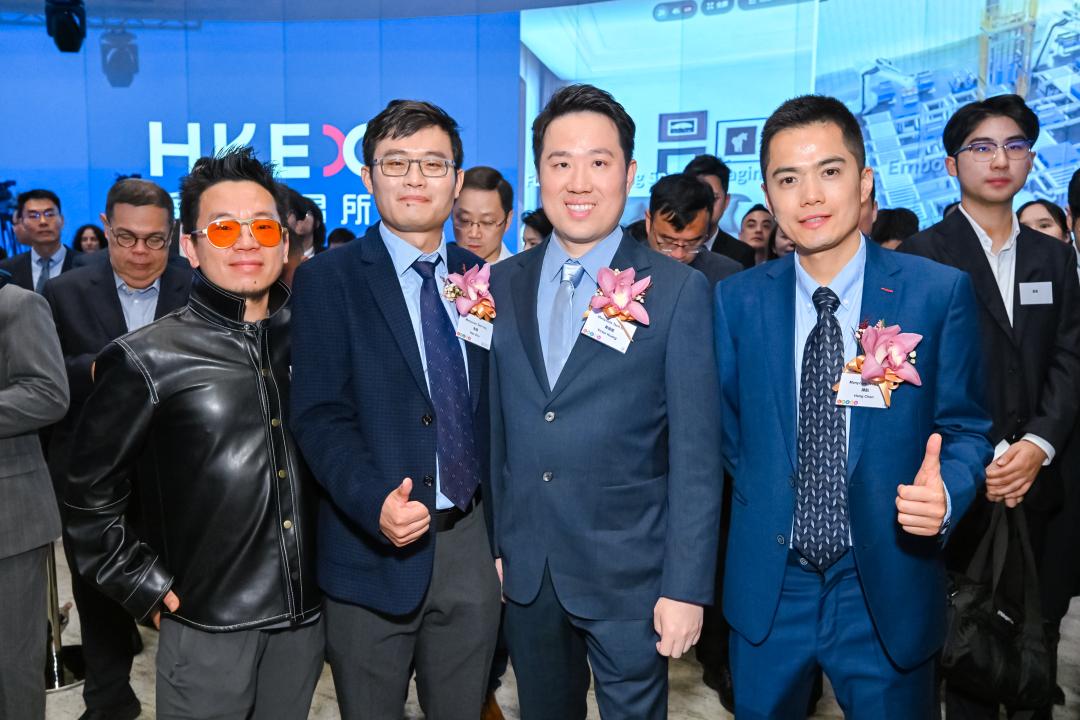
Harry, Zhu Hao, Huang Xiaohuang, and Chen Hang at the listing ceremony
Those Who Don't Understand You but Insist on Teaching You How to Start a Business
▍Wang Huai: Your company didn't have many financing rounds. Which rounds were easy, and which were particularly difficult?
▍Huang Xiaohuang: The first round was the most difficult, and the subsequent rounds were relatively easy. Looking back, our team's resume becomes more and more valuable as time goes by. Moreover, our business has been growing steadily, and our management style has been very stable. We can anticipate and make adjustments in advance before a crisis occurs or the era undergoes great changes.
▍Wang Huai: Yes, it seems very stable, but you can always seize the structural opportunities brought by technological changes.
▍Huang Xiaohuang: This is also what we emphasize internally, going with the trend.
▍Wang Huai: Looking back, are there any rounds that you think you shouldn't have raised?
▍Huang Xiaohuang: Bad investors have a very negative impact on operations. For example, they will suppress you in everything you do to achieve their own goals.
Based on my experience with many investors, a good investor is someone who, when you have an idea, will constantly introduce you to similar projects and practitioners in the market for communication; or even if they don't agree, they trust your character, don't cause trouble for the company, and support you when needed.
But the worst investors not only don't agree but also try to impose their ideas on you. To some extent, the methodologies and systems of investors are mostly experiences summarized from the capital market and may be lagging behind.
▍Wang Huai: So, to understand the new world, you need a new language system and a new concept system to understand the operating rules of this new world.
▍Huang Xiaohuang: But I don't think everyone can understand you. If you don't understand, don't be a nuisance, right? We are probably quite lucky. Many of my friends encountered such investors at a very early stage, and they had to start all over again.
▍Wang Huai: How do you get through this? What if a core investor always opposes you, especially on some key decisions?
▍Huang Xiaohuang: Just play it by ear. Just like running a business, there will always be a turning point in the long run.
Making a Conclusion after Listening for 5 Minutes Is a Kind of Arrogance
▍Wang Huai: What kind of investors have really helped you a lot?
▍Huang Xiaohuang: I think most of the investors I've met are quite good. As I said before, my various ideas are definitely a mix of reliable and unreliable ones, and I will adjust them myself. But I definitely don't want you to tell me it's unreliable after only listening for 5 minutes. I spent at least a few months researching a thing before I decided to do it.
▍Wang Huai: Making a conclusion after listening to you for 5 minutes is actually a kind of arrogance.
▍Huang Xiaohuang: Actually, investors have access to more information rather than experience. A lot of information is very crucial and helpful to me. Especially for some things we want to do, if other companies have tried and failed, and he introduces that person to me for a chat, I'll immediately realize it's not feasible.
▍Wang Huai: So, investors need to have vision, connection ability, and be willing to introduce, right? Whether you can absorb it is a matter of ability.
Do you remember one thing? You wanted me to be on your board back then, but I refused. Looking back, I don't regret it because at that time, my cognitive boundary was to be a pure angel investor. When you need me, just give me a call, and I'll show up and help if I can. If not, just leave me alone.
▍Huang Xiaohuang: What I really regret is that we raised too much money in 2020 and 2021, didn't achieve much, and then the era changed greatly.
▍Wang Huai: Yes, this is also an inevitable lesson. Were there any moments when the pressure was so great that you wanted to cry?
▍Huang Xiaohuang: Not often. I'm a rational person. I'll be anxious but won't cry. For example, in our first year of business, we were rejected countless times. Maybe the investment environment was just bad at that time. Then, in 2013, when our product made some progress, investors suddenly came to us, and they were even fighting over the shares.
Another example is that for a while, when our company had only about 1,000 people, a giant poached 500 of our employees. It felt like we were in the main track of the giant. But as you know, every time we were in a painful situation, there would always be a turn for the better. After experiencing many ups and downs, we've learned to meet the challenges head - on.
Part 02 Transformation and Re - transformation
Transformation Can Only Be a Top - Down Project
▍Wang Huai: How would you describe the game of starting a business?
▍Huang Xiaohuang: First of all, our ultimate goal has not been achieved yet. When we started the business, we definitely wanted to make a big impact on the world. In the process, we found that the goal kept getting bigger. But I found that as long as you survive, you will always have new opportunities. The spotlight on companies in the era keeps changing, but the stage doesn't always belong to a few companies. So, in starting a business, you have to always stay at the forefront of the era, support yourself, and make timely adjustments.
▍Wang Huai: You should have developed a methodology for transformation.
▍Huang Xiaohuang: Every time we transform, I have to be personally responsible for reorganizing the team, which is like starting a brand - new company. The old business is handed over to the current partners or other senior executives to ensure that the new business can be upgraded without interference.
▍Wang Huai: But where does the initial idea for each transformation come from?
▍Huang Xiaohuang: You have to keep learning. Actually, everyone knows the direction of the era's development. The difficult part is what kind of product you want to make. For most companies, it's often difficult to do new things because of the old things holding them back. The adjustment of a company is a systematic process.
So, in several transformations, the underlying technology of our company has not changed much. The underlying technology has a cycle of decades, but the application layer above changes very quickly. The most core problem in transformation may not be organizational processes and the like, but that to start a new thing, you need new people and to burn money.
▍Wang Huai: So, you look for new people instead of forming a team within the company?
▍Huang Xiaohuang: We look for people both inside and outside the company. But we can't move the entire existing team over. Among those who have been with you in the business for many years, some are suitable for the new direction, and some are not.
We've made a lot of mistakes in the past. We let the old employees who were just okay start working on the new thing, and it might end up in a mess. They are not malicious, but their ability has its limits.
So, it's best for us co - founders to take the lead and focus on the new thing. Many companies may recruit a VP or other senior executives from outside to handle the transformation, but the pressure on them is too great, and there are also many internal contradictions. For example, if some old employees want to join your new project and you don't agree, won't you offend them?
▍Wang Huai: So, it can only be you guys who step up.
▍Huang Xiaohuang: Transformation must be a top - down project.
▍Wang Huai: Were there any moments when the three of you argued and said this couldn't be done like this?
▍Huang Xiaohuang: There were arguments in the early days of the business, but now we basically don't argue. We are like a rational "old couple". We discuss issues objectively. Everyone makes mistakes, and the person in charge makes the decision and takes the responsibility.
Discussions among People with Different Backgrounds May Lead to Mediocrity
▍Wang Huai: Let's talk about you three brothers. You've been together for 15 years since starting the business. There should be very few such teams.
▍Huang Xiaohuang: We knew each other in school. We worked on projects together and didn't feel like we were being dominated by others at work.
▍Wang Huai: Many entrepreneurs get along well as classmates, but when they work together as co - founders and face pressure, some problems in ability or personality are exposed. Did you have such moments?
▍Huang Xiaohuang: I think it's probably because we are all mild - tempered and never show off.