Joining the "Tsinghua circle", Jensen Huang can't let go of China
Whether it's you or me, we all care about one question: Will AI make us lose our jobs?
However, as a driving force in the entire AI era, Jensen Huang, who has just entered the "Tsinghua circle," refuted the claim that "AI has already caused a large number of job losses." In a recent interview, he said that blaming job losses on AI is actually a "lazy" approach.
He said, "AI has just arrived. How could it have already caused people to lose their jobs so quickly? AI has only really become productive and useful in the past six months. How could they have laid off employees due to AI two years ago? That doesn't make sense."
Jensen Huang believes that the reasons behind layoffs may be cost reduction, business adjustment, pressure from the capital market, and organizational bloating, rather than AI having replaced so many people.
"That's just a way for them to make themselves sound smart, and I really hate that," Jensen Huang said. "I think we're scaring people, and that's irresponsible. We should tell a balanced story, a balanced narrative about the potential of this technology, and also clarify the importance of advancing it safely."
Jensen Huang said that AI will change jobs, but we can't attribute all company layoffs to AI.
He gave clear advice to those who are worried about their jobs being replaced by AI: "Go and learn about AI. You won't lose your job to AI. You'll lose it to someone who knows more about AI than you do."
Subsequently, Jensen Huang was asked about the Chinese market. He was quite frank in his response, saying, "We haven't withdrawn from China."
He admitted that when NVIDIA was prohibited from entering the Chinese market due to export controls, a vacuum was left there, and Chinese companies were able to fill it.
"As a result, Huawei and many Chinese startups have had record years. They are now growing at an astonishing rate. Even though NVIDIA's technology is better, when we're absent, the technology you can get from the market is the best technology, and its performance is good enough," he said.
What he meant was that Jensen Huang recognized the technical strength of Chinese AI chip companies, but he's also ready to come back at any time.
Jensen Huang doesn't shy away from this reality. He said, "It's understandable that China, like any other country, will encourage the success of domestic enterprises and hope to create conditions for their success. This is what every country does and should do."
But he still believes that NVIDIA can create great value for the Chinese market. He mentioned his concept of the "five - layer cake" again.
Jensen Huang said, "AI is a five - layer cake. When NVIDIA participates in and serves the Chinese market, as we've done in the past, it will support the development of the other layers."
What Jensen Huang implied was that you shouldn't just look at NVIDIA from the perspective of domestic chip substitution. You should look at it from the perspective of the development of the entire Chinese AI industry.
If you only look at chips, then NVIDIA is indeed a competitor. But if you look at the entire Chinese AI industry chain, NVIDIA is actually an accelerator.
"If you look at the market in a more holistic way, NVIDIA can serve this industry well and create a lot of value for the Chinese market," Jensen Huang said.
During the interview, the host also asked how Jensen Huang's growth experience has shaped his current personality.
Jensen Huang said that his current personality comes from his parents.
Jensen Huang's father is a person who values precision. He has beautiful handwriting and is meticulous in everything he does, always pursuing perfection. Jensen Huang said that his father's requirements for craftsmanship, details, and order have deeply influenced him.
His mother influenced him in a more direct way. She has an almost obsessive focus on details and can't let go of many things. Jensen Huang feels that he has also inherited this trait.
He can focus on one thing for a long time, constantly ponder, and constantly make corrections. NVIDIA has been around for 33 years, and he said that he still feels as tense and dedicated as on the first day, wanting to do things well.
This personality comes not only from family education but also from his immigration experience.
Jensen Huang's parents first left Taiwan for Thailand and then went to the United States. Every time they moved, it was a new beginning.
Jensen Huang said that after he arrived in the United States, he had almost no friends and no relatives to rely on. The family didn't have much money, and they had to face a completely unfamiliar society and higher living costs.
Jensen Huang said that he watched his parents struggle in a strange environment from a young age, and watched them take risks so that their children could grow up in the United States and have better opportunities. These experiences have shaped his personality and the later NVIDIA CEO who can't easily relax.
So, when a reporter asked him why he works seven days a week and where his energy comes from, Jensen Huang's answer wasn't "I have a lot of energy," but "I'm always tired."
It's not that he's not tired; it's that he doesn't dare to stop.
Jensen Huang said that he doesn't want to fail, and he doesn't want NVIDIA to fail because too many people rely on the company: employees, partners, companies in the ecosystem, and many people whose fates are connected to NVIDIA.
He believes that if a leader wants everyone to succeed, they must bear this pressure.
But Jensen Huang isn't just driven by fear. He said that there's also a dreamer in him. He wants to create a future and hopes to see it realized in his lifetime. So he's in a hurry.
Jensen Huang is one of the most successful entrepreneurs in the world, but he works as if he's on the verge of losing his job at any time.
Jensen Huang attributes this state to NVIDIA's early "struggles." NVIDIA has been on the verge of failure many times, and those experiences haven't disappeared with the company's success. Instead, they've stayed with him and become a long - term sense of tension.
So he said, "I want to work for as long as possible. I want to die at my job."
This statement sounds exaggerated, but in Jensen Huang's story, it's not just an empty boast; it's a way of survival.
Who has entered this "Tsinghua identity network"?
NVIDIA doesn't want to give up the Chinese market.
Because China is not only a sales market but also a developer ecosystem. Chinese developers account for a large proportion of global AI developers. If Chinese developers completely switch to domestic GPUs or products from AMD and Intel, NVIDIA's CUDA ecosystem will definitely be weakened.
So even under chip restrictions, Jensen Huang still wants to maintain contact with China.
So Jensen Huang needs an identity, which is the "Tsinghua circle."
Tsinghua is an important node for this connection. That's why Jensen Huang joined the Advisory Board of the School of Economics and Management at Tsinghua University.
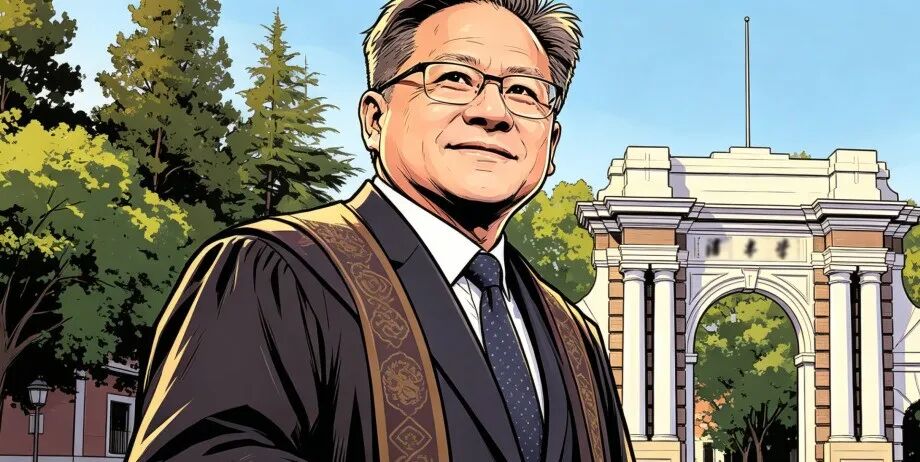
In fact, looking at the international community, Harvard, Stanford, and MIT all have corporate advisory boards, but they are more of a consulting mechanism at the business school level.
The uniqueness of the "Tsinghua circle" is that it's not just a consulting institution for the school. It also connects the political, business, and academic circles in China.
Before Jensen Huang, many big names in the global AI circle had also entered the "Tsinghua circle" for similar purposes: to increase their influence in China.
Tim Cook of Apple took over as the chairman of the Advisory Board of the School of Economics and Management at Tsinghua University in 2019. This was his second connection with Tsinghua.
As early as 2013, Cook had joined the advisory board. That year, he was promoting Apple's transformation from the product - driven era of Steve Jobs to the current service - and - ecosystem - driven model.
The Chinese market is crucial to Apple. At one point, iPhone sales in China accounted for a quarter of Apple's global revenue.
Since taking office, Cook has come to China almost every year to meet government officials, supply - chain partners, and also visit Tsinghua.
He has given lectures on supply - chain management in the classrooms of the School of Economics and Management at Tsinghua, talked about how Apple coordinates hundreds of suppliers globally, and how to control costs while maintaining innovation. These topics may sound like business management courses, but behind them is the real logic of how Apple integrates China's manufacturing capabilities into its global product system.
Satya Nadella joined the Advisory Board of the School of Economics and Management at Tsinghua University in 2015, just one year after he took over as the CEO of Microsoft.
At that time, Microsoft was in the throes of transformation. The growth of its traditional Windows and Office businesses was slowing down, and Nadella pinned all his hopes on the cloud business.
Azure needed the Chinese market, but it didn't have much of a presence in China.
In 2016, Microsoft and Tsinghua cooperated to establish a joint research institute, with research directions including artificial intelligence, machine learning, and big data.
Actually, when it comes to Microsoft, apart from the advisory board, it also has a close relationship with Tsinghua.
For example, Yaqin Zhang, who joined Microsoft Research Asia in 1999, became the youngest global vice - president of Microsoft at the age of 31 and the dean of Microsoft Research Asia at 38.
In 2014, Yaqin Zhang left Microsoft and joined Baidu as the president, promoting the layout of autonomous driving, cloud computing, and AI until his retirement in 2019.
In 2021, Yaqin Zhang returned to Tsinghua and became the founding dean of the Institute for AI Industry Research (AIR) at Tsinghua University.
AIR is not a traditional academic research institution. It's a research platform for emerging technologies, covering areas such as autonomous driving, intelligent transportation, robotics, and AI governance. Its partners include companies like Baidu, Tencent, ByteDance, and Pony.ai.
There's also Xiangyang Shen, who worked at Microsoft for 23 years, rising from a researcher to the executive vice - president in charge of Microsoft's AI and Research Division.
In 2019, Xiangyang Shen left Microsoft, and in 2020, he was appointed as a dual - appointed professor at the Advanced Research Institute of Tsinghua University. He teaches AI courses at Tsinghua, supervises postgraduate students, and participates in Tsinghua's AI strategic planning.
And Kai - fu Lee often appears at Tsinghua. He has given many speeches at Tsinghua, communicated with Tsinghua students, and invested in AI companies founded by Tsinghua alumni.
Kai - fu Lee's Innovation Works is located in the Tsinghua Science Park.
I think the reason might be that the physical distance between Microsoft and Tsinghua is very close. Microsoft Building is at No. 5, Danling Street, Haidian District, only about two kilometers away from the west gate of Tsinghua University.
Moreover, if you walk from Microsoft to Tsinghua University, you'll pass through the Haidian Huangzhuang business district and the Zhongguancun business district, which are full of white - collar meals loved by programmers.
Back to the main topic, Mark Zuckerberg, who was only 30 years old in 2014, also joined the Advisory Board of the School of Economics and Management at Tsinghua University. He is the youngest member since the establishment of the advisory board.
That year, he gave a speech in Chinese throughout a class at the School of Economics and Management at Tsinghua. Although his Chinese wasn't very fluent, he still insisted on speaking for half an hour, talking about Facebook's startup story, how social networks connect the world, and why he learned Chinese.
He said he wanted to communicate with his wife's family, understand Chinese culture, and get Facebook into the Chinese market.
In 2015, Elon Musk, the current world's richest man, joined the Advisory Board of the School of Economics and Management at Tsinghua University. At that time, Tesla had just established a foothold in China. In 2014, Tesla delivered its first batch of Model S cars in China, and Musk personally handed the car keys to Chinese owners.
But Tesla's sales in China have never been ideal. There are few charging stations, the prices are high, and the brand awareness is not enough.
Musk needs the Chinese market, not only for sales but also for the supply chain and manufacturing capabilities.
In 2019, Tesla's Shanghai factory started construction, and in 2020, the domestic - made Model 3 began to be delivered. The Chinese market quickly became one of Tesla's largest global markets.
Musk's appearance at Tsinghua is not just about selling cars. He wants Tesla to take root in China.
He has talked about the future of electric vehicles, the technical route of autonomous driving, and how SpaceX reduces rocket launch costs at Tsinghua.
The "Tsinghua circle" is not only a symbol of fame but also a magical social network.
The unique translation system of the "Tsinghua circle"
Jensen Huang is the CEO of NVIDIA, Tim Cook is the CEO of Apple, and Satya Nadella is the CEO of Microsoft.
They represent business interests and technological monopolies.
But after entering the "Tsinghua circle," their identities have changed. They've become advisory board members, youth mentors, international partners, education supporters, and global communicators.
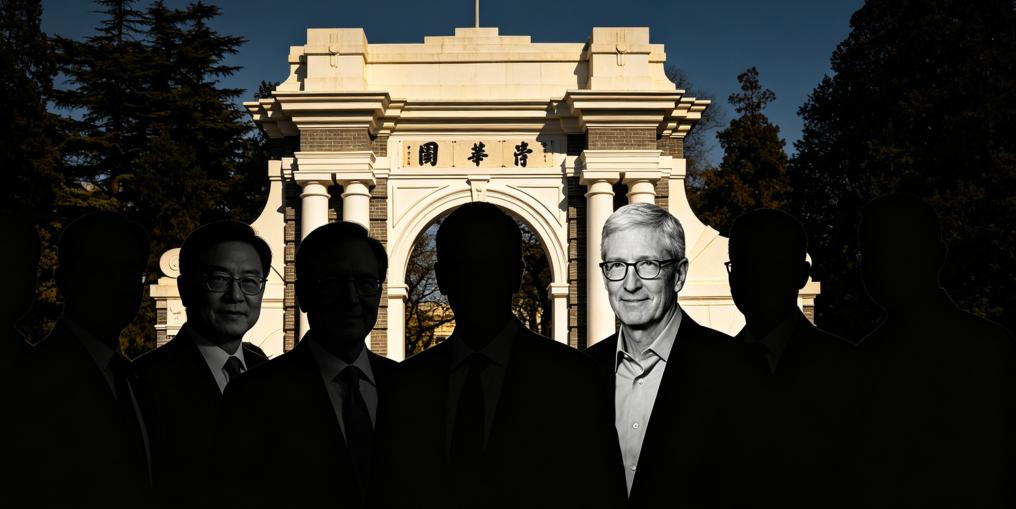
This set of titles translates business power from "people who make money from you" to "people who teach you knowledge."
Moreover, it changes not only the titles but also the positions of these people in public narratives.
When a company wants the Chinese market, it sounds very commercial. When a CEO enters a Tsinghua classroom, it sounds very public.
When a company needs policy communication, it sounds sensitive. When an entrepreneur participates in a university advisory board, it sounds like international education cooperation.
When a company wants to influence the regulatory environment, it sounds like lobbying. When an entrepreneur gives a speech at the Tsinghua Global Management Forum, it sounds like an exchange of ideas.
This is the key to the translation mechanism. Even though they're saying the same thing, the meaning changes when the scene changes.
The Advisory Board of the School of Economics and Management at Tsinghua University provides not just a title but a whole set of infrastructure for identity transformation.
Before and after the annual meetings of the advisory board, the school also holds the "Tsinghua Global Management Forum," round - table forums, the activity of "Advisory Board Members Entering the Classrooms of the School of Economics and Management at Tsinghua," and the activity of students from the School of Economics and Management at Tsinghua visiting the companies of advisory board members.
Since 2019, the activity of "Dialogue between Advisory Board Members and Chinese Entrepreneurs" has also been held.
Through these activities, business power is transformed into educational resources. CEOs become mentors for students; companies become learning places; and business experience becomes public education.
This transformation is two - way.
For entrepreneurs, the Tsinghua identity provides a more gentle cover.
AI giants usually have a lot of controversies. Monopoly and job losses are topics that people don't want to hear. But Tsinghua acts as a buffer.
In the face of the layoff wave, no one believes Jensen Huang no matter how he explains that it has nothing to do with GPUs. However, at Tsinghua, he can say, "This is the future."
Another point is that entrepreneurs usually enter the "Tsinghua circle" when their companies need the Chinese market, Chinese policies, or the Chinese supply chain. And Tsinghua usually accepts them when the Chinese industry needs to understand these technologies, cultivate these talents, and build these networks.
So the advisory board is also a platform for interest exchange.
Its