In fact, Unitree has no choice.
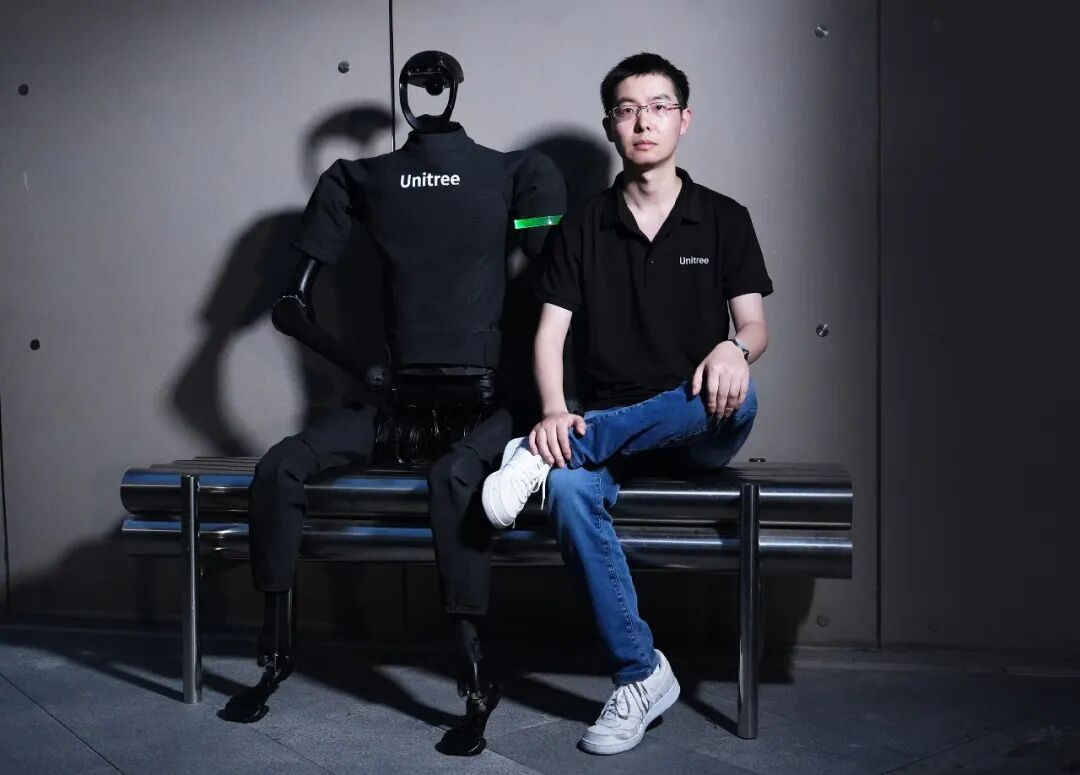
Two years ago, in a media interview, Wang Xingxing, the founder of Unitree Technology, once said that one of the insights he gained from thinking about the reasons why large companies succeed and grow is:
"When what you do aligns with the main theme of the era, some good resources will tilt towards you."
Since its establishment in mid-2016, over the span of a decade, the "momentum" of robots has grown from nothing to prosperity. This company has also taken advantage of the trend to grow from obscurity to a star in the industry.
Now, Unitree Technology has the opportunity to set the fastest record of "passing the review" in the A-share market in the past two years and is very close to becoming the "first A-share humanoid robot stock."
On May 25th, the Shanghai Stock Exchange website announced that the Listing Review Committee of the Shanghai Stock Exchange has scheduled the 31st Listing Review Committee Meeting on June 1st, 2026, to review the initial public offering (IPO) of Unitree Technology Co., Ltd. A company passing the Listing Review Committee Meeting means it has passed the review, which is the most crucial step in a company's IPO.
On March 20th this year, the Shanghai Stock Exchange just accepted Unitree's IPO application. From then to the "review meeting" on June 1st, there will only be 73 days in between, 15 days faster than Moore Threads, which had a "lightning review" last year.
The "Unitree speed" is part of the hot narrative in the intelligent robot track. Looking at the broader picture, there are not only Unitree among the companies being pushed forward, either actively or passively, and standing in the spotlight. The list of companies that are rapidly rising, getting funding, and seeing their valuations soar with the tailwind of the track is getting longer.
According to IT Juzi data, as of May 11th, there have been 218 investment cases in the field of embodied intelligence in China in 2026, with an investment amount exceeding 57.7 billion yuan, surpassing the total investment amount for the whole of 2025.
From a more concrete perspective, it's not uncommon for a company to receive nearly 5 billion yuan in financing within just one year of its establishment. On April 16th this year, Tashizhihang, which completed a $455 million Pre-A round of financing, was founded in February last year. Before this round of financing, it completed a $120 million angel round of financing at the end of March last year and a $122 million angel + round of financing at the beginning of July last year.
With the continuous influx of hot money and the continuous increase in valuations... When the "momentum" of embodied intelligence falls on Unitree and the startups constantly pouring into this industry, whether explicitly or implicitly, competition is everywhere.
Unitree is currently leading the way, but in the fog of an unclear market pattern, the more crucial questions surrounding this company are:
Behind the accelerated IPO, how much faster is it than its competitors?
What are the current competition points in the track? And what will be the competition points in the medium and long term?
When "reaching for higher technology" becomes a must-answer question, how should Unitree step out of its comfort zone?
01 Disputed shipment volume: A warm-up match under a "small market"
From 2023 to 2025, Unitree showed rapid growth - its revenue jumped from 159 million yuan to 1.699 billion yuan; its net profit changed from a loss of 11.145 million yuan in 2023 to a profit of 278 million yuan last year.
However, in the first quarter of this year, Unitree's growth momentum began to slow down.
In terms of revenue, the year-on-year growth rate of 68.49% was lower than before. From 2023 to 2025, the company's compound annual growth rate was about 226.89%. In terms of profit, the net profit after deducting non-recurring gains and losses decreased by 52.55% year-on-year.
In the updated prospectus, Unitree provided an explanation. To summarize briefly:
The slowdown in revenue was mainly due to the higher revenue base of the company, the moderation of industry enthusiasm, and the intensifying market competition. The main reason for the decline in profit was the significant increase in the company's R & D expenses and sales expenses.
For Unitree at present, the short - to medium - term performance fluctuations are relatively easy to understand.
This is related to the stage of the robot track. In the early stage of development, neither the business model nor the implementation path is clear.
In other words, on the premise that the entire industry has not even completed market education, it is unrealistic to require a stable revenue growth rate and profit growth rate.
From a competitive perspective, the trend is getting hotter, and the investment and financing boom continues, but the competition is far from reaching the stage of a head - on fight.
Another key indicator that is more worthy of attention and discussion is the product shipment volume, which is also the core variable for Unitree's significant revenue and profit growth in 2025.
Firstly, the shipment of quadruped robots was stable. From 2023 to 2025, the sales volume of Unitree's quadruped robots was 3,121, 7,136, and 23,037 respectively, with a rapid growth rate. In 2025, it contributed 40% of the company's revenue.
Secondly, the humanoid robots began to be shipped in increasing quantities. At the same time, due to the higher product unit price, they began to become the main source of revenue. From 2023 to 2025, the sales volume of Unitree's humanoid robots was 5, 412, and 5,215 respectively. The contribution ratio to the company's revenue also jumped from 1.88% in 2023 to 51.78% in 2025.
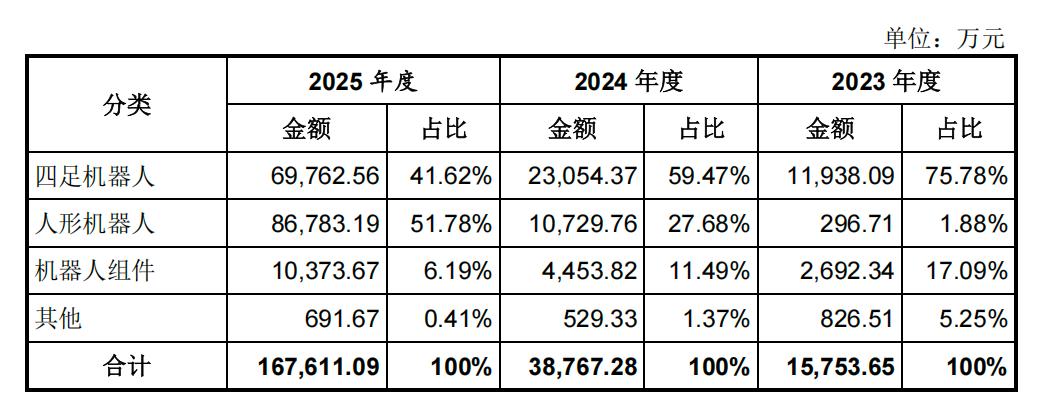
Figure/Unitree's prospectus
At first glance, neither the 23,037 units of quadruped robots nor the 5,215 units of humanoid robots have a high sales volume in terms of numbers.
However, this is already at the leading level in the track.
According to IDC data, the global shipment volume of humanoid robots reached 18,000 units in 2025. Based on this calculation, Unitree has captured nearly 30% of the market share. The "Blue Book on the Development of Quadruped Robot Scenario Applications (2025)" mentioned that the global shipment volume of quadruped robots was around 82,000 units in 2025. Based on this calculation, Unitree has also captured nearly 40% of the market share.
Unitree also mentioned in its prospectus that "the market share of its quadruped robots has ranked first globally for many consecutive years." "In 2025, the company's shipment volume of humanoid robots exceeded 5,500 units (pure humanoid, excluding wheeled dual - arm robots), ranking first globally in terms of shipment volume."
Of course, there is a dispute over who is the global leader, and there are also disputes over the shipment volume in different institutional calculations.
In January this year, Zhipu Robotics cited Omdia data and stated that the total global shipment volume of humanoid robots in 2025 is expected to reach 13,000 units. Among them, Zhipu, with an annual shipment volume of more than 5,100 units, accounts for 39% of the global market share, ranking first globally in both the shipment volume and market share, two key indicators.
Yunzhisheng mentioned in its prospectus, citing Sullivan's data, that in 2025, the company ranked first globally in terms of revenue in the industrial application field of quadruped robots, second globally in terms of quadruped robot revenue, and fourth globally in terms of embodied intelligent robot revenue.
Objectively speaking, these disputes are actually not important. The two more critical signals presented behind the disputes are:
Firstly, the overall market scale of the track has not been developed yet; secondly, from quadruped robots to humanoid robots, the concentration effect of shipment volume is relatively obvious, but this is not the result of full - fledged competition, and the competition has not even truly begun.
02 Divergent paths: Who are the robots sold to?
On the premise that the market scale has not been fully opened up, the competition in the robot market at this stage is not fierce. What companies are competing for is more about the right to speak and the entry ticket.
Sheng Zhong, the head of Morgan Stanley's China industrial research, previously told Caixin that 2026 is still the period of product iteration and verification for robots, and only small - scale orders and preliminary applications are expected.
However, in the medium and long term, the differentiation of capabilities brought about by the differentiation of scenarios, paths, and strategies will continue to emerge. Focusing on several companies that have achieved initial large - scale shipments, who the products are sold to and which market fields they flow into is an equally important observation perspective.
From January to September 2025, in the field of quadruped robots, the proportions of Unitree's products flowing to scientific research and education, commercial consumption, and industrial applications were 31.58%, 42.30%, and 26.12% respectively, which was relatively balanced overall.
The challenge comes from the humanoid robot field. During the same period, 73.60% of the products sold by Unitree flowed to the scientific research and education field, 17.39% to the commercial consumption field, and 9.01% to the industrial application field. In addition, industrial applications mainly include enterprise guidance, intelligent manufacturing, and intelligent inspection, and enterprise guidance accounts for about 50 - 70%.
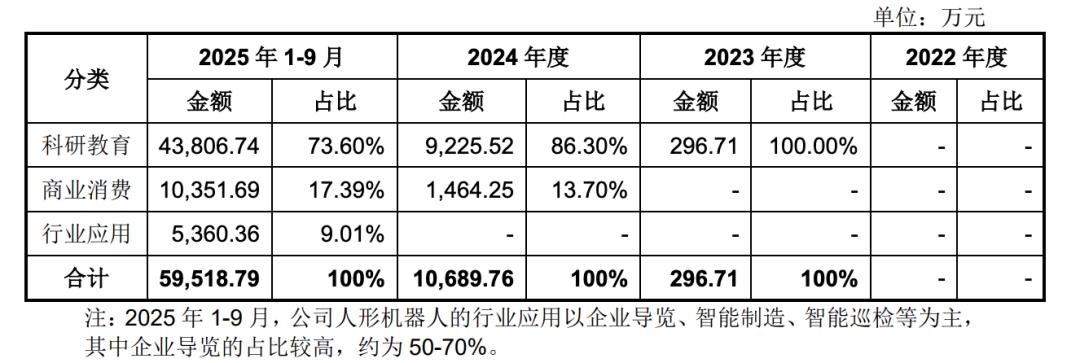
Figure/Unitree's response to the inquiry letter
Unitree also made a statistics. The total sales revenue of humanoid robots used in clear scenarios such as intelligent manufacturing, intelligent inspection, and logistics distribution was only 15.702 million yuan.
On the commercial consumption side, customers who purchase Unitree's humanoid robots mainly focus on scenarios such as display and introduction or on - site interaction in stores, business halls, and scenic spots; and cultural and tourism performances in large - scale events and amusement parks.
This means to some extent that behind the high growth rate and high market share in the past period, what Unitree has captured is actually the part of the cake that is theoretically more replaceable.
The reason is simple. The ability of a robot to interact and to do things are two different concepts, and the ability to dance and to work in a factory are also two different concepts.
In January this year, an investor, when talking about the current application situation of robots, told Tencent News that "if the humanoid robots in 2026 are still just dancing and performing tricks, the only outcome will be a dead end."
This view is a bit radical, but it also serves as a warning to robot companies.
In the first half of the year, an industry insider once judged that in 2026, some robot companies that cannot generate cash flow may fall behind. There are mainly three types of companies that can survive: one is those that can self - develop robot hardware bodies and have sales channels; the other is those that find rigid - demand scenarios in specific niche industries and have stable shipment volumes; and the third, which is even rarer, is those that focus on technology R & D while investors remain patient.
Unitree is obviously the first type, and it has never hidden its weakness in the lack of in - depth market application.
In the previous inquiry letter from the Shanghai Stock Exchange, Unitree's response was straightforward. "The leading market share the company has achieved does not come from the differentiated coverage of the market application field, but is based on the comprehensive competitive advantages of the company's product technology and cooperation ecosystem."
Zhipu, which was competing with Unitree for the top spot in global shipment volume at the beginning of the year, and Yunzhisheng, which ranked first in the industrial application field revenue of quadruped robots, tend to be the second type.
Taking Yunzhisheng as an example, its prospectus shows that its industrial applications cover fields such as power inspection and emergency fire - fighting, and the number of industrial - level application customers exceeds 500.
Of course, at present, in terms of revenue scale and profit level, Unitree is the better - performing one.
Unitree also explained the reason. "Since its establishment, the company has adhered to the full - stack self - developed technology path for the whole machine and core components, which has significantly improved the product performance and reliability and effectively reduced the product cost and public selling price."
From 2022 to 2025, Unitree's gross profit margin increased significantly from 44.2% to 60.3%. The core reason is the full - stack self - development and self - production of core components such as motors, reducers, and lidars. Except for the optional high - specification externally - purchased lidars or dexterous hands, the externally - purchased cost only accounts for 14% - 18% of the total cost.
Therefore, the cost advantage brings more room for price reduction, which brings a price advantage, and in turn, is expected to bring a sales volume advantage.
03 Test of ability boundaries: What will be the competition in the future?
Today's quadruped robots and humanoid robots can run, jump, and even do backflips, but this does not mean they can do work.
A robot that can punch on the Spring Festival Gala stage is completely different from a robot that can continuously carry boxes in a workshop for eight hours.
However, the gap from the laboratory to the industrial end is not so easy to cross.
Ai Rui Consulting mentioned in a research report that before large - scale commercialization, embodied intelligence still needs to overcome four major bottlenecks:
Data bottleneck. Different from large language models, there is a lack of multi - modal data in the physical world, high - quality practical operation data is scarce, simulation data still has defects, and there is a lack of a data evaluation mechanism.
Technology bottleneck. Technologies such as dexterous hands, generalization ability, and Sim2Real migration are not yet mature.
Cost bottleneck. The investment in core components and computing power remains high.
Business and social aspects. The ROI cycle is long, and ethical and safety issues still need to be resolved.
In other words, being able to build a robot is one thing, and whether the robot is smart enough to do things and whether it can be trusted at the consumer end and the industrial end is another thing.
Facing the potential broad application scenarios, whether customers can afford to use the robots is another test. Gao Yang, an assistant professor at the Institute for Interdisciplinary Information Sciences of Tsinghua University, previously told Caixin that due to the limited generalization ability of the current humanoid robot AI