In 2026, the biggest cognitive bias
In the past two days, the global semiconductor market has once again witnessed a highly disruptive and magical market trend.
Micron Technology soared by 19.29% in a single day, achieving its strongest single - day increase since 2011. Its stock price soared to $895.88, and its market value exceeded $1 trillion, officially joining the ranks of global semiconductor giants with a trillion - dollar market value.
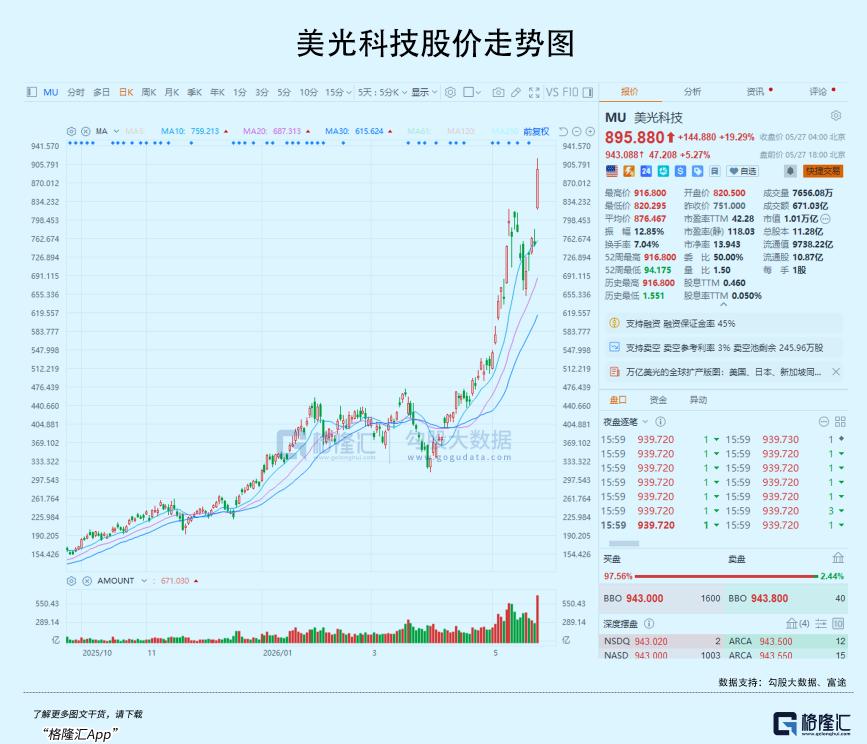
South Korea's SK Hynix also rose by 9.51% today on the basis of a 5.7% increase the day before yesterday, and its market value has long exceeded $1 trillion.
In the past year, the market values of SK Hynix, Samsung, Micron, and SanDisk have soared by 9.6 times, 7.3 times, 8.4 times, and 41 times respectively!
Moreover, many storage industry leaders in the market have also achieved several - fold or even ten - fold increases, becoming one of the most eye - catching sectors in the global capital market.
A year ago, almost no one dared to predict that the traditional storage sector, which had been shunned by the market for many years, could experience such a spectacular market trend.
It is precisely this extreme contrast that has pushed the market's divergence on this sector to the peak.
Those who missed the opportunity believe that the market trend is absurd and full of bubbles, and it is just mindless capital speculation.
Those who hold the stocks are significantly optimistic, believing that the ceiling is far from being reached.
And the most entangled ones are ordinary investors who took profits early and got off the train with small gains. Now they can only watch helplessly as the chips they once held soar, but they dare not chase after them and can only silently await an opportunity for a correction.
An epic storage super - bull market has actually become a screening machine for market cognitive stratification.
01
Micron Technology's sharp single - day rise was catalyzed by news.
According to foreign media reports, at a private party over the weekend, Trump directly named Micron and sparingly praised it: "Big company Micron, boy, Micron is great…".
Such a high - profile public endorsement is equivalent to attaching a "top - level trust label" to Micron.
Actually, before this, Trump had carried out the operation of "buying a certain stock first and then publicly supporting it" many times. Companies such as Dell, Micron, Apple, Palantir, and Thermo Fisher Scientific have all benefited from this.
This time, his continued support for Micron has further ignited the market's bullish sentiment.
Meanwhile, with the full implementation of NVIDIA's new - generation VR200 computing power platform, a research report from Morgan Stanley shows that the total cost of a single rack of NVIDIA's Vera Rubin (VR200) has soared from about $3.995 million to $7.803 million, almost doubling.
Among them, memory is the biggest driver of the cost increase. Its value has soared from $373,900 to $2.0016 million, an increase of up to 435%, and its proportion has jumped from less than 10% to 26%, exceeding one - quarter of the total machine cost for the first time.
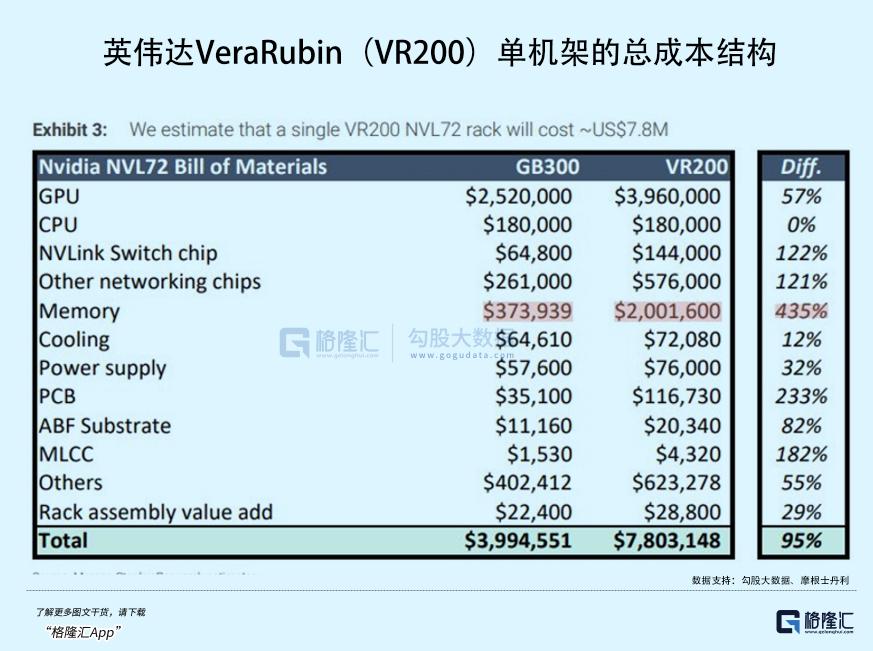
The market interprets this as follows: such an exaggerated value increase has made Samsung, SK Hynix, and Micron the three biggest beneficiaries, and has further opened up their future performance imagination space.
Recently, top Wall Street institutions have also carried out "epic upward adjustments" to the target prices of these companies.
UBS directly raised Micron's target price from $535 to $1,625, an increase of more than 200%, becoming the highest target price given by Wall Street, corresponding to a market value of $1.8 trillion.
What really triggered the sentiment was the appearance of several large and aggressive buy orders in Micron Technology's options market.
Among them, there was a super long - call contract worth more than $1.41 million, locking in an exercise price of $1,400 and expiring in January 2027 - which shows that there is indeed capital aggressively betting on Micron's future growth.
With several positive factors combined, the super - market trend of Micron Technology has been completely ignited.
02
The short - term positive stimulus is the fuse of the market trend.
However, behind the epic market trend of a ten - fold or dozens - fold increase in two years and a market value exceeding $1 trillion, it must mean that there has been a certain subversive reconstruction of the underlying logic of the industry itself.
For many years in the past, the storage industry has been troubled by periodic fluctuations. The spot price is determined according to the market. When prices rise, production expands; when there is an oversupply, prices drop; when there are losses, production is cut. A complete cycle lasts 6 - 8 years, and the corporate profit fluctuation range exceeds 80%. The performance is completely at the mercy of the market.
But the AI era has completely broken this rule.
The current competition in the AI industry is no longer just a competition of GPU computing power.
In the past two decades, GPU computing power has soared by 60,000 times, but the bandwidth of traditional memory has only increased by 100 times. This serious "memory wall" has become the core bottleneck restricting the efficiency of large - model training and inference.
High - end HBM (High - Bandwidth Memory) - whether it is HBM3, HBM3E, or HBM4 - has become the standard configuration for NVIDIA and AMD's high - end AI chips. Without the support of HBM, even the top - level GPU computing power is difficult to fully unleash.
Currently, only three companies in the world, Samsung, SK Hynix, and Micron, have the stable mass - production capacity of high - end HBM, forming a typical oligopoly pattern.
Even more exaggerated is that due to the extremely tight shortage of high - end HBM, SK Hynix's production capacity in 2026 has been completely sold out.
Some leading cloud providers are even willing to pay a 50% to 60% premium to snap up the forward production capacity in 2028, but it is still in short supply.
This has allowed these storage giants to enjoy the rare dividend of "both volume and price increase", and this trend seems to be able to last until around 2028.
Now, Micron, Samsung, and SK Hynix have all signed long - term supply contracts of 3 to 10 years with global top - level technology giants such as NVIDIA, Google, and Microsoft, locking in 40% to 70% of their high - end HBM production capacity and core profits.
This long - term agreement (LTA) model, through triple guarantees of sales volume locking, floor price locking, and prepaid margin, has largely smoothed out the originally severe periodic fluctuations in the storage industry, and also made the market have fanatical confidence in their growth in the next two years.
This is also the core confidence for UBS to abandon the traditional cycle valuation and give a growth premium.
Many investors' cognitive biases towards storage giants mainly lie in the fact that they do not clearly distinguish the logical differences between ordinary consumer - grade memory and high - end AI storage.
In the low - end storage sector, consumer - grade DDR and household SSDs mainly rely on the stock market of mobile phones and PCs, and the global production capacity is still expanding. With the concentrated release of production capacity in the second half of 2027, prices may face certain pressure, showing traditional cyclical characteristics.
However, the high - end HBM sector is a completely different new track.
The technical process is more advanced, it is difficult to expand production capacity, and the yield - rate climbing cycle is longer, resulting in a huge and long - term demand gap.
More importantly, the three storage giants hold most of the pricing power.
Today's storage leaders are no longer simply hardware suppliers, but core strategic partners deeply integrated into NVIDIA's AI computing power ecosystem.
They are even actively reducing low - end production capacity and fully tilting towards the high - end sector.
The gross profit margin of high - end storage is as high as 68% to 90%, almost comparable to top - level AI growth - type enterprises such as NVIDIA.
This means that high - end storage should no longer be simply classified into the category of traditional cyclical industries, but has become a high - gross - profit and high - growth industry that follows AI capital expenditure, just like core AI sectors such as AI chips, optical modules, and large models.
03
The extreme divergence in the market towards the storage market trend is ultimately probably due to cognitive biases.
When most retail investors see Micron and SK Hynix achieving ten - fold increases, their first reaction is often: it has risen too much, it's too crazy, it's just speculation, and there must be a correction at the high level.
So they take profits early and miss the opportunity completely, and even start to short the market. In the end, they can only watch helplessly as the market trend continues to hit new highs.
But the research and pricing rhythm of first - tier institutions is indeed different from that of ordinary retail investors.
Among the 46 mainstream securities firms covering this sector at present, more than 70% still choose to maintain a bullish view or continuously upgrade their ratings.
Institutions' pricing of HBM always revolves around real industrial changes such as the long - term supply - demand pattern, the LTA long - term contract profit - locking model, and the iteration of AI computing power structure.
This has also completely widened the income gap between the two types of investors.
Ordinary people are frightened by the price increase, while professional capital earns the dividend of cognitive iteration.
Actually, many people repeatedly miss the AI main line and cannot hold onto super - bull stocks. Perhaps it is not a problem of technology and luck, but the fixed old cognition that repeats similar mistakes of missing opportunities again and again.
Looking back at the development context of the AI sector in the past three years, almost every ten - fold main line has been continuously screening the cognitive ability of market investors.
In 2023, the AI large - model started a doubling market trend, and the market collectively shouted that it was a bubble. As a result, it later achieved dozens - fold increases.
In 2024, AI chips continued to rise. Many people were afraid of the high level and left the market one after another, but NVIDIA continued to hit new highs.
In 2025, the optical communication sector exploded. Most people thought it was just short - term theme speculation. After getting off the train, the sector doubled again.
From large models to AI chips and then to optical modules, the market rhythm is often: first doubt, then diverge, and finally accelerate.
Most people miss the opportunity halfway.
Now, the high - end storage sector seems to be replicating this trend.
04
The market's natural fear of the storage sector largely stems from past cyclical memories.
In the past decade, the storage industry was a typical strong - cyclical industry, where a sharp rise was followed by a sharp fall. In the two complete cycles in 2018 and 2022, the stock prices were cut in half after a sharp rise, trapping countless investors.
Over time, the market has formed a fixed trading muscle memory: reduce positions when the storage stock price doubles, clear positions when it doubles again, and think that the top has been reached when there is a sharp rise.
But a question worth asking is: Have we really delved into what subversive changes have taken place in this industry?
Today, the underlying rules of the high - end storage industry have quietly changed, but many people's trading thinking still remains in the old era.
Using an old ruler to measure new assets, missing opportunities may be inevitable.
The pricing in the capital market has never been based on historical prices.
It only relies on the current business model, profit quality, and growth space.
It should be noted that this article is by no means advocating chasing the rise at a high level. It is just a reflection on a common confusion among all investors: why can we only witness but hardly really participate in each era - level dividend? Why do we always miss opportunities in the face of trend divergence and get off the train halfway during the main uptrend?
Perhaps the answer is not complicated.
What defeats us is never market fluctuations, but those lagging and fixed cognitions.
The market itself does not make mistakes. It is often the lagging cognition that is wrong.
Cognitive bias may be the most difficult enemy to deal with throughout the entire investment career.
Maintaining an open - minded attitude, continuously iterating cognition, and keeping up with the industrial trend - although it sounds like a cliche, it may indeed be the most reliable and long - lasting foundation for ordinary investors in the capital market.
Glonhui Statement: The views in this article are all from the original author and do not represent the views and positions of Glonhui. It is specially reminded that investment decisions should be based on independent thinking. The content of this article is for reference only and is not intended as any actual operation advice. The trading risk is borne by the investor.
This article is from the WeChat official account “Glonhui APP” (ID: hkguruclub), written by Lone Ranger, and published by 36Kr with authorization.