OpenAI has recruited an F1-level racing driver for public relations.
OpenAI is gearing up for marketing!
You heard it right. Although CEO Altman is active on various social media platforms every day, who would have thought:
It took them a full six months just to find a suitable CMO (Chief Marketing Officer).
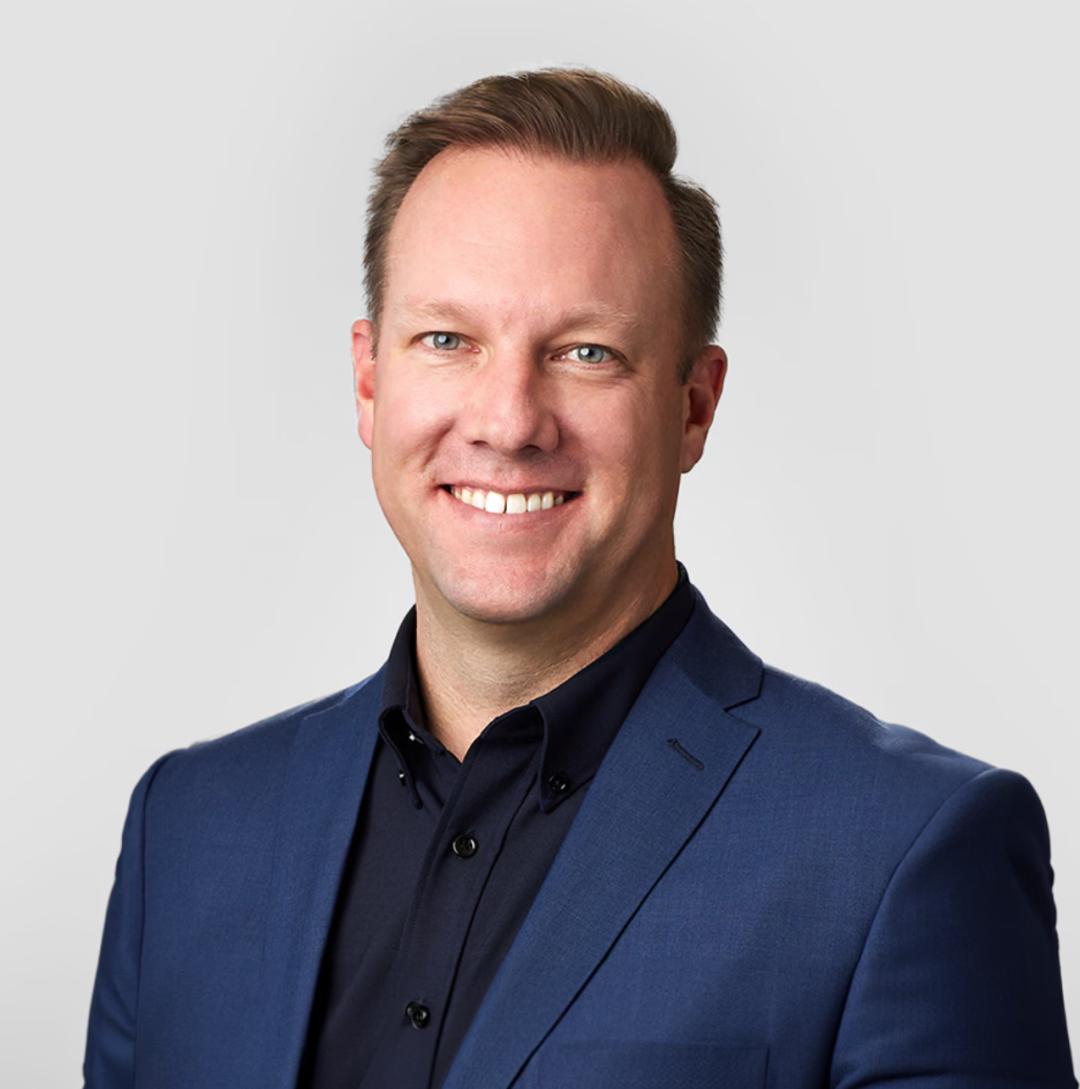
Finally, they've found the man - Colin Fleming.
Here's a little gossip from The New York Times. Before settling on Colin Fleming, the candidates for OpenAI's CMO were all big names:
Jill Hazelbaker, the President of Uber; Sarah O’Brien, the public relations head of former Apple design director Jony Ive; Aaron Zamost, a former public relations executive at Square... Each of them is capable of handling important tasks independently.
However, in the end, it was Colin Fleming who "stood out".
So why? It can only be said that this CMO, who once worked for the Red Bull Racing Team and participated in F1-level professional races in the early days, has an extremely exciting life experience.
About Colin Fleming
After going through Colin Fleming's LinkedIn profile, I finally understood why OpenAI chose him.
There are probably two reasons: one is experience, and the other is courage.
Experience is quite obvious. Before joining OpenAI, he had three marketing-related work experiences.
Less well-known is his four-year tenure as the marketing director at eSoles.
This is a company that provides customized insole services for professional sports such as cycling and skiing. It can basically be regarded as the starting point of Colin's transformation from a racing driver to a marketer.
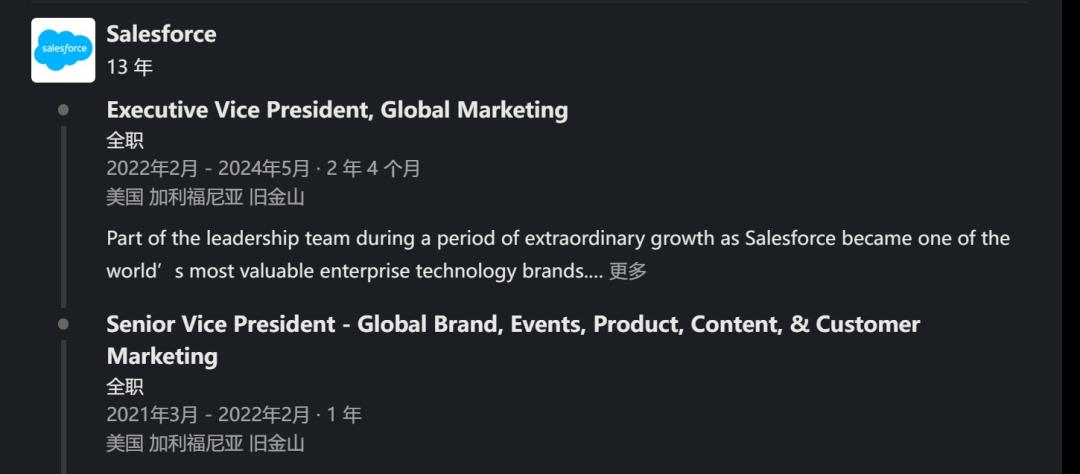
Later, it was the 13 years at Salesforce that really made him well-known.
During his 13 years at Salesforce, Colin actually caught up with the most crucial shift in the enterprise software industry.
Today, people are used to cloud computing and SaaS. But at that time, most enterprises were still using local servers and licensed software, and terms like "CRM" (Customer Relationship Management) were more like industry jargon to many people.
What Colin and his team did was to translate these complex technologies into a language that the market could understand -
They no longer just talked about product features but started to talk about "future work styles", "enterprise digitalization", and "the cloud era" in more popular narratives.
This was an important step for Salesforce to transform from a CRM software company into an industry representative in the cloud computing era.
During this process, Colin was promoted from the product marketing director to the executive vice president of global marketing and won a bunch of awards such as Adweek's B2B Brand of the Year and AdAge's Marketer of the Year.
After that, he went to ServiceNow as the CMO, which was his position before joining OpenAI.
Although this company is not as well-known as Apple and Microsoft, it is the standard and synonym in the "enterprise digital workflow" field.
Let's put it this way. When you call the bank customer service, submit a reimbursement application at the company, or ask the IT department to repair your computer... ServiceNow is probably working behind these things.
At ServiceNow, Colin still did the same thing -
He continued to translate those complex, abstract, and underlying enterprise technologies into a language that the market was willing to understand.
In less than a year, he was included in Forbes' list of the world's most influential CMOs.
So, to some extent, what Colin is best at may not be traditional advertising and marketing, but:
When a new technology emerges, how to make the entire market truly understand it.
In the current context, this sentence seems to be tailor-made for OpenAI.
ChatGPT is already well-known. The fundamental reason why OpenAI approached Colin is how to further snatch the enterprise market from Anthropic.

However, experience alone is not enough to explain why it was him.
This brings us to the second point: courage. To understand this courage, we need to know how difficult this job is.
It is said that none of the candidates on that list took the job, and the key problem was "CEO Altman was too off-putting".
He frequently speaks publicly and sets his own agenda, which makes them think that it's impossible to work as a CMO beside him.
So why did Colin take the job?
As a professional with nearly 20 years of marketing experience, he must be aware of this.
But he used to be a racing driver who pursued excitement and loved challenges. Colin introduced himself on his personal homepage like this:
Early in my career, I worked for the Red Bull Racing Team and participated in F1-level professional races. The speed, precision, and pressure have shaped my leadership style today: decisive, responsible, and able to handle large-scale operations with ease even in high-risk situations.
To some extent, this experience also explains many of his later career choices because he is not the kind of person who likes to stay in a safe zone.
After retiring from the racing track, he didn't choose a safer path but directly entered an industry almost unrelated to racing and started from scratch in marketing and branding.
Later, whether it was Salesforce, ServiceNow, or now OpenAI, almost every time he changed jobs, he caught the most drastic technological paradigm shift.
And this time may be especially so. After all, OpenAI is not only the hottest AI company in the world but also one of the most complex and difficult companies to manage in terms of branding.
On one hand, there is the high-pressure commercial expansion; on the other hand, there are huge controversies such as AGI, security, regulation, and public opinion. Coupled with Altman, who almost has global traffic, many traditional CMOs would be headache just thinking about it.
But Colin still took the job. When he announced his departure from ServiceNow on LinkedIn, he used the word "gut-wrenching" to describe this decision.
But then he added:
I would regret it for the rest of my life if I didn't go.
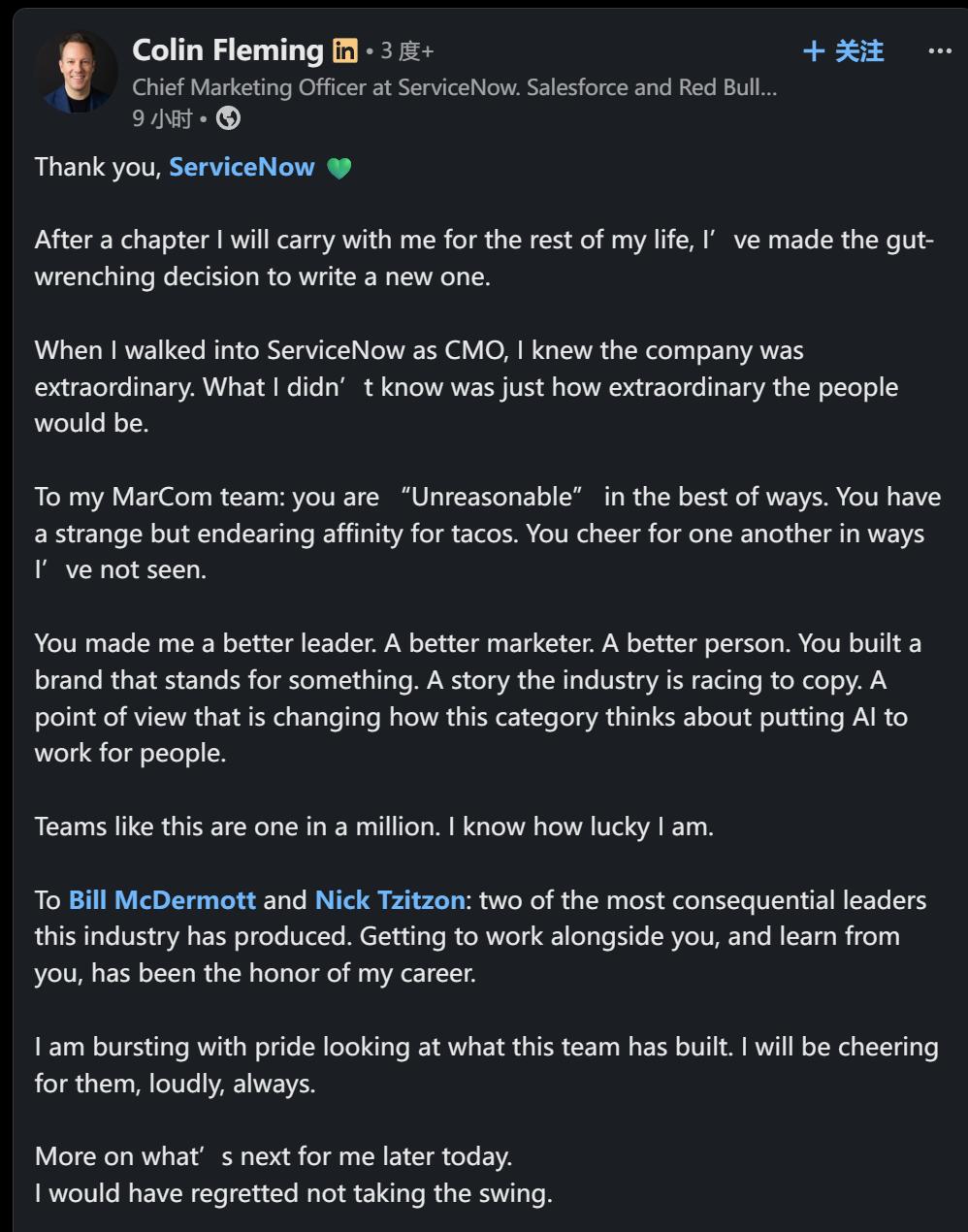
To some extent, this sentence is very much like the thinking mode of a racing driver:
Even though he knows the risks are huge, as long as it's a turning point in the era and an exciting enough challenge, he will still step on the accelerator.
Is marketing the long-term systematic deficiency of OpenAI?
To be honest, it seems that OpenAI has never lacked marketing, after all, there is Altman, the top spokesperson.
But when I dug deeper into Colin's appointment as OpenAI's CMO, I found something quite counterintuitive -
Marketing is precisely the long-term systematic deficiency of OpenAI.

Strictly speaking, the history of OpenAI's CMO position is very short, almost ridiculously short.
This is because before 2024, OpenAI was more like a research laboratory, and the functions of branding, communication, and marketing were long-term weakened.
The first person in charge of this area was Hannah Wong, who jumped from Apple to OpenAI in 2021. But her later title was the first CCO (Chief Communications Officer).
She was in charge of media, public relations, and policy communication. Strictly speaking, it was communication, not traditional marketing.
Actually, there has only been one person in the company's history who officially held the CMO title: Kate Rouch, who took office in 2024.
However, in April this year, Kate Rouch issued a statement saying that she had to step down due to cancer treatment. During the transition period, Kelly Sims, the marketing partner of major shareholder Thrive Capital, temporarily filled in. (P.S. Hannah Wong left the company in December last year).
So now, a company with a valuation of nearly one trillion dollars and on the verge of an IPO has both its marketing and public relations lines in a leaderless state.
In the context of OpenAI's transformation from a "research laboratory" to a "global consumer technology company", this undoubtedly shows that:
OpenAI's organizational construction in marketing is half a step behind.
To some extent, Colin's arrival is part of the process of making up for this deficiency.
However, he is the CMO of the enterprise business line, not the overall brand leader of the company.
The position of public relations director is still vacant.
That is to say, the biggest variable, Altman, still has no one to manage.
Reference links:
[1]https://x.com/colinjfleming/status/2059359698214957543
[2]https://www.theinformation.com/newsletters/ai-agenda/openais-pr-challenge?rc=eg0wqy
This article is from the WeChat official account "QbitAI", author: Yishui. Republished by 36Kr with permission.