Swallowing 100 trillion Tokens per month, AI transit station OpenRouter is making huge profits.
[Introduction] With a real traffic of 25 trillion tokens per week and its valuation doubling in a year, OpenRouter has secured $113 million in Series B financing.
The business of the token transfer station is really making huge profits.
Just yesterday, OpenRouter announced the completion of $113 million in Series B financing, led by CapitalG, the growth fund under Alphabet, the parent company of Google, and followed by well - known venture capital firms such as NVentures of NVIDIA.
Old shareholders like a16z and Menlo Ventures also continued to increase their investments.
Its valuation soared directly to $1.3 billion, more than doubling compared to $547 million a year ago.
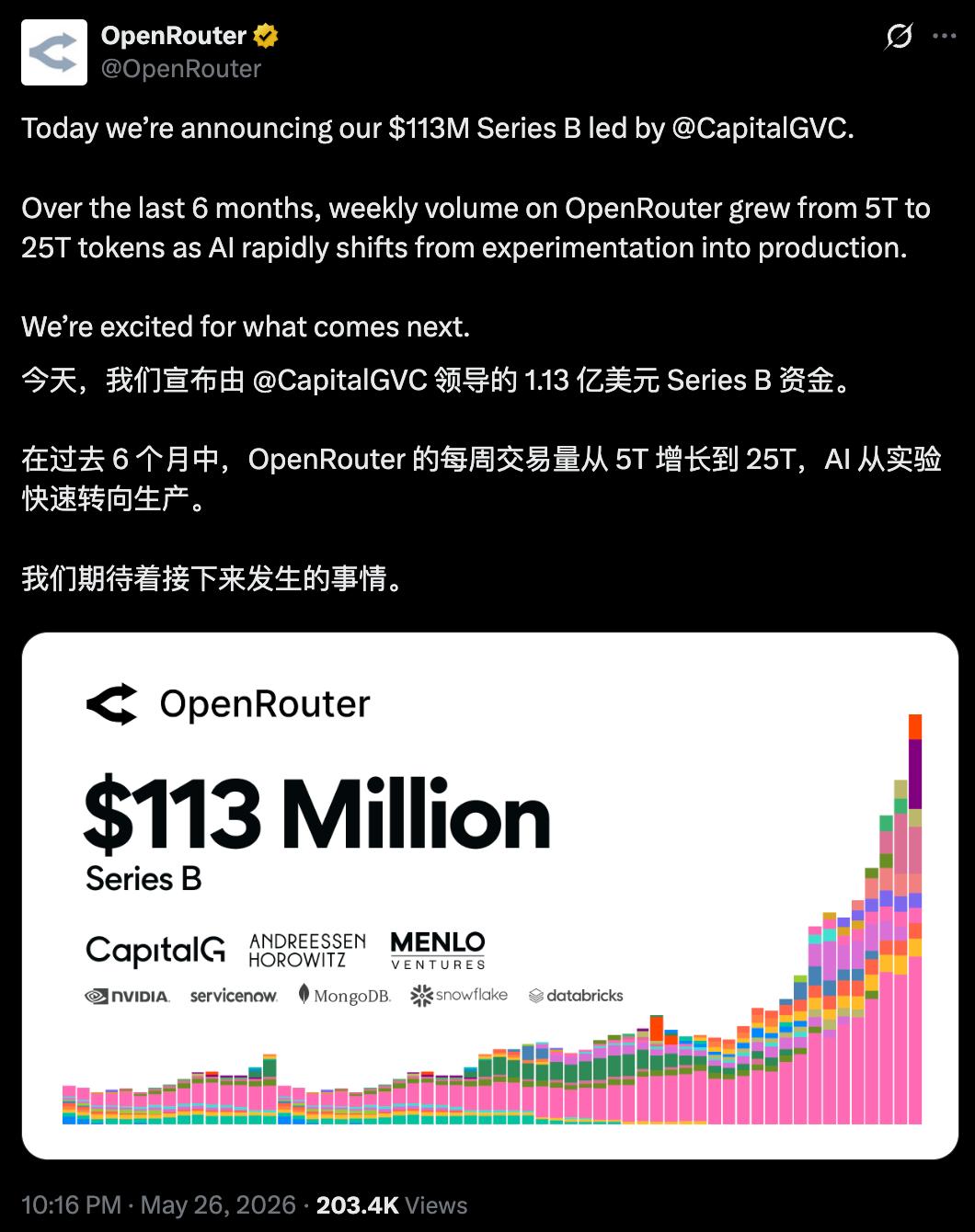
This token "middleman" now processes 25 trillion tokens per week, equivalent to about 100 trillion tokens per month - a five - fold increase compared to six months ago. Currently, it has over 8 million global users.
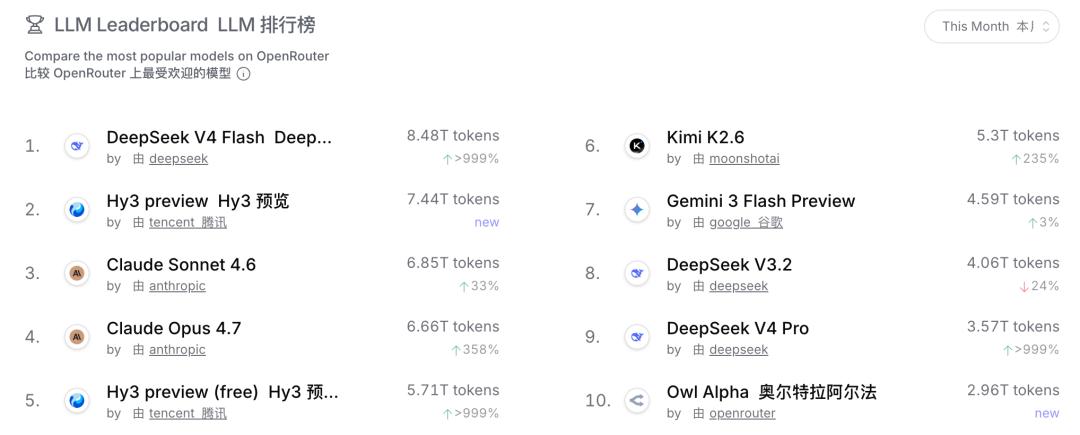
By the way, people in the AI circle may have a more intuitive impression of OpenRouter - its token call volume ranking list.
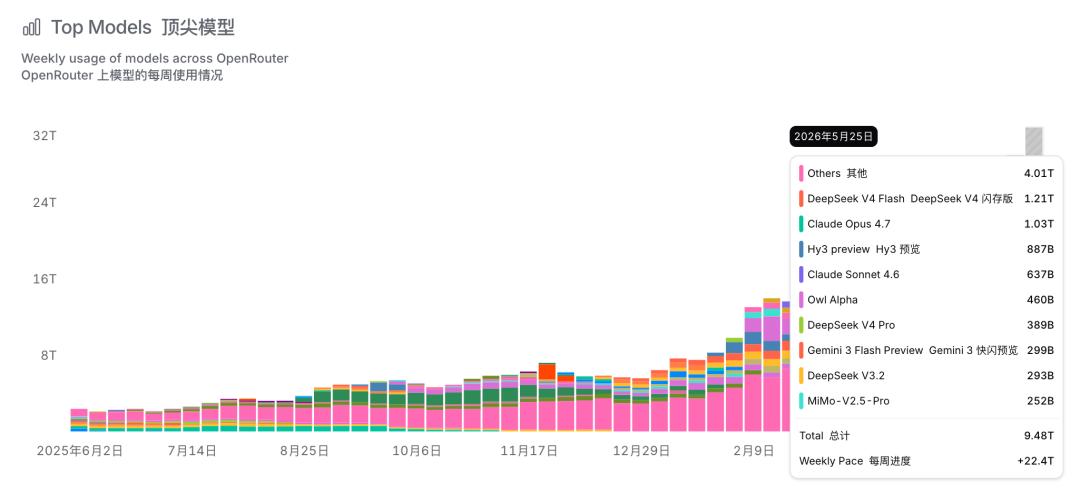
Investors, researchers, and the media all watch this list to gauge the trends of which models are the most popular, which companies' call volumes are increasing, and how prices are changing.
In a sense, OpenRouter has become the "Dianping" of the AI industry.
What exactly does this "AI exchange" solve?
To understand why OpenRouter is worth so much, we first need to understand a major change that is taking place: The way of using AI has changed.
A year ago, people were still arguing about "which large model to bet on." Today, people are not just calling one model.
The reason is simple. Different tasks require different models: Small models are sufficient for summarizing documents, with low cost and high speed; flagship - level large models are needed for complex tasks that require in - depth reasoning; and there is another set of solutions for multi - modal scenarios - audio, video, and images.
In a company's AI workflow, there may be four, five, or even more models running simultaneously.
A Deloitte study in 2026 found that 67% of enterprises consume more than 1 billion tokens per month.
The CTO of Uber even told the media bluntly that the company's AI budget for the whole year of 2026 was used up in just a few months.

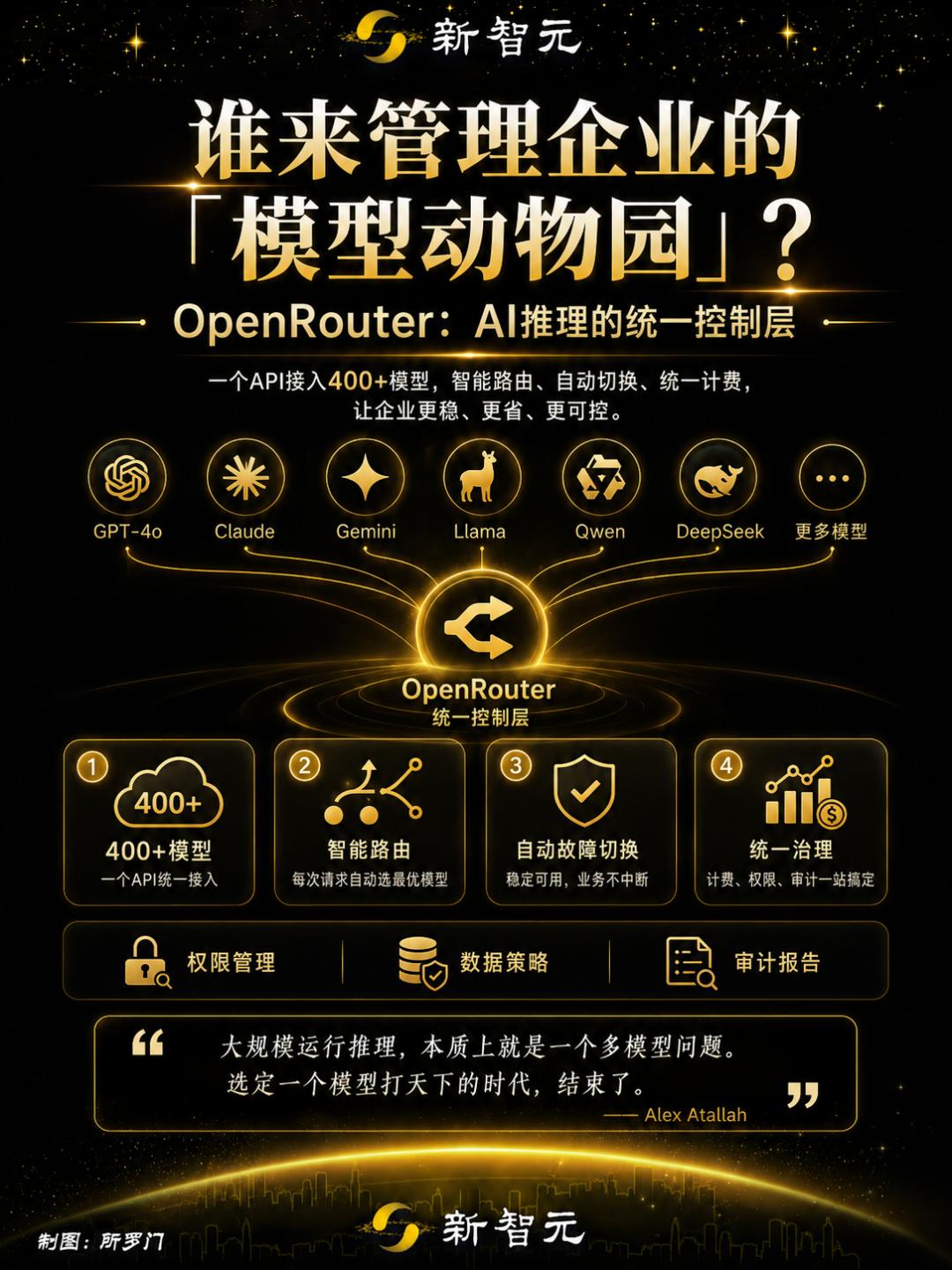
This brings up a core question: Who will help enterprises manage this increasingly complex "model zoo"?
OpenRouter's answer is: Create a unified control layer for AI inference.
One API connects to more than 400 models. Intelligent routing determines which path each request takes, automatic fault - switching ensures availability, and unified billing makes costs clear at a glance.
Coupled with permission management, data processing strategies, and audit - level usage reports - it covers all the "housekeeper" functions that enterprises need.
CEO Alex Atallah put it very well: Running inference at scale is essentially a multi - model problem. The era of relying on a single model is over.
Speaking of Alex Atallah, his resume itself is a story.
Graduated from the Computer Science Department of Stanford University, he co - founded OpenSea with Devin Finzer in 2018 - yes, it's the world's largest NFT trading platform.
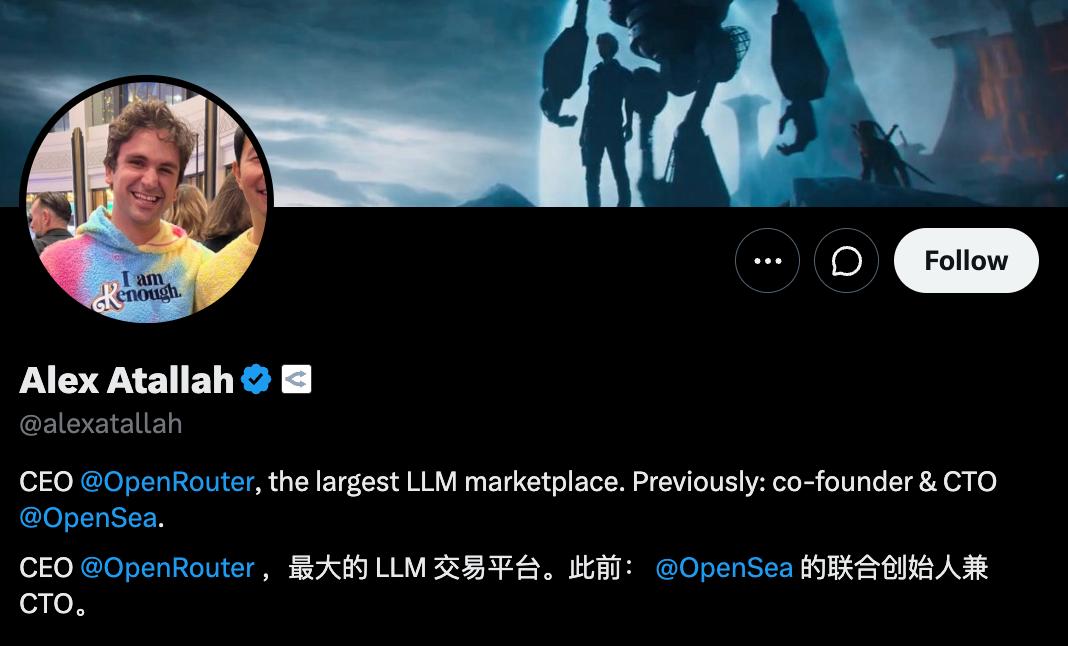
At its peak, OpenSea was valued at up to $13.3 billion, and Atallah's personal wealth once exceeded $2 billion.
But in 2022, when the NFT boom cooled down rapidly, Atallah chose to leave OpenSea, saying that he wanted to "create something new from scratch."
The direction he targeted was AI inference infrastructure. In 2023, he co - founded OpenRouter with Louis Vichy.
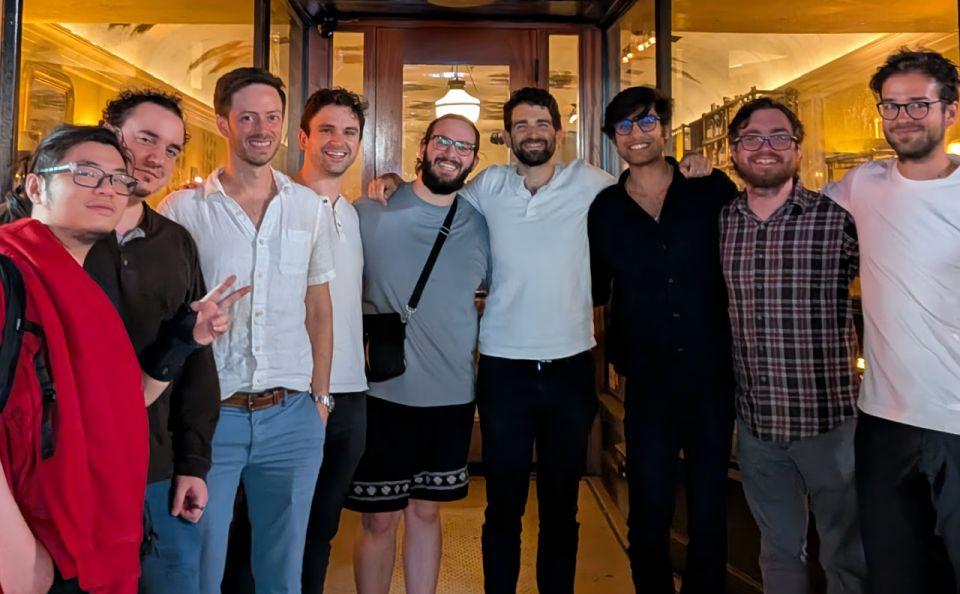
From an NFT trading platform to an AI model trading platform, what Atallah does essentially remains the same: In a market with explosive growth, be the "exchange" that connects the supply and demand sides.
It's just that this time, the items on the shelf have changed from digital collectibles to large language models, and the "currency" of the transaction has changed from ETH to tokens.
There is an interesting sentence in the memo written by a16z when it invested in OpenRouter last year: Atallah showed his talent in distributed systems in college. "While others see chaos, he sees the possibility of order and elegance."
A big bet on AI infrastructure
Take a look at OpenRouter's model call ranking list in the past week - The most popular are the open - source models from DeepSeek and Tencent, followed closely by Claude Opus 4.7, the flagship of Anthropic.
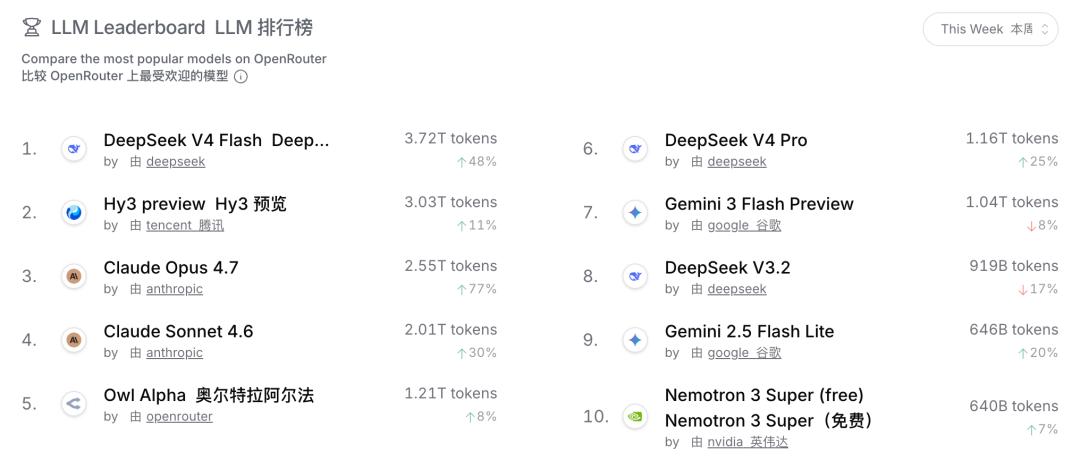
The rise of open - source models is accelerating "multi - model scheduling" to become the default strategy for enterprise AI.
When no single model can dominate the market, the value of the middle layer will continue to expand.
What's more worthy of attention is the symbolic meaning of the investor lineup. CapitalG (Google), NVentures (NVIDIA), and the strategic investment departments of enterprise software giants such as ServiceNow, MongoDB, Snowflake, and Databricks - they almost cover the entire chain of AI infrastructure.
These companies are not just making financial investments. They are betting on a judgment: The entrance to future enterprise AI will not be in the hands of a certain model company, but in the routing and scheduling layer.
OpenRouter itself is very clear about this.
It uses the public model ranking list and usage data as a strategic weapon - when the entire industry refers to your data to make decisions, you become the information hub of the entire ecosystem.
Alex Atallah compares OpenRouter to Stripe in the AI field.
But if the story develops according to the current script, its potential may be greater than that of Stripe - after all, Stripe deals with payments, while OpenRouter is dealing with the most expensive and fastest - growing computing resource of this era: Tokens.
References:
https://x.com/openrouter/status/2059277623629664758
https://techcrunch.com/2026/05/26/openrouter-more-than-doubles-valuation-to-1-3b-in-a-year/
https://siliconangle.com/2026/05/26/openrouter-raises-113m-bring-order-enterprise-ai-inference-routing/
https://www.01net.it/openrouter-raises-113-million-capitalg-led-series-b-as-weekly-volume-explodes-to-25t-tokens/
https://techstartups.com/2026/05/26/openrouter-raises-113m-as-ai-token-usage-surges-to-100-trillion-monthly/
This article is from the WeChat official account "New Intelligence Yuan". Edited by Solomon. Republished by 36Kr with authorization.