Liangkun Technology Secures Hundreds of Millions in Angel Round Funding, AI4S Urgently Needs Quantum-level Precision Data | Exclusive from 36Kr
Exclusive news from "Undercurrent Waves": Quantum computing company "Liangkun Technology" recently completed angel and angel + rounds of financing worth hundreds of millions of RMB. This round of series financing was led by Inno Angel Fund, with participation from multiple institutions such as Guoqi Investment, Beigong Investment, BV Baidu Ventures, Tsinghua Alumni Fund, and Mingshi Venture Capital. Light Source Capital served as the exclusive financial advisor.
Behind this financing lies a gradually clear judgment: AI for Science requires quantum computing.
AI can learn patterns, but the upper limit of the model's ability is restricted by the "resolution" of the world it has seen. In R & D scenarios such as chemistry, materials, and medicine, if the precision of the underlying data is insufficient, the model's prediction results will also be significantly limited.
Quantum computing is naturally suitable for simulating molecular structures, chemical bonds, and other systems. As a high - precision solver, it may output calculation results closer to the laws of the physical world; the quantum - level high - precision data produced by the calculation is also a key for AI4S to improve the model's performance.
Liangkun Technology was founded in January 2026. Its founder, Lü Dingshun, worked at Huawei and ByteDance's AI4S Lab for seven years, leading the team to explore the boundaries of quantum computing capabilities. Before that, he was one of the earliest Ph.D. students in the field of quantum computing at Tsinghua University and was deeply involved in the construction of an ion - trap quantum computing system.
In the past, by following the path of "software first when hardware is insufficient", Lü Dingshun achieved many results in large companies. In his view, a heterogeneous intelligent computing platform that integrates quantum technology, AI, and high - performance computing can maximize the value of limited quantum computing power at the application layer.
This young science and engineering Ph.D. has always wanted to use quantum computing to solve major real - world problems. When the hardware technology route of quantum computing has not yet converged, he did not join the wave of hardware startups. Instead, he chose the algorithm and software platform above the hardware, encapsulating quantum algorithms, AI models, and industry workflows into callable scientific agents to connect quantum computers with AI4S application requirements.
Lü Dingshun speaks very fast. In a nearly two - hour interview, he said "exciting" 15 times. In his first year at Huawei, the research that broke Google's "quantum supremacy" narrative did not make him very excited. However, achieving SOTA in high - temperature superconductivity - related model calculations using AI excited him; he also gets excited when he meets people who dare to challenge Google and IBM and can fight tough battles.
Currently, the Liangkun Technology team has nearly 40 people, gathering cutting - edge talents in the fields of quantum, AI, and high - performance computing. In Lü Dingshun's view, "The team is a reflection of the founder's inner perception. When one deeply understands quantum computing as a systematic project, one will know how to recruit a team. The most important thing for talents is to have high morale."
Why does AI4S need quantum computing? How big are the entrepreneurial opportunities at the algorithm and operating system levels? Will quantum computing become a new solution for computing power in the future? The following is our edited conversation with Lü Dingshun:
I. The Past
"Undercurrent": Why was "quantum supremacy" so shocking? As one of the first Ph.D. students in quantum computing at Tsinghua University, why did you firmly choose to enter the industrial world?
Lü Dingshun: In 2019, Google released a processor with 53 available qubits and completed a study in just 200 seconds. It also claimed that it would take the most powerful classical computer at that time 10,000 years to complete the same task. This is the origin of "quantum supremacy".
Later, we spent a year at Huawei, using a hundred - card traditional GPU for simulation. Through algorithm optimization, we verified that a classical computer did not need 10,000 years at all and could complete the calculation in a few months or even days. This research can be said to have broken Google's quantum supremacy.
However, after completing this work, I was not particularly excited. Because quantum computers are still evolving, and scaling (exponential scale expansion) is a reality. We could catch up with 53 qubits, but as the number of qubits increases to 60 or 100, it will be very difficult for classical supercomputers to keep up.
What I am more concerned about is what real - world problems quantum computing can solve when the capabilities of quantum hardware continue to improve. Can the problems it solves be more significant? Quantum computing is a systematic project, so I firmly chose to enter the industrial world.
"Undercurrent": During your time at Huawei, how did you find real - world application scenarios for quantum computing?
Lü Dingshun: A quantum computer is like a hammer, and we need to find the right nails.
In addition to random circuit simulation, there were two other exploration experiences. One was the simulation of chemistry and materials science. Since a quantum computer is a microscopic quantum system, it is logical to use it to simulate another quantum system, such as in materials chemistry. Before entering the industrial world, I had never studied chemistry, so I spent three months reading articles on computational chemistry, writing algorithms, and making reproductions. Later, we pushed quantum chemistry simulation to 28 qubits, which was also the largest - scale simulation in the industry at that time.
The other was to solve combinatorial optimization problems, such as maximum cut and network traffic optimization. When the computing power of the quantum computer was not high, we used the QAOA (Quantum Approximate Optimization) algorithm for dimensionality reduction and simplification. Finally, we used less than 20 qubits of quantum computing resources to simulate a business scale of 100,000 qubits.
"Undercurrent": When did you start to focus more on AI4S scenarios? How did the idea of the "hybrid heterogeneous computing" platform come about?
Lü Dingshun: At ByteDance, at first, we still followed the logic of "practical application of quantum computing". If a quantum computer only has 20 - 50 qubits in the long term, how can we solve major real - world problems?
Later, I found that "quantum embedding" was a good idea, which simply means using the best resources where they are most needed. It decomposes the computing task, uses the quantum computer to solve the most core and complex contradictions, and uses the classical computer to calculate the secondary parts, thus achieving a balance in computing scale, precision, and cost.
For example, on this conference table in front of us, the most important feature is that there are two computers, and the other parts are similar. Then we use the quantum computer to calculate the "computer" part. In specific scenarios, we chose strongly correlated materials with complex electronic structures and difficult - to - break - through traditional algorithms for research, such as transition metal oxides like nickel oxide.
With the explosive development of AI large - language models, the team's thinking has become more application - oriented. Originally, we were looking for nails with the "hammer" of the quantum computer; later, as long as we could solve scientific problems, we used AI, quantum computing, and classical algorithms together.
We explored three paths around chemistry and materials: multi - scale quantum computational chemistry simulation, which converts problems that originally required tens of thousands of qubits into problems that only require 20 qubits; using the quantum computer as a high - precision solver to provide high - quality data for AI4S models. The quantum embedding algorithm based on GPU does not depend on the improvement of quantum hardware capabilities; there is also the method of solving physical problems based purely on neural network quantum states, which serves both as a problem solver and a data synthesizer.
"Undercurrent": You care a lot about whether the problems you solve are "big" enough. What is the most important thing when doing these application explorations?
Lü Dingshun: The most important thing is "topic selection". We need to find a problem with enough influence.
Later, we chose "high - temperature superconductivity", which is a problem that the condensed - matter physics field pays much attention to, and ordinary people can also perceive it. With the help of an AI neural network, we achieved SOTA in the Hubbard model calculation of high - temperature superconductivity.
This made me quite excited. Compared with the traditional computing paradigm, our algorithm shows an advantage starting from the second decimal place, while the previous academic community was competing at the fourth decimal place.
This AI model is not a traditional data - driven algorithm. In essence, it is based on the "variational principle" to solve the extremely complex Schrödinger equation. By continuously optimizing and reducing the loss, it finds the true ground - state solution. From the perspective of first - principles, it can be extended to many problems in chemistry and materials.
At first, this method consumed a large amount of computing resources. Then we improved the algorithm and framework, greatly reducing the computing power requirements and allowing more research teams to participate.
II. The Present
"Undercurrent": In the systematic project of quantum computing, how do you understand your position?
Lü Dingshun: In the quantum computing industry, many companies are working on quantum computer hardware to solve the basic computing power problem. The demand at the application layer on the top is also very strong. Users want to use quantum computing and AI to solve real - world problems, such as semiconductor materials, chemical materials, and new drug molecule R & D.
However, between the hardware computing power layer and the application layer, algorithms and software tools are actually missing. The operating system for quantum computing power is exactly the position we want to occupy.
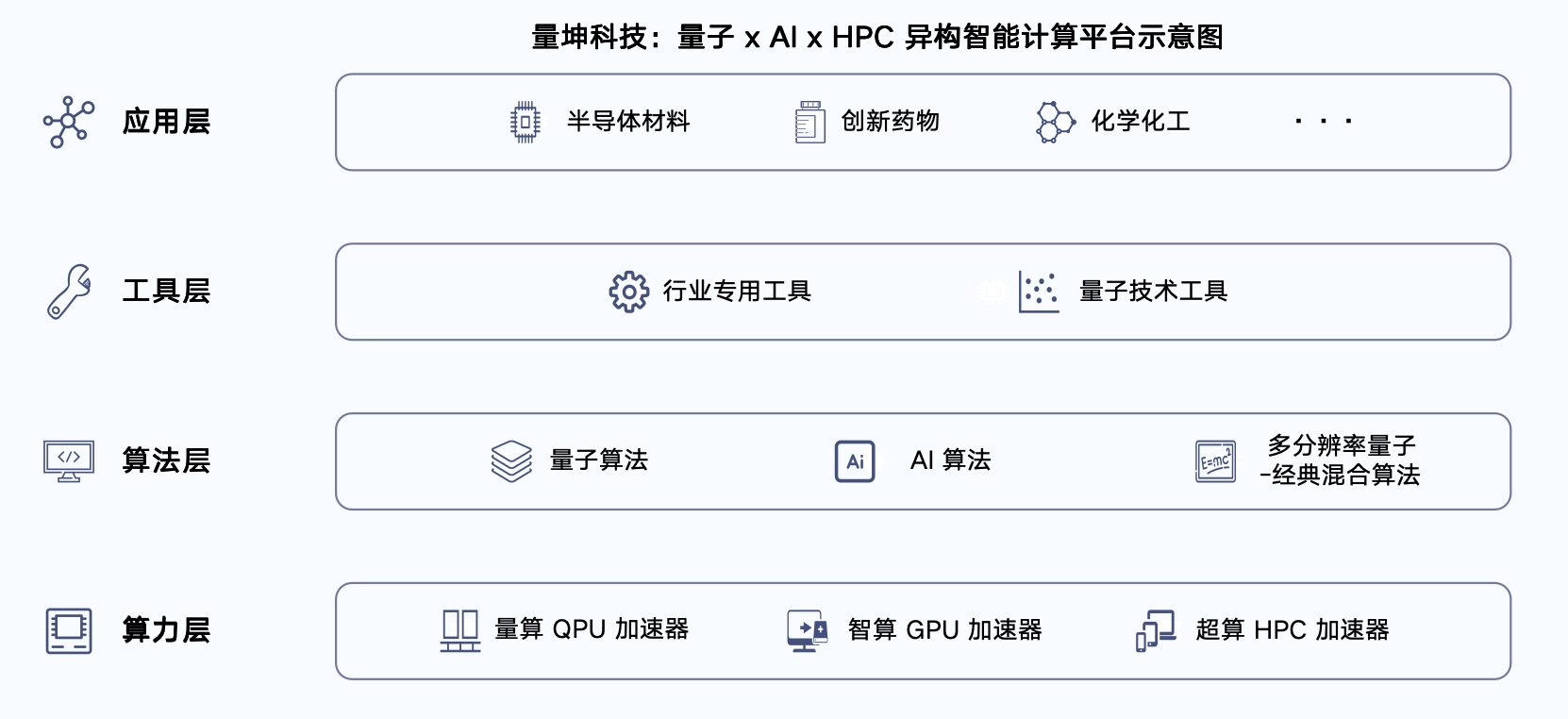
Image source: Liangkun Technology
"Undercurrent": How do you understand the technical barriers of the intermediate algorithm and tool layer? Why did you choose the entrepreneurial opportunity at the algorithm and operating system end?
Lü Dingshun: The intermediate layer is not simply programming existing algorithms. Especially when the hardware resources of quantum computers are not abundant.
The lack of abundance means that not all algorithm paths can complete the task. Because the errors in quantum computing will accumulate, only by fully optimizing the algorithm and making the path short enough can we squeeze out and maximize the use of the limited quantum computing power.
This is different from running algorithms on a GPU. On a GPU, even if the algorithm is a bit poor and the efficiency is several times lower, it can still run, just with a higher cost. However, in quantum computing, if the algorithm efficiency is 5 times lower, it may not run at all. This is the difference between success and failure.
Therefore, the barrier at the algorithm layer lies in whether one can skillfully design and modify the algorithm. After this set of algorithms and the operating system platform are established, functions can be continuously expanded, gradually evolving into an algorithm and tool platform.
"Undercurrent": In the current industrial landscape of quantum computing, which users do you want to serve?
Lü Dingshun: The first type is customers who already have quantum computing needs, such as state - owned enterprises, central enterprises, and scientific research institutions. They need to cultivate quantum computing capabilities and iterate quantum algorithms. Usually, they start from tools, decompose problems into quantum algorithms, and then run them on the corresponding quantum computers.
The second type is industrial customers with clear R & D needs, such as enterprises in semiconductor materials and new drug R & D. Users do not care whether the underlying computing power comes from a quantum computer. They are more concerned about whether the problem can be solved and the cost - efficiency. In the solution path, they may use AI algorithms, quantum algorithms, or multi - resolution quantum - classical hybrid algorithms. (The hybrid algorithm means handing over the most difficult and core parts to quantum computing and using neural networks, classical algorithms, or other precise algorithms to handle the rest)
Quantum computer manufacturers are also our cooperation and service targets. Many companies focus on the evolution of hardware, and the operating system, algorithm tools, and application ecosystem require a professional team and long - term investment. In terms of cooperation methods, for example, we can package the operating system and algorithm platform with the hardware for sale, sell computing power together, or sell the whole machine with the operating system.
"Undercurrent": There are many AI4S companies now, and the financing is also very hot. Why is quantum computing necessary?
Lü Dingshun: From the perspective of pure AI for Science, AI is a solution, and quantum computing is also a solution. In addition to fast computing speed (quantum acceleration), precision is also an advantage of quantum computing.
Many problems in materials and chemistry require high - precision solutions. Pure AI models are very dependent on the quality of training data. For example, in binding energy prediction, if the precision of the underlying data is insufficient, the model results will also be limited. The traditional DFT method also has its own precision boundary and depends on the choice of functionals.
High - precision calculations can also be done on a GPU, but they are often limited by video memory and can only handle smaller - scale systems. Although the scale of quantum computing is still small at present, it has an advantage in precision and has the opportunity to extend high - precision solutions to larger systems in the future.
"Undercurrent": How do you deliver and commercialize your products to meet the needs of these customers?
Lü Dingshun: What we deliver is actually the encapsulated capabilities of quantum computing, AI, classical computing, and industry tools. There are many delivery forms: CRO - style solutions, high - precision data synthesis, workflows, cloud access portals, etc.
In the early stage, it is mainly project - based. Later, we will accumulate project experience and serve users through a standardized scientific discovery cloud service platform. In the future, in similar large - scale scenarios, 95% of the capabilities of this system may be standardized, and only a small part needs to be customized.
Actually, we hope to abstract the intermediate links. Quantum algorithms can also be abstracted into skills. Users can schedule multiple skills through natural language to construct composite functions for solving problems.
Users only need to bring their problems. The user - end entrance may be an agent system. They don't need to care which quantum computer is used at the bottom, and they don't even need to worry about which algorithm to call. Just like using large models today, users don't care which hardware is behind them, but only care about the output quality and token efficiency.
"Undercurrent": In the AI era, the anxiety about computing power and energy consumption persists. Will the development of quantum computing be a new solution for computing power?
Lü Dingshun: Both AI and quantum are "complete" solvers, and they can empower each other. There has been a lot of discussion about AI for Quantum. AI can help build better quantum computers and algorithms and amplify quantum computing capabilities.
Conversely, Quantum for AI also has several meanings. First, some insights from quantum computing may inspire the design of AI algorithms; second, as a high - precision solver, the quantum computer can generate high - quality and differentiated data, which will be the key to enhancing AI models in the future.
In the long run, today we can deploy models on GPUs and FPGAs. In theory, we may also deploy quantum - version large models on quantum computers in the future. At that stage, new solutions may emerge for the computing power and energy consumption problems faced by AI.
However, we are not there yet. Quantum hardware is still evolving, and the technology route has not fully converged. A more realistic situation is to combine quantum computing, AI algorithms, and classical computing under the current hardware conditions, break through the precision ceiling with quantum computing, reshape the efficiency boundary with AI, and promote the solution of difficult and important scientific problems.
This is also our definition of the current stage: "Fourth Paradigm ++ Science".
III. Fighting Tough Battles
"Undercurrent": Quantum computing and AI4S require many high - level talents. Is it difficult for you to recruit people?
Lü Dingshun: We have now entered a virtuous cycle of recruitment. Our team now has nearly 40 people. In the AI field, there are talents with backgrounds in the national physics and chemistry competition training teams; in high - performance computing, there are special award winners and genius teenagers from Tsinghua University; in engineering, there are technical backbones from large companies.
Quantum computing and AI4S are systematic projects, and there must be strong people in all directions without obvious weaknesses.
"Undercurrent": You've only been in business for four or five months. Why were you able to recruit so many talents?
Lü Dingshun: We