After iQiyi was severely criticized, it is rushing to go public with 100,000 AI workers.
The controversy over iQiyi's AI artists is still fresh in people's minds, while another larger "virtual human" business has reached the doorstep of the Hong Kong Stock Exchange.
Recently, Nanjing Silicon Intelligence Technology officially submitted a listing application to the main board of the Hong Kong Stock Exchange. This is its second attempt after the first application expired last year. If all goes well, Silicon Intelligence is expected to become the "first digital human stock in the Hong Kong stock market."
Image source: Silicon Intelligence's prospectus
This company has an impressive background.
Founded nearly a decade ago, Silicon Intelligence has completed 10 rounds of financing, raising over 1 billion yuan. Behind it stand a group of top - tier capital such as Tencent, Sequoia, 360, and CMBC International, making it a rising star in the industry.
However, only about three weeks after the previous version of its Hong Kong stock listing application expired at the end of April, Silicon Intelligence submitted an updated prospectus for another attempt.
Silicon Intelligence's eagerness to go public is not just about seizing the title of "the first digital human stock."
Backed by Heavy - Weight Capital
A digital human is a digital virtual character driven by artificial intelligence and simulation technology. It looks like a human, can speak, and even interact with you.
Currently, digital humans are mainly used in commercial scenarios such as live - streaming e - commerce, corporate customer service, and virtual idols. For example, live - streaming hosts and the virtual idol Hatsune Miku. Different from traditional pre - scripted digital humans, the generation of digital humans relies on a large amount of data collection and processing, voice and visual interaction analysis, deep learning and other technologies.
In 2017, inspired by the AlphaGo Go competition, Sima Huapeng, the founder of Silicon Intelligence, came up with the idea of "Silicon - based civilization" and founded Nanjing Silicon Intelligence Technology.
Similar to the classification of autonomous driving, Silicon Intelligence divides the development of digital human agents into L1 to L5, corresponding to five development stages: "conversational interaction, reasoning ability, task execution, autonomous learning, and group intelligence." At the L5 stage, digital human agents have human - like decision - making and execution abilities and can unleash commercial potential in high - value scenarios.
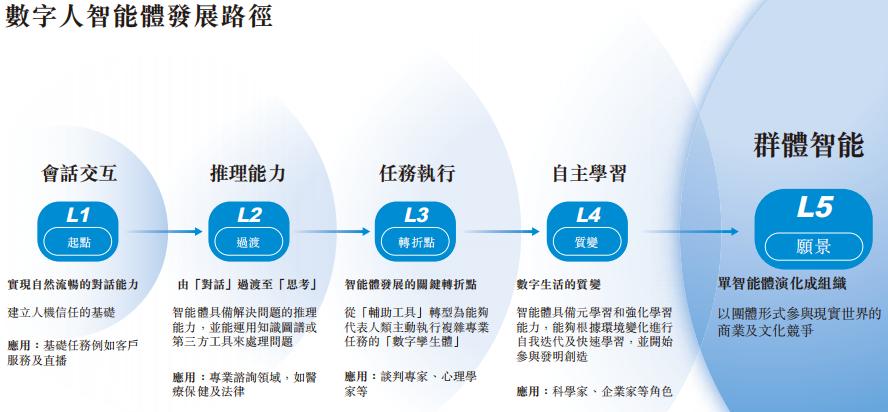
Image source: Silicon Intelligence's prospectus
The plan is ambitious, but Silicon Intelligence's development has not been smooth sailing.
In 2019, Silicon Intelligence launched its first AIGC digital human, but it didn't make much of a splash.
It wasn't until the explosion of large AI models that the narrative logic of Silicon Intelligence changed.
The multi - modal collaboration and more natural human - machine interaction experience brought by large AI models have turned digital humans into intelligent agents that can understand users and display various expressions and postures, making interactions more real - time and smooth.
In 2024, Silicon Intelligence launched a new - generation multi - modal large model, DUIX ONE, in the form of an API. DUIX ONE uses algorithms such as speech recognition and synthesis, NLP, and computer vision to greatly enhance the realism of digital human interaction and provide the ability for commercialization.
With e - commerce platforms like Douyin gradually opening up local - life digital human live - streaming, Silicon Intelligence's products have been deployed in batches and quickly penetrated into multiple industries such as telecommunications, finance, healthcare, and education. Currently, over 100,000 digital human agents have been deployed in total.
Currently, Silicon Intelligence's products cover a one - stop silicon - based labor solution that includes intelligent voice, digital human videos, digital human live - streaming, digital human intelligent interaction, and fully automated content production.
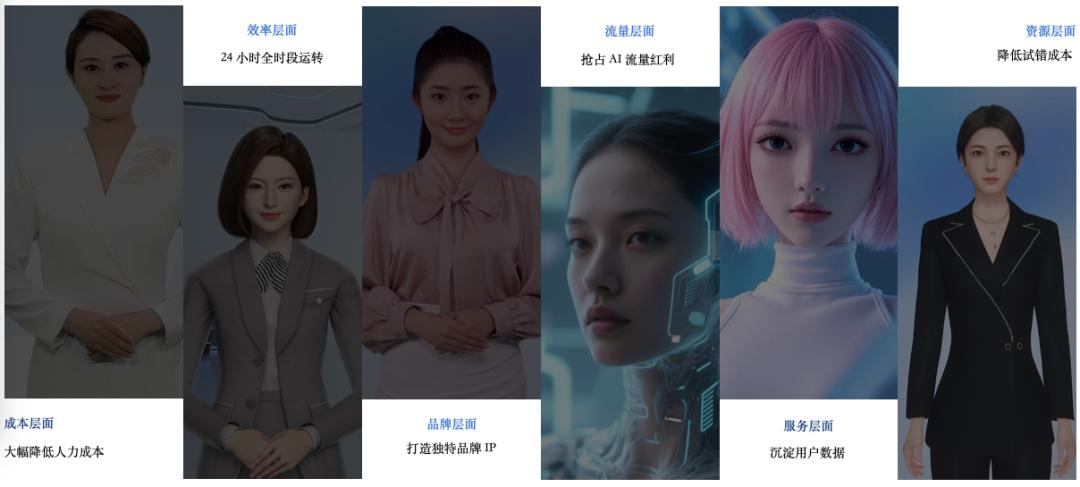
Image source: Silicon Intelligence's official website
This is also the trump card that Silicon Intelligence wants to show to the capital market at present.
In August last year, Silicon Intelligence upgraded its interactive AI system (assisting human production) to AI Autopilot mode (independently executing end - to - end content production), officially entering the field of fully automated content production.
Specifically, AI Autopilot can fully automatically generate complete video content, including characters, scenes, dialogues, voice - overs, subtitles, sound effects, and visual special effects. In the currently popular high - frequency content industries such as short dramas, comic dramas, and live - streaming, this ability is also regarded as a new tool for cost - reduction and efficiency - improvement. Currently, Silicon Intelligence has successfully created an IP account matrix including Silicon Jisima, Tech Jisima, and Jisima Talks about Technology, with a total of over 10 million fans across the internet.
Silicon Intelligence has gradually established a foothold in the market by leveraging its unique advantages.
According to data from CIC, in terms of the revenue generated from providing digital human agent solutions in 2024, Silicon Intelligence ranks first among all digital human agent providers in China, with a market share of up to 32.2%; it ranks second globally, only behind its overseas competitors.
From 2023 to 2025, Silicon Intelligence's revenue increased from 531 million yuan to 655 million yuan, and then to 789 million yuan, with a compound annual growth rate of 21.90% in three years, maintaining a certain growth trend.
Meanwhile, capital has started to enter the market.
Since its establishment in 2017, Silicon Intelligence has completed 10 rounds of financing, with a total financing amount of over 1 billion yuan. Many capitals such as Tencent, Sequoia, CMBC Fund, and Pengpai Capital have participated. In May 2025, Silicon Intelligence received another 200 million yuan in Series D financing from Jiaxing High - tech, and its post - investment valuation reached 3.15 billion yuan.
However, despite the support of capital, although the digital human business is in the limelight, only a few companies can actually make money. Even Silicon Intelligence, a leading company in the industry, has just reached the threshold of profitability.
Nearly 800 Million in Annual Revenue, but Still Struggling to Make a Profit
Currently, Silicon Intelligence's product services are mainly sold in two ways: local customized project - based and productization.
The local customized project - based model is mainly targeted at large customers, charging authorization, development, and maintenance fees for each project; for small and medium - sized customers, standardized products are promoted, along with flexible billing options such as subscriptions and pay - per - use.
At present, the revenue generated from local deployments for large - customer customization accounts for the vast majority and has been increasing year by year, reaching 98.7% in 2025.
This means that most of Silicon Intelligence's revenue comes from large - customer groups.
The prospectus shows that Silicon Intelligence's customer base is mainly concentrated in large institutions such as telecommunications, finance, and government. From 2023 to 2025, the revenue from the top five customers accounted for 57.7%, 78.9%, and 57.4% respectively.
Among them, the largest customer A (a leading telecommunications operator founded in 2004 with its headquarters in Beijing) contributed 36.8%, 64.4%, and 41.3% of the revenue, almost single - handedly driving Silicon Intelligence's performance growth in the past two years.
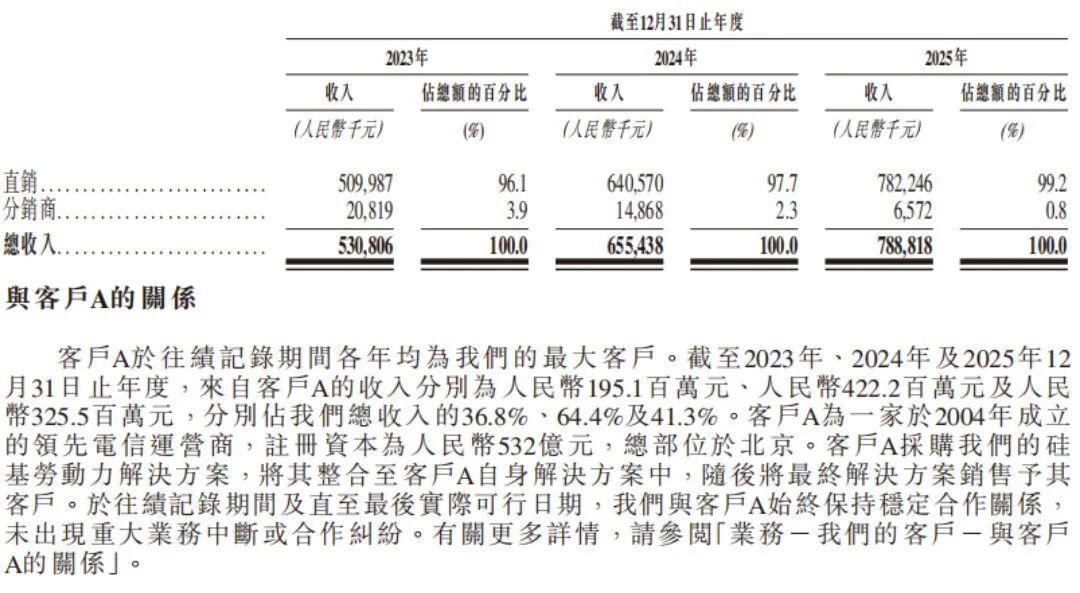
Image source: Silicon Intelligence's prospectus
However, it's not easy to rely on large customers.
Customers such as banks and telecommunications operators have long project cycles, many customization requirements, and they also bargain hard on prices. Silicon Intelligence has to make continuous concessions. In the prospectus, Silicon Intelligence explicitly stated that it adopted a "competitive pricing model" to ensure stable cooperation with large customers, resulting in a relatively low gross profit margin.
Directly dealing with large customers also brings additional burdens.
From 2023 to 2025, the proportion of direct - sales revenue has always remained above 96%, reaching as high as 99.2% in 2025. It is almost a company completely driven by direct sales.
The "trading price for volume" model has brought scale, but in the end, it doesn't make much money.
From 2023 to 2025, Silicon Intelligence accumulated a net loss of about 233 million yuan. Although the adjusted net profit turned positive in 2025, the company has not truly turned a profit in terms of net profit.
A highly concentrated customer structure will seriously weaken the company's bargaining power. However, this may also be Silicon Intelligence's helpless choice because it's really difficult to retain small and medium - sized customers.
According to customer data, the customer base has shrunk, from 1,009 in 2023 to 431 in 2025, and the number of new customers has decreased by two - thirds.
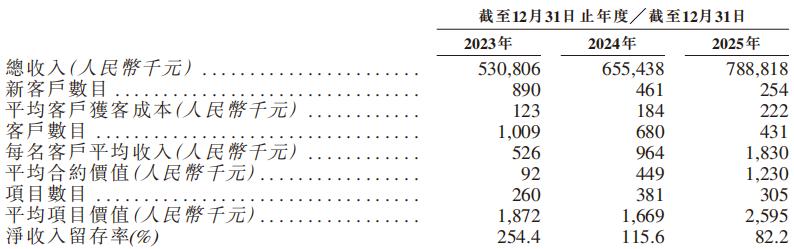
Image source: Silicon Intelligence's prospectus
That is to say, only 177 customers renewed their contracts in 2025, and the retention rate of old customers is only 26%.
In addition to the low retention rate, the limited value of small and medium - sized customers is also a major problem.
In 2025, Silicon Intelligence's revenue was 789 million yuan. If we exclude the 325 million yuan from the largest customer A, the remaining revenue is 465 million yuan, corresponding to 430 customers. On average, each customer contributed about 1.07 million yuan in revenue, but Silicon Intelligence's average customer acquisition cost for this group was 222,000 yuan.
In other words, for every 10 yuan Silicon Intelligence earns, 2 yuan is spent on customer acquisition and conversion.
However, difficulty in making a profit is just the first hurdle for Silicon Intelligence.
The Two Sides of Digital Humans
In terms of industry space, the track that Silicon Intelligence is in is just in its infancy and far from reaching its peak.
IDC data shows that in 2024, the market size of AI digital humans in China was about 412 million yuan, with a growth rate of up to 85.3%. It is expected that by 2029, this market size will reach 2.505 billion yuan, with a compound annual growth rate of 43.5%.
However, this broad track is already very crowded.
On one hand, internet giants such as Baidu, Alibaba, Tencent, and iFlytek are leading the way with their powerful ecosystems and AI technology capabilities. They can be deeply integrated into affiliated social and shopping apps, and there is no need to worry about commercialization on both the C - end and B - end.
In 2025, at the Baidu World 2025 Conference, the appearance of Luo Yonghao's digital human once again demonstrated Baidu's layout in chips, frameworks, models, and applications in the digital human track. Just 26 minutes after the live - stream started, it exceeded the GMV of Luo Yonghao's real - life live - stream in one hour, and the GMV that night exceeded 55 million yuan.

Image source: Screenshot of Luo Yonghao's digital human live - stream
On the other hand, there are millions of small and medium - sized enterprises.
The 2024 "China Virtual Digital Human Influence Index Report" shows that in 2023, there were more than 993,000 enterprises related to "digital humans and virtual humans," a year - on - year increase of more than 40% compared to 2022. Among them, more than 60% are small enterprises with a registered capital of less than 2 million yuan, and 40.6% were established within one year.
Therefore, on the surface, the digital human track is a new AI narrative, but in fact, it is more like a crazy expansion on the supply side.
In the face of fierce competition, Silicon Intelligence's situation is a bit awkward.
In 2023, Sima Huapeng once shouted the ambitious slogan of "providing 100 million silicon - based labor forces globally by 2025." However, Silicon Intelligence has only deployed over 100,000 so far, with a goal completion rate of only 0.1%.
With the collective influx of players and the intensifying competition, the technical threshold is easily lowered, and product homogenization is becoming more and more serious.
The AI customer service of the three major telecommunications operators often has communication problems. Many users have complained that "they can't understand human language, can't transfer to human service, and the money is wasted."
In addition to ineffective communication, digital human live - streaming also faces the "uncanny valley" effect, that is, "resembling a human" but "not completely like a human." This dissonance can cause discomfort and psychological rejection among users.
This is also one of the reasons why iQiyi caused public outrage due to its "AI artists" some time ago.
At present, AI artists have stiff expressions and lack the emotions and expressiveness of real people. While approaching reality, they actually magnify the sense of discord. On the other hand, when platforms start to mass - produce actors, voices, and performances, whether real - life creators will be under - priced or replaced, and how to define the boundaries of portraits and voices are still issues that need serious