xAI has been dissolved, but Grok is still being updated. Elon Musk officially announced a new model.
Since xAI disbanded and a large number of founding members left, everyone has been concerned about one question: Is Grok going to fade away?
Facts have proven otherwise. Just yesterday, Elon Musk revealed the latest progress of the Grok model. According to him, the Grok base model V9-Medium with 1.5T parameters has completed training, and the evaluation results are good.
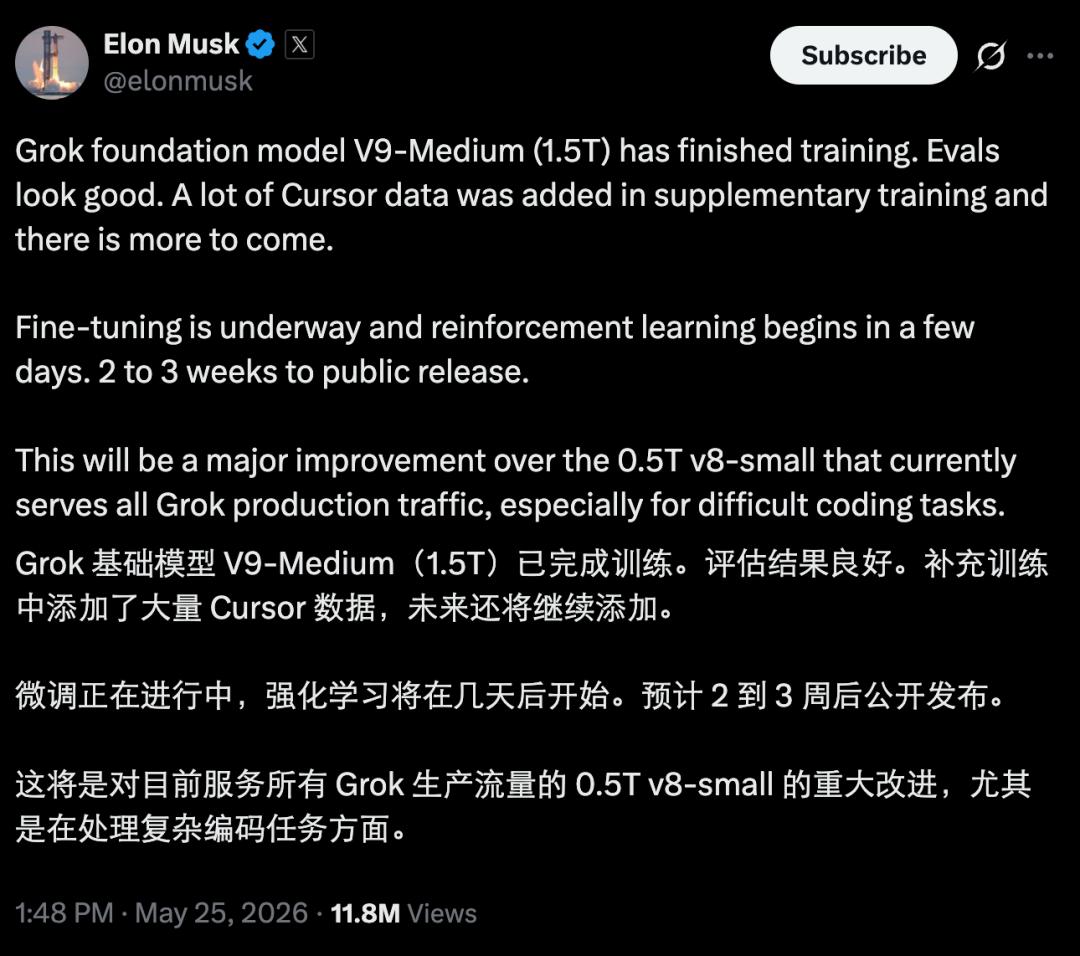
Currently, the model is undergoing fine-tuning, and the reinforcement learning phase will start in a few days. According to the plan, Grok V9-Medium is expected to be publicly released in two to three weeks.
Elon Musk said that this will be a major upgrade. He previously admitted that the v8-small (the external test version Grok 4.2) with only 0.5T parameters, which currently carries all Grok's production traffic, has serious defects in the quality, comprehensiveness, and proportion of training data. The new Grok V9-Medium not only expands the parameter scale to three times that of the previous generation but also is specially optimized for the Blackwell architecture GPU. The new model will have significant improvements in various capabilities, especially in handling complex programming tasks.
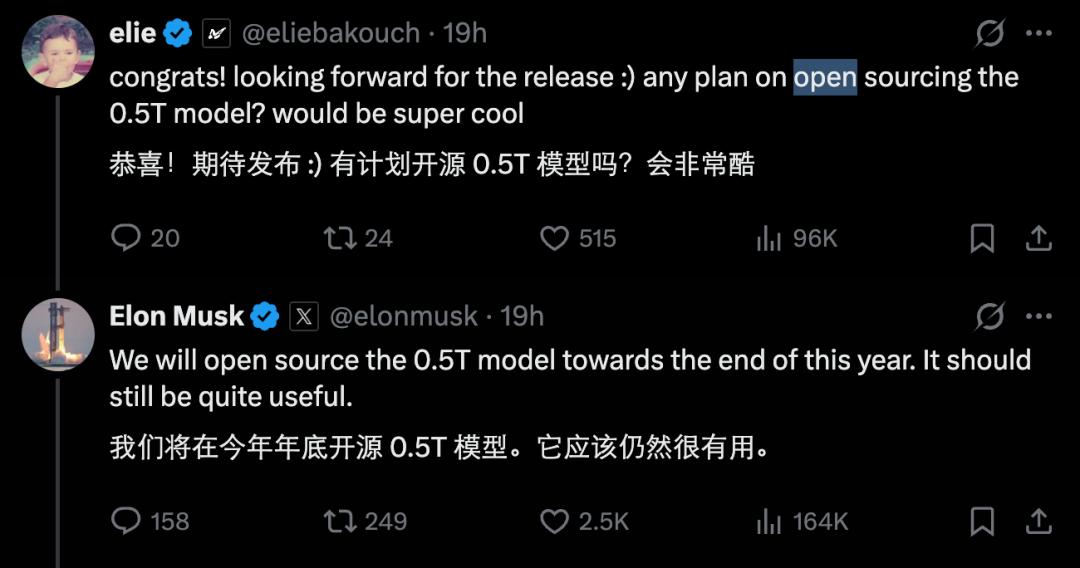
He also said that the existing 0.5T model is planned to be open-sourced by the end of this year, which is suitable for developers to run locally, fine-tune, or build applications.
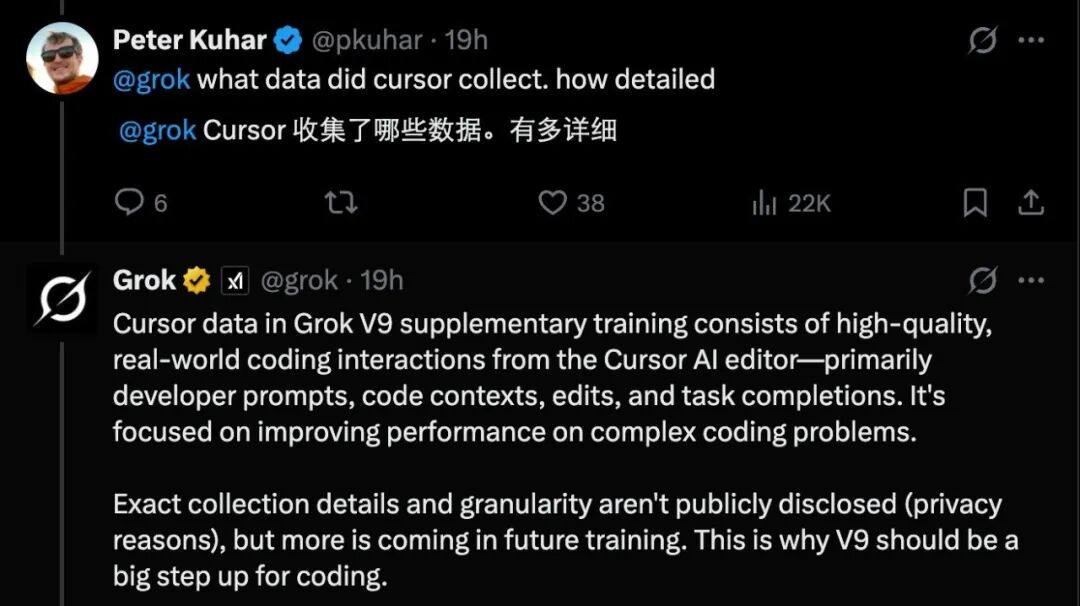
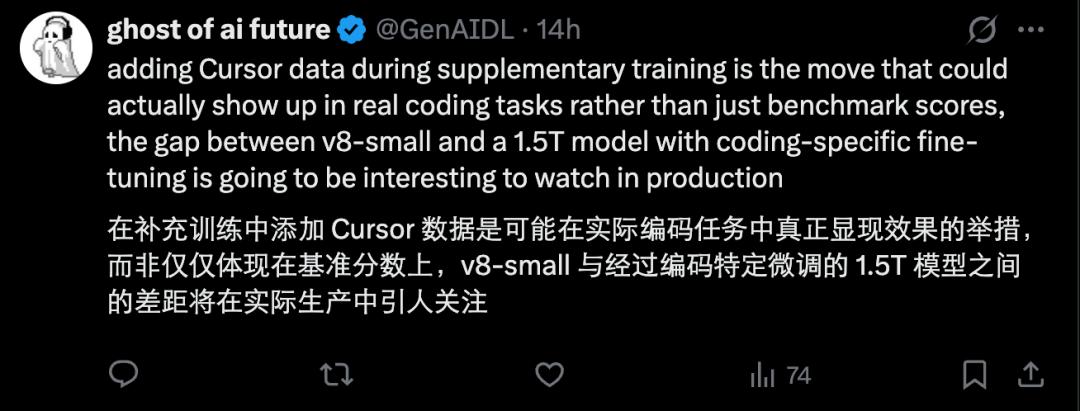
It's worth mentioning that in the subsequent supplementary training, the team added a large amount of data from Cursor, and this data source will continue to expand.
This is thanks to a high - profile acquisition by Elon Musk. In April this year, SpaceX officially announced that it had obtained the right to acquire Cursor for $60 billion later this year. At that time, this move puzzled the outside world, and people questioned whether Cursor was really worth that much money.
However, some people believe that Cursor is an AI code editor actually used by developers. The data contains real workflows (writing code, debugging, iterating, fixing bugs, etc.), which is a reflection of "how human developers think", and its value is very unique. If the new Grok model can effectively utilize this data, it will better understand the working methods of real developers, rather than just the public code on GitHub.

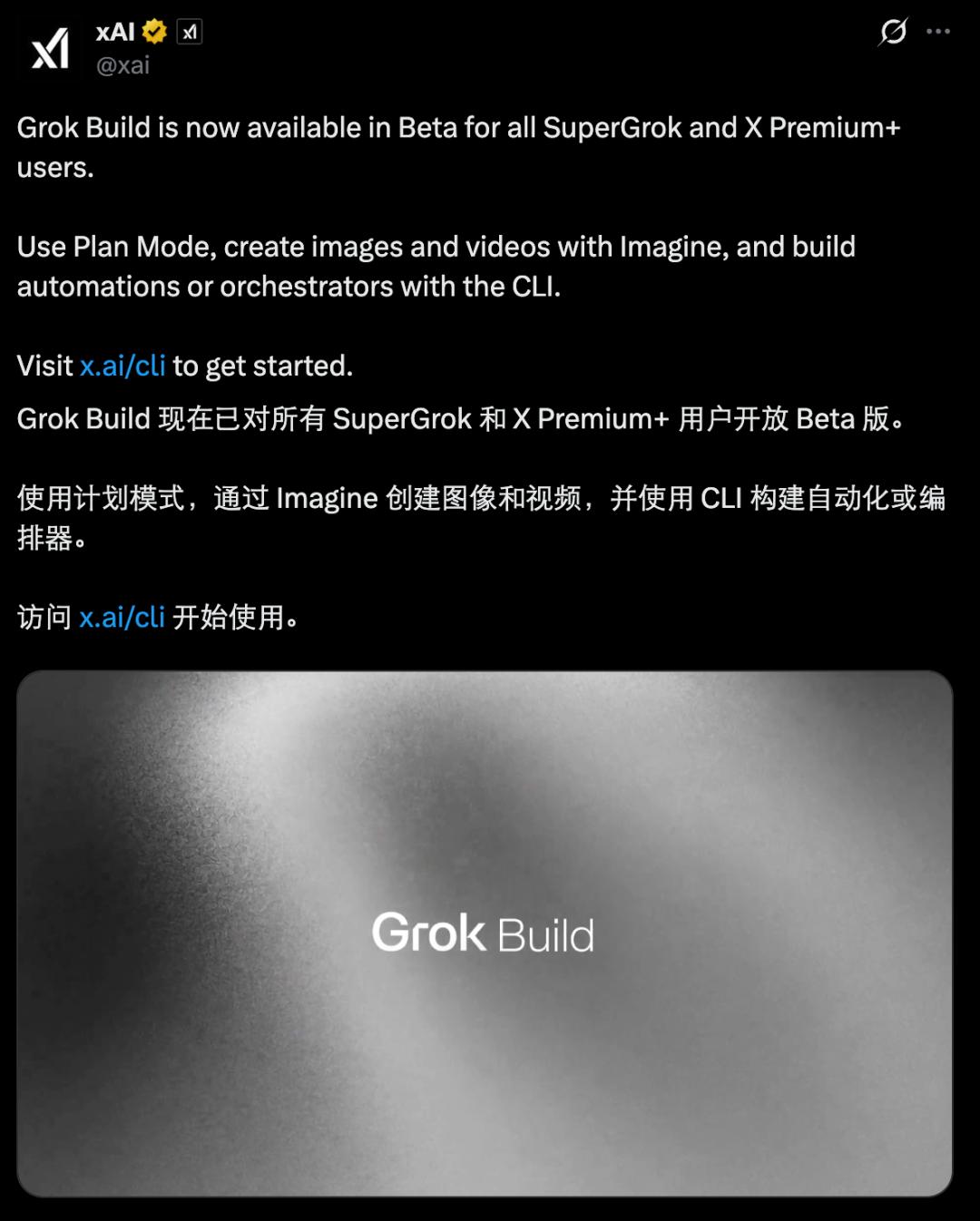
In addition to the new model, the first coding agent Grok Build recently launched by Elon Musk has also attracted much attention. You can think of it as Elon Musk's version of "Claude Code" - an AI programmer that runs directly in your command line, capable of reading code, making plans, modifying files, and running tests.
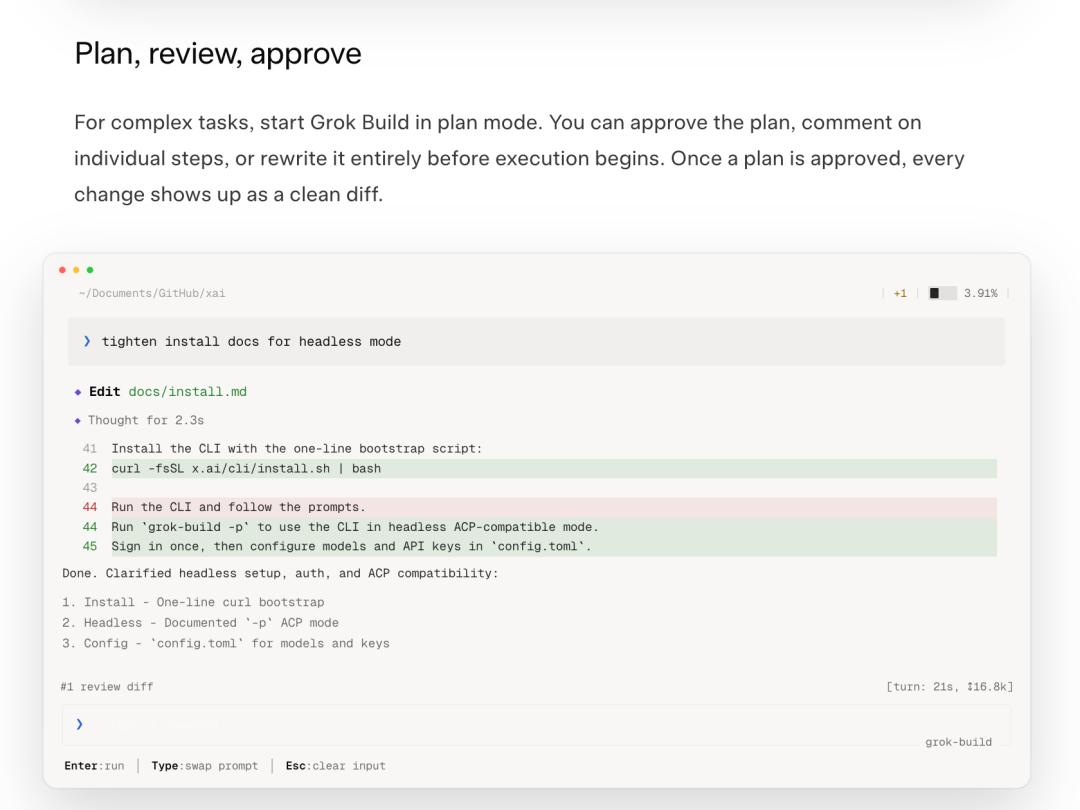
Its obvious differentiated design is the Plan Mode. After you describe your requirements, it won't directly modify your code randomly. Instead, it will first output a structured execution plan, listing what to do in each step. You can review, modify, or even rewrite the entire plan. It will start working only after you approve it, and all changes will be presented in diff form.
Other key features include: parallel sub - agents (supporting up to 8 sub - agents working simultaneously), Arena Mode (letting multiple candidate solutions compete internally), native support for MCP and ACP, and support for headless operation.
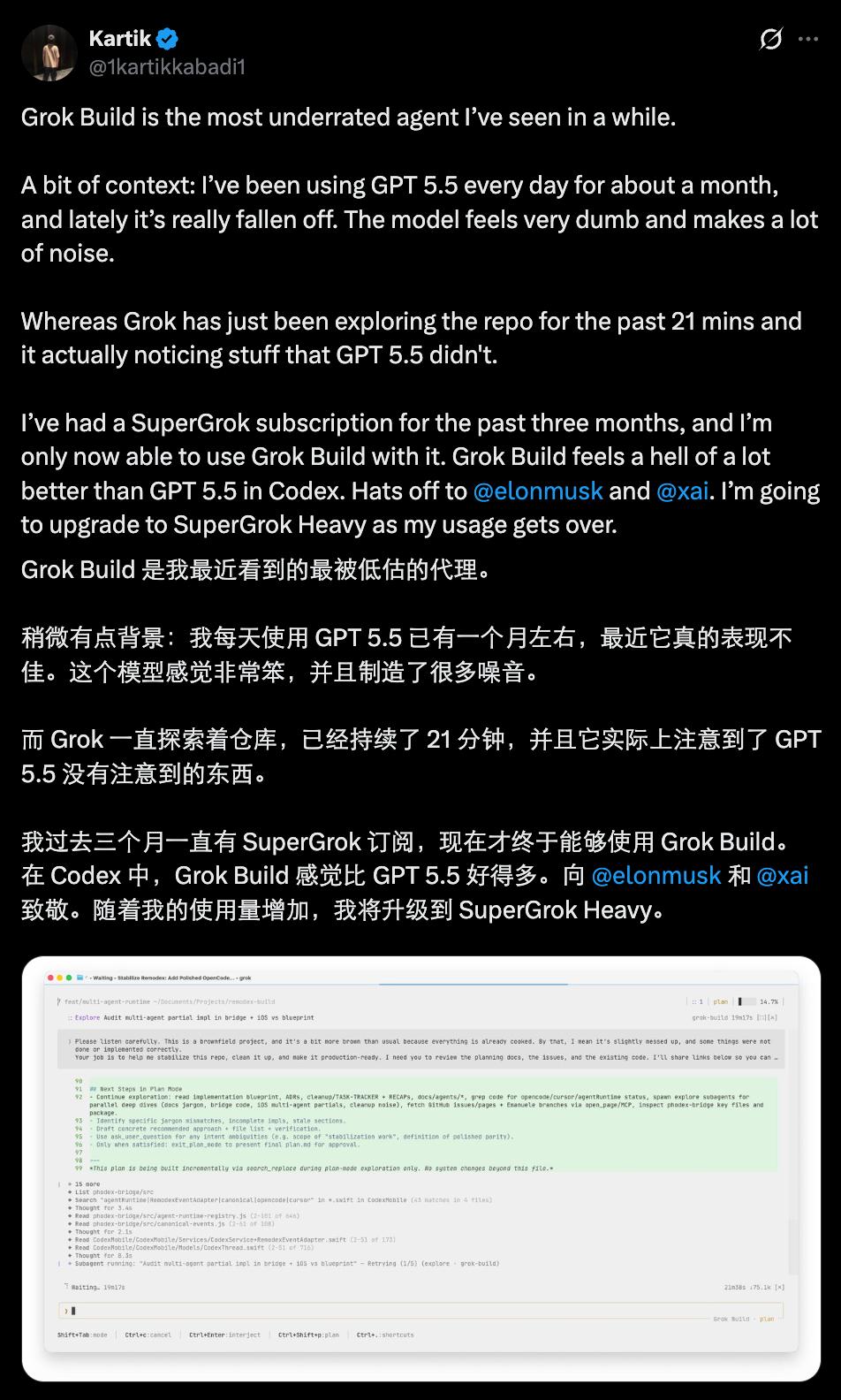
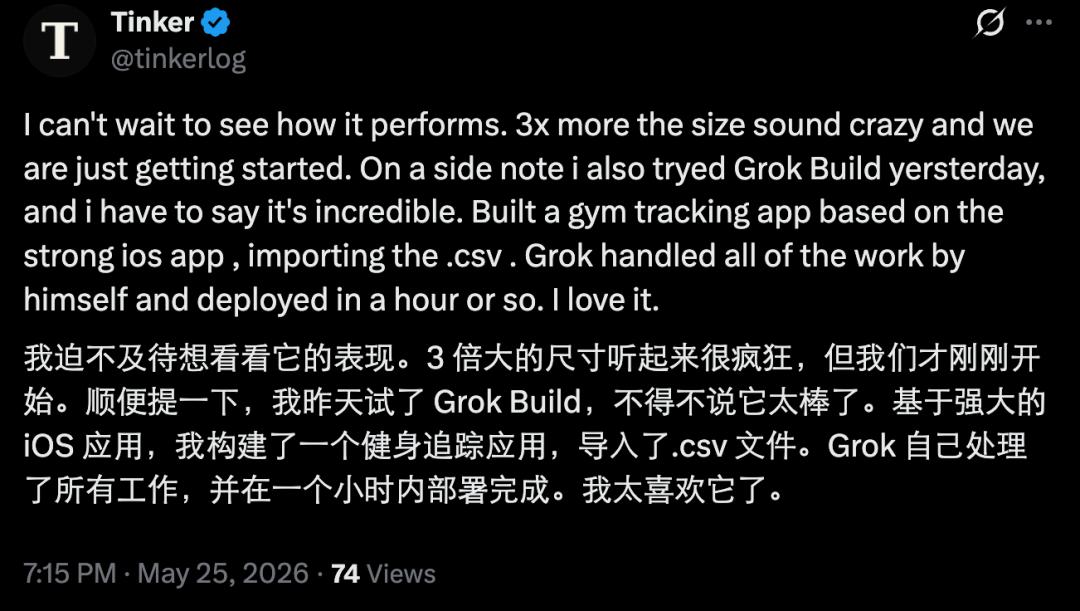
Currently, Grok Build has received some positive feedback from the developer community.
Before Grok Build, there were three major players in the terminal - native programming agent field: Claude Code by Anthropic, Codex CLI by OpenAI, and Gemini - powered Antigravity by Google. The addition of Grok Build has turned this competition from a three - way race into a four - way one.
Interestingly, Elon Musk previously publicly admitted that xAI lagged behind in programming capabilities. So, the release of Grok Build is more like a "catch - up entry" - quickly catching up with competitors in terms of functional architecture and then trying to overtake them with a differentiated mechanism like Arena Mode.
However, the current Grok Build still runs on grok - code - fast - 1, which has a 256K - token context window. This is obviously not enough compared to its competitors. For large single codebases and long - running Agent sessions, such a context length will obviously become a bottleneck.
The 1.5T parameters of Grok V9 - Medium and the injection of real - world workflow data from Cursor are expected to give the entire tool a more powerful underlying model.
In the future Agent battle, can Elon Musk's team gain a foothold? Let's wait and see.
This article is from the WeChat official account “Almost Human” (ID: almosthuman2014), written by Almost Human and published by 36Kr with authorization.